
Every discerning investor reaches a point where true wealth is measured not just by possessions but by lasting impact and refined choices. The evolving luxury market in 2026 is defined by a growing demand for experiences, sustainability, and authentic engagement, shifting how affluent buyers view exclusive real estate opportunities. The Côte d’Azur stands at the crossroads of heritage and innovation, revealing how luxury real estate is emerging as an important segment driven by affluent consumers seeking exclusivity and investment value globally.
Table of Contents
- Emerging Luxury Market—Core Definition For 20256
- Key Segments: Real Estate, Experiential, Personal Goods
- Characteristics Of New Luxury Demand And Consumer Behaviours
- Global Growth Hubs And Market Variations
- Risks, Volatility, And Financial Implications For Investors
Key Takeaways
| Point | Details |
|---|---|
| Emerging Luxury Paradigm | The luxury market in 2026 focuses on sustainability, experiential value, and digital integration to meet evolving consumer demands. |
| Segmented Consumer Behaviour | Consumers are increasingly discerning, seeking authenticity and personalised experiences along with ethical production practices. |
| Global Growth Hubs | Emerging regions, especially in Asia-Pacific and Africa, present significant growth opportunities, necessitating tailored strategies. |
| Investment Risks | Investors must address geopolitical uncertainties, price sensitivity, and margin compression in their luxury investment strategies. |
Emerging luxury market—core definition for 2026
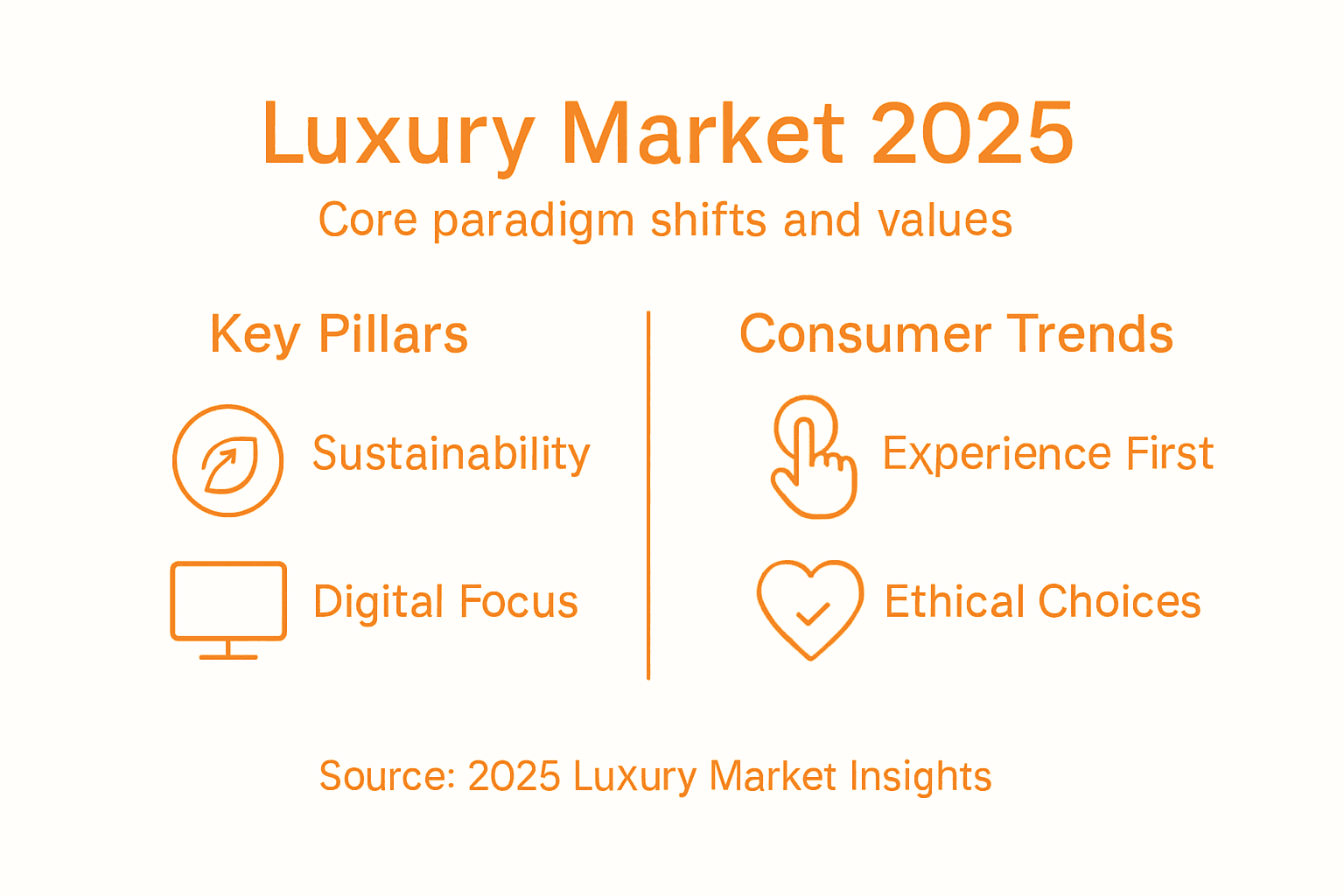
The luxury market in 2026 represents a pivotal transformation beyond traditional consumption patterns, characterised by profound shifts in consumer expectations and global economic dynamics. As luxury market evolves dramatically, strategic redefinition becomes paramount for brands seeking sustained relevance.
Key characteristics of this emerging luxury landscape include:
- Heightened consumer discernment
- Prioritisation of experiential value
- Sustainability as a core differentiator
- Digital integration and technological innovation
- Global cultural contextualisation
Traditional luxury paradigms are fundamentally disrupting. Market transitions emphasise cultural relevance, moving beyond mere product exclusivity towards meaningful engagement. Consumers now demand authentic narratives, transparent supply chains, and demonstrable societal impact from luxury brands.
The contemporary luxury market transcends transactional relationships, embedding deeper emotional and ethical connections. High-net-worth individuals increasingly seek experiences that reflect personal values, environmental consciousness, and global interconnectedness. Brands must therefore craft sophisticated strategies balancing heritage, innovation, and genuine social responsibility.
To clarify distinctive strategies, here’s how luxury brands must balance heritage and innovation:
| Strategic Focus | Heritage-Driven Brands | Innovation-Centric Brands |
|---|---|---|
| Emotional Appeal | Emphasise tradition, lineage | Showcase creativity, adaptability |
| Consumer Engagement | Build loyalty via legacy | Foster excitement through novelty |
| Sustainability Approach | Incremental adaptations | Pioneering eco-solutions |
| Brand Communication | Storytelling rooted in history | Digital narratives, influencer partnerships |
Digital transformation and sustainability emerge as critical pillars reshaping luxury consumption. Global luxury centres are expanding beyond established European markets, with significant growth potential in Asian and Middle Eastern regions.

Pro tip: Research emerging luxury markets comprehensively, understanding nuanced cultural preferences before developing targeted engagement strategies.
Key segments: real estate, experiential, personal goods
The luxury market in 2026 demonstrates a profound transformation across three critical segments, each representing unique consumer aspirations and investment strategies. Luxury market segments reveal complex dynamics, reflecting unprecedented shifts in global consumption patterns.
Key luxury market segments include:
- Real Estate: High-value property investments
- Experiential Luxury: Travel, wellness, and exclusive encounters
- Personal Goods: Traditional luxury products with evolving consumer expectations
Luxury real estate emerges as a particularly compelling segment, attracting high-net-worth individuals seeking both financial appreciation and lifestyle enhancement. Affluent buyers increasingly view premium properties not merely as residences but as strategic assets with potential for significant long-term value appreciation.
Experiential luxury continues expanding rapidly, especially among younger and affluent older demographics. This segment transcends traditional consumption, emphasising personalised experiences, wellness journeys, and transformative travel encounters that offer deeper emotional connections.
Personal luxury goods, while foundational, are experiencing nuanced transformation. Consumers now demand authenticity, sustainability, and meaningful narratives alongside exceptional craftsmanship. Brands must innovate continuously, understanding that modern luxury is less about conspicuous consumption and more about personal expression and ethical consciousness.
Pro tip: Diversify luxury investments across segments, understanding each sector’s unique growth potential and alignment with personal values.
Characteristics of new luxury demand and consumer behaviours
Luxury consumption in 2025 represents a profound paradigm shift, characterised by increasingly sophisticated and nuanced consumer expectations. Consumer behaviours reveal complex motivations, reflecting a deeper desire for meaningful engagement beyond traditional purchasing patterns.
Key characteristics of new luxury demand include:
- Sustainability as a core purchasing criterion
- Personalisation of product and experience
- Ethical production transparency
- Digital-first engagement strategies
- Emotional connection with brand narratives
Consumers are demonstrating remarkable segmentation, with global luxury consumption patterns evolving dynamically. Emerging consumer profiles range from discerning icon collectors to subtle luxury enthusiasts, each representing unique value propositions and consumption rhythms. Generation Z and affluent older demographics are particularly driving these transformative demand patterns, prioritising authenticity and personal meaning over traditional status signifiers.
The luxury market now demands a more holistic approach, where brands must seamlessly integrate digital platforms, sustainable practices, and compelling storytelling. Consumers seek brands that align with their personal values, offering not just products but comprehensive lifestyle experiences that reflect individual identity and ethical consciousness.
Digital platforms and social media have become pivotal in shaping luxury consumption, creating unprecedented transparency and allowing consumers to curate their luxury narrative with greater agency than ever before. The traditional hierarchical luxury model has been replaced by a more democratic, experience-driven ecosystem.
Pro tip: Cultivate a nuanced understanding of your target consumer’s values, leveraging digital insights to create personalised luxury experiences.
Global growth hubs and market variations
The luxury market in 2025 reveals a dynamic global landscape, characterised by emerging regions challenging traditional consumption patterns. Emerging markets demonstrate remarkable potential, presenting unprecedented opportunities for strategic luxury investments across diverse geographical contexts.
Significant global luxury growth hubs include:
- Asia-Pacific: Vietnam, Indonesia, Philippines
- Africa: South Africa, Nigeria
- Latin America: Mexico, Colombia
- Middle East: United Arab Emirates
- Eastern Europe: Emerging economic regions
Global luxury spending reveals nuanced regional dynamics, with each region presenting unique consumption characteristics. Asia-Pacific demonstrates explosive growth driven by digitalization and expanding middle-class wealth, while African markets exhibit increasing sophistication in luxury consumption patterns.
Demographic variations significantly influence luxury market strategies. Younger consumers in emerging markets display heightened digital engagement and sustainability consciousness, compelling luxury brands to develop regionally tailored approaches that transcend traditional marketing paradigms. Digital readiness, local cultural nuances, and economic growth levels become critical determinants of luxury market potential.
The luxury landscape now represents a complex, interconnected ecosystem where mature markets like Europe maintain stable consumption, while emerging regions showcase exponential growth potential. Brands must navigate these variations with strategic agility, understanding that global luxury is no longer a monolithic concept but a diverse, culturally responsive phenomenon.
To highlight global market diversity, see how luxury hubs differ in opportunity and risk:
| Region | Key Growth Opportunity | Main Market Risk |
|---|---|---|
| Asia-Pacific | Expanding affluent middle class | Regulatory volatility |
| Africa | Rising urban consumer base | Infrastructure gaps |
| Middle East | High investment in experiences | Political instability |
| Europe | Stable demand, legacy consumers | Low growth potential |
| Latin America | Emerging wealth, new luxury entrants | Economic uncertainty |
Pro tip: Develop region-specific luxury strategies by conducting granular market research and understanding local cultural consumption dynamics.
Risks, volatility, and financial implications for investors
The luxury investment landscape in 2026 demands unprecedented strategic sophistication, with multifaceted risks challenging traditional investment approaches. Luxury sector investment risks reveal complex dynamics, requiring investors to develop nuanced, adaptive investment strategies.
Critical investment risks include:
- Geopolitical uncertainty affecting market stability
- Price sensitivity among consumer segments
- Margin compression due to rising operational costs
- Brand performance polarisation
- Economic cyclical normalization
Investors must navigate a sophisticated landscape where traditional metrics no longer guarantee performance. The luxury market demonstrates increasing segmentation, with brands experiencing dramatically divergent growth trajectories. Successful investors will prioritise brands demonstrating resilience, innovation capacity, and adaptability to rapidly changing consumer expectations.
Financial implications extend beyond immediate market performance, encompassing broader strategic considerations. Digital transformation, sustainability investments, and ability to create meaningful consumer experiences become critical differentiators. Brands capable of balancing heritage with progressive innovation will likely outperform more conservative competitors.
The investment ecosystem demands holistic assessment, considering not just financial metrics but also brand cultural relevance, digital readiness, and capacity for authentic consumer engagement. Technological disruption, shifting demographic preferences, and global economic uncertainties create a complex investment environment requiring sophisticated, forward-looking strategies.
Pro tip: Develop a diversified luxury investment portfolio emphasising brands with proven adaptability and robust digital transformation capabilities.
Discover Timeless Wealth with Luxury Real Estate on the Côte d’Azur
The emerging luxury market in 2026 demands astute investment strategies that blend heritage, innovation, and sustainability to match sophisticated consumer expectations outlined in the latest market insights. High-net-worth investors face challenges such as geopolitical risks, evolving digital consumption, and the need for authentic, value-driven assets. Amid this complexity, the French Riviera stands apart as a sanctuary where real estate transcends mere property and becomes a legacy – a tangible connection to both personal values and the broader luxury narrative.
At Living on the Côte d’Azur, we guide visionary buyers through tailored opportunities across iconic locations including Cap d’Antibes and Èze. Our expertise covers essential due diligence on title clarity and seismic resilience as well as access to eco-certified estates that align with 2026’s sustainability priorities. Through immersive storytelling and precise market data, we illuminate how our luxury villas and new constructions offer projected appreciation rates of 5–8% coupled with unparalleled lifestyle richness from Cannes’s vibrant culture to Saint-Tropez’s timeless allure.
Ready to embark on your Riviera legacy investment journey with confidence? Explore our expert guidance on acquiring luxury villas on the French Riviera and crafting wealth strategies designed for the discerning 2026 investor. Connect with us today at Living on the Côte d’Azur to secure your place in this evolving luxury landscape.
Frequently Asked Questions
What are the key characteristics of the emerging luxury market in 2026?
The emerging luxury market in 2026 is characterised by heightened consumer discernment, prioritisation of experiential value, sustainability as a core differentiator, digital integration, and global cultural contextualisation.
How is sustainability influencing luxury consumption?
Sustainability is now a core purchasing criterion, with consumers demanding authenticity and transparent production processes. Brands that demonstrate genuine social responsibility are more likely to resonate with modern luxury consumers.
What factors are driving the shift towards experiential luxury?
Experiential luxury is driven by a demand for personalised experiences, wellness journeys, and transformative travel encounters that foster deeper emotional connections, especially among younger demographics and affluent older consumers.
What should investors consider when navigating risks in the luxury market?
Investors should focus on brand resilience, innovation capacity, and adaptability to changing consumer expectations, while also considering geopolitical uncertainties, economic cycles, and margin pressures that may affect market stability.
Recommended
 //
//