
TL;DR:
- Owning multiple residences is a strategic choice for high-net-worth individuals seeking lifestyle flexibility and geographic diversification. Most owners value spontaneous travel, family cohesion, and tailored property use over solely financial gains, while structures like property management and legal planning mitigate risks. Successful portfolios are thoughtfully assembled with clear purpose, local expertise, and careful risk management across different jurisdictions.
Owning multiple residences is defined as holding two or more properties across different locations, each serving a distinct lifestyle or financial purpose. About 50% of high-net-worth individuals owned more than one property as of 2025–2026, according to the Sotheby’s 2026 Luxury Outlook Report. That figure signals a profound shift: multi-property ownership is no longer a rare privilege but a deliberate strategy among the world’s most discerning buyers. The reasons to have multiple residences span spontaneous travel freedom, long-term wealth preservation, and geographic diversification across political and regulatory blocs. Understanding all three dimensions is what separates a well-structured portfolio from an expensive mistake.
Why own multiple residences: the core case
The primary motivator among high earners for owning multiple residences is lifestyle freedom, not financial return. That finding reframes the entire conversation. Most buyers do not acquire a second or third home because a spreadsheet told them to. They acquire it because they want to arrive in the South of France on a Thursday evening without booking a hotel, negotiating rates, or packing for a week in a suitcase.
Multi-property ownership is increasingly viewed as geographic diversification, balancing lifestyle and wealth preservation simultaneously. A villa in Provence, a pied-à-terre in Monaco, and a property in Lisbon each serve a different role. Together, they form a constellation of bases that supports a genuinely international life. The financial case is real, but it is secondary to the lived experience.
The advantages of owning several properties also include the ability to tailor each home to a specific purpose. One property might be configured for family gatherings, another for professional retreats, and a third for rental income during months when it sits empty. That intentional design is what transforms a collection of assets into a curated way of living.
What are the primary lifestyle benefits of owning multiple residences?
Freedom to travel without logistical friction is the most cited benefit among owners of several homes. No surge pricing, no availability gaps during peak season, no compromising on location or quality. You arrive at a home that is already yours, already furnished to your taste, and already stocked to your preferences.

The proximity principle matters enormously here. Distance over two to three hours reduces how often owners use a property, and that underuse frequently leads to eventual sale due to maintenance and travel fatigue. Properties within a comfortable travel radius, whether a two-hour drive or a short direct flight, become genuine extensions of daily life rather than occasional retreats. A home in Nice is far more useful to a Paris-based family than one in the Maldives, however beautiful the latter may be.
Family considerations also drive the decision to own multiple homes. Grandparents in one city, children in another, and a shared holiday property that draws everyone together creates a social architecture that money genuinely cannot replicate in a hotel. Owners frequently describe the family home as the most emotionally valuable property in their portfolio, regardless of its market price.
The challenges are real, however. Maintenance, unexpected repairs, and the psychological weight of managing several properties across different jurisdictions add up. The most effective mitigation is treating each property as a managed asset from day one, not an afterthought.
- Spontaneous travel. No booking windows, no minimum stays, no seasonal price spikes.
- Personalised comfort. Each home reflects your specific tastes, from kitchen equipment to art on the walls.
- Family cohesion. A shared property creates a recurring gathering point that strengthens relationships over time.
- Proximity value. Homes within a two-to-three-hour radius are used far more frequently and generate greater satisfaction.
- Seasonal flexibility. Owners can follow the climate, spending winters in warmer locations and summers in cooler ones.
Pro Tip: Before purchasing a second property, track how often you actually travel to that region over a twelve-month period. Frequency of genuine desire to be there is the most reliable predictor of long-term satisfaction.
How does owning multiple residences create financial benefits?
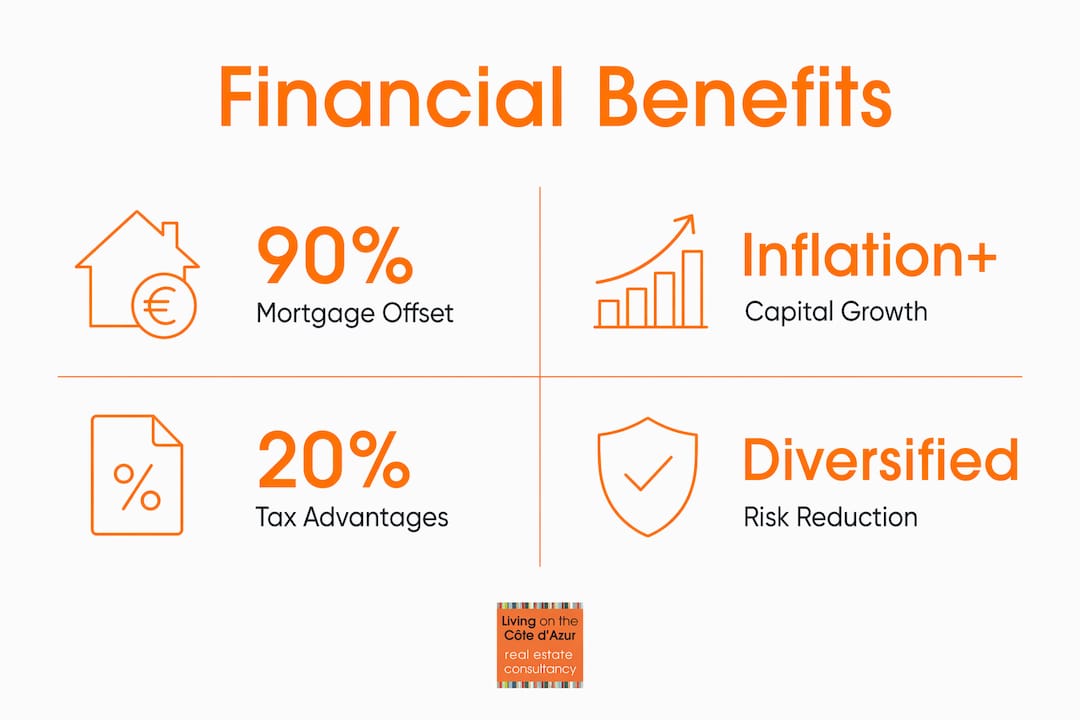
The financial benefits of real estate across multiple locations are built on four pillars: rental income, capital appreciation, tax efficiency, and risk diversification. Each pillar reinforces the others when the portfolio is structured thoughtfully.
Rental income and cost offset
Renting a home for approximately 90 days a year can cover mortgage costs in high-demand markets. That figure is significant because it means a property used personally for nine months of the year can effectively pay for itself during the remaining three. Short-term rental platforms have made this model accessible even in markets where long-term tenancy was previously the only viable option. The Côte d’Azur, for example, commands exceptional short-term rental premiums during july and august, making a well-positioned villa both a personal retreat and a productive asset.
Capital appreciation and equity building
Long-term property appreciation in prime locations has historically outpaced inflation. Properties in Saint-Tropez, Monaco, and Cap Ferrat have demonstrated consistent value growth over decades, driven by constrained supply and sustained international demand. Each mortgage payment builds equity, and that equity compounds over time into a substantial portion of a family’s net worth. The long-term value strategy for luxury real estate differs from standard residential investment precisely because prime locations resist the cyclical corrections that affect broader markets.
Tax considerations
Lenders in North America typically require a 20% down payment for investment properties and offer depreciation benefits over 27.5 years. In France, mortgage interest deductions and property expense allowances apply under specific ownership structures, including the Société Civile Immobilière (SCI), which is widely used by non-resident buyers to manage inheritance and tax exposure. Understanding these structures before purchase, rather than after, is the difference between an efficient portfolio and a costly one.
Geographic and sovereign risk diversification
Diversification across regions and sovereignty reduces risk and stabilises property portfolios. Owning properties in different financial hubs and jurisdictions hedges against local economic and political disruption. A buyer who holds property only in one country is exposed to that country’s tax changes, currency fluctuations, and regulatory shifts. Spreading ownership across the European Union and beyond creates a buffer that single-market investors simply do not have.
| Financial benefit | How it works | Key consideration |
|---|---|---|
| Rental income | Short-term lets offset mortgage and running costs | Demand varies sharply by location and season |
| Capital appreciation | Prime locations grow in value over the long term | Supply constraints in prestige markets support prices |
| Tax efficiency | SCI structures, depreciation, and deductions reduce liability | Requires specialist legal and tax advice per jurisdiction |
| Sovereign diversification | Multi-jurisdiction ownership hedges political and currency risk | Regulatory complexity increases with each additional country |
| Equity accumulation | Each payment builds ownership stake and net worth | Leverage amplifies both gains and losses |
Pro Tip: Consult a cross-border tax specialist before completing any multi-jurisdiction purchase. The savings available through correct structuring frequently exceed the cost of advice by a significant margin.
What practical challenges should prospective owners be aware of?
Multi-property ownership carries real costs that buyers consistently underestimate. Owners often underestimate maintenance, emergency repairs, and travel burdens associated with several properties. A burst pipe in a property you visit twice a year is not a minor inconvenience. It is a crisis that requires immediate local response, and without trusted local contacts, it becomes an expensive and stressful one.
The following practical realities deserve honest assessment before committing to additional properties.
- Unexpected repair costs. Roofs, plumbing, and electrical systems do not respect your travel schedule. Budget a contingency reserve for each property, separate from your operating costs.
- Property management logistics. Maintaining multiple residences requires treating ownership as a business with professional management. Hiring local property managers or concierge services is not a luxury. It is a necessity for properties you do not occupy year-round.
- Emotional division of attention. Splitting focus between homes can dilute the enjoyment of each. Owners who treat every property as equally important often find none of them feel fully like home.
- Underuse and the sunk-cost trap. A property visited fewer than four times a year rarely justifies its carrying costs. Honest usage tracking prevents the gradual accumulation of underperforming assets.
- Concentration risk. Concentrating properties in one market increases vacancy risk and exposure to local market volatility. Geographic spread is not optional for a resilient portfolio. It is the foundation of one.
Local property management is the single most effective tool for maintaining readiness for spontaneous occupancy. A trusted local team means the property is clean, stocked, and functional whenever you choose to arrive. That readiness is what makes the lifestyle benefit real rather than theoretical. You can read more about managing property investment risks in the context of the 2026 market to understand how professional oversight protects long-term value.
How do owners structure multiple residences for lifestyle and investment?
The most effective multi-residence portfolios are not assembled by accident. Multi-residence portfolios typically include a primary home, a European base for stability, and a non-European property as tax or contingency planning. That three-part structure reflects both lifestyle logic and regulatory intelligence.
The three-property model
The primary residence anchors daily life, schooling, and professional commitments. The European base, often in France, Italy, or Monaco, provides cultural richness, strong property rights, and access to world-class healthcare and education. The non-European property, frequently in the Caribbean, Southeast Asia, or the Gulf, serves as a contingency asset and a tax-planning tool under certain residency programmes.
Wealthy families systematically diversify homes across different regulatory and political blocs to mitigate sovereign risk. This is not paranoia. It is the same logic that drives institutional investors to hold assets across multiple asset classes. No single government, currency, or regulatory environment should control the entirety of a family’s property wealth.
Aligning properties with life priorities
Each property in a well-structured portfolio serves a specific life function. A coastal villa on the Côte d’Azur might serve summer family gatherings and short-term rental income in equal measure. A city apartment in Paris or London supports professional travel and cultural access. A rural estate in Provence or Tuscany provides the restorative retreat that neither city nor coast can offer.
Education and healthcare proximity increasingly shape location decisions for families with children. International schools in Nice, Cannes, and Monaco attract buyers who want their children educated in English or the International Baccalaureate system while living in one of Europe’s most beautiful regions. The advantages of diversifying wealth through global luxury property are most fully realised when each property serves a clear purpose within the family’s broader life plan.
| Property role | Typical location type | Primary function |
|---|---|---|
| Primary residence | Major city or home country | Daily life, schooling, professional base |
| European lifestyle base | Côte d’Azur, Tuscany, Monaco | Culture, family, short-term rental income |
| Non-European contingency | Caribbean, Gulf, Southeast Asia | Tax planning, sovereign diversification |
| Investment property | High-demand urban or resort market | Rental yield and capital growth |
Key takeaways
Owning multiple residences delivers its greatest value when each property serves a clear purpose, whether lifestyle freedom, rental income, capital growth, or sovereign diversification.
| Point | Details |
|---|---|
| Lifestyle freedom is the primary driver | High earners cite spontaneous travel and personal comfort above financial return as their main motivation. |
| Proximity determines usage | Properties within two to three hours of your primary base are used far more frequently and generate greater satisfaction. |
| Rental income can offset costs | Renting a property for approximately 90 days a year can cover mortgage costs in high-demand markets. |
| Geographic diversification reduces risk | Holding properties across different jurisdictions hedges against sovereign, currency, and regulatory exposure. |
| Professional management is non-negotiable | Local property managers maintain readiness for spontaneous occupancy and prevent costly neglect. |
What I have learned from watching clients build multi-residence portfolios
The buyers who thrive with multiple properties share one trait: they are honest about why they are buying. The ones who struggle are usually chasing a financial return they read about in a magazine, while quietly hoping for a lifestyle they have not yet defined.
I have seen clients purchase a beautiful farmhouse in rural Provence because the numbers looked compelling, only to visit it twice in three years. The maintenance costs mounted, the emotional connection never formed, and the sale came with a sense of relief rather than regret. Contrast that with a client who bought a modest apartment in Antibes because she genuinely loved the town, used it every school holiday, and eventually retired there. The financial return was secondary. The life she built around it was the point.
The proximity rule is the most underrated piece of advice in this space. A property you can reach in ninety minutes becomes part of your rhythm. One that requires a connecting flight and a hire car becomes an obligation. I always ask clients: “Would you go there on a long weekend, spontaneously, with no particular plan?” If the answer is hesitant, the location is wrong regardless of the yield projections.
The other thing I have learned is that maintenance fatigue is real and cumulative. Each property adds a layer of responsibility. The solution is not to avoid additional properties but to build the management infrastructure before you need it. A trusted local contact, a reliable property manager, and a clear protocol for emergencies transform ownership from a burden into a pleasure.
The Côte d’Azur remains, in my experience, one of the most satisfying locations for a second or third residence precisely because the infrastructure for this lifestyle already exists. The concierge networks, the property management services, the legal specialists, and the international community are all in place. You are not building from scratch. You are joining something that has been refined over generations.
— Ab Kuijer
How Livingonthecotedazur supports your multi-residence ambitions
Livingonthecotedazur connects discerning buyers with over 100,000 properties across the French Riviera, from Saint-Tropez to Monaco, including a curated selection of off-market luxury properties that never appear on public listings. For buyers building a multi-residence portfolio, access to these private listings is often the difference between acquiring a truly exceptional property and settling for what the open market offers. The team provides personalised guidance on tax structuring, legal audits, SCI arrangements, and financing, ensuring each acquisition fits both your lifestyle vision and your financial objectives. Whether you are adding a Riviera base to an existing portfolio or beginning your first international property purchase, Livingonthecotedazur offers the local knowledge and trusted relationships that make the process both efficient and rewarding. You can also explore the full range of exclusive property services available to buyers on the French Riviera.
FAQ
Why do high-net-worth individuals own multiple residences?
About 50% of high-net-worth individuals own more than one property, primarily for lifestyle freedom, geographic diversification, and wealth preservation across different jurisdictions.
What is the biggest financial benefit of owning several properties?
The combination of rental income, long-term capital appreciation, and tax efficiency across multiple jurisdictions creates a compounding wealth effect that single-property ownership cannot replicate.
How far should a second home be from your primary residence?
Properties within two to three hours of your primary base are used significantly more often. Greater distances reduce frequency of use and frequently lead to eventual sale due to maintenance and travel fatigue.
What are the main risks of owning multiple homes?
The primary risks include unexpected maintenance costs, concentration in a single market, underuse of properties, and the complexity of managing legal and tax obligations across different jurisdictions.
How do wealthy families structure multi-residence portfolios?
A common structure includes a primary residence, a European lifestyle base for stability and culture, and a non-European property for tax planning and sovereign risk diversification, each serving a distinct purpose within the family’s broader wealth strategy.
Recommended
 //
//