
TL;DR:
- A family office property guide provides a rigorous framework for acquiring, governing, and managing luxury real estate across generations on the French Riviera. It emphasizes detailed due diligence, formal governance structures, portfolio management technologies, and diversified geographic and sector investments to protect and grow wealth. Building local expertise and disciplined processes are essential to creating enduring property legacies in the Riviera’s unique micro-markets.
A family office property guide is a structured framework for acquiring, governing, and managing luxury real estate as a multi-generational wealth asset. For high-net-worth families targeting the French Riviera, this framework is not optional. Real estate serves as the primary investment for 73% of North American family offices, and with family office assets under management projected to grow from $3.1 trillion to $5.4 trillion between 2025 and 2031, the discipline of real estate family office management has never carried greater consequence. The Côte d’Azur, stretching from the lemon-scented ramparts of Menton to the yacht-dotted marinas of Antibes, remains one of the world’s most resilient luxury property markets. Properties here appreciate 5 to 8% annually, making them not merely residences, but heirlooms etched in Provençal stone.
What are the essential steps in acquiring luxury property for family offices on the French Riviera?
Acquisition is where fortunes are protected or squandered. The standard buyer’s checklist is wholly insufficient for family office-grade investments. Judicial-grade due diligence spans 30 to 45 days and covers more than 50 specific verification points, from legal title clarity spanning several decades to physical condition surveys and financial performance projections. This rigorous process exists precisely because the hidden risks in luxury property, particularly on the Riviera, are rarely visible at first inspection.
For acquisitions exceeding €10M, the protocol intensifies further. Engaging a colegiated Judicial Expert is a non-negotiable requirement for this tier, and the 30 to 45 day window must be built into every acquisition timeline from the outset. A Cap d’Antibes villa or a Monaco-adjacent plot in Beausoleil carries prestige, but it also carries complexity: shared ownership histories, coastal building restrictions, and heritage classifications that only expert-level verification will surface.
A disciplined acquisition process follows this sequence:
- Define the investment mandate. Clarify whether the asset serves legacy residence, seasonal rental yield, or capital appreciation. A Sainte-Maxime beachside apartment targeting 3 to 5% annual rental yield demands different criteria than a Saint-Jean-Cap-Ferrat estate held for generational transfer.
- Commission a legal title audit. Verify ownership chains, servitudes, and planning permissions. For Riviera properties, confirm compliance with the Loi Littoral, which governs coastal construction rights.
- Engage a technical surveyor. Assess structural integrity, seismic resilience, and the condition of utilities. Eco-luxury finishes and solar arrays, increasingly standard in 2026 new builds, require specialist evaluation.
- Conduct a financial performance assessment. Model rental income scenarios, maintenance reserves, and exit valuations. Properties in Mougins or Valbonne, with their proximity to Sophia Antipolis and international schools, command premium long-term tenant profiles.
- Appoint a colegiated Judicial Expert for assets above €10M. This specialist performs verifications that go beyond standard surveying, protecting the family from latent defects and complex title disputes.
Pro Tip: Build the 30 to 45 day due diligence window into your Letter of Intent, not as a courtesy but as a contractual right. Sellers of trophy assets on the Riviera expect it from sophisticated buyers. Our acquisition workflow guide details exactly how to structure this clause.
How should family offices structure and govern luxury property portfolios?
Governance is the architecture that holds a property portfolio together across generations. Without a formal real estate committee, properties drift into improper entities, tax opportunities are missed, and wealth transfer becomes a legal ordeal rather than a seamless succession. The most significant governance failure in family office real estate is precisely this absence of structured oversight.
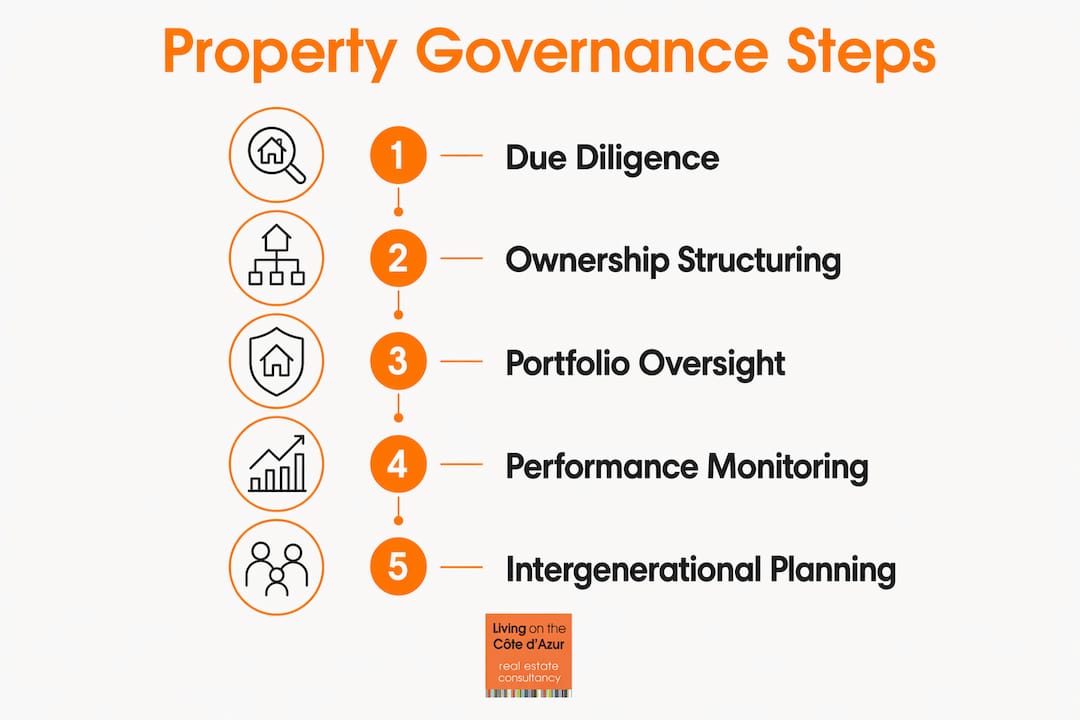
A well-constituted real estate governance committee brings together internal family representatives, an independent tax adviser, a local notaire, and a property asset manager. This group meets at minimum twice annually to review acquisition pipelines, refinancing opportunities, and succession readiness. For families holding assets across Saint-Paul-de-Vence, Roquebrune-Cap-Martin, and international markets such as Dubai or Mauritius, the committee also monitors cross-border compliance.
Key governance principles for luxury property portfolios include:
- Separate residential from commercial holdings. Blending these asset classes in a single entity creates tax inefficiencies and obscures succession planning. A Grasse Provençal mas held for family use and a Cannes commercial property generating rental income belong in distinct sub-portfolios with separate ownership structures.
- Review ownership structures annually. Cross-jurisdictional holdings require annual reviews to maintain tax treaty benefits and international compliance. Regulatory environments shift; what was optimal in 2024 may be a liability by 2026.
- Document decision rights explicitly. Define who authorises acquisitions, disposals, and capital expenditure above defined thresholds. Ambiguity in decision rights is the primary cause of intra-family disputes over property.
- Apply tax optimisation techniques systematically. Cost segregation studies, entity selection between SCI, SAS, and holding structures, and intra-family transfer pricing all require annual attention, not ad hoc review.
“Real estate governance is not bureaucracy. It is the difference between a portfolio that compounds across three generations and one that dissolves in probate.” — Family Office Advisory
Pro Tip: When structuring ownership of a Riviera estate, consider a French SCI (Société Civile Immobilière) for residential assets. It offers transparent succession mechanics and can be paired with a Luxembourg holding company for international families. Our guide on structuring luxury property portfolios covers the specific entity combinations we recommend for Côte d’Azur acquisitions.
What portfolio management strategies and technologies enhance luxury property investment?
Portfolio management for family offices is not asset management multiplied. It is a fundamentally different discipline. A profitable single asset can become a liability if it disrupts portfolio-wide risk-adjusted returns. The chess analogy holds precisely here: optimising one piece without considering the board reduces your overall position.

Advanced portfolio management software delivers up to 90% savings in soft costs and reduces capital expenditure by up to 30%, with payback periods measured in months rather than years. These platforms provide unified dashboards covering lease expiry schedules, maintenance reserves, rental yield by asset, and scenario modelling for interest rate shifts. For a family holding properties across Nice’s Mont Boron, Théoule-sur-Mer’s coastal cliffs, and Èze’s medieval perch, centralised visibility is not a luxury. It is a risk management requirement.
| Management approach | Key benefit | Riviera application |
|---|---|---|
| Centralised lease management | Reduces vacancy risk and optimises rental timing | Coordinates seasonal lets across Cannes, Antibes, and Saint-Tropez |
| Scenario planning tools | Models yield under varying interest rate and occupancy assumptions | Critical for off-plan VEFA purchases in Sainte-Maxime and Nice |
| ESG integration | Aligns portfolio with sustainability mandates and future-proofs assets | Prioritises eco-villas with solar arrays and green certifications |
| Capital expenditure tracking | Prevents cost overruns and maintains reserve adequacy | Monitors renovation cycles for Provençal mas and heritage estates |
Setting measurable portfolio-wide KPIs transforms property management from reactive to strategic. Target metrics should include gross yield by asset class, occupancy rates for seasonal rentals, capital value growth against the 5 to 8% annual Riviera benchmark, and ESG compliance scores. Families who track these metrics quarterly make materially better capital allocation decisions than those who review performance annually.
Pro Tip: Do not wait for a full portfolio review to act on underperforming assets. Set trigger thresholds: if a property’s yield falls below 2.5% for two consecutive quarters, initiate a governance committee review. Early intervention preserves optionality.
Why is geographic and sector diversification key for Riviera family office portfolios?
Diversification in a family office property portfolio is the discipline of protecting capital while preserving the conditions for growth. The French Riviera offers a rare combination: micro-markets with distinct risk and return profiles, all within an hour’s drive of Nice Côte d’Azur Airport. This geographic concentration with internal diversity is precisely what makes the Côte d’Azur so compelling for property investment strategies focused on legacy.
A well-structured Riviera portfolio balances four investment categories:
| Investment type | Risk profile | Riviera example |
|---|---|---|
| Core | Low risk, stable income | Saint-Jean-Cap-Ferrat villa, long-term let |
| Core-plus | Moderate risk, income with appreciation | Mougins or Valbonne family residence with seasonal rental |
| Value-add | Higher risk, renovation upside | Menton old town apartment, pre-renovation |
| Opportunistic | Highest risk, development potential | Off-plan VEFA in Sainte-Maxime or Nice Mont Boron |
Geographic spread across the Riviera’s villages adds a further layer of protection. A portfolio concentrated solely in Cannes carries event-driven risk tied to the film festival season and Croisette demand cycles. Spreading across Beaulieu-sur-Mer, Roquefort-les-Pins, and Cap-d’Ail introduces different buyer and tenant profiles, different planning environments, and different appreciation drivers. The Menton Lemon Festival in February and the Cannes Film Festival in May each generate distinct short-let demand spikes that a diversified portfolio can capture simultaneously.
Sector diversification matters equally. Residential estates, boutique commercial properties in Saint-Paul-de-Vence, and new-construction VEFA apartments in Sainte-Maxime each respond differently to inflation, interest rate cycles, and lifestyle migration trends. Eco-luxury builds with biophilic design and ten-year structural warranties represent the fastest-growing segment in 2026, with demand for sustainable builds rising sharply. Families who balance heritage stone with contemporary eco-construction hold portfolios that appeal to both current and future generations of discerning buyers.
Emotional attachment to a particular village or property style is natural and not inherently problematic. The discipline lies in ensuring that emotional preference does not override financial logic. A Cabris hilltop mas may hold profound personal meaning, but it must still meet the portfolio’s yield and liquidity requirements to justify its place in the allocation.
Key takeaways
A family office property guide for the French Riviera succeeds when judicial-grade due diligence, formal governance, technology-driven management, and geographic diversification operate as a single integrated system.
| Point | Details |
|---|---|
| Due diligence is non-negotiable | A 30 to 45 day process with 50-plus verification points protects against hidden risks in high-value Riviera acquisitions. |
| Governance prevents wealth erosion | A formal real estate committee with annual ownership structure reviews safeguards tax efficiency and succession clarity. |
| Technology multiplies returns | Portfolio management software can reduce capital expenditure by up to 30% and centralise decision-making across multiple assets. |
| Diversification protects capital | Spreading holdings across core, value-add, and opportunistic assets in different Riviera villages reduces concentration risk. |
| Legacy requires financial discipline | Emotional connection to a property must be balanced against measurable yield, appreciation, and succession metrics. |
What I have learned managing luxury family office portfolios on the Riviera
The families who build the most enduring property legacies on the Côte d’Azur share one characteristic: they treat governance as seriously as acquisition. I have seen portfolios of extraordinary quality, a Belle Époque villa in Beaulieu-sur-Mer here, a contemporary estate above Èze there, quietly undermined by the absence of a formal committee and an annual ownership review. The properties were magnificent. The structures holding them were fragile.
The second lesson is that technology adoption separates the families who scale from those who stagnate. Centralised portfolio dashboards are not the preserve of institutional investors. A family holding four properties across Nice, Antibes, and Mougins benefits from unified metrics as much as a fund managing forty assets. The operational clarity alone justifies the investment.
The third, and perhaps most counter-intuitive, insight is this: the Riviera’s micro-markets reward specificity over breadth. Families who develop genuine expertise in a cluster of villages, say Valbonne, Mouans-Sartoux, and Châteauneuf-Grasse, consistently outperform those who spread thinly across the entire coastline. Local knowledge of planning cycles, seasonal demand patterns, and off-market relationships is a genuine competitive advantage. It cannot be replicated by data alone.
The Riviera is not simply a market. It is a living inheritance, where the salt-kissed air of Pampelonne and the lavender-laced lanes of Grasse are as much a part of the asset as the stone and timber. The families who understand this, and who build the governance and discipline to protect it, are the ones whose grandchildren will still be gathering on these terraces.
— ab
How Livingonthecotedazur supports your family office property legacy
Livingonthecotedazur specialises in exactly the intersection this guide describes: exclusive access to off-market luxury properties on the Côte d’Azur that never appear on public portals, paired with the advisory depth that family office mandates demand. We work with families acquiring legacy estates in Saint-Jean-Cap-Ferrat, Cap d’Antibes, and Roquebrune-Cap-Martin, as well as those building diversified portfolios across the Riviera’s villages. Our team guides you through due diligence and portfolio structuring, from the first site visit to notarial completion. We also accept cryptocurrency payments, reflecting our commitment to serving the next generation of wealth. Contact us to begin a conversation about your family’s Riviera legacy.
FAQ
What is a family office property guide?
A family office property guide is a structured framework covering acquisition due diligence, governance, portfolio management, and diversification for high-net-worth families investing in real estate as a generational wealth asset. It goes significantly beyond standard buyer guidance to address tax structuring, succession planning, and risk-adjusted portfolio performance.
How long does due diligence take for a luxury Riviera property?
Judicial-grade due diligence requires 30 to 45 days and covers more than 50 verification points. For assets above €10M, a colegiated Judicial Expert must be engaged within this window.
Why does governance matter for family office real estate?
Without a formal real estate committee, properties are frequently held in improper entities, creating missed tax opportunities and complex wealth transfer challenges. Governance aligns holdings with family strategy and succession objectives.
Which Riviera villages offer the best diversification for family offices?
A balanced portfolio might combine core assets in Saint-Jean-Cap-Ferrat or Beaulieu-sur-Mer with value-add opportunities in Menton or Biot, and opportunistic off-plan positions in Sainte-Maxime or Nice. Each village carries distinct demand drivers, planning environments, and tenant profiles that reduce concentration risk.
Can family offices use technology to manage Riviera property portfolios?
Portfolio management software can deliver up to 90% savings in soft costs and reduce capital expenditure by up to 30%. Centralised platforms covering lease management, maintenance scheduling, and scenario planning are now standard practice for family offices managing multiple luxury assets.
Recommended
 //
//