
French Riviera luxury real estate ROI guide 2026
Contrary to popular belief, French Riviera luxury real estate has not consistently outperformed equity markets over the past 15 years. Yet high-net-worth investors continue flocking to this sun-drenched coastline, seeking not only lifestyle prestige but also multi-generational wealth preservation. This guide unpacks the true ROI drivers for 2026, from forced heirship complexities to sustainability premiums, helping you align investment decisions with legacy goals and market realities.
Table of Contents
- Introduction To The French Riviera Luxury Real Estate Market
- Market Trends And ROI Fundamentals For 2026
- Legacy Investment Considerations And Legal Frameworks
- Sustainability And Eco-Friendly Investments On The Côte D’Azur
- Comparing New Constructions With Historic Villas
- Common Misconceptions And Reality Checks
- Practical Guide To ROI Analysis And Decision Making
- Explore Luxury Real Estate Opportunities With Living On The Côte D’Azur
- Frequently Asked Questions
Key takeaways
| Point | Details |
|——-|———||
| Capital growth and rental yields | Luxury villas appreciate 5% to 8% annually, with rental yields of 3% to 5% in prime locations like Nice and Cannes. |
| Legal and tax complexities | Forced heirship reserves 50% of estates for heirs; rental income tax jumped from 17% to 40% for lettings above €23,000. |
| Sustainability premium | Eco-certified properties see 15% higher demand and sell faster, whilst poor energy ratings extend market time by 20%. |
| Asset class comparison | New constructions offer 10-year warranties and lower notary fees; historic villas deliver prestige and legacy value but higher renovation costs. |
Introduction to the French Riviera luxury real estate market
The 2026 French Riviera luxury property market remains a seller’s domain, driven by constrained ultra-luxury villa supply and persistent demand from global elites. High-net-worth individuals and multi-generational family offices now dominate acquisitions, prioritising legacy-focused investments that transcend transactional returns. Sustainability and energy efficiency have evolved from nice-to-haves into non-negotiable value determinants.
Typical investors include digital millionaires seeking lifestyle assets with solid ROI, established families preserving wealth through Monaco-adjacent estates, and family offices channelling inherited capital into Provençal mas or contemporary eco-villas. The Riviera’s unique appeal lies in its fusion of Mediterranean lifestyle, international prestige, and robust legal frameworks for wealth transfer.
Key geographic hubs shape investment profiles. Cap d’Antibes offers unmatched privacy for ultra-high-net-worth buyers. Monaco borders deliver prestige and tax efficiency for residents. Nice and Cannes balance lifestyle amenities with rental yield potential. Menton and Èze attract heritage seekers valuing authenticity and botanical tranquillity. Understanding how to invest strategically across these submarkets is essential for optimised returns.
Investor priorities in 2026 include:
- Multi-generational legacy planning through real estate trusts and structured ownership
- Sustainability certifications that enhance resale value and attract premium tenants
- Transparent ROI analysis factoring in French tax changes and inheritance law
- Access to off-market properties avoiding competitive bidding wars
Market trends and ROI fundamentals for 2026
Understanding current market behaviour and quantitative benchmarks allows you to forecast realistic returns. Ultra-luxury villas in sought-after locations like Cap d’Antibes and Monaco borders appreciate 5% to 8% annually, driven by scarcity and sustained elite demand. Seasonal rental income typically generates 3% to 5% yields for well-positioned properties in Nice, Cannes, and Antibes, though tax changes have compressed net returns.

Market velocity reveals critical insights. Properties with high energy performance certificates sell within 45 to 75 days, whilst listings with poor energy ratings linger longer, impacting liquidity. Buyers increasingly demand eco-luxury finishes, solar arrays, and biophilic design elements, reshaping what constitutes a premium asset.
Cash transactions dominate the ultra-luxury segment. Over 70% of purchases above €5 million proceed without mortgage financing, insulating investors from interest rate volatility but requiring substantial liquid capital. This equity-only dynamic favours established wealth and family office structures over leveraged speculators.
Key ROI drivers for 2026 include:
- Appreciation tied to location scarcity and lifestyle appeal rather than speculative flipping
- Rental yields moderated by higher taxation but supported by strong seasonal tourism
- Liquidity influenced by energy ratings and property condition
- Value premiums for sustainability features and concierge-ready amenities
Selecting the perfect investment property requires balancing these factors against your capital allocation and legacy timeline. Properties in established neighbourhoods with proven rental demand offer stability, whilst emerging eco-developments near Sainte-Maxime promise growth potential.
For data-driven insights into luxury rental performance, scrutinise historical occupancy rates, average nightly rates, and seasonal demand patterns. Winter months see lower occupancy outside ski-adjacent regions, whilst summer commands premium pricing from May through September.
Legacy investment considerations and legal frameworks
French inheritance law profoundly shapes ROI for multi-generational investors. The 50% forced heirship rule mandates reserving half your estate for direct heirs, constraining testamentary freedom. This affects how you structure ownership through SCI entities, life insurance wrappers, or offshore trusts to optimise wealth transfer efficiency.
Recent tax changes have further complicated legacy planning. Rental income tax rates surged from 17% to 40% for furnished lettings above €23,000 annually, dramatically reducing net yields. Family offices now favour long-term capital appreciation over short-term rental strategies, holding properties for decades to maximise compound growth and minimise tax drag.
Legacy asset types popular in 2026 include:
- Provençal mas in Grasse or Valbonne, offering authentic heritage and renovation upside
- Monaco-adjacent villas in Roquebrune-Cap-Martin, combining tax efficiency with proximity to financial hubs
- Eco-certified new builds in Sainte-Maxime, delivering sustainability credentials for environmentally conscious heirs
- Historic estates in Antibes with established gardens and cultural significance
Pro Tip: Engage French inheritance and tax specialists within your first property evaluation phase. Early structuring through SCI vehicles or usufruct arrangements can preserve 15% to 25% more wealth for heirs versus reactive post-purchase planning.
Sustainability considerations now intersect with legacy value. Properties with poor energy ratings face regulatory pressure for costly retrofits, eroding long-term returns. Conversely, investing in solar arrays, geothermal systems, and green certifications protects estate value against tightening environmental standards. Wealth preservation strategies increasingly incorporate climate resilience and energy independence as core pillars.
For detailed guidance on navigating French inheritance law and structuring family office acquisitions, consult advisers familiar with cross-border estate planning. Understanding forced heirship implications before signing purchase agreements prevents costly restructuring later.
Sustainability and eco-friendly investments on the Côte d’Azur
Sustainability has transitioned from niche preference to mainstream demand driver in 2026. Eco-certified properties enjoy 15% higher buyer interest and shorter market times, reflecting growing awareness among high-net-worth investors. Properties with poor energy performance certificates languish 20% longer on listings, signalling liquidity risk for sellers.
The market now distinguishes between surface-level greenwashing and substantive sustainability. Buyers seek tangible features: solar photovoltaic systems generating 8-12 kW, greywater recycling infrastructure, locally sourced natural materials, and smart home automation optimising energy use. These elements command premiums of €200,000 to €500,000 on ultra-luxury villas whilst reducing ongoing operational costs.
Key sustainability investments enhancing ROI include:
- High-performance insulation and triple-glazed windows meeting Passivhaus standards
- Heat pumps and geothermal systems replacing fossil fuel heating
- Native landscaping with drought-resistant Mediterranean species reducing water consumption
- EV charging infrastructure anticipating regulatory mandates and buyer preferences
New developments in Nice’s Mont Boron and Sainte-Maxime’s Garonette beachfront integrate biophilic design principles, maximising natural light and ventilation whilst minimising environmental footprint. These properties attract younger ultra-high-net-worth buyers, digital entrepreneurs, and family offices with ESG investment mandates.
Sustainability also mitigates regulatory risk. France continues tightening energy performance standards, with penalties for non-compliant rental properties. Investing in properties with strong energy ratings future-proofs your portfolio against forced upgrades and potential rental restrictions.
For comprehensive analysis of 2026 market sustainability trends, review regional data on certification uptake, buyer willingness to pay green premiums, and projected regulatory timelines. Properties achieving A or B energy ratings consistently outperform C-rated comparables by 8% to 12% in capital appreciation.
Comparing new constructions with historic villas
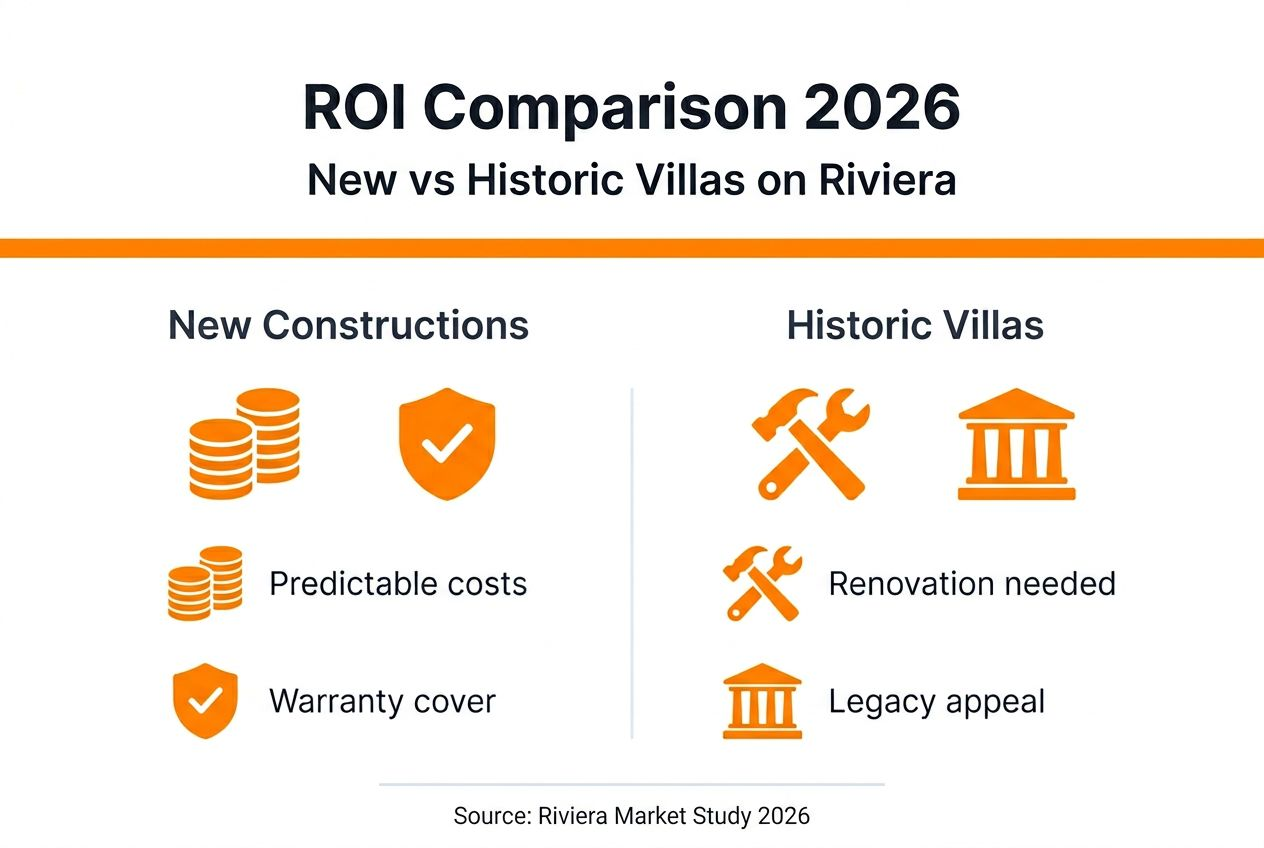
Choosing between new builds and heritage properties requires balancing warranties, costs, legacy value, and personal lifestyle preferences. Each asset class offers distinct advantages and trade-offs impacting long-term ROI.
| Feature | New constructions | Historic villas |
|---|---|---|
| Warranty protection | 10-year structural guarantee | None; buyer assumes all risks |
| Notary fees | 2% to 3% on purchase price | 7% to 8% on purchase price |
| Energy rating | Typically A or B certified | Often D to F; requires retrofitting |
| Legacy prestige | Modern aesthetic; limited heritage | Established provenance and cultural significance |
| Maintenance costs | Low for first decade | High; ongoing restoration and compliance |
| Payment flexibility | Zero-interest staged payments during construction | Full equity or traditional mortgage |
New constructions like those in Sainte-Maxime and Nice deliver financial predictability. VEFA contracts shield buyers from construction overruns, staged payments ease cash flow, and lower notary fees save €150,000 to €300,000 on a €5 million purchase. Ten-year warranties cover structural defects, eliminating surprise repair costs.
Historic villas in Antibes, Èze, or Menton offer irreplaceable authenticity. Established gardens, architectural heritage, and proximity to cultural landmarks create legacy value that appreciates beyond pure market metrics. However, renovation costs can exceed 25% of purchase price, and energy compliance retrofits add €100,000 to €400,000 for older properties.
Investor profiles align with asset classes:
- New builds suit pragmatic investors prioritising cash flow predictability and minimal maintenance
- Historic villas attract legacy-focused families valuing heritage and willing to absorb higher carrying costs
- Family offices often diversify, holding both new eco-villas for rental income and heritage estates for multi-generational use
Pro Tip: For new constructions, verify developer financial stability and project insurance before committing. For historic villas, commission comprehensive structural surveys and heritage compliance audits to quantify true renovation costs upfront.
Navigating luxury property acquisition requires understanding these trade-offs within your broader wealth strategy. New builds offer turnkey convenience; historic estates demand patient capital and active stewardship.
Common misconceptions and reality checks
Several persistent myths distort investor expectations about French Riviera luxury real estate. Confronting these misconceptions with data ensures realistic ROI planning.
Myth one: Riviera property always outperforms financial markets. Reality reveals luxury real estate underperformed equities over the past 15 years when accounting for transaction costs, carrying expenses, and opportunity cost of capital. Properties excel at wealth preservation and lifestyle benefits but rarely match stock market compound returns.
Myth two: Short-term luxury rentals generate effortless passive income. Recent tax changes obliterate this narrative. With rental income taxation jumping from 17% to 40% for annual receipts above €23,000, net yields compress significantly. Factor in property management fees (15% to 25% of gross rent), maintenance, and vacancy periods, and returns often fall below 2% net.
Myth three: All Riviera locations appreciate equally. Micro-location drives performance. Cap d’Antibes and Monaco borders command persistent premiums, whilst secondary towns like Fréjus or La Napoule lag. Proximity to amenities, sea views, and energy ratings create 30% to 50% valuation gaps between comparable properties.
Key realities for 2026 investors:
- Luxury real estate works best as portfolio diversification, not core growth engine
- Legacy value and lifestyle benefits justify investment beyond pure financial returns
- Tax and legal complexities require professional guidance to optimise ROI
- Sustainable properties outperform non-compliant assets in both appreciation and liquidity
“Successful Riviera investment balances financial pragmatism with emotional connection. Properties should serve family needs across decades, not merely chase speculative gains.”
For evidence-based investment strategies, scrutinise historical transaction data, rental yield benchmarks, and tax impact models. Avoid basing decisions on anecdotal success stories or outdated pre-tax-change assumptions. Detailed analysis from market trend reports provides essential context for realistic planning.
Practical guide to ROI analysis and decision making
Implementing rigorous ROI analysis transforms intuition into actionable investment strategy. Follow this framework to evaluate luxury properties systematically.
Step one: Calculate comprehensive ROI
- Project annual capital appreciation using 5% to 8% benchmarks for prime locations
- Estimate gross rental income based on comparable seasonal rates and occupancy
- Subtract rental income tax at 40% for receipts above €23,000
- Deduct property management (20% of gross), maintenance (1.5% of property value), and insurance
- Factor in notary fees, renovation costs, and opportunity cost of capital
- Calculate net annual return as percentage of total invested capital
Step two: Complete legal and tax due diligence
- Verify clear title through notaire searches and cadastral records
- Assess forced heirship implications for your succession plan
- Model estate tax liability under French and home country rules
- Review energy performance certificate and retrofit cost estimates
- Confirm zoning allows intended rental or commercial use
Step three: Evaluate neighbourhood and demand factors
- Cap d’Antibes: Maximum privacy, limited supply, ultra-high-net-worth buyer pool
- Monaco borders: Tax efficiency for residents, financial hub proximity
- Nice and Cannes: Strong rental demand, lifestyle amenities, airport access
- Menton and Èze: Heritage appeal, lower entry prices, slower appreciation
Pro Tip: Weight liquidity alongside appreciation potential. Properties selling within 60 days offer flexibility for rebalancing portfolios, whilst illiquid assets lock capital for years.
Step four: Assess risk factors
- Regulatory risk: Energy performance mandates tightening; non-compliant properties face rental restrictions
- Market liquidity risk: Ultra-luxury segment narrows buyer pool; selling may require 12 to 18 months
- Sustainability risk: Climate change impacts coastal properties; flood and wildfire zones require enhanced insurance
- Tax policy risk: France’s fiscal environment remains unpredictable; future tax increases could further compress yields
For wealth preservation strategies and legacy planning, align property acquisition with multi-generational goals. Building Riviera wealth requires patience and strategic holding periods of 10 to 20 years to maximise compound appreciation.
Explore prime investment property examples showcasing diverse asset classes, from Provençal mas to contemporary eco-villas. Each property type serves distinct investor profiles and legacy objectives.
Explore luxury real estate opportunities with Living on the Côte d’Azur
Living on the Côte d’Azur connects discerning investors with exclusive off-market properties across the Riviera’s most coveted locations. Our curated portfolio spans heritage villas in Antibes, eco-certified new builds in Sainte-Maxime, and Monaco-adjacent estates designed for multi-generational legacy. We accept cryptocurrency payments, serving digital millionaires seeking seamless global transactions.
Our advisers specialise in legacy-focused investment strategies, navigating forced heirship complexities, tax optimisation, and sustainability certifications. Access off-market luxury opportunities unavailable through public listings, avoiding competitive bidding wars.
Whether you seek a villa or penthouse for family retreats or rental income, our team delivers tailored guidance aligned with your wealth preservation goals. Connect with our experts today to begin your luxury property acquisition journey.
Pro Tip: Engaging specialised advisers early in your property search maximises ROI through strategic negotiation, legal structuring, and access to exclusive inventory.
Frequently asked questions
What is forced heirship and how does it affect my French Riviera property investment?
Forced heirship requires reserving 50% of your estate for direct heirs under French law. This constrains testamentary freedom and necessitates careful ownership structuring through SCI entities or trusts to optimise wealth transfer. Consult inheritance specialists before purchasing to align property holding structures with your succession plan.
How do sustainability features influence luxury property ROI on the Côte d’Azur?
Eco-certified properties enjoy 15% higher buyer demand and sell faster in 2026, whilst poor energy ratings extend market time by 20%. Sustainability investments like solar arrays and high-performance insulation deliver value premiums of €200,000 to €500,000 whilst reducing operational costs. Green features also mitigate regulatory risk from tightening energy standards.
What are the risks of investing in historic villas compared to new constructions?
Historic villas require substantial renovation budgets, often exceeding 25% of purchase price, and lack warranties covering structural defects. Energy compliance retrofits add €100,000 to €400,000 for older properties. New constructions offer 10-year warranties, lower notary fees (2% to 3% versus 7% to 8%), and superior energy ratings, delivering financial predictability and reduced maintenance risk.
Why have rental income profits from luxury short-term lettings declined recently?
Rental income taxation increased from 17% to 40% for furnished lettings above €23,000 annually, dramatically compressing net yields. Combined with property management fees of 15% to 25% and maintenance costs, net rental returns often fall below 2%. Investors now prioritise long-term capital appreciation over short-term rental strategies to optimise after-tax ROI.
Recommended
 //
//