
TL;DR:
- Securing luxury property on the Côte d’Azur requires a disciplined, intelligence-led negotiation workflow rooted in thorough preparation and strategic communication. Buyers should use independent market data to set offers, present multiple structured options, and transition early to verbal interactions to build rapport and reduce misunderstandings. Maintaining a clear walk-away threshold and leveraging due diligence findings as negotiation tools enhances outcomes and prevents overpayment in high-demand markets.
Securing a luxury property on the Côte d’Azur or in any high-demand market is never simply a matter of presenting the highest offer. The property purchase negotiation workflow that separates disciplined investors from disappointed ones is a structured, intelligence-led process that begins long before any number is placed on the table. Whether you are acquiring a villa above the Provençal garrigue in Mougins, a sea-facing apartment in Nice’s Mont Boron, or an off-market estate near the Monaco border in Beausoleil, the same principle holds: preparation and process outperform enthusiasm every single time.
Table of Contents
- Key takeaways
- The property purchase negotiation workflow explained
- Crafting a compelling opening offer
- Execution: communication, timing, and counteroffers
- Verification and closing: due diligence as a negotiation tool
- Common negotiation mistakes to avoid
- Our perspective on luxury negotiation discipline
- How Livingonthecotedazur supports your acquisition
- FAQ
Key takeaways
| Point | Details |
|---|---|
| Anchor your offer strategically | Use independent market data, not the seller’s listing price, as your negotiation reference. |
| Present multiple offer structures | Giving sellers two or three viable options increases the probability of acceptance significantly. |
| Shift to verbal communication early | Moving from email to phone or in-person meetings reduces misunderstandings and accelerates decisions. |
| Set your walk-away threshold in writing | Pre-agreed limits prevent emotional overpaying in high-pressure luxury markets. |
| Due diligence reshapes the deal | Inspection findings are legitimate renegotiation leverage, not deal-ending crises. |
The property purchase negotiation workflow explained
Understanding the full property acquisition workflow before you make contact with any seller is what distinguishes a confident buyer from one who reacts rather than leads. The framework has four stages: research and preparation, offer construction, execution and communication, and verification through to closing. Each stage feeds directly into the next, and skipping any one of them creates vulnerability at precisely the moment you can least afford it.
The Côte d’Azur is not a forgiving market for improvisation. In 2026, prestige villa prices along Cap d’Antibes and Roquebrune-Cap-Martin continue to command premiums that reflect both scarcity and global demand from buyers in the Gulf, Asia, and the Americas. Your workflow must be calibrated to that reality from the outset.
Know the market before you speak to the seller
Every property acquisition workflow begins with data. Gather recent sales comparables for the immediate area, not just the broader commune. A four-bedroom villa sold last autumn in Èze village does not directly inform the value of a comparable property on the Basse Corniche. Location precision matters enormously on the Riviera.
Analyse current inventory levels, average days on market, and the ratio of list price to final agreed price. Effective negotiation saves buyers over £11,000 per transaction on average through tactical price anchoring and inspection-based renegotiation. That figure is the direct result of preparation.

Pro Tip: Build a simple one-page intelligence brief for each property you seriously consider. Include recent comps, seller holding period, current market absorption rate, and any publicly available information about the vendor’s circumstances. This document becomes your negotiation anchor before a single word is exchanged.
Crafting a compelling opening offer
Once your market intelligence is assembled, the next property acquisition step is constructing your Anchor Letter of Intent. The Anchor LOI resets the negotiation frame entirely. Rather than responding to the seller’s listed price as though it were a given, you introduce your own reference point, grounded in independent data, that becomes the document everyone works from.
A well-constructed LOI for a luxury property typically includes:
- Your offer price, derived from comparable sales and your target yield or capital growth projection
- The amount and structure of the earnest money deposit
- All material contingencies, including financing, survey, and legal due diligence
- Your proposed timeline for each stage, from acceptance through to completion
- Any exclusivity period requested to conduct due diligence without competing offers
Critically, strong LOIs clearly separate binding deal terms from non-binding ones. This eliminates redundant renegotiations later in the process when emotions and legal fees are both running high.
The approach that consistently improves outcomes is presenting two or three structured packages rather than a single price. Presenting multiple offer options empowers sellers to choose rather than feel pressured, and that psychological shift meaningfully increases acceptance rates. Consider the contrast below.
| Approach | Seller psychology | Likely outcome |
|---|---|---|
| Single price offer | Feels pressured to accept or reject | Higher risk of outright refusal |
| Two to three structured packages | Exercises agency, feels respected | More likely to engage and counteroffer |
| Seller’s price accepted verbatim | Perceives buyer as uninformed | Seller anchors higher in future rounds |
Strategic concessions are the final element of offer construction. A flexible closing date costs you almost nothing if your financing is already arranged, but to a seller who has already committed to a new property, it may be the most valuable term in the entire LOI. Using concessions of low cost but high perceived value builds trust and creates goodwill that sustains the negotiation through difficult moments.
Pro Tip: When a seller counters above your walk-away price, do not simply counter back at a midpoint. Instead, reframe the conversation: “We have arrived at this figure based on the following comparable transactions.” Returning to your data anchor neutralises the emotional pull of splitting the difference.
Execution: communication, timing, and counteroffers
The most meticulously prepared offer can still unravel if the execution phase is handled poorly. Early verbal interaction builds rapport, clarifies motivations, and reduces the back-and-forth email exchanges that so frequently stall negotiations at a critical moment. Move from written communication to a phone call or, where possible, a face-to-face meeting as soon as the seller has acknowledged your LOI.
Active listening during those conversations is where many buyers lose ground without realising it. Sellers reveal their true priorities in casual remarks far more than in formal responses. A vendor who mentions repeatedly that they need a smooth, uncomplicated closing is signalling that certainty of completion may matter to them more than extracting every last euro from the price. That is negotiation intelligence you cannot buy.
Timing is a tool in itself. Consider these points in managing the rhythm of any negotiation:
- Set response deadlines on your offers. Three to five business days is professional and creates purposeful urgency without pressure.
- Avoid responding to counteroffers within minutes. A brief pause signals calm deliberation, not desperation.
- Effective negotiators structure multiple offer options addressing the seller’s priorities rather than issuing a single price demand.
- Written walk-away limits agreed before offers are submitted prevent costly emotional decisions in the heat of a competitive round.
- Document every conversation with a brief follow-up email summarising what was discussed and agreed. This protects both parties and prevents “remembered differently” disputes later.
Pro Tip: Agree your walk-away number with your advisory team before the first offer goes in. Write it down. The moment you find yourself rationalising why you should exceed it, that document will save you from a decision you will regret.
Verification and closing: due diligence as a negotiation tool
Most buyers treat the due diligence phase as a formality that follows negotiation. In practice, it is an integral part of the property acquisition steps and one of the most underused sources of legitimate leverage. Most deals fail not because of the physical condition of the property, but because of emotional reactions to due diligence findings from both sides of the table.
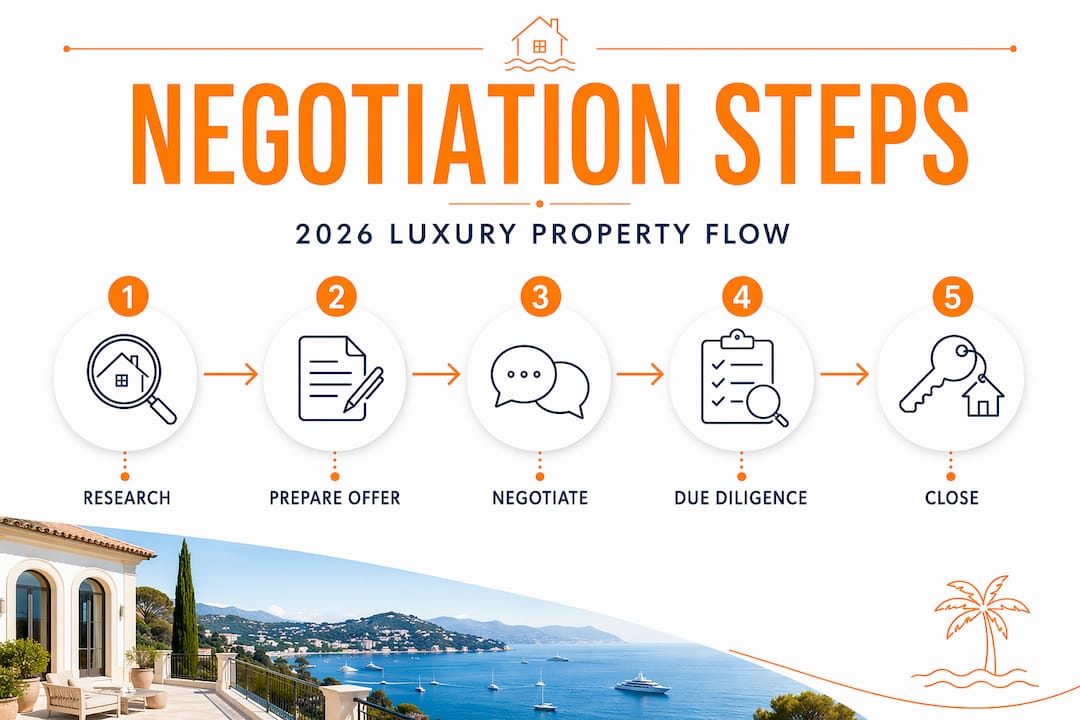
Setting expectations early changes this dynamic. Before surveys are commissioned, communicate clearly that findings will be assessed objectively and that any material issues will be addressed through negotiation, not treated as deal-ending crises. This creates a shared commitment to resolution rather than confrontation.
The outcomes you can typically negotiate post-inspection fall into two categories:
- Price reductions: Appropriate when defects are structural or systemic, such as roofing, plumbing, or electrics requiring significant capital expenditure.
- Credit at completion: Often preferable in luxury transactions, as it avoids delays caused by the seller’s chosen contractors and allows you to appoint specialists of your own selection.
- Works completed prior to completion: Use this only when the seller has demonstrably better access to reliable tradespeople, or when the defect creates a safety issue.
- Retention agreements: A sum held in escrow post-completion to cover remediation of a known issue. Less common in French transactions but worth exploring through your notaire.
Maintaining a consistent closing cadence with all parties, solicitors, agents, and notaires, prevents deal fatigue and eliminates the last-minute surprises that cause otherwise sound agreements to collapse.
Common negotiation mistakes to avoid
Even experienced investors make costly errors in luxury property negotiations. The mistakes below are not theoretical. They are the ones we see derail transactions on the Riviera with uncomfortable regularity.
- Accepting the listing price as the anchor. The seller’s asking price is a marketing figure. Your independent data is the legitimate reference.
- Waiving contingencies to appear competitive. In a high-demand market, this feels necessary. It rarely is, and it exposes you to significant financial risk.
- Neglecting to identify seller motivations. A seller in no rush and with no urgency requires an entirely different approach to one managing a relocation deadline or an inheritance dispute.
- Overcommitting emotionally. The villa above the Cannes hillside may feel irreplaceable. There will be another. Losing your walk-away posture is the single most expensive mistake a buyer can make.
- Poor documentation. Verbal agreements in luxury real estate have no binding value. If it was not confirmed in writing, assume it was not agreed.
- Allowing negotiations to stall. If a deal has gone quiet for more than a week without a scheduled next step, intervene proactively. Initial meetings yield a 47% counteroffer rate, meaning most sellers are open to dialogue. Stalled silence is usually recoverable with a well-timed, constructive approach.
Our perspective on luxury negotiation discipline
I have worked alongside buyers acquiring properties from Menton’s lemon-perfumed hillsides to the opulent promenades of Nice, and the pattern is consistent. The buyers who achieve the most favourable terms are never the most aggressive. They are the most prepared.
What I have learned is that a workflow mindset does not constrain creativity. It creates the confidence to be creative, because you are operating from a position of genuine knowledge rather than anxiety. When a seller senses that you understand the market as well as they do, the conversation shifts from adversarial to collaborative.
The buyers I have seen overpay, almost without exception, abandoned their walk-away threshold at the precise moment they believed the deal was unique. No property is unique in the sense that no alternative exists. Saint-Jean-Cap-Ferrat and Théoule-sur-Mer are both extraordinary. Patience between them has never cost a disciplined investor a penny.
Rapport matters too, in ways that data cannot fully capture. Understanding that a seller’s attachment to their estate in Antibes is emotional, not merely financial, and honouring that with sensitivity in your communication, often unlocks flexibility that a harder approach would have permanently closed off.
The 3 Ps of negotiation success, preparation, patience, and persistence, are not abstract virtues. They are the practical architecture of every successful luxury acquisition I have witnessed.
— “We do not simply present listings, we provide a healthy French Riviera lifestyle.” Ab Kuijer
How Livingonthecotedazur supports your acquisition
At Livingonthecotedazur, we do not simply present listings. We guide high-net-worth buyers and investors through every stage of a curated property acquisition workflow, from the first intelligence brief through to the notaire’s signature. Our access to off-market luxury properties across the Côte d’Azur means that many of the finest estates we present never appear on public portals, giving our clients a negotiation advantage that begins before the first offer is drafted.
Whether you are structuring a legacy acquisition for your family’s future, seeking a prestigious pied-à-terre between Nice’s Château Hill and the Cannes Croisette, or exploring the step-by-step transaction process for your first Riviera purchase, our team is positioned to provide personalised negotiation support. We also embrace cryptocurrency payments, reflecting our commitment to the global digital investors who are reshaping luxury real estate. Contact us to begin a conversation about your next acquisition and discover how a structured approach transforms aspiration into ownership.
FAQ
What is a property purchase negotiation workflow?
A property purchase negotiation workflow is a structured, step-by-step process that covers market research, offer preparation, communication strategy, due diligence, and closing. It replaces reactive negotiation with a disciplined framework that consistently produces better outcomes for buyers.
How do I negotiate a real estate deal effectively?
Begin with independent market data as your anchor, present two or three structured offer options rather than a single price, and move to verbal communication early to build rapport. Tactical negotiation strategies save buyers over £11,000 per transaction on average.
What is an Anchor LOI and why does it matter?
An Anchor Letter of Intent is a formal document that sets your terms, including price, contingencies, timeline, and earnest money, based on independent data rather than the seller’s listing. It resets the negotiation reference point in your favor from the outset.
When should I renegotiate after the survey?
Renegotiation after a survey is appropriate whenever material defects are identified that affect the property’s value or require significant capital expenditure. Request either a price reduction, a completion credit, or a retention agreement through your legal adviser rather than demanding repairs from the seller.
How do I avoid overpaying in a competitive luxury market?
Set your walk-away price in writing before submitting any offer, and commit to it regardless of emotional attachment to the property. The concierge-level support of an experienced buying agent further protects you by maintaining negotiating discipline when pressure mounts.
Recommended
 //
//