
TL;DR:
- France’s investor visa requires active business investments, not passive property ownership.
- A genuine French residency program involves creating or protecting jobs through business investments.
- Monaco offers property-based residency with tax benefits, without job creation mandates.
Many high-net-worth buyers arrive on the Côte d’Azur, captivated by the salt-kissed air drifting over Cap d’Antibes or the bougainvillea-draped terraces above Èze, and assume that purchasing a prestigious villa will open the door to French residency. It is an understandable assumption, and one we hear often. The reality, however, is considerably more nuanced. Golden visa programmes vary dramatically across Europe, and France’s own investor pathway carries requirements that surprise even seasoned international investors. This guide cuts through the confusion, offering clear insight into your residency options, a sharp comparison of European destinations, and practical steps to position your Riviera ambitions for long-term success.
Table of Contents
- What is a golden visa?
- The French approach to investor visas
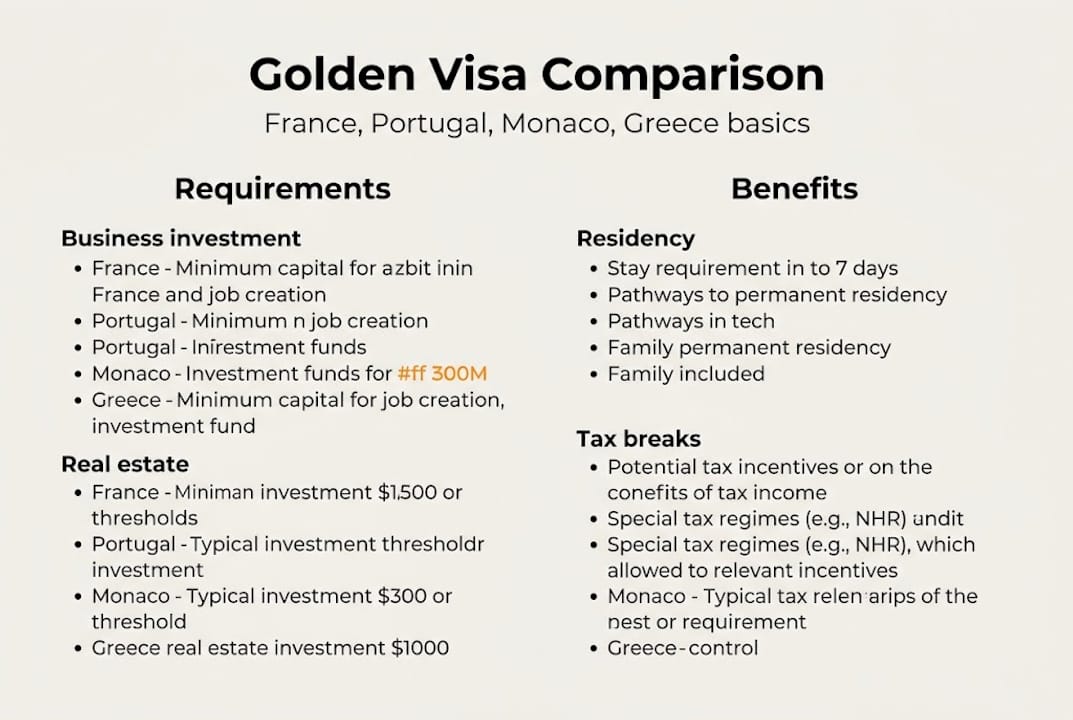
- Comparing golden visas in popular European destinations
- Practical steps for French investor visa seekers
- Expert perspective: What most luxury investors overlook
- Luxury real estate solutions for Riviera investors
- Frequently asked questions
Key Takeaways
| Point | Details |
|---|---|
| France requires active business investment | Unlike Portugal or Greece, France mandates substantial investment in a French company with job creation—not just property buying. |
| Residency via real estate is limited | Buying luxury property on the Riviera strengthens investment profiles but doesn’t automatically grant residency rights. |
| Monaco offers property-based residency | Monaco’s approach appeals to those seeking prestige and tax optimisation through property and financial deposits. |
| Investor visa process is complex | Applicants must prepare a business plan, proof of funds, and navigate a two-stage French residency process over 2-6 months. |
| Tax and legacy planning is crucial | Understanding the interplay of wealth tax, residency criteria, and investment strategies is essential for sustainable success. |
What is a golden visa?
The term “golden visa” has become shorthand for an entire family of residency-by-investment schemes that have reshaped how the world’s wealthiest individuals think about borders, tax planning, and lifestyle. At its core, a golden visa is a formal government programme that grants residency rights in exchange for a qualifying economic contribution. Golden Visa programs are residency-by-investment schemes offered by over 100 countries, primarily requiring significant economic investments such as real estate, funds, bonds, or business ventures to obtain residency rights, often with paths to citizenship.
The qualifying investment categories vary considerably from one country to another. Most programmes accept one or more of the following:
- Real estate acquisition above a minimum threshold
- Government bonds or sovereign funds held for a defined period
- Capital transfers into approved financial instruments
- Business creation with accompanying job generation
- Cultural or heritage fund contributions (notably in Portugal)
The appeal for globally mobile investors is self-evident. A golden visa typically extends residency rights to the primary investor’s spouse and dependent children, making it an elegant vehicle for family-wide lifestyle planning. Schengen Area access is particularly prized; holding residency in a Schengen member state allows visa-free movement across 27 European countries, from the sun-baked marinas of Antibes to the lemon-scented promenades of Menton during the famous Fête du Citron.
“A golden visa is not merely a travel document. For the discerning investor, it is a generational instrument, weaving residency rights, tax efficiency, and legacy planning into a single, elegant structure.”
Beyond mobility, golden visa holders often benefit from preferential tax treatment, access to high-quality healthcare and education systems, and the prestige of holding European residency. For those who have built wealth through digital enterprises or international business portfolios, formalising a European base through a legitimate residency programme is both a practical necessity and a statement of intent. Our international property investment guide explores how Riviera assets fit within this broader global strategy.
The French approach to investor visas
France occupies a fascinating and sometimes misunderstood position in the golden visa landscape. Unlike Portugal, Greece, or Spain, France does not offer a traditional property-based golden visa. This is the single most common misconception we encounter among buyers who fall in love with a sea-view penthouse above Nice’s Baie des Anges or a historic bastide near Cannes and assume the purchase alone confers residency privileges.
France does not offer a traditional Golden Visa; instead, high-net-worth individuals can pursue the Talent Passport ‘Business Investor’ visa requiring a minimum €300,000 investment in fixed tangible or intangible assets of a French company, at least 10 to 30% ownership, and commitment to create or protect jobs within 4 years. This is an active, commercially engaged pathway, not a passive wealth-parking mechanism.
The distinction matters enormously. Pure real estate purchases do not qualify for French investor residency; investments must be in commercial enterprises with economic impact like job creation. A magnificent villa on Cap d’Antibes, however extraordinary its architecture and however commanding its sea views, does not satisfy this criterion on its own.
| Requirement | Details |
|---|---|
| Minimum investment | €300,000 in tangible or intangible assets |
| Ownership stake | 10 to 30% of a French company |
| Job commitment | Create or protect employment within 4 years |
| Visa duration | 4-year renewable residence permit |
| Family inclusion | Spouse and dependants included |
| Path to permanence | Permanent residency eligibility after 5 years |
This means that if your Riviera ambition includes French residency via the Talent Passport, you will need to pair your property acquisition with a genuine business investment. Hospitality ventures, tech enterprises, or sustainable tourism businesses operating along the Côte d’Azur are among the more natural fits for internationally mobile entrepreneurs.

Pro Tip: Many of our clients successfully combine a Riviera property purchase with a minority stake in a local luxury hospitality or property management business, satisfying the Talent Passport’s commercial requirements whilst anchoring their family life in one of the world’s most coveted addresses. Explore our curated Côte d’Azur real estate options alongside our portfolio of legacy luxury investments to understand how these strategies work in practice.
Comparing golden visas in popular European destinations
For investors whose primary goal is property-anchored residency near the French Riviera, the European landscape offers several compelling alternatives. Over 60% of EU countries have Golden Visas; popular for French Riviera seekers include nearby Portugal (€250k in cultural funds), Greece (€250k to €800k real estate), Spain, and Italy; but France emphasises job-creating business investments over passive real estate.
Each destination carries its own distinct character, investment threshold, and lifestyle proposition. The table below distils the most relevant details for discerning investors weighing their European options.
| Destination | Minimum investment | Real estate eligible? | Job creation required? | Schengen access | Tax advantages |
|---|---|---|---|---|---|
| France | €300,000 (business) | No | Yes | Yes | IFI wealth tax applies |
| Monaco | Property + bank deposit | Yes | No | Limited | Exceptional tax haven |
| Portugal | €250,000 (cultural/funds) | Limited (restricted areas) | No | Yes | NHR tax regime |
| Greece | €250,000 to €800,000 (real estate) | Yes | No | Yes | Flat tax options |
| Spain | €500,000 (real estate) | Yes | No | Yes | Beckham Law option |
| Italy | €250,000 (innovative startups) | No (direct) | Conditional | Yes | Flat tax €100,000/yr |
The contrast between France and Monaco is particularly striking for buyers already captivated by the Riviera’s coastal grandeur. Monaco residency via property + bank deposit offers tax optimisation and prestige without job creation mandates, contrasting France’s active business investment focus. For investors who wish to enjoy the Riviera’s golden light, the Lérins Islands visible from Cannes, or the yacht-lined quays of Antibes, whilst optimising their fiscal position, Monaco’s pathway deserves serious consideration.
Portugal’s Non-Habitual Resident (NHR) tax regime remains one of Europe’s most attractive, offering flat-rate foreign income treatment for a decade. Greece has restructured its thresholds to €800,000 in prime areas, reflecting soaring international demand. Spain’s Investor Visa, requiring €500,000 in direct real estate, is accessible and efficient, though the programme’s future has been subject to political debate. Detailed golden visa comparisons across European jurisdictions are worth reviewing with your legal adviser before committing capital.
For our clients tracking Côte d’Azur luxury trends, the relationship between residency planning and property acquisition is increasingly sophisticated. We are seeing growing demand for luxury apartments in Monaco-adjacent communes such as Beausoleil and Roquebrune-Cap-Martin, precisely because they combine Riviera lifestyle with proximity to Monaco’s residency and tax benefits.
A key insight: whichever residency route you pursue, the quality of your Riviera property holding strengthens your overall wealth profile. A Pampelonne-facing estate or a Belle Époque villa above Saint-Jean-Cap-Ferrat is not merely a home. It is a cornerstone of your legacy architecture.
Practical steps for French investor visa seekers
If, having weighed your options, the Talent Passport remains your preferred route, precision and preparation are essential. France Talent Passport applications involve two-stage process: a long-stay visa from the consulate, then a residence permit at the prefecture; the process requires a business plan, proof of funds, and health insurance, with processing taking 2 to 6 months in total.
Here is how we advise approaching the process methodically:
- Secure your business investment first. Identify a French company in which you will hold at least 10 to 30% ownership. This must involve €300,000 in fixed tangible or intangible assets.
- Prepare a credible business plan. French authorities assess whether your investment is commercially viable and will genuinely support employment. Vague plans will be rejected.
- Gather financial documentation. Bank statements, asset declarations, and proof of the investment transfer must be presented clearly and in French or with certified translations.
- Obtain comprehensive health insurance. This is non-negotiable for the visa application and must cover you and all family members included in the application.
- Apply for your long-stay visa at the French consulate in your country of residence. Allow 8 to 12 weeks for this stage alone, and submit well in advance of your intended relocation date.
- Arrive in France and register at your local prefecture within the statutory timeframe to obtain your physical residence permit.
- Monitor your job creation obligations. You have 4 years to demonstrate that your investment has created or protected employment. Meticulous record-keeping from day one is essential.
The Talent Passport provides a 4-year renewable residence permit for the investor and family, allowing Schengen travel, work rights, and a path to permanent residency after 5 years. This is a genuinely powerful instrument for investors committed to France as a long-term base.
Pro Tip: Pairing the Talent Passport process with strategic financing for luxury real estate on the Côte d’Azur allows you to maximise capital efficiency. French banks often extend preferential mortgage terms to holders of residency permits, which can free capital for the business investment itself. Meanwhile, investing in sustainable property advantages on the Riviera positions your estate for both strong rental yields and long-term appreciation, a pairing that resonates deeply with the next generation of heirs.
Expert perspective: What most luxury investors overlook
We have guided clients from Singapore to São Paulo through the nuances of Riviera acquisition, and one pattern recurs with striking consistency: investors focus so intently on the property itself that they underestimate the fiscal architecture surrounding it. France’s IFI (Impôt sur la Fortune Immobilière) is a case in point. France’s IFI wealth tax on real estate over €1.3M applies to French real estate holdings; new residents benefit from a five-year grace period on foreign assets, whilst Monaco exempts financial assets entirely. Understanding this before you sign is not a legal technicality. It is the difference between a well-structured legacy and an inadvertent tax burden.
The deeper issue is one of strategy versus aspiration. Many buyers we speak with have conflated two distinct goals: owning a beautiful home on the Riviera and obtaining European residency. These are compatible ambitions, but they require separate instruments. A Provençal mas near Antibes or a contemporary villa above Sainte-Maxime will not, on its own, satisfy a residency application. What it will do is anchor your lifestyle, generate seasonal rental income in the 3 to 5% yield range, and build the kind of generational asset that appreciates quietly and reliably year after year. Explore our insights on luxury home pricing factors to understand precisely what drives values in each Riviera micromarket.
The investors who navigate this landscape most elegantly are those who treat the property and the residency strategy as complementary chapters of the same story, not the same sentence.
Luxury real estate solutions for Riviera investors
At Living on the Côte d’Azur, we curate what others simply cannot find. Our portfolio spans invisible luxury properties available entirely off-market, from Monaco-adjacent bastions of discretion to beachside estates in Sainte-Maxime where Nartelle sunsets become a daily ritual. Whether you are building your business investment case for the Talent Passport or securing a flagship asset for your family’s future, our team provides bespoke guidance at every stage. Browse our full collection of French Riviera villas and penthouses and discover the broader international property benefits that make the Côte d’Azur the world’s most enduring luxury address.
Frequently asked questions
Can I get French residency by buying luxury property?
No, pure real estate purchases do not qualify for French investor residency; you must invest in a business that creates or protects jobs, making the Talent Passport a commercially active, not passive, pathway.
How much do I need to invest for a French Talent Passport?
You must commit at least €300,000 in tangible or intangible assets of a French company; France does not offer a traditional Golden Visa, so this business investment must also involve at least 10 to 30% ownership and a job creation commitment within four years.
Is Monaco a better option for property-based residency?
Yes, for investors who want Riviera living without France’s business requirements; Monaco residency via property + bank deposit offers exceptional tax advantages and prestige, with no obligation to create employment.
How long does the French investor visa process take?
France Talent Passport applications involve two-stage process taking 2 to 6 months in total, covering both the consulate visa and prefecture residence permit stages.
Are financial assets like stocks eligible for French investor residency?
No, purely financial investments excluded from Talent Passport eligibility; only business investments with demonstrable economic viability and real commercial impact qualify under French law.
Recommended
 //
//