
TL;DR:
- High-net-worth real estate emphasizes legacy, scarcity, and location over simple price appreciation.
- Sustainable features and precise ownership structures enhance long-term value and privacy.
- The highest-value properties serve as long-term capital preservation assets for families and institutions.
Most people assume luxury real estate is simply a matter of price. The higher the figure, the more exclusive the asset. Yet for high-net-worth individuals and family offices, the distinction runs far deeper than a price tag. True high-net-worth real estate is defined by capital resilience, generational legacy, and the kind of scarcity that no developer can manufacture. Along the Côte d’Azur, where lavender-laced breezes drift across sun-warmed stone and the Mediterranean shimmers at every turn, these principles converge in a market unlike any other. This article explores what truly separates elite property from standard luxury, and why legacy, sustainability, and location are the real currencies of wealth preservation.
Table of Contents
- Defining high-net-worth real estate: Assets, clients, and property types
- Capital preservation and legacy: Why location and exclusivity matter
- Sustainability and eco-features: Enhancing value retention
- Edge cases: Hybrid uses, privacy, and institutional scenarios
- Why legacy, sustainability, and privacy redefine luxury real estate
- Explore luxury investment opportunities on the Côte d’Azur
- Frequently asked questions
Key Takeaways
| Point | Details |
|---|---|
| Prime location matters | High-net-worth real estate thrives in exclusive areas such as the Côte d’Azur. |
| Legacy drives decisions | Family offices and HNWIs prioritise capital preservation and generational wealth transfer. |
| Sustainability boosts value | Eco-features and energy efficiency are now essential for maximising ROI in luxury properties. |
| Hybrid ownership rising | Privacy-centric and institutional models offer flexibility for elite investors. |
Defining high-net-worth real estate: Assets, clients, and property types
High-net-worth real estate is not simply a category of expensive homes. It is a distinct asset class built around a specific client profile. HNWIs hold liquid assets of at least $1 million, while ultra-high-net-worth individuals (UHNWIs) command $30 million or more in investable wealth. For these buyers, property is rarely a primary residence alone. It is a portfolio instrument, a family sanctuary, and often, a statement of permanence in an uncertain world.
The properties themselves span a curated spectrum. Clifftop villas above Èze, where Nietzsche once walked in contemplative solitude. Penthouse residences overlooking Nice’s Baie des Anges, with Château Hill framing the horizon at dusk. Provençal estates near Antibes, their stone walls etched with centuries of history. Each represents a different expression of the same underlying truth: scarcity and prestige command premiums that standard luxury cannot replicate.
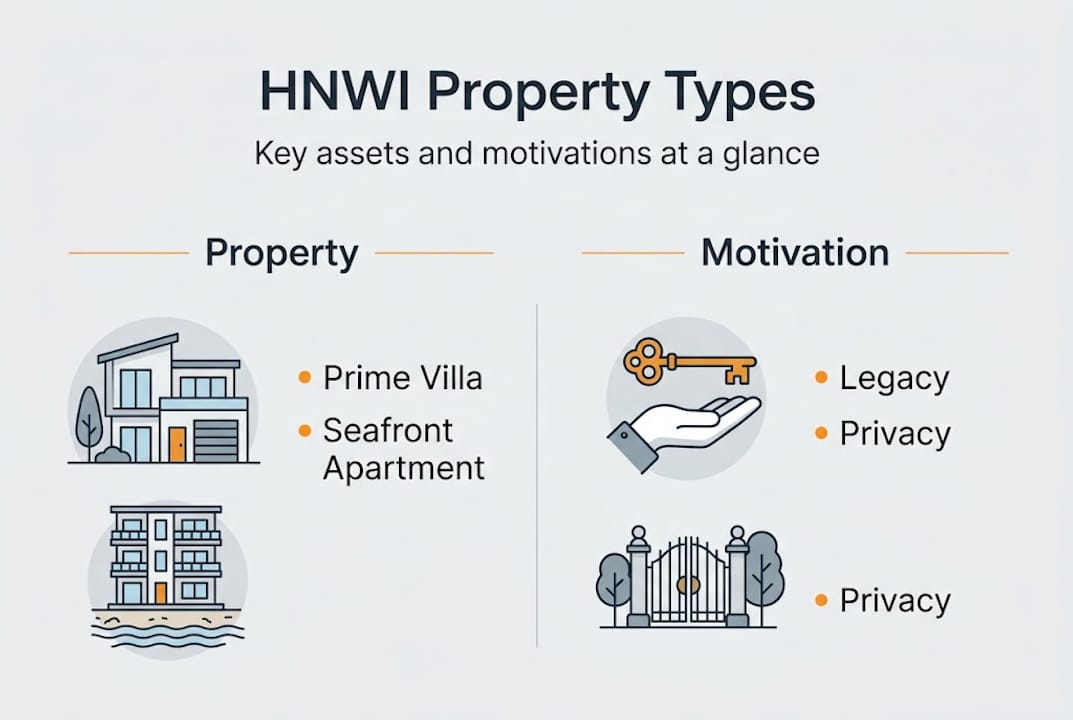
| Property type | Buyer profile | Primary motivation | Typical value range |
|---|---|---|---|
| Prime villa | HNWI | Lifestyle and capital growth | €2M to €10M |
| Legacy estate | UHNWI | Generational transfer | €10M and above |
| Standard luxury flat | Affluent buyer | Rental yield | €500K to €2M |
| Eco-certified residence | HNWI/UHNWI | Sustainability and retention | €3M to €15M |
The motivations of HNW buyers are equally varied. Some seek privacy, drawn to Cap d’Antibes’ secluded coastal sentiers or the hushed lanes of Menton near the Italian border. Others prioritise prestige, acquiring Monaco-adjacent plots where address alone carries extraordinary value. Many, particularly family offices, are guided by emerging luxury market intelligence, identifying locations before demand peaks.
The Côte d’Azur commands a 22.7% share of Europe’s luxury real estate market, a figure that reflects both the region’s enduring prestige and the structural scarcity of its finest addresses. Understanding luxury buyer trends reveals that buyers in 2026 are increasingly motivated by long-term value rather than short-term yield, reshaping how the finest properties are priced, positioned, and acquired. Tracking luxury market trends on the Riviera is essential for any investor seeking to act with precision.
Capital preservation and legacy: Why location and exclusivity matter
For family offices and generational investors, the Côte d’Azur is not merely a beautiful place to own property. It is one of the most reliable instruments of capital preservation available anywhere in the world. French Riviera luxury assets prioritise capital preservation over yield, a philosophy that distinguishes this market from yield-chasing strategies in less resilient locations.

The logic is elegant in its simplicity. Fixed supply, relentless international demand, and a lifestyle proposition that transcends economic cycles create an environment where values hold firm even when broader markets falter. Appreciation driven by scarcity and HNWI demand consistently outperforms standard residential benchmarks, with prime Riviera properties appreciating between 5% and 8% annually over the long term.
| Investment type | Annual appreciation | Volatility | Legacy suitability |
|---|---|---|---|
| Riviera prime villa | 5% to 8% | Low | Excellent |
| European luxury flat | 3% to 5% | Medium | Good |
| Global REIT | 4% to 7% | High | Limited |
| Monaco-adjacent plot | 6% to 10% | Very low | Outstanding |
Legacy planning on the Riviera follows a clear hierarchy of priorities:
- Acquire in locations with structural scarcity, such as Cap d’Antibes or the Monaco border.
- Prioritise properties with architectural distinction and historical provenance.
- Structure ownership through tax-efficient vehicles suited to cross-border wealth transfer.
- Generate 3% to 5% annual yields through elite seasonal lets during Cannes Film Festival, regattas, and summer.
- Reinvest rental income into property improvements that enhance long-term capital value.
Exploring wealth preservation tips specific to the Riviera reveals strategies that mainstream financial advisers rarely discuss. Our annual growth guide outlines how to position acquisitions for maximum resilience across market cycles.
“The finest Riviera estates are not purchased. They are inherited, curated, and passed forward as living expressions of a family’s values.”
Pro Tip: When evaluating a Riviera property for legacy purposes, assess the ratio of land value to build value. In prime coastal zones, land scarcity means the land itself often represents 70% or more of total value, making it far more resilient than the structure above it. This insight shapes how to invest in Riviera real estate with genuine long-term confidence.
Sustainability and eco-features: Enhancing value retention
Sustainability has moved from a desirable feature to a defining criterion in high-net-worth real estate. Sustainable properties are increasingly demanded by HNWIs, with eco-certified assets demonstrating superior long-term value retention compared to conventionally built equivalents. This is not simply an ethical preference. It is a financial imperative.
The Côte d’Azur’s 2026 new-build renaissance reflects this shift vividly. Sainte-Maxime’s beachside residences, steps from Nartelle’s golden sands, incorporate solar arrays, geothermal heating, and biophilic design principles as standard. Nice’s Mont Boron developments offer panoramic sea views alongside LEED-equivalent certifications that future-proof asset values for decades. Eco-features now enhance legacy and resilience in ways that purely aesthetic upgrades cannot replicate.
The most sought-after sustainable features in 2026 include:
- Solar energy systems integrated into roof and facade design without compromising architectural beauty
- Geothermal heating and cooling, reducing energy dependence and operational costs significantly
- Rainwater harvesting and greywater recycling systems, particularly valued in the Riviera’s warm climate
- LEED or HQE certification (Haute Qualité Environnementale, France’s leading green building standard)
- Smart home energy management platforms that monitor and optimise consumption in real time
- Native landscaping using drought-resistant Mediterranean species, reducing water use and maintenance costs
Finding the perfect Riviera property now means understanding how these features interact with local planning regulations and resale dynamics. The key Riviera features that drive value retention are increasingly those that align financial performance with environmental responsibility.
Pro Tip: Many buyers focus on visible eco-features such as solar panels while overlooking insulation standards and thermal performance ratings. A property with superior thermal mass and passive cooling, common in well-restored Provençal stone architecture, can outperform a modern eco-certified build on both energy costs and lasting real estate value over a 20-year horizon.
Edge cases: Hybrid uses, privacy, and institutional scenarios
Not every high-net-worth acquisition fits a neat template. Some of the most sophisticated ownership structures on the Côte d’Azur operate at the intersection of income generation, privacy, and institutional purpose. Hybrid ownership models combine revenue generation with privacy, and institutional use for foundations, creating asset configurations that standard real estate frameworks rarely address.
Consider the following real-world scenarios that illustrate the breadth of high-net-worth property utilisation:
- The privacy estate: A UHNWI acquires a secluded Cap d’Antibes villa primarily for personal security and discretion. The property generates no rental income but appreciates steadily, functioning as a private reserve of capital outside the financial system’s visibility.
- The foundation asset: A family office transfers a Menton estate into a philanthropic foundation structure. The property hosts cultural events during the Lemon Festival season, generating goodwill and tax advantages while preserving the asset within the family’s broader wealth architecture.
- The hybrid income property: A Cannes penthouse overlooking the Croisette operates as a private residence for 4 months annually and a premium short-let during the Film Festival and MIPIM, generating yields that offset carrying costs entirely.
- The institutional portfolio holding: A sovereign wealth fund acquires a portfolio of Saint-Tropez villas near Pampelonne, managed as a collective asset for senior personnel accommodation and client entertainment, with values tracked separately from liquid holdings.
These scenarios share a common thread. Illiquid property assets are frequently excluded from formal net worth calculations, meaning the true wealth represented by a Riviera estate often exceeds what financial statements reveal. Exploring prime Riviera investment examples illuminates how sophisticated buyers structure these arrangements for maximum efficiency.
“Privacy is not merely a lifestyle preference for HNWIs. It is a strategic asset class in its own right, one that commands a premium no yield calculation can fully capture.”
Understanding the full range of real estate strategies available to institutional and private buyers is essential before committing to any single ownership model.
Why legacy, sustainability, and privacy redefine luxury real estate
We have observed, across years of curating the finest Riviera acquisitions, that the investors who build the most enduring wealth are rarely those chasing the highest short-term yield. They are the ones who ask a different question entirely: what will this property mean to my family in 30 years?
The mainstream real estate conversation remains fixated on yield metrics and market timing. Yet luxury real estate at the highest level operates on a different logic. Capital preservation and sustainability trends consistently outpace short-term income strategies over a decade or more. Privacy, so often treated as a lifestyle amenity, is in fact a structural value driver that insulates assets from speculative volatility.
Our contrarian view is this: legacy first, yield second. A Provençal mas restored to architectural perfection near Antibes, or a sea-view estate above Èze where the salt-kissed air carries the scent of wild rosemary, will outlast any yield-optimised investment strategy. The stone endures. The view endures. The family memory endures. That is the true measure of a high-net-worth acquisition.
Explore luxury investment opportunities on the Côte d’Azur
We invite you to move beyond the theoretical and into the tangible. Our curated portfolio of French Riviera villas and penthouses spans the most prestigious addresses on the coast, from Monaco’s gilded borders to Saint-Tropez’s sun-drenched Vieux Port. Each listing is selected for its legacy potential, capital resilience, and lifestyle distinction. For those ready to structure a Riviera legacy acquisition with precision and confidence, our specialists are available to guide every step. Explore our luxury portfolio essentials and discover how the Côte d’Azur can become the cornerstone of your family’s enduring wealth story. We also accept cryptocurrency payments, making access as seamless as the lifestyle itself.
Frequently asked questions
How are high-net-worth real estate assets classified?
They are classified by targeting HNWIs with liquid assets over $1 million and UHNWIs over $30 million, typically located in prime areas such as the Côte d’Azur where scarcity and prestige underpin sustained value.
Why do high-net-worth individuals prefer legacy and capital preservation?
Legacy and capital preservation reduce volatility and favour long-term family wealth over short-term yield. French Riviera assets prioritise this approach, making them particularly resilient across economic cycles.
Does sustainability increase ROI in luxury real estate?
Yes. Sustainable properties attract growing HNWI demand, with eco-certified assets demonstrating superior long-term value retention and stronger appeal to legacy-focused buyers.
What are hybrid ownership models in high-net-worth real estate?
Hybrid models combine privacy with revenue generation or institutional uses for foundations, and often exclude illiquid property assets from formal net worth calculations, making them highly flexible wealth instruments.
Recommended
 //
//