
TL;DR:
- Reputation functions as invisible equity that enhances access and reduces risks in luxury real estate investments.
- Building and verifying genuine reputation through thorough due diligence and credible professionals is essential for safeguarding long-term value.
There is a persistent illusion in luxury real estate: that the finest address and the highest price tag together constitute a safe, enduring investment. Sophisticated investors on the French Riviera know that this is rarely the whole story. What separates a trophy asset that appreciates gracefully across generations from one that quietly disappoints is something far subtler and far more powerful. Reputation functions as invisible equity, accelerating access to capital and counterparties in ways that price alone never can. Understanding this changes everything about how you invest.
Table of Contents
- Why reputation is ‘invisible equity’ in luxury real estate
- How reputation protects buyers: due diligence and credible processes
- Can reputation signal real value? Empirical evidence and sentiment effects
- What happens when reputation is damaged? Risks and legacy impact
- Building and verifying reputation: a practical framework for discerning investors
- Why reputation is the undervalued driver of Riviera legacy
- Discover legacy investment opportunities on the Riviera
- Frequently asked questions
Key Takeaways
| Point | Details |
|---|---|
| Reputation is invisible equity | A trustworthy reputation gives buyers and sellers critical leverage and access in high-stakes property deals. |
| Risk is reduced by credible process | Engaging reputable professionals and proven due diligence minimises legacy and investment risks. |
| Reputation moves property values | Market evidence confirms that sentiment and reputation measurably affect long-term housing prices. |
| Damage persists across generations | Negative reputation shocks can cause lasting value loss that impacts future family wealth. |
| Assessment must be systematic | Investors should use a framework to check reputation alongside legal and financial fundamentals for true legacy security. |
Why reputation is ‘invisible equity’ in luxury real estate
With preconceptions about value set aside, it is time to look at reputation as the true engine driving outcomes for those who invest at the highest level of the market.
“Reputation operates as ‘invisible equity’ that accelerates access to capital and counterparties; it functions as a form of relational leverage in deal execution.”
This insight reframes the entire conversation. On the Côte d’Azur, where a golden-stone villa above Èze commands eye-watering sums and a penthouse facing Cannes’ shimmering Croisette changes hands in hushed negotiations, reputation is the currency that opens doors before a price is even mentioned. A buyer known for swift, clean completions receives early calls about off-market estates. A seller whose provenance is well-documented attracts competing offers from credible investors worldwide. The deal, in short, is shaped before the formalities begin.
Reputation delivers several concrete advantages:
- Access to off-market opportunities not listed on public portals, often representing the finest properties at the most competitive terms.
- Trust that accelerates timelines, reducing the friction of negotiations in a market where speed genuinely matters.
- Relational introductions through curated networks, connecting buyers with the most credible legal, technical, and financial professionals.
- Protection against costly errors, because reputable counterparties have more to lose from a flawed transaction than from walking away.
We have witnessed, time and again, how lasting relationships in luxury real estate translate directly into preferential terms and privileged access. The buyers who cultivate genuine reputations, who transact with integrity and respect process, consistently outperform those who treat each deal as a purely transactional event. Working with boutique luxury agencies that carry their own impeccable standing is itself a reputational signal, one that opens further doors.
How reputation protects buyers: due diligence and credible processes
If reputation is an asset, then its most tangible expression lies in the rigour it demands from every professional involved in a high-value transaction.
When you are purchasing an estate near Cap d’Antibes or a contemporary villa above the lemon-scented lanes of Menton, the complexity of French property law is formidable. Notaires, avocats, structural engineers, and agents each carry their own professional standing, and that standing directly determines the quality of the due diligence you receive. Hidden legal and technical issues can become the buyer’s responsibility after commitment, which is precisely why the credibility of everyone around the table matters so profoundly.
Here is a practical, step-by-step approach to evaluating the reputational quality of any transaction:
- Verify the professional provenance of every adviser. Confirm bar registrations, notarial credentials, and agency licences. Ask for references on comparable transactions, not testimonials, but traceable completions.
- Demand documented process transparency. Reputable teams produce clear, sequenced due diligence reports covering title clarity, planning history, structural integrity, and any encumbrances on the land.
- Confirm that legal and technical reviews are coordinated, not siloed. A reputable transaction has an avocat and notaire who speak to one another and to the structural surveyor. Gaps in this coordination are warning signals.
- Scrutinise the property’s documented history. Planning permissions, renovation records, and any prior disputes should be fully accessible and presented proactively by a credible seller.
- Assess the agency’s standing in the market. Ask how long they have operated in this specific locale, who their repeat clients are, and whether they maintain the importance of experienced buyer agents as a standard of service.
Pro Tip: Do not mistake marketing polish for substantive risk protection. A beautifully produced brochure and a digitally flawless presentation are not substitutes for rigorous legal and technical review. We have seen stunning properties with elegant marketing that concealed unresolved planning disputes. The credibility of the process, and the people running it, is your real protection. High-value real estate curation must always be matched by equally rigorous process.
Can reputation signal real value? Empirical evidence and sentiment effects
Understanding the process is only half the equation. The more compelling question for the discerning investor is whether reputation can be measured in financial terms, whether it genuinely moves the price.
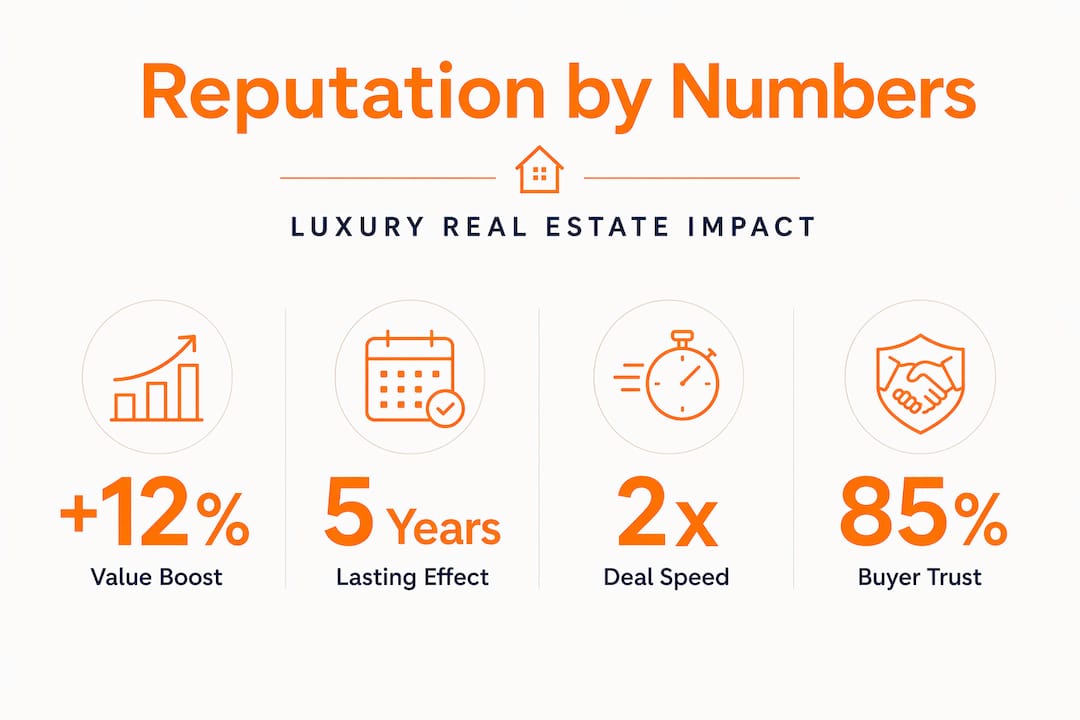
The answer, supported by robust research, is yes. Combining residents’ sentiment with rating scores meaningfully improves the predictive power of housing valuation models, with sentiment variables remaining statistically significant even after controlling for the physical characteristics of a property such as size, age, and amenities. This is a finding that should change how you think about any acquisition.
| Reputation factor | Impact on valuation | Duration of effect |
|---|---|---|
| Positive community sentiment | Measurable price premium | Medium to long term |
| High professional credibility | Faster deal closure, fewer price reductions | Per transaction |
| Negative sentiment signals | Persistent price discount | Can extend years |
| Verified provenance and process | Reduced buyer risk premium | Ongoing |
On the Côte d’Azur, this plays out in specific, observable ways. The villages of Èze and Saint-Jean-Cap-Ferrat consistently command premiums not solely because of their physical beauty, but because decades of curated residency and well-managed community reputation have created a self-reinforcing cycle of prestige. A property in a locale where neighbours are credible, where local governance is respected, and where the social fabric is admired by global elites, will always command a premium over a comparable property in a locale without that standing.
Statistic worth noting: Studies confirm that sentiment variables, even when extracted from text-based community reviews, contribute independently to housing price explanations after all physical variables are controlled. This is not soft data. It is measurable, persistent, and increasingly incorporated into sophisticated property valuation on the Riviera. For the investor whose horizon spans multiple generations, understanding this dynamic is not optional. It is essential.
What happens when reputation is damaged? Risks and legacy impact

Whereas positive reputation signals drive exceptional returns, negative ones carry consequences that extend far beyond a single transaction.
The academic evidence here is striking. Reputational shocks are priced into luxury real estate and, critically, these effects persist over time. This is not merely about brand association. It is about how a property’s reputation, tied to its owner, its history, or its locale, can sustain a measurable discount that proves stubbornly difficult to reverse.
“Reputation risk should be treated as a material risk factor in valuation and risk management, not a peripheral concern.”
Consider how this translates to a generational inheritance scenario. If you acquire a celebrated estate above the Pampelonne coastline of Saint-Tropez or a Provençal mas near Antibes, its value to your heirs is partly the stone, the views, and the legal title, but also the story that surrounds it. A property associated with controversy, unresolved disputes, or declining community standing carries that shadow forward.
| Scenario | Without reputation risk analysis | With reputation risk integrated |
|---|---|---|
| Pre-acquisition | Price taken at face value | Sentiment and provenance assessed alongside financials |
| Ownership period | Vulnerability to unforeseen discounts | Active reputation monitoring protects yield |
| Legacy transfer | Risk passed to heirs | Clean provenance enhances inheritance value |
| Distressed sale | Compounded by reputational discount | Mitigated through documented credibility |
Practical steps for managing this risk are straightforward but frequently overlooked:
- Include a formal reputation assessment, covering community sentiment, ownership history, and any litigation history, within your due diligence framework.
- Engage advisers who understand both the financial and the social dimensions of a property’s standing.
- Review the luxury investment risk types relevant to Riviera acquisitions, because reputational exposure belongs alongside legal and structural risks, not beneath them.
Pro Tip: When assessing an estate, research the history of its previous owners and any public controversies attached to the property or its immediate neighbours. A single unresolved planning dispute or a well-publicised ownership scandal can create a discount that persists for years, even after the underlying issue is technically resolved. The impact of valuation after shocks is rarely immediate; it compounds quietly.
Building and verifying reputation: a practical framework for discerning investors
Given the potential for both upside and material risk, the final step is to operationalise reputation assessment in every transaction.
We recommend a three-stage evidence-based system, drawing on the most rigorous methodology for evaluating reputation available to high-net-worth investors. The framework treats reputation not as a feeling or an impression, but as a structured body of evidence assembled before commitment.
- Provenance of all counterparties. Verify the ownership history of the property, the professional credentials of agents and advisers, and the track record of any developer if the acquisition involves a new build. For off-market acquisitions, this is especially important, as the absence of public scrutiny means the burden of verification rests entirely with you.
- Documented process quality in due diligence. Insist on written records of every stage: title searches, planning audits, structural surveys, environmental assessments, and tax clearance. Reputable professionals produce these as a matter of course. Those who resist or minimise this step are communicating something important about their own standards.
- Measurable trust signals. Review community sentiment data for the locale, assess the property’s rental yield history if applicable, and seek references from professionals who have completed transactions in that micro-market. For an off-market reputation guide, these signals are often the most reliable indicators of genuine value.
Weaving these three elements together produces a reputation profile that is evidence-backed, not impression-led. For an investor protecting generational wealth, this rigour is not overcaution. It is the standard that separates enduring legacy from expensive regret.
Pro Tip: Weight reputation as one pillar alongside financial analysis and technical due diligence, not as a replacement for either. The most astute investors we work with treat reputation as a lens that focuses and sharpens their other investigations, not as a shortcut past them.
Why reputation is the undervalued driver of Riviera legacy
We observe, across years of working with some of the world’s most discerning buyers, a consistent blind spot: sophisticated investors who apply forensic rigour to financial projections yet treat reputation as a qualitative afterthought.
The contrarian reality is that reputation influences both pricing and access in ways that can be confounded with other fundamentals, which is precisely why it requires its own structured framework rather than a cursory glance. Surface-level reputation, a celebrated address or a well-known former owner, is not the same as deep, documented credibility. The former can disguise risk; the latter actively reduces it.
For those building real estate legacy and ROI across generations, this distinction is everything. The lavender-laced hills above Grasse, the salt-kissed corniche estates of Cap d’Antibes, the sun-drenched terraces of Nice’s Mont Boron, each of these carries a reputation that is layered, textured, and partly invisible to those who have not spent years navigating this market. We have. And what we know with conviction is this: the investors who build multi-generational fortunes on the Côte d’Azur are those who treat reputation not as a marketing narrative, but as a pillar of their investment philosophy, examined, verified, and actively managed.
Conventional due diligence checklists rarely include a reputation audit. We believe that is a systemic oversight, and one that the most prescient buyers are beginning to correct.
Discover legacy investment opportunities on the Riviera
For those who recognise the decisive role that reputation plays in every dimension of a Riviera acquisition, the next step is access. We offer precisely that: curated, reputation-assured introductions to invisible luxury real estate that never reaches the public market, guided by advisers whose own standing in this community is their most valuable asset. Whether your vision is a Provençal estate to anchor three generations or a contemporary penthouse facing the Lérins islands, our French Riviera investment guide provides the strategic foundation, while our curated portfolio of French Riviera villas and penthouses offers the finest expressions of enduring value. We accept cryptocurrency payments, and we welcome visionaries who understand that the finest properties are not bought, they are earned through the right relationships.
Frequently asked questions
What makes reputation so critical when investing in French Riviera real estate?
Reputation accelerates access to capital and counterparties, speeds up complex negotiations, and protects high-value transactions from unseen risks that price and location alone cannot guard against.
How can I verify a property’s or agency’s reputation?
Treat it as an evidence-backed system: check the provenance of all counterparties, demand fully documented due diligence, and assess measurable trust signals including local sentiment data and verifiable professional reviews.
What are the dangers of ignoring reputation in property investment?
Ignoring reputation can expose you to long-lasting value loss, because reputational shocks persist over time and create discounts that compound quietly, potentially undermining the generational legacy your investment was designed to protect.
Does a strong reputation guarantee higher property values?
A strong reputation is a proven driver of value, but reputation can be confounded with other fundamentals; always integrate reputational assessment alongside location, legal clarity, and technical quality for a complete and reliable investment picture.
Recommended
 //
//