
TL;DR:
- Proper maintenance of luxury assets involves regular, expert-led routines that protect their condition and value over time. Strategic ownership structures and independent advisory work together to ensure long-term preservation and efficient management.
Luxury asset maintenance is defined as the structured, specialist care of high-value possessions, including property, vehicles, yachts, and watches, to preserve their condition, performance, and market worth over time. Knowing how to maintain luxury assets is not simply a matter of keeping things clean. It requires preventive routines, expert partnerships, and ownership structures that protect value across generations. The discipline that separates a well-preserved Côte d’Azur villa from a depreciating one, or a collectable timepiece from a worn trinket, is consistency. We have seen, time and again, that owners who treat maintenance as a fixed commitment rather than a reactive expense protect both their enjoyment and their investment.
What essential maintenance routines are required for luxury properties?
Luxury property maintenance demands a level of rigour that standard residential upkeep simply does not require. Annual professional inspections of structural elements, roofing, HVAC systems, and plumbing form the non-negotiable baseline. Neglecting small issues, such as cracked roof tiles or blocked HVAC filters, causes water intrusion and accelerates deterioration in ways that are costly and sometimes irreversible.
Seasonal and specialist care
A seasonal maintenance schedule keeps a luxury property performing at its best throughout the year. Spring and autumn are the natural moments to service pools, irrigation systems, and landscaping. Smart home systems and security infrastructure require their own annual audit, ideally conducted by the original installer or a certified specialist.
The materials found in prestige properties demand particular attention. Natural stone and hand-finished plaster require specific cleaning agents and humidity controls that differ entirely from standard household products. Using the wrong cleaner on Calacatta marble or a lime-washed wall can cause irreversible surface damage and trigger repair costs that dwarf the original maintenance budget.
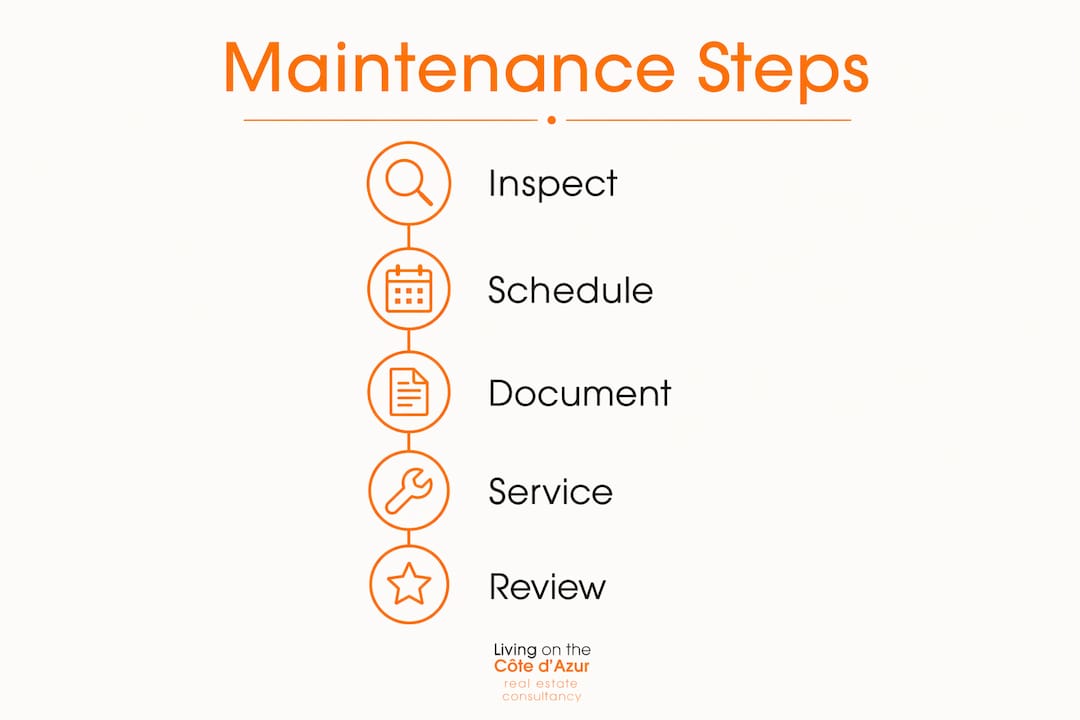
A structured seasonal checklist for luxury property owners includes:
- Structural and roofing inspection every spring, carried out by a licensed surveyor
- HVAC servicing twice yearly, including filter replacement and refrigerant checks
- Pool and irrigation audit before and after the summer season
- Smart home and security system review annually, with firmware updates applied
- Landscaping programme aligned to the local climate, particularly relevant on the Côte d’Azur where Mediterranean summers stress irrigation systems
Budgeting and documentation
Treat maintenance as a fixed annual cost rather than a discretionary one. Owners who defer repairs to protect short-term cash flow consistently face larger bills later. Consistent record-keeping of every inspection and repair adds measurable resale value and simplifies future planning. A documented maintenance history signals diligence to appraisers, insurers, and prospective buyers alike.
Pro Tip: Keep a dedicated digital folder for each property, organised by year and trade, containing invoices, inspection reports, and photographs. This single habit transforms your maintenance history into a tangible asset at the point of sale.
How should luxury vehicles be maintained to sustain performance and value?
Luxury vehicle care depends on one principle above all others: follow the manufacturer’s prescribed service intervals without exception. Delaying service risks masking hidden mechanical or software failures that escalate maintenance costs dramatically. A vehicle that feels fine is not necessarily performing within its designed tolerances.

Mechanical and diagnostic servicing
Modern prestige vehicles, whether a Bentley Continental, a Porsche 911, or a Ferrari 812, require manufacturer-level diagnostics that independent generalist garages cannot replicate. Specialist fluid specifications matter enormously. Using an incorrect transmission fluid in a dual-clutch gearbox, for example, can shorten component life by years. Routine servicing for luxury vehicles should cover:
- Engine oil and filter changes at manufacturer-specified intervals, using approved grades
- Brake system inspection, including caliper condition and fluid moisture content
- Suspension geometry check annually or after any significant road impact
- Software diagnostics at every service visit to identify fault codes before they become failures
- Tyre condition and pressure monitoring, with replacements sourced from approved suppliers
Exterior and interior care
Paint protection is a long-term investment. Ceramic coating applied by a specialist detailer provides durable protection against UV degradation and minor abrasion. Avoid automatic car washes entirely. The brushes and chemicals used in standard facilities are incompatible with the clear coats and specialist finishes found on prestige vehicles.
Interior care for leather and Alcantara requires dedicated products. Conditioning leather every three to four months prevents cracking and maintains the suppleness that defines a premium cabin. For wood veneers and carbon fibre trim, use only pH-neutral, non-abrasive cloths.
Pro Tip: Establish a relationship with one authorised service centre and one specialist detailer, and stay loyal to both. Continuity of care means technicians know your vehicle’s history, and that knowledge prevents misdiagnosis.
What are the best practices for maintaining luxury yachts and vessels?
A multi-million-pound yacht is simultaneously a high-performance engineering platform and a hospitality venue. Yacht maintenance requires a planned maintenance matrix that tracks both calendar time and engine hours, rather than responding to problems as they arise. Reactive repairs on a vessel of this complexity are invariably more expensive and more disruptive than scheduled prevention.
A structured maintenance framework
The most effective approach to yacht upkeep follows a four-tier structure:
- Daily checks covering engine oil levels, bilge condition, battery charge, and navigation light function
- Weekly inspections of running rigging, deck fittings, and freshwater systems
- Seasonal haul-out for hull cleaning, antifouling application, and underwater gear inspection
- Annual full service covering engines, generators, watermakers, electronics, and safety equipment
Using formal planned maintenance software such as IDEA YACHT or Seahub transforms this framework from a paper exercise into an auditable record. These platforms log service intervals, defect reports, and crew actions in real time. That audit trail is invaluable when renewing insurance, preparing for a survey, or presenting the vessel for sale.
Documentation and specialist coordination
| Maintenance area | Frequency | Specialist required |
|---|---|---|
| Engine and generator service | Annual or by hours | Authorised marine engineer |
| Hull antifouling | Annual haul-out | Boatyard with lift facilities |
| Electronics and navigation | Annual | Certified marine electronics technician |
| Safety equipment (flares, rafts) | Per manufacturer schedule | Certified safety equipment service |
| Rigging inspection | Annual or after heavy weather | Rigging specialist |
Pro Tip: Coordinate your annual haul-out with your insurance renewal date. A clean survey report submitted alongside your renewal often reduces your premium and demonstrates the vessel’s condition to underwriters.
How to care for luxury watches and precious items to preserve condition and market value
Preserving high-end assets like a Patek Philippe or an A. Lange & Söhne requires a discipline that is more restrained than most owners expect. Complete professional servicing every 3–5 years is the standard recommendation from luxury watch specialists. That interval ensures mechanical precision and moisture resistance remain within the manufacturer’s tolerances.
The case against over-polishing
The most common and costly mistake in watch care is excessive polishing. Over-polishing removes microscopic layers of original metal, permanently altering the case geometry and diminishing collector value. A watch with its original brushed surfaces and sharp lugs is worth considerably more to a serious collector than one that has been polished to a mirror finish. Mechanical integrity always takes precedence over cosmetic refinishing.
Daily habits and safe storage
The way you wear and store a watch matters as much as formal servicing. Practical care habits include:
- Avoid water exposure beyond the watch’s stated water resistance rating, which degrades with age even on water-resistant models
- Remove the watch before contact sports, heavy lifting, or any activity involving magnetic fields, such as proximity to loudspeakers or MRI equipment
- Store in a watch winder only for automatic movements that benefit from continuous motion; manual-wind and quartz pieces are better stored flat in a dry environment
- Clean gently with a soft, lint-free cloth after daily wear to remove skin oils and perspiration
- Keep original boxes and papers separate from the watch itself to preserve their condition; original documentation significantly preserves market value
Warning signs that indicate immediate professional servicing include: a crown that feels loose or gritty, a seconds hand that stutters, condensation visible beneath the crystal, or a movement that gains or loses more than a few seconds per day.
Pro Tip: Never send a collectable watch for polishing unless a specialist has confirmed it adds value in that specific case. The default answer is almost always no.
How does expert advisory and specialist ownership structures optimise luxury asset maintenance?
The physical care of luxury assets is only one dimension of preservation. The strategic dimension, covering ownership structures, tax planning, and independent advisory, determines whether that care translates into lasting financial value. This is where luxury asset management and what is known as passion asset advisory become indispensable.
The role of passion asset advisory
Private passion asset advisory offices provide independent, conflict-free advice working solely on the client’s mandate. They hold no inventory and push no sales. This distinction matters profoundly. A dealer advising on a watch purchase has a financial interest in the transaction. An independent advisory office has only one interest: yours. Owners benefit most from advisors who represent no one but them, and who bring specialist knowledge across property, vehicles, yachts, and collectables under one coordinated framework.
Ownership structures that protect value
Specialist ownership structures such as trusts, corporate vehicles, and special purpose vehicles (SPVs) are critical for efficient luxury asset management, succession, and tax optimisation. Expert administrators coordinate legal, tax, and governance functions to safeguard long-term asset viability. For a Côte d’Azur villa held across generations, the difference between a well-structured SCI and an unplanned direct ownership can amount to hundreds of thousands of euros in succession costs.
“The most effective luxury asset owners treat their portfolio like a business: with governance, documentation, and independent oversight. Physical maintenance without strategic administration is only half the picture. The two disciplines reinforce each other, and neither is optional for owners who are serious about preserving what they have built.”
Key benefits of integrating advisory with ownership structures include:
- Tax efficiency through appropriate holding vehicles aligned to your residency and succession intentions
- Liability management by separating high-value assets from personal balance sheets
- Succession clarity through pre-agreed governance that avoids family disputes and forced sales
- Insurance alignment ensuring coverage reflects current valuations and usage patterns
- Continuity of care when assets pass between generations or are placed under professional management
Livingonthecotedazur works with clients to align luxury property portfolios with precisely these structures, ensuring that the physical and administrative dimensions of ownership work in concert.
Key takeaways
Maintaining luxury assets requires consistent, specialist-led physical care combined with well-structured ownership and independent advisory to preserve both condition and long-term value.
| Point | Details |
|---|---|
| Annual inspections are non-negotiable | Structural, HVAC, and specialist material checks prevent costly deferred repairs on luxury properties. |
| Follow manufacturer service intervals | Luxury vehicles require authorised diagnostics and correct fluid specifications; delaying service masks hidden faults. |
| Use planned maintenance systems for yachts | Software-based logs tracking calendar time and engine hours create audit-ready records for insurance and resale. |
| Avoid over-polishing watches | Excessive polishing removes original metal and reduces collector value; prioritise mechanical servicing instead. |
| Combine physical care with strategic ownership | Trusts, SPVs, and independent advisory protect tax efficiency, succession, and long-term asset viability. |
What I have learned about maintaining luxury assets over the years
The owners I respect most share one trait: they treat maintenance as a discipline, not a chore. They do not wait for something to break. They build relationships with the right specialists before they need them, and they document everything.
What surprises many first-time luxury property owners on the Côte d’Azur is how quickly deferred maintenance compounds. A missed HVAC service in spring becomes a failed system in August, at the height of the rental season or a family gathering. A cracked terrace tile left unaddressed allows water into the substrate, and by winter the repair bill has multiplied. The Mediterranean climate is glorious, but it is not forgiving of neglect.
The same principle applies to vehicles and watches. I have seen a Rolex Daytona lose a significant portion of its collector premium because a previous owner polished it twice. The case geometry was altered. The original surfaces were gone. No amount of mechanical servicing could restore what the polishing cloth removed. That lesson, once understood, changes how you approach every asset in your care.
The strategic dimension is where I see the most consistent gaps. Owners invest in the physical care of their assets but leave the ownership structure unexamined for years. An SCI set up in 2005 may no longer reflect current tax law, your family situation, or your succession intentions. Independent advisory, the kind that holds no inventory and earns no commission, is the most underused resource available to high-net-worth owners. The advantages of holding luxury assets for legacy are real, but only when the governance around them is equally well maintained.
My honest advice: review your maintenance schedules and your ownership structures in the same annual conversation. They are not separate disciplines. They are two sides of the same commitment to preserving what you have built.
— Ab Kuijer
How Livingonthecotedazur supports luxury property owners
At Livingonthecotedazur, we work with discerning owners and buyers across the Côte d’Azur, from Saint-Tropez to Monaco, to ensure that acquiring a prestige property is only the beginning of a well-managed ownership experience. Our approach integrates legal audits, tax structuring, and financing guidance from the outset, so that the physical and administrative care of your property work together from day one. We connect clients with over 100,000 properties, including off-market Côte d’Azur estates that never reach the open market. For owners focused on legacy and ROI, we offer bespoke guidance that extends well beyond the transaction itself. Contact us to discuss how we can support your property ownership with the depth it deserves.
FAQ
What does luxury asset maintenance actually involve?
Luxury asset maintenance covers structured, specialist care across property, vehicles, yachts, and collectables, combined with ownership structures and independent advisory that protect long-term value.
How often should a luxury watch be professionally serviced?
Luxury watch specialists recommend a complete professional service every 3–5 years to maintain mechanical precision and moisture resistance, adjusted for frequency of use.
What is a passion asset advisory and why does it matter?
A passion asset advisory is an independent office that provides conflict-free advice on luxury assets, working solely on the owner’s mandate with no inventory to sell and no dealer commissions to earn.
Why is documentation so important for luxury property maintenance?
Consistent records of inspections and repairs add measurable resale value, satisfy insurance requirements, and demonstrate diligence to appraisers and future buyers.
What ownership structures best protect luxury assets?
Trusts, corporate vehicles, and special purpose vehicles (SPVs) are the most widely used structures for tax efficiency, liability management, and succession planning across high-value asset portfolios.
Recommended
 //
//