
Whether you can run a compliant Airbnb comes down to three checks, not the purchase price. Before you sign anything, verify the mairie’s registration and night-cap rules, read the règlement de copropriété for letting restrictions, and confirm the property’s DPE energy rating meets the local threshold. If any of these raises doubt, commission a site-specific feasibility check before you exchange, not after.
TL;DR:
- Verifying local registration, copropriété restrictions, and energy ratings before purchasing is essential to ensure compliance for Airbnb operations.
- Different ownership structures, such as LMNP or SCI, impact tax obligations and administrative responsibilities but do not alter letting regulations.
- Owners must continuously track registration numbers, night caps, and changing copropriété rules to stay compliant and avoid platform delistings.
- Running an Airbnb has recurring costs, including higher insurance, management fees, and regulatory upgrades, which can significantly reduce gross yield.
- Conducting a thorough feasibility check before buying helps identify legal obstacles early, saving time and avoiding risky investments.
Table of Contents
- How to manage an Airbnb: feasibility checks before you sign
- Which ownership and tax structure suits your Airbnb?
- Staying compliant once you own the property
- Filing taxes as a non-resident Airbnb owner
- Self-manage, co-host or hire a professional: which model fits?
- Setup and annual checklist for staying audit-ready
- What does an Airbnb actually cost to run each year?
- Riviera and Ibiza rental demand: what the seasons actually look like
- How to vet a professional management company
- Why we push buyers towards a feasibility check first
- How Living On The Cote d’Azur prepares buyers for compliant Airbnb ownership
- Sources
- FAQ
How to manage an Airbnb: feasibility checks before you sign
Learning how to manage an Airbnb on the Riviera or in Ibiza starts long before you own one. The property you fall in love with might be structurally incapable of running as a tourist let, and no amount of clever pricing fixes that.
Start with the mairie. Many communes now require a registration number before a meublé de tourisme can legally advertise, and some apply a full changement d’usage regime that limits how many properties in a building or street can convert to tourist use, depending on local regulations. Service-public’s guidance sets out the declarative steps clearly: declare to the mairie, obtain the registration number where required, supply DPE details, and display that number on every listing.
Next, read the règlement de copropriété line by line, not the summary the agent gives you. Some buildings carry a clause d’habitation bourgeoise that bans commercial activity outright, which makes short-term letting far harder to authorise. Ask the syndic directly rather than relying on the seller’s word.
- Request the commune’s latest deliberation on meublés de tourisme from the mairie
- Ask the syndic for the full règlement de copropriété, not an extract
- Confirm the DPE class and its expiry date
- Ask the notaire to list any pending changement d’usage applications on the building
Pro Tip: Ask the seller for the DPE certificate and the last three years of taxe de séjour filings before you make an offer. Gaps in either tell you more than the sales brochure ever will.
Which ownership and tax structure suits your Airbnb?
Most non-resident owners choose between three fiscal routes, and the choice shapes how much paperwork you carry every year.
LMNP (loueur en meublé non professionnel) is the default for furnished tourist lets. Under the micro-BIC regime you get a flat allowance against rental income, provided turnover stays under the relevant threshold; above it, or if you prefer to deduct real costs, the régime réel applies and requires proper accounting. Either way, you need a SIRET number, obtained via INSEE’s business registration process, before you can legally trade as a loueur en meublé.
Revenus fonciers applies if you let unfurnished, which is rare for Airbnb-style lets but worth knowing. Here the choice is micro-foncier (a flat allowance) versus régime réel (actual deductions).
SCI (société civile immobilière) is popular for inheritance planning and multi-heir ownership, but it does not change the underlying tax regime on furnished letting income and adds its own administrative layer.
- LMNP micro-BIC: simplest, flat allowance, capped turnover
- LMNP régime réel: real deductions, needs bookkeeping
- Revenus fonciers: for unfurnished lets only
- SCI: useful for succession, not a letting tax shortcut
Staying compliant once you own the property
Compliance is not a one-off filing. It is a rolling set of obligations that platforms and mairies increasingly enforce together.
- Display your registration number on every listing; platforms can and do delist adverts that omit it.
- Track night caps carefully. A property let as a primary residence is generally capped at 120 nights a year, though some communes have already lowered that ceiling to 90.
- Check whether changement d’usage compensation rules apply in your commune, since dense zones like parts of Nice or Antibes can require you to “compensate” by converting commercial space elsewhere, a costly and often impractical condition.
- Notify the syndic the moment you receive your registration number. The 2025 ministry guide confirms copropriétés can now vote more easily to restrict or ban tourist lets, so staying on the syndic’s good side matters.
- Carry landlord insurance that explicitly covers short-term commercial letting, not standard home cover.
The ministry guide also flags a detail overseas buyers frequently miss: since the loi Le Meur, communes can request platform data directly, closing the gap that once let quiet non-compliance slide for years.
Filing taxes as a non-resident Airbnb owner
France taxes rental income at source, regardless of where you live. Non-resident owners file through the SIPNR (Service des Impôts des Particuliers Non-Résidents), and getting the regime right from day one saves considerable stress later.
For furnished lets, LMNP status under micro-BIC or régime réel governs your declaration; for unfurnished income, micro-foncier is the equivalent simplified route. The non-resident filing guide walks through both the 2042 and 2044 forms non-residents typically need.
One figure catches almost every first-time owner off guard: non-residents face a 20% minimum tax rate on French-source rental income, with higher bands above certain thresholds. The taux moyen option, which calculates tax based on your worldwide income rate, can work out cheaper than the flat 20% floor, so it is worth running both calculations before you file.
Social levies are a separate question. If you are covered by social security in another EU or EEA state, you may qualify for reduced or exempted social-levy treatment on French rental income rather than the standard charges.
- Register with SIPNR before your first tax year as an owner
- Decide micro-BIC vs régime réel (or micro-foncier vs réel for unfurnished) early
- Compare the 20% floor against the taux moyen option every year
- Keep DPE, insurance, and invoice records ready for audit
Pro Tip: File the same way every year once you choose a regime. Switching between micro-BIC and régime réel repeatedly is one of the fastest ways to trigger SIPNR scrutiny.
Self-manage, co-host or hire a professional: which model fits?
The operating model you choose determines how much of the compliance burden above actually lands on your desk.
Self-managing from abroad saves the most money on paper, but you carry every mairie deadline, DPE renewal, and guest issue personally, often across time zones. It suits owners who visit frequently or have a trusted local contact.
Co-hosting or concierge services sit in the middle. A local co-host handles keys, cleaning, and guest messages for a percentage fee, while you retain responsibility for registration, tax filings, and syndic relations. This fits part-time owners with a smaller apartment rather than a sprawling villa.
Full professional management costs more, typically a larger percentage of turnover, but delivers turnkey compliance handling alongside guest operations. It suits absentee owners of higher-value villas where downtime and compliance slips are expensive mistakes.
- Self-manage: lowest cost, highest personal time and legal exposure
- Co-host: shared load, best for smaller apartments and part-time owners
- Full management: highest cost, best for high-value villas and absentee owners
Our guide to property management for second homes breaks down what each service tier typically includes.
Setup and annual checklist for staying audit-ready
A tidy paper trail is the difference between a five-minute mairie query and a stressful investigation.
- Gather and store centrally: registration number, SIRET, DPE certificate, insurance attestation, and invoices.
- On purchase, request any pending changement d’usage records from the notaire and check the syndic minutes for letting votes.
- Before the first guest, confirm the registration number appears on every listing platform you use.
- Annually, review taxe de séjour filings, DPE re-assessment deadlines, and any new syndic notifications.
- Delegate cleaning, guest messaging, and pricing to a manager if you choose that route; retain personal oversight of tax filings and copropriété votes yourself.
Practitioner guidance consistently recommends a single compliance file per property, covering registration, DPE, SIRET, and insurance together, so nothing gets left in an inbox when a commune asks questions.
Pro Tip: Keep a digital and physical copy of every document. Some mairie offices still expect paper on request, and a missing original slows everything down.
What does an Airbnb actually cost to run each year?
Purchase price is only the entry fee. Running a compliant short-term let carries recurring costs that catch overseas buyers off guard because they rarely appear in the initial sales pitch.
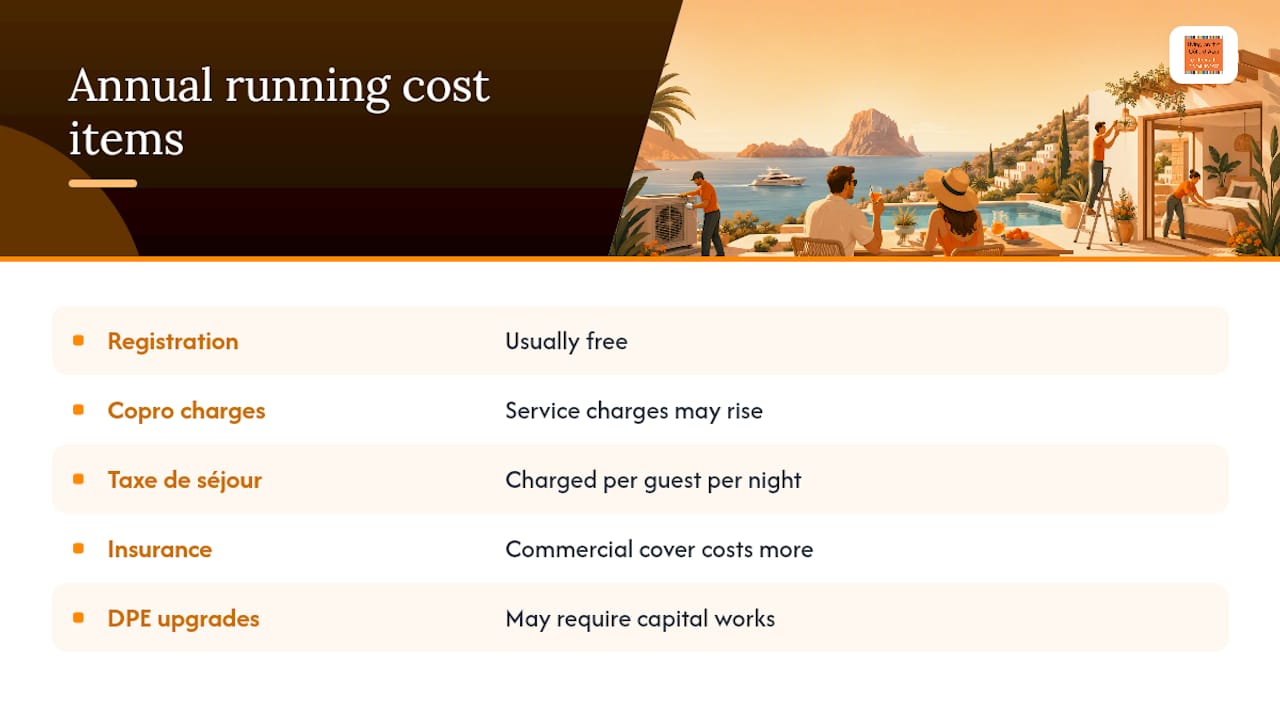
Registration itself is generally free through the mairie or national teleservice, but the surrounding costs add up. Expect syndic and copropriété charges to rise if the building formally permits tourist letting, since some assemblies levy higher service charges on units let commercially. Taxe de séjour is charged per guest per night and collected either by you or automatically by the booking platform, depending on the commune’s arrangement.
Insurance for a commercially let property costs more than standard home cover, reflecting the higher guest turnover and liability exposure. DPE certification and any energy-efficiency works needed to meet the local threshold represent a genuine capital cost, not a paperwork formality. For villas at the upper end of the market, planning DPE upgrade costs into your yield forecast from the outset is sensible, since regulatory floors will progressively exclude poorly rated properties from tourist letting in several zones.
Add management fees, whether that is a co-host’s percentage or a full management contract, plus routine maintenance, cleaning between stays, and utilities that scale with occupancy rather than sitting flat. None of these costs are prohibitive individually, but stacked together they typically shave several percentage points off the gross yield figures quoted in listing brochures. Budget conservatively, and treat any yield projection that ignores these line items with suspicion.
Riviera and Ibiza rental demand: what the seasons actually look like
Short-term letting on the French Riviera is heavily seasonal, and that shapes both your income and your compliance exposure differently across the year.
Demand peaks from June to September, with Cannes, Nice, and Saint-Tropez commanding the highest nightly rates during the summer festival and yachting season. Shoulder months, April through May and October, still generate reasonable bookings around events and mild weather, while winter occupancy drops sharply outside a handful of coastal towns with year-round appeal, such as Nice’s old town.
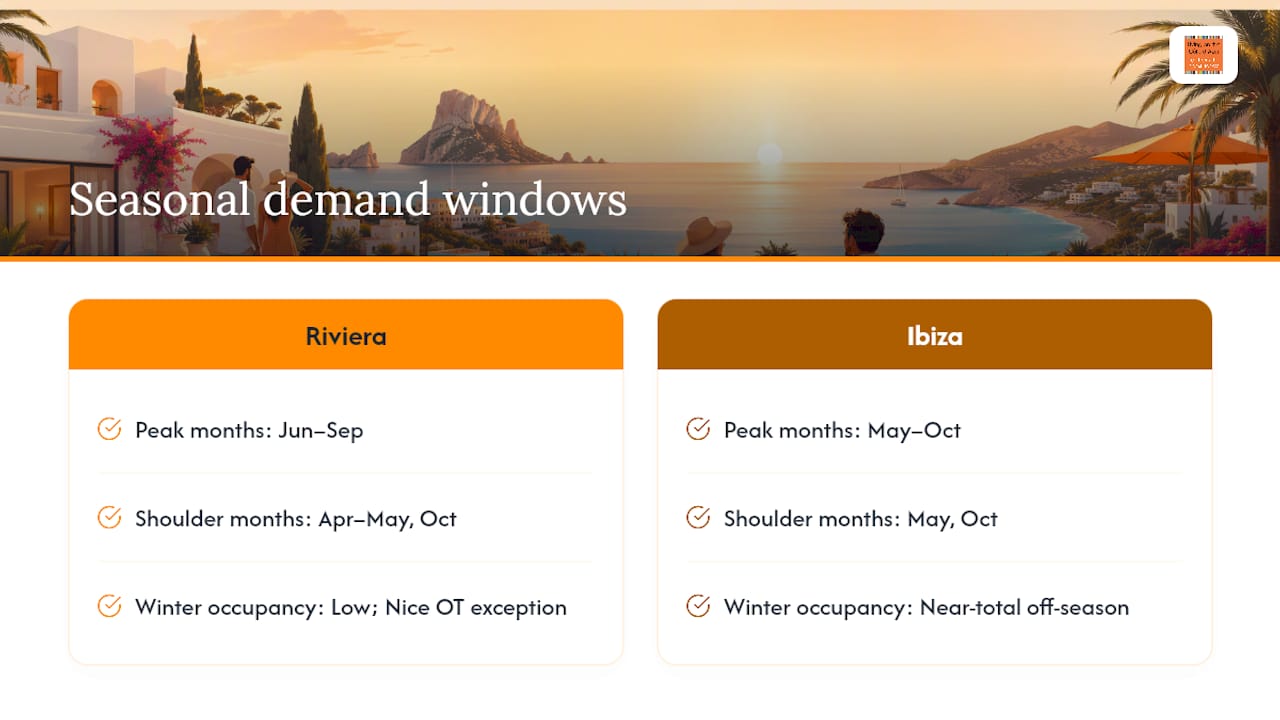
Ibiza follows a similarly compressed pattern, with the bulk of demand concentrated from May to October and a near-total off-season beyond that window. This seasonality matters practically: if your commune applies a 120 or 90 night cap tied to primary-residence status, you need to decide whether to concentrate those nights in peak season or spread them, since either choice affects gross income differently.
Buyers often underestimate how much a location’s micro-market drives occupancy. A villa a short walk from Antibes’ old port fills a different calendar to one requiring a car for every errand. When we search the market for clients, occupancy potential is one of the practical filters applied early, alongside the legal checks, because a legally compliant property that sits empty nine months a year rarely justifies the entry price. Our investment guide by region covers how demand patterns differ across the coast in more depth.
How to vet a professional management company
Choosing a manager is as important as choosing the property, and the wrong choice can undo months of careful feasibility checking.
Start with compliance credentials, not marketing polish. Ask directly whether the company handles mairie registration renewals, DPE tracking, and syndic communication, or whether that stays with you. A manager who cannot answer specifically has likely never dealt with a full compliance file.
Ask for references from owners with a comparable property type, since a company skilled with city apartments may lack the staffing for a large villa with a pool, garden, and higher-touch guest expectations. Request a sample monthly report to see what visibility you actually get into occupancy, income, and maintenance issues.
On contracts, check the fee structure carefully: is it a flat percentage of turnover, a fixed monthly retainer, or a hybrid? Confirm the notice period for termination, who holds guest deposits, and whether cleaning and maintenance are included or billed separately. Ask who is contractually responsible if a compliance breach occurs, such as a missing registration number leading to a fine.
Finally, ask how the company reports tax-relevant figures back to you at year end. A manager who cannot produce clean annual income summaries makes your SIPNR filing harder, not easier. Our note on luxury property management strategies covers additional value-preservation angles worth raising in that conversation.
Why we push buyers towards a feasibility check first
Most of the regulatory friction described above is entirely predictable if you check for it before you buy, and entirely painful if you discover it after. That is the pattern we see repeatedly working as an independent buyer agent across the French Riviera and Ibiza market: a buyer falls for a villa’s view, skips the règlement de copropriété, and only learns about a habitation bourgeoise clause once the notaire flags it weeks before signing.
A feasibility check changes the decision, not just the paperwork. Because Living On The Cote d’Azur searches the entire market through local agents and developers rather than a fixed portfolio, we can compare a property’s legal standing against alternatives before you commit emotionally or financially. If a listing fails the mairie or copropriété test, we simply move to the next one.
— Ab Kuijer
How Living On The Cote d’Azur prepares buyers for compliant Airbnb ownership
Living On The Cote d’Azur works exclusively for you, the buyer, not the seller, which changes how thoroughly a property gets checked before you make an offer. We search across more than 100,000 listings through our network of local agents and developers, filtering out properties with obvious copropriété restrictions or DPE problems before they ever reach your shortlist.
Beyond the search itself, we coordinate viewings, negotiate on your behalf, and connect you with trusted notaires, tax advisers, and renovation specialists who understand meublé de tourisme rules on the ground, not from a generic guide. For buyers weighing self-management against a professional manager, we can also introduce vetted local partners once the purchase closes.
If you are weighing a Riviera or Ibiza purchase against these compliance checks, start with our property search workflow to see how a buyer-first search actually runs, or get in touch for a site-specific feasibility review before you make an offer.
Sources
- Faire de sa résidence secondaire une location de vacances (meublé de tourisme) | Service Public
- GUIDE PRATIQUE 2025 DE LA RÉGLEMENTATION DES MEUBLÉS DE TOURISME
- Short-Term Rental France 2026: Meublé de Tourisme Rules for Hosts
FAQ
Can a foreign owner legally run an Airbnb on the French Riviera?
Yes, but only after confirming the commune’s registration and night-cap rules and checking the règlement de copropriété; some buildings and zones restrict or ban tourist letting outright.
What is the night cap for a primary residence let as Airbnb?
The standard cap is 120 nights a year, though some communes have reduced this to 90 nights under local rules.
Do non-resident owners pay French tax on Airbnb income?
Yes, French-source rental income is taxed in France regardless of residency, generally at a 20% minimum rate, with the taux moyen option sometimes more favourable.
Does an SCI reduce tax on short-term rental income?
No, an SCI mainly helps with succession and multi-owner structuring; it does not change the underlying LMNP or micro-BIC tax regime on letting income.
How does Living On The Cote d’Azur help with feasibility checks?
Living On The Cote d’Azur searches the market on the buyer’s behalf, filtering out properties with copropriété restrictions or compliance problems before they reach a shortlist, and can arrange a site-specific pre-purchase feasibility review.
Recommended
 //
//