
If you love entertaining and want sea views from your own pool, a villa usually fits best. If you dream of thick whitewashed walls, olive groves and genuine Ibizan character, a finca is the natural choice. If low upkeep and town life matter more than space, an apartment tends to win. Legal checks on land status and rental licences can shift what is actually realistic, so we always recommend confirming those before falling in love with a particular property.
TL;DR:
- Before paying a deposit on a finca, verify its rustic classification, existing structures, and permitted extensions; unauthorized work may be impossible to legalize later.
- Check license status directly with Balearic authorities: holiday rental permission depends on zoning, and an existing license may not transfer when the property sells.
- Before buying an apartment, check community fees and building rules, because municipal zoning and complex restrictions can limit holiday rentals.
- A villa’s pool and large garden add water, electricity, and gardening expenses, so set a maintenance budget before committing to a property.
Table of Contents
- What a villa, a finca and an apartment actually are on Ibiza
- Which lifestyle suits each type: a practical checklist for buyers
- Practical buying checks on Ibiza: land, planning and letting licences
- Where on Ibiza is best for villas, fincas or apartments
- How we help buyers choose the right Ibiza property type
- Typical timeline and process stages for buying on Ibiza
- Negotiating price: what changes by property type
- Financing options for international buyers on Ibiza
- Our honest view on choosing between villas, fincas and apartments
- Enquire: buyer agent service for Ibiza searches
- FAQ
- Sources
What a villa, a finca and an apartment actually are on Ibiza
The three property types on Ibiza look different, sit on different land, and come with different obligations once you own them.
A villa is typically a newer build, often with an open-plan layout, a private pool and large glazed spaces that make the most of a coastal or elevated position. Many of the island’s best-known villas sit in the south and west, close to beaches and the marina towns, with modern design prioritising infinity pools and sea-facing terraces. That openness comes at a price: bigger pools and gardens mean higher water, electricity and gardening bills, and a villa usually asks for a full-time or part-time caretaker.
A finca is the traditional Ibizan farmhouse: thick whitewashed walls that keep interiors cool, small windows, wooden beams and rustic stone or tile finishes. Fincas sit on larger rural plots, sometimes stretching to around 15,000 square metres, with built area on the dwelling itself often capped well below that, commonly cited at a maximum of 320 square metres as of 2026 under current planning norms for single-family rural homes, according to architectural research on Ibiza’s building character. That land typically falls under rustic classification, which brings its own planning restrictions we cover below.
An apartment, by contrast, sits within a multi-unit building in a town, port or resort development. You get communal services such as a shared pool, lift access and sometimes a concierge, with far less personal maintenance. The trade-off is that holiday letting on apartments can be more tightly controlled depending on the building and municipality.
- Villa: contemporary build, private pool, coastal or hillside position, higher running costs.
- Finca: traditional architecture, rural plot, strict planning limits, authentic character.
- Apartment: communal building, lower maintenance, town or resort setting, variable letting rules.
Which lifestyle suits each type: a practical checklist for buyers
Matching the property to how you actually plan to live there saves a great deal of regret later.
A family that hosts often, wants a pool for the children and values privacy from neighbours tends to gravitate towards a villa. A buyer chasing authenticity, who wants land to plant, olive trees to tend and a sense of being properly on the island rather than visiting it, usually falls for a finca. Someone who wants to lock up and leave, with rental demand close to shops and restaurants, is generally better served by an apartment.
When you view properties, work through the same checklist each time:
- Check proximity to shops, the port or the airport against how often you will actually use the property.
- Set a realistic maintenance budget before you fall for the garden or the pool.
- Ask about rental potential and whether a valid licence exists or can be obtained.
- Confirm any planning constraints tied to the land, especially for rural properties.
Pro Tip: Before you get emotionally attached, ask the agent for the land classification and any tourist-rental licence paperwork in writing, not just a verbal assurance.
Practical buying checks on Ibiza: land, planning and letting licences
The paperwork behind a property matters as much as the kitchen or the view, particularly for fincas and anything you hope to let out.
Spanish land is classified as either suelo urbano (urban land) or suelo rústico (rustic land), and the distinction shapes what you can legally build or extend. Fincas commonly sit on rustic plots, where renovation and extension rights are significantly more restricted than on urban land, and unauthorised works on rustic land are often difficult or impossible to regularise after the fact. That makes a land and planning check before any deposit non-negotiable.
Tourist letting is its own layer of regulation. The 2017 modification to the Balearic tourism law set zoning rules for tourist commercialisation and required valid habitability documentation before any property could legally be advertised for short stays, as set out in Ley 6/2017. A later measure in 2025 added obligations aimed at preventing noisy or disruptive short-term lets, with stronger enforcement tools for local authorities under Ley 1/2025. Whether an apartment or a villa can legally be let as a holiday rental depends on its specific zone, not on what the seller tells you.
Many properties on Ibiza are marketed without a confirmed tourist-rental licence (ETV), and legal advisors recommend verifying licence status directly with the Balearic administration rather than relying on a seller’s claim. A valid licence can meaningfully lift rental income, but it is tied to zoning and does not always transfer automatically with a sale.
- Verify land classification before assuming a finca can be extended.
- Confirm ETV licence status in writing, never by assurance alone.
- Budget for higher running costs on villas with pools and large gardens.
- Factor community fees into any apartment purchase from day one.
Buildable land is also genuinely scarce. The Plan Territorial Insular limits new construction, and market analysts point to this structural land constraint as a persistent pressure on prime-location availability, which is part of why off-market access matters so much here.
Where on Ibiza is best for villas, fincas or apartments
Location shapes which property type actually makes sense, and the island splits fairly clearly along these lines.
- The south and west coastal belts, around areas favoured for sunset views and beach access, concentrate modern villas with sea views and proximity to beach clubs and marinas.
- The interior and the quieter north hold most of the island’s fincas, where larger plots and genuine rural character come with more distance from nightlife and services.
- Ibiza town (Eivissa) and Santa Eulària offer the strongest apartment markets, with year-round services, walkable amenities and steadier rental demand, making them a natural fit for couples or anyone who wants a simpler, lock-up-and-leave lifestyle.
Our earlier look at what draws buyers to the island goes further into why so many return for a second or third visit before they buy, and it is worth reading alongside this comparison.
How we help buyers choose the right Ibiza property type
We provide independent buyer agent services, focusing on finding the right property for you rather than promoting specific listings. That starts with a clear buyer brief covering budget, lifestyle priorities and how you intend to use the home, then moves into sourcing, including properties that never reach the main portals.
Because buildable land on Ibiza is genuinely limited, off-market access and a proper legal audit of land status and rental licensing carry real weight in this market. We coordinate those checks alongside negotiation and closing support, so the villa, finca or apartment you commit to actually matches what the paperwork allows.
Typical timeline and process stages for buying on Ibiza
The buying process follows a broadly similar structure across villas, fincas and apartments, though the due diligence stage can stretch considerably longer for rural fincas.
Most purchases begin with a defined search phase, where you narrow down location, type and budget, often alongside viewings arranged through local agents or an independent buyer representative. Once a property is identified, a reservation agreement or private purchase contract typically follows, often with a deposit, while legal and technical checks get underway.
For an apartment with clean paperwork and an existing letting licence, this due diligence phase can move relatively quickly. For a finca on rustic land, checking land classification, verifying any existing structures were legally built, and confirming what extensions are permitted can take considerably longer and may uncover issues that need resolving before you commit further funds. Villas with pools and larger plots sit somewhere in between, though sea-view coastal plots can carry their own planning sensitivities worth investigating early.
Completion before a notary follows once checks are satisfied and financing, where used, is in place. Throughout, our step-by-step guide to the Ibiza buying process and our overview of the property buying process set out the stages in more detail, and we walk clients through each one rather than leaving them to interpret Spanish paperwork alone.
Negotiating price: what changes by property type
Negotiation leverage looks different depending on what you are buying and why the seller is selling.
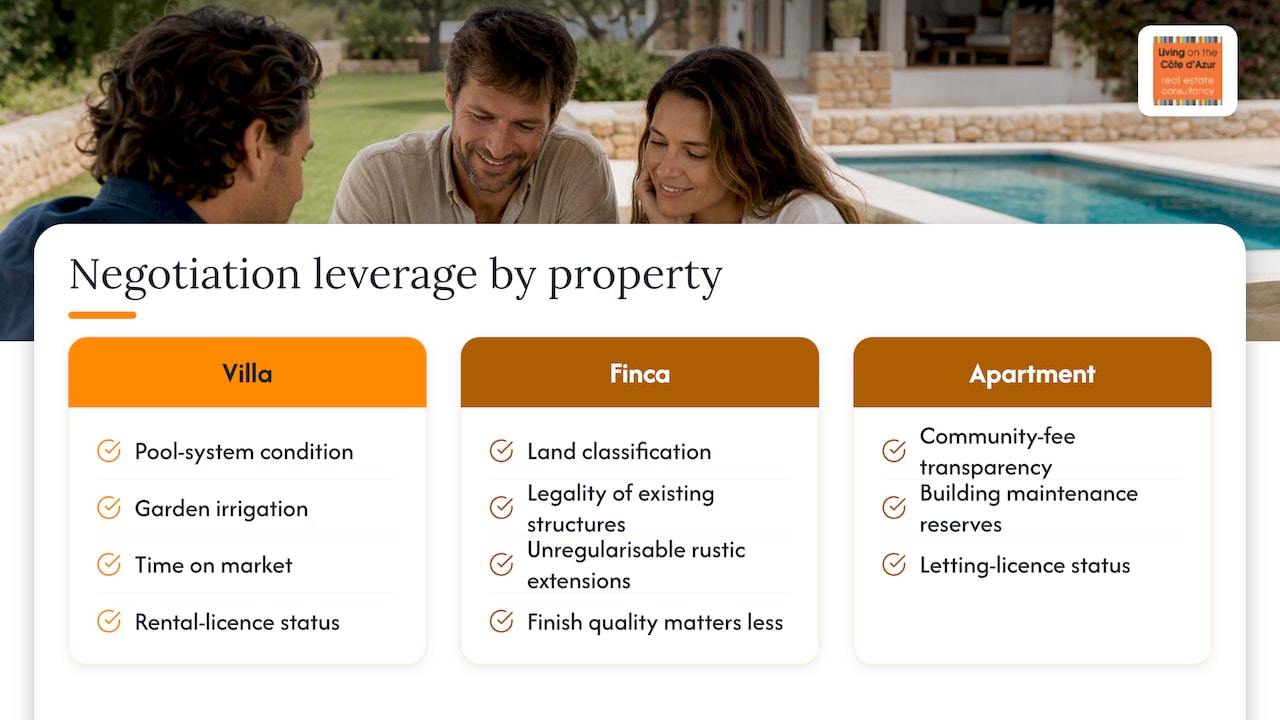
On villas, condition of the pool system, garden irrigation and any recent renovation work tend to be the strongest bargaining points, alongside how long the property has sat on the market. A villa with an expired or missing tourist-rental licence is worth noticeably less to a buyer planning to let it, so raising licence status early in negotiations is often more productive than haggling over fixtures.
Fincas negotiate differently because land classification and the legality of existing structures carry more weight than finish quality. If a survey or legal audit turns up unauthorised extensions on rustic land that cannot be regularised, that is a legitimate basis for renegotiating price or walking away, since rustic land restrictions make such works difficult to fix retroactively.
Apartments tend to move on community fee transparency, building maintenance reserves and, again, letting licence status where rental income factors into your decision. Because buildable land on the island is constrained, sellers of well-located properties in any category often have less incentive to negotiate hard on price alone, which is where identifying off-market opportunities before a listing goes public tends to matter more than tactics used at the table. We handle that groundwork directly with our network of local agents and developers.
Financing options for international buyers on Ibiza
International buyers typically have several financing routes open to them, though the right one depends heavily on residency status, the property type and how the funds are structured.
Spanish banks do lend to non-resident buyers, though terms and the proportion of the purchase price they will finance generally differ from resident mortgages, and lenders will want clarity on the property’s legal status before approving anything, which is another reason land classification checks on fincas matter early rather than late. Some buyers instead arrange financing through international private banks or wealth managers in their home jurisdiction, using other assets as security, which can simplify currency and timing issues.
Cash purchases remain common at the upper end of the Ibiza market, particularly for villas and fincas where speed and certainty in a competitive, land-constrained environment can matter more than leverage. Whichever route you take, we connect clients with trusted mortgage brokers and tax advisers as part of the buying process, so financing questions get answered alongside the legal and planning checks rather than as an afterthought once you are already committed. Buyers weighing up affordability more broadly, including whether to borrow against other property, may find it useful to compare approaches used in other markets, such as this overview of affordability checks for second properties, though Spanish lending rules naturally differ.

Our honest view on choosing between villas, fincas and apartments
Most advice on this topic treats the choice between villa, finca and apartment as purely a matter of taste, as if it were a question of interior style. We think that undersells the decision. The property type you choose determines which legal checks matter most, and skipping those checks causes far more regret than picking the wrong tile colour.
Buyers chasing a finca for its character often underweight how binding rustic land restrictions really are. A beautiful farmhouse with an illegal extension is not a bargain, it is a liability. Equally, buyers drawn to a villa for rental income sometimes assume a licence will simply follow the sale, when zoning and licensing can be far more specific than that.
Our honest recommendation: decide your lifestyle priority first, villa, finca or apartment, then insist on the land and licence checks before you get attached to a specific address. The island’s limited buildable land means good properties do not linger, but rushing past due diligence to beat another buyer is how people end up owning something they cannot legally use the way they planned.
— Ab Kuijer
Enquire: buyer agent service for Ibiza searches
We represent buyers, not sellers, which means our search for your Ibiza villa, finca or apartment covers the whole market, including homes that never reach public listings. Get in touch and we will start with a short briefing call to understand your lifestyle priorities, budget and timeline, then set out the next steps for a tailored search. Begin your enquiry through our buyer agent service page.
FAQ
Is a villa or apartment better?
Neither is universally better: a villa suits buyers who want privacy, a pool and space to entertain, while an apartment suits those who want lower maintenance and easier year-round or rental use. The right choice depends on how much upkeep you want to manage and how often you will be on the island.
Is Ibiza property a good investment?
Ibiza’s investment appeal rests partly on constrained buildable land under the Plan Territorial Insular, which analysts note supports value for well-located properties. Rental income potential depends heavily on securing a valid tourist-rental licence, so returns are not guaranteed without that paperwork in place.
What part of Ibiza is best for couples?
Ibiza town (Eivissa) and Santa Eulària suit couples well, offering walkable services, restaurants and a steady year-round atmosphere rather than a purely seasonal one. Both towns also tend to support apartment living better than the more rural interior.
Is a villa a private residence?
Yes, a villa is typically a private single-family home, usually with its own pool, garden and boundary, distinct from the shared buildings and communal facilities found in apartment complexes. Whether it can also be used as a holiday let depends separately on its zoning and licence status.
Sources
- Ibiza architecture and property character — Las Villas Ibiza
- BOE-A-2017-10539 Ley 6/2017 (modification of Balearic tourism law)
- Investing in Ibiza — Knight Frank
- Balearic holiday rental law for foreign owners — Costa Luz Lawyers
Recommended
 //
//