
For years, getting around Ibiza without a car has often felt like a challenge. Visitors and residents alike know the routine: buses that arrive late, routes that seem designed for another decade, and little information when things go wrong.
Now, that may finally be changing.
From 1 April 2026, ALSA launches a completely redesigned public transport system across the island. It is not a small update or a few timetable adjustments. Ibiza is replacing its existing network with a new structure of 62 lines, a modern fleet of around 100 buses, digital ticketing, and live tracking.
If it works as promised, this could become one of the biggest improvements to everyday life on the island in years.
The change comes at exactly the right time. Ibiza has become increasingly difficult to navigate in recent summers. Roads between Ibiza Town, Sant Antoni de Portmany, and Santa Eulària des Riu are often heavily congested. Parking near beaches is a nightmare in July and August. And with the island also introducing new restrictions on the number of vehicles allowed onto Ibiza, many people will increasingly need an alternative.
Ibiza’s New Bus Network Could Completely Change the Island
This new bus network is clearly designed to become that alternative.
The most visible change will be the buses themselves. Over the coming months, the fleet will grow to around 100 vehicles. More than half of them — 64 buses in total — will be fully electric, with another three hybrid buses joining the network. That immediately makes Ibiza one of the most advanced tourist destinations in Europe for sustainable public transport.
The new buses are not just greener. They are also much more modern. The vehicles will offer free Wi-Fi, USB charging points, accessibility ramps and contactless payment. In other words, taking the bus in Ibiza may finally start to feel more like using transport in a major city rather than relying on an outdated seasonal service.
But the biggest difference is not the buses. It is the way the entire island is being reorganised.
Until now, Ibiza’s bus system has often felt fragmented. Some routes overlap, others make little sense, and certain villages or beaches have been difficult to reach unless you drive.
The new network is designed around a clearer structure.
At the centre are the new “T routes”, which will act as the main transport corridors across the island:
- T1: Sant Antoni – Sant Rafel – Ibiza Town
- T2: Sant Antoni – Sant Josep – Ibiza Town
- T3: Santa Eulària – Ibiza Town
- T4: Santa Eulària – Sant Joan
- T5: Santa Eulària – Sant Antoni
- T6: Sant Joan – Sant Llorenç – Santa Eulària
- T7: Sant Joan – Sant Antoni
These lines are intended to create faster and more logical connections between the main population centres. Instead of a confusing mix of seasonal and local services, the new system should make it easier to understand how to travel between the two sides of the island.
For example, someone staying in Santa Eulària des Riu can reach Sant Antoni de Portmany directly via the T5 route, while visitors staying in Sant Joan de Labritja can travel more easily to either Santa Eulària or Sant Antoni.
Beyond the T routes, the system introduces several additional categories:
- A routes: local connections to smaller villages and accessibility links
- P routes: links between towns and beaches, especially important during the summer
- U routes: urban transport within towns
- UE routes: urban transport specifically within Ibiza Town
That may sound complicated at first, but it is actually a much more logical system than before. Once people understand the meaning of the letters, it should become easier to identify whether a line is long-distance, local, beach-focused, or urban.
The beach connections could be especially important.
Every summer, some of Ibiza’s most beautiful beaches become almost inaccessible due to traffic and a lack of parking. Popular spots such as Cala Comte, Cala Bassa, and Benirràs Beach often experience severe congestion.
If the new P routes work well, tourists may begin leaving their rental cars behind and taking buses instead. That would reduce traffic, parking pressure, and emissions while also making the beaches more enjoyable.
There is also a strong possibility that the new network will change how people explore Ibiza.
At the moment, many visitors rarely leave the area where they are staying. Someone in Sant Antoni may spend their entire holiday in the west of the island simply because travelling elsewhere feels inconvenient. Better transport could encourage people to discover more of Ibiza — from the restaurants of Santa Eulària to the villages in the north and the beaches around Sant Josep.
That could spread tourism more evenly across the island and benefit local businesses outside the traditional hotspots.
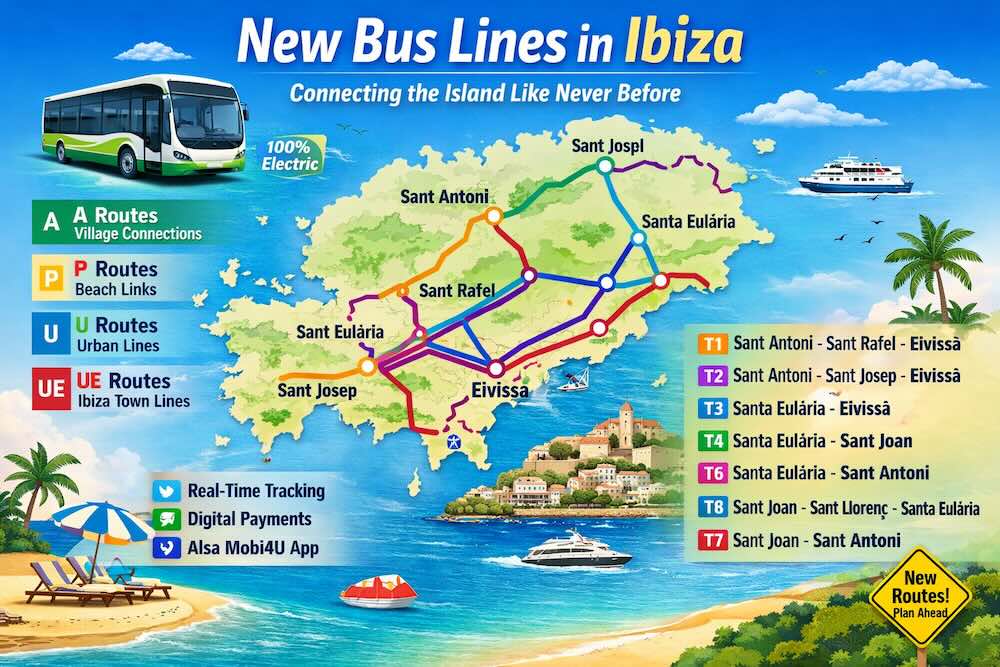
Technology major part of the upgrade
Passengers will be able to use the Alsa Mobi4U app to see exactly where their bus is and when it will arrive. Real-time information, QR codes at bus stops, and digital payments should finally eliminate one of Ibiza’s oldest transport frustrations: standing at a bus stop with no idea whether the bus is five minutes away or has already disappeared. (ALSA.ES)
That said, there is one important warning.
Large transport changes almost always create confusion at first.
From April, many existing lines disappear completely. Route numbers, timetables and destinations will change. Even people who have used the buses for years are likely to make mistakes during the first weeks. Authorities are already advising residents and tourists to check the new routes in advance before travelling. (Cadena SER)
There is another question mark too: will the improvements continue outside the summer season?
Ibiza has often been criticised for offering good transport in July and August but weak services during the rest of the year. Winter buses can be infrequent, routes are sometimes reduced, and some villages feel isolated without a car.
The new system promises to improve year-round consistency. But until people have experienced it through autumn and winter, nobody really knows whether that promise will be kept.
Impressive ambition
This is not just a transport update. It is an attempt to rethink how people move around the island.
If the new system succeeds, Ibiza could become easier, cleaner, and less stressful to explore. Traffic could fall, parking problems could improve, and many people may discover that they no longer need a car for every journey.
And for an island that has long been famous for its beaches, nightlife, and luxury villas, perhaps it is finally time for Ibiza to become known for something less glamorous — a bus system that actually works.
 //
//