
TL;DR:
- A villa is a statement of lifestyle, combining scale, light, and materiality to create a unique living space. Effective design emphasizes spatial zoning, indoor-outdoor flow, authentic materials, layered lighting, and restrained furnishing choices. Incorporating art, provenance, and durability ensures the interior remains timeless, meaningful, and suitable for seasonal rentals.
A villa is not simply a large house. It is a statement of how you choose to live, a space where scale, light, and materiality converge to create something truly singular. Whether you are refining a sun-warmed retreat on the Côte d’Azur or approaching a blank canvas in Bali or Ibiza, the interior design tips for villas that actually work go far beyond choosing a sofa or a paint colour. They demand a deeper understanding of spatial flow, material truth, and the quiet art of luxury. This guide gives you that understanding, point by point.
Table of Contents
- Key takeaways
- 1. Interior design tips for villas: start with spatial zoning
- 2. Mastering indoor-outdoor flow
- 3. Lighting design strategies to lift mood and luxury
- 4. Choosing materials and finishes for timeless elegance
- 5. Furnishing and decorating with restraint
- 6. Integrating art, culture, and provenance
- 7. Designing for seasonal living and rental yield
- My perspective on villa interiors that truly endure
- Discover villas designed to become heirlooms
- FAQ
Key takeaways
| Point | Details |
|---|---|
| Zone your spaces deliberately | Separate public, semi-public, private, and service areas to protect privacy and enhance daily function. |
| Prioritise indoor-outdoor continuity | Use continuous large-format flooring and tonal consistency to dissolve the boundary between interior and garden. |
| Layer your lighting | Combine ambient, task, and accent lighting with dimmers to control mood at every hour of the day. |
| Choose authentic materials | Natural stone, quality timber, and textured fabrics create a longevity that synthetic alternatives never match. |
| Furnish with restraint | Fewer, finely chosen pieces with defined zones read as more luxurious than rooms filled with too many options. |
1. Interior design tips for villas: start with spatial zoning
Before a single tile is chosen or a fabric swatch pinned to a board, the architecture of daily life must be mapped. Villa space planning follows a multi-zone model that separates public zones (reception rooms, dining, terraces), semi-public zones (home offices, guest suites), private zones (principal bedroom wing, family rooms), and service zones (kitchens, utility rooms, staff quarters). Each zone serves a distinct purpose and should have its own circulation logic.
Service zones, in particular, must have independent circulation paths from both public and private areas. Nothing disrupts the atmosphere of a formal dinner faster than a service corridor cutting through the main salon. In well-designed villas, staff can move invisibly from kitchen to terrace without crossing the principal living spaces.
- Map every zone on your floor plan before committing to any layout
- Identify where the morning light falls and align the breakfast and kitchen areas accordingly
- Position the principal bedroom suite at the furthest remove from the entrance and entertaining spaces
- Reserve semi-public zones as buffers between the social heart of the villa and the most private retreats
Pro Tip: Trace your most common daily paths directly onto a printed floor plan. Walk from bed to coffee machine, from front door to study, from pool to bathroom. If those paths cross awkwardly or create bottlenecks, the layout needs revision before anything else is decided.
Dead zones such as oversized entrance halls or circuitous corridors waste both space and the energy required to condition them. Every square metre of a villa should earn its place.
2. Mastering indoor-outdoor flow
The greatest gift of villa living is the effortless passage between interior and exterior. On the French Riviera, where salt-kissed air drifts through stone-pine gardens and a terrace in Antibes or Èze can rival any interior room for sheer beauty, this transition is not decorative. It is the heart of the design.
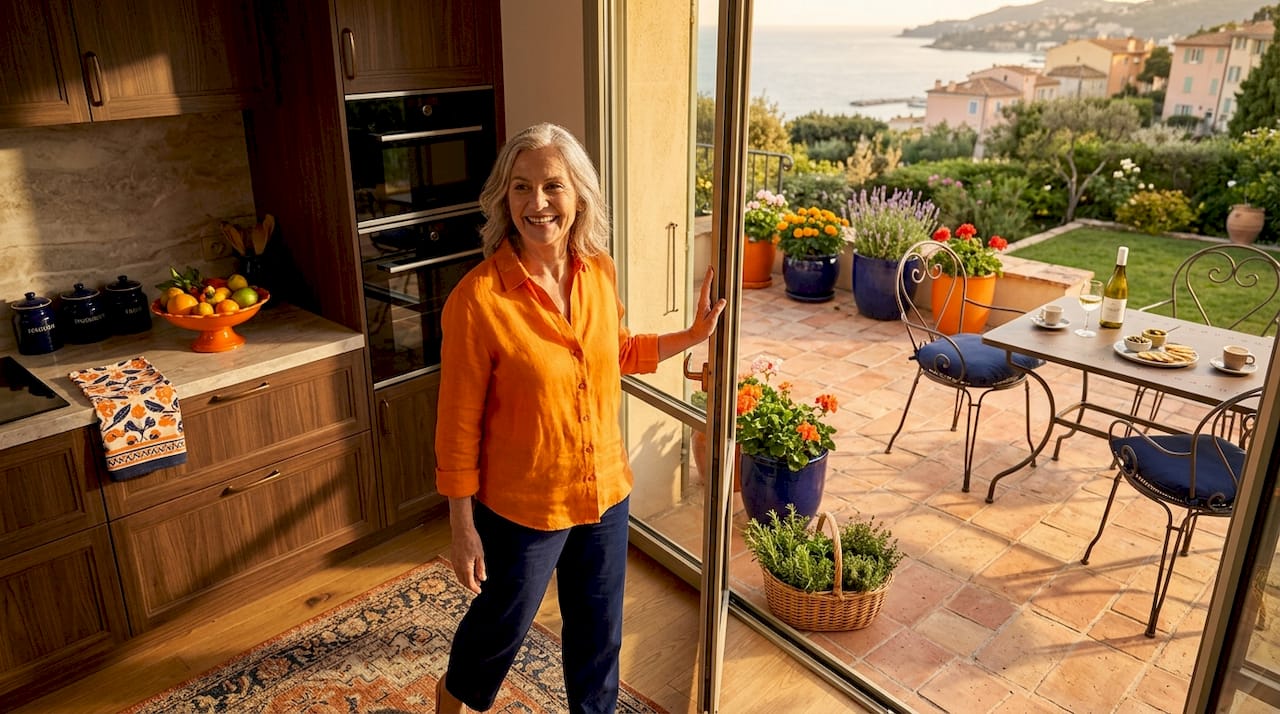
Seamless indoor-outdoor flow depends on continuous large-format tiles that run uninterrupted from inside to outside. Tile sizes of 600x1200mm or larger, including slab formats at 3.6m x 1.2m, minimise grout joints and create an unbroken visual plane. When the floor reads as one surface, the room appears to extend indefinitely into the garden.
| Flooring material | Best use | Key benefit |
|---|---|---|
| Travertine | Covered terraces, salon floors | Warm tone, ages beautifully |
| Porcelain slab | Pool surrounds, open-plan living | Frost-resistant, minimal joints |
| Brushed limestone | Indoor-outdoor transitions | Tonal versatility, natural texture |
| Teak or Iroko timber | Shaded loggias, dining terraces | Warmth, tactile contrast |
Patios treated as natural interior extensions, with matching tonal and textural elements, enhance both lifestyle and the spatial experience of the entire property.
Pro Tip: Align grout lines at the threshold between inside and outside, and avoid any level change at the transition point. Even a 10mm step reads as a visual and physical interruption that breaks the continuity you are working hard to create.
3. Lighting design strategies to lift mood and luxury
Lighting is the most underestimated element in villa interiors. Get it right, and every material glows with depth. Get it wrong, and even the finest stone looks flat and institutional. The three-layer approach used by professional villa designers covers ambient, task, and accent lighting, each serving a distinct purpose and working together through a dimmer-controlled system.
- Ambient lighting at 2700K with a CRI of 90 or above creates a warm, enveloping baseline. This is the layer that sets the room’s fundamental mood.
- Task lighting at 3500 to 4000K serves functional areas: kitchen worktops, reading chairs, vanity mirrors, and home offices where clarity matters more than romance.
- Accent lighting sculpts the architecture. It picks out a stone wall’s texture, bathes a painting in focused warmth, or traces the line of a coffered ceiling.
“Lighting is the silent element dictating room success, giving materials depth and defining atmosphere with shadow and light balance.” The psychology of light
Smart lighting systems programmed with pre-set scenes, such as a “Sunset Scene” that dims overhead lights while accent lighting rises to create evening ambience, allow you to shift the villa’s atmosphere with a single gesture. This kind of intentional control is what separates a well-designed home from a truly luxurious one.
The intentional absence of light matters as much as its presence. Corners left in shadow, walls that fade at their edges, and ceiling perimeters that recede into darkness all add depth and mystery. Uniform brightness is the enemy of atmosphere.
Pro Tip: Commission a lighting design consultant at the architectural stage, not after the ceilings are plastered. Conduit placement, ceiling void depth, and structural decisions all affect what is possible later. Retrofitting great lighting into a finished villa is expensive and rarely as good as designing it in from the start.
4. Choosing materials and finishes for timeless elegance
Quiet luxury in villa interiors is defined by proportion, material authenticity, and spatial flow rather than by the accumulation of expensive objects. This is one of the most important principles in modern villa interior design, and one of the most frequently misunderstood.
Natural stone carries a weight and warmth that no manufactured alternative replicates. Travertine, marble, limestone, and slate each bring their own geological biography into a space. Paired with quality timber, whether as wide-plank flooring, bespoke joinery, or structural ceiling beams, these materials create an interior that speaks of permanence and care.
- Colour palette: Neutral tones of warm beige, taupe, ivory, and soft grey create interiors that feel calm and endure across decades. Use deeper hues, such as slate blue, forest green, or charcoal, as deliberate contrasting accents rather than dominant forces.
- Texture layering: Combine polished stone with rough-hewn timber, linen with velvet, and matte wall finishes with glossy architectural elements. Texture is what makes a room feel rich at close quarters.
- Investment priorities: Spend on architectural finishes first. Stone flooring, bespoke cabinetry, and plaster wall finishes outlast sofas and soft furnishings by decades. You can always replace a cushion; re-tiling a villa is a major undertaking.
- Material authenticity: Buyers and guests perceive the difference between genuine marble and high-quality porcelain. In a luxury villa, where the entire experience depends on the quality of every surface, authenticity matters.
For design ideas for luxury villas that will appreciate in value, consult the French Riviera interior design philosophy, where heritage and modernity are balanced with particular elegance.
5. Furnishing and decorating with restraint
Furniture in a luxury villa should complement the architecture rather than compete with it. Fewer, finely considered pieces arranged with spatial intelligence create rooms that feel curated and alive. A salon with five exceptional pieces, perfectly placed, outperforms one with twenty mediocre ones every time.
Large villa rooms present a particular challenge: their scale can make even generous furniture appear small and disconnected. The solution is not to fill the space but to define it.
- Use oversized rugs to anchor seating groups and give each zone a sense of enclosure within the larger room
- Introduce wall panelling or boiserie to bring the ceiling plane down visually and add architectural warmth
- Consider custom millwork, from built-in bookshelves to integrated media walls, to give rooms a tailored, finished quality that freestanding furniture alone cannot provide
- Select one or two statement art pieces per room to add personality and provide a natural focal point for the eye
| Approach | Effect in large villa rooms |
|---|---|
| Oversized rug per seating group | Creates intimate zones within a grand space |
| Statement artwork at key sightlines | Draws the eye and anchors the room’s character |
| Custom millwork and joinery | Delivers architectural cohesion and reduces visual clutter |
| Layered textiles (throws, cushions) | Adds tactile richness and human scale |
Understanding what defines an ultra-luxury villa at the highest level of the market can sharpen your instincts for which furnishing decisions genuinely add value and which merely add cost.
6. Integrating art, culture, and provenance
A villa on the Côte d’Azur carries the whisper of Picasso’s Antibes fortress, of Matisse’s light-flooded studios in Nice, of the lemon-yellow walls of Menton’s old town. The interior design of a villa in such a place should not exist in a cultural vacuum. Art and provenance give a home its soul.
Commission works from regional artists or source pieces through the galleries of Saint-Paul-de-Vence, where the tradition of artists and collectors living in extraordinary communion has continued for over a century. Sculptural ceramics, hand-woven textiles from Provençal ateliers, and antique stone fountains placed in garden courtyards all speak of a life lived with intention and taste.
The best approach to villas interior decorating at this level is to treat acquisition as a long-term process. Buy what moves you rather than what matches the sofa. Over time, a collection assembled with genuine personal conviction will always produce a more compelling interior than one curated by a decorator following a trend board.
7. Designing for seasonal living and rental yield
If your villa will serve as both a family retreat and a high-yield seasonal rental, the design must accommodate both masters gracefully. On the Côte d’Azur, elite seasonal lets during the Cannes Film Festival, the Monaco Grand Prix, and the summer season along the Pampelonne coast command extraordinary nightly rates. The design must be photograph-ready and experientially flawless.
Durability and luxury are not mutually exclusive. Choose performance fabrics that resist salt air, UV exposure, and heavy use while reading as soft and expensive. Stone flooring is both beautiful and almost indestructible. Bespoke cabinetry with soft-close mechanisms and solid timber drawers outlasts flat-pack furniture by a generation.
Invest in a home automation system that allows guests to control lighting, climate, blinds, and audio with a single panel or smartphone. In 2026, this is not a luxury feature. It is an expectation among high-net-worth villa renters from London, Dubai, and New York, who will factor the quality of the technology experience into their review.
My perspective on villa interiors that truly endure
I have walked through extraordinary villas on the Côte d’Azur that cost tens of millions of euros and felt oddly cold. And I have spent evenings in relatively modest properties that felt like the most beautiful places on earth. The difference is almost never about money. It is about whether the person who designed the space was thinking about how it would be lived in, or only about how it would be photographed.
What I have come to believe, working with discerning buyers and owners across the Riviera, is that the most enduring villa interiors share three qualities. They are honest about their materials. They are planned for the rhythms of real daily life. And they use light not as an afterthought but as the primary architectural tool.
The mistake I see most often is the pursuit of extravagance over authenticity. A room lined with marble that has been chosen for its prestige rather than its beauty will always feel slightly wrong. A room where the stone was chosen because the owner fell in love with its particular vein and warmth will feel right for a lifetime.
My advice, always, is to slow down at the beginning and spend the design budget on the things that cannot be changed cheaply later: the floors, the ceilings, the light, and the spatial logic. Everything else is furniture.
— ab
Discover villas designed to become heirlooms
At Livingonthecotedazur, we work with homeowners and visionary buyers who understand that a villa is not simply a property. It is a living asset, a family legacy, and in the right hands, one of the most satisfying spaces a person can inhabit. Whether you are sourcing a property to design from scratch or refining an existing estate, our portfolio of off-market Côte d’Azur villas gives you access to residences that rarely appear publicly. For those beginning the ownership journey, our step-by-step transaction guide covers every stage of the process with clarity and precision. We accept cryptocurrency payments and offer a truly personalised service for discerning clients worldwide.
FAQ
What makes villa interiors different from standard home design?
Villa interiors require multi-zone spatial planning, greater attention to indoor-outdoor continuity, and a higher investment in architectural finishes due to the scale and prestige of the property.
What are the best interior styles for luxury villas?
Quiet luxury, characterised by proportion and authentic materials, consistently outperforms trend-led styles because it creates spaces that feel refined and relevant across decades rather than seasons.
Which colour schemes work best for villa interiors?
Warm neutrals including beige, taupe, ivory, and soft grey form the most enduring base palette, with deeper contrasting hues introduced through soft furnishings, joinery, and artwork.
How should I approach lighting when designing a villa?
Use a three-layer system of ambient, task, and accent lighting with fully dimmable controls, and commission a lighting consultant before the ceiling structure is completed to allow proper conduit and void planning.
Can a luxury villa interior also perform well as a seasonal rental?
Yes, provided the design balances visual impact with durable materials, intuitive home automation, and photography-ready styling that appeals to high-net-worth guests from global markets.
Recommended
 //
//