
International buyers use a buyer’s agent on the French Riviera because the French system is built around the seller’s side of the table. A buyer’s agent (in French, a chasseur immobilier) works only for you. They search the whole market, including homes that never reach a portal. They negotiate, check the paperwork and coordinate the purchase through to the notaire, often from another country.
We are Living on the Côte d’Azur, an independent international buyer agent, and this is how we see it after guiding buyers from many countries through Nice, Cannes, Cap d’Antibes, Saint-Tropez and the hills behind them. Below you will find what the role involves, how it differs from the estate agent you meet at a viewing, how fees work, and where buyers most often get caught out.
TL;DR
- A French estate agent is mandated by the seller. A buyer’s agent is retained by you, so the search, the advice and the negotiation are all on your side.
- The Riviera is a patchwork of micro-markets. A good buyer’s agent compares across towns and reaches off-market and new-development stock, not just one agency’s listings.
- In France a chasseur is paid on result, and no fee should be demanded before the sale is concluded. For our buyers the service is free, because we are paid through commission shared by the selling agent.
- The biggest risks sit in the paperwork: the compromis, diagnostics, co-ownership records and ownership structure. Having someone who reads them with you matters more from abroad.
- You still need your own lawyer and tax adviser. A buyer’s agent coordinates them rather than replacing them.
Table of Contents
- Who is on the other side of the table
- Why the Riviera in particular rewards representation
- What a buyer’s agent actually does, step by step
- The French purchase process, and where help matters most
- The checks that matter before you make an offer
- How buyer’s agent fees work in France
- Who uses a buyer’s agent, and why
- Our perspective
- How to choose a buyer’s agent
- Work with us on your Riviera search
- FAQ
- Sources
Who is on the other side of the table
When you walk into a French estate agency and ask about a villa, the agent in front of you has a mandate from the seller. Their job is to sell that property at a good price. Many agents are honest and helpful, and the best ones will tell you a lot. But their duty runs to the person who signed the mandate, and they can only show you what they hold.
That is the structural reason overseas buyers look for their own representation. You are in a market where you do not know the streets, the price per square metre in each village, or which agencies have the quiet listings. You are also buying under French rules rather than the ones you grew up with.
A buyer’s agent reverses the arrangement. The Fédération des Chasseurs Immobiliers describes the chasseur as a professional who replaces the buyer in prospecting, visits, selection and negotiation, and who carries professional liability insurance. The point of the role is simple: someone whose only client is the buyer.
Buyer’s agent versus seller’s agent at a glance
| Seller’s estate agent | Buyer’s agent | |
|---|---|---|
| Retained by | The seller | You |
| Stock they can show | Their own mandates, plus some shared listings | The wider market, via agents, developers and off-market contacts |
| Main aim | Sell this property well | Find the right property and buy it well |
| Negotiation | For the seller | For you |
| Paperwork | Prepares the sale side | Reviews it with you and your advisers |
The two roles are not enemies. In practice a buyer’s agent works with seller’s agents all the time, and good relationships with them are part of why a buyer’s agent can open doors. The difference is who is accountable to whom.
Why the Riviera in particular rewards representation
The French Riviera is not one market. A flat in central Nice, a sea-view villa in Cap d’Antibes, a bastide in the hills above Mougins and a village house in the Var behave differently on price, resale, rental potential and day-to-day life. Prices also move by street, by view and by building, not only by town.

For a buyer arriving from London, New York, Dubai or Amsterdam, that creates three practical problems.
Fragmented listings. The same property can be advertised by several agencies at slightly different prices, and some of the best homes are sold quietly before they are advertised. We cover how that works in our guides to off-market property on the Côte d’Azur and the invisible luxury market.
Distance. Most of our clients do not live here. They need someone to do the first filtering, so that a long weekend of viewings covers six homes that genuinely fit, not fifteen that do not.
Local reading of a property. Whether a road is noisy in August, whether a terrace is overlooked, how a co-ownership is run, whether a sea view can be built over: these are things a local sees in ten minutes and a visitor can miss entirely.
What a buyer’s agent actually does, step by step
The role is easiest to understand along the purchase itself. This is how we work with international clients.
1. Defining the search
We start with a conversation, not a list. Is this a second home for summers, a base for a family relocating, an investment, or a legacy property? Budget, timing, school or airport needs, boat access, golf, garden, rental plans and future resale all shape the brief. A clear brief is half the work, and it stops buyers drifting between Nice apartments and Saint-Tropez villas without knowing why.
2. Sourcing and comparing
We search through our network of local agents, developers and off-market contacts, which gives access to more than 100,000 properties across the Riviera, from apartments in Nice and Cannes to villas in Saint-Tropez, Ramatuelle, Mougins, Cap d’Antibes and Villefranche-sur-Mer, plus properties near Monaco. Our search mandate is built around exactly this.
3. Viewings
We shortlist, arrange and attend viewings, and give an honest read on each property. Where you cannot travel, we can walk you through a home in detail before you commit to a trip.
4. Negotiating
Negotiation on the Riviera is about knowing what comparable homes have actually sold for, how long a property has been on the market, and what the seller needs. We cover the logic in our negotiation workflow guide.
5. Coordinating the legal side
Once an offer is accepted, we coordinate with the notaire, your own lawyer if you have one, and, when needed, mortgage brokers, tax advisers, architects and renovation specialists. Our overview of the legal process for buying in France walks through the stages.
The French purchase process, and where help matters most
A typical French purchase follows a clear sequence, and each stage has a moment where representation earns its place.
After your offer is accepted, you sign a binding compromis de vente. According to a guide by French lawyer Maître Reda Kohen, a non-professional buyer acquiring a dwelling has a non-waivable 10-day withdrawal period. The notaire then typically takes two to four months to verify title, mortgages, easements, planning certificates, diagnostics and pre-emption rights, before the final acte authentique is signed.
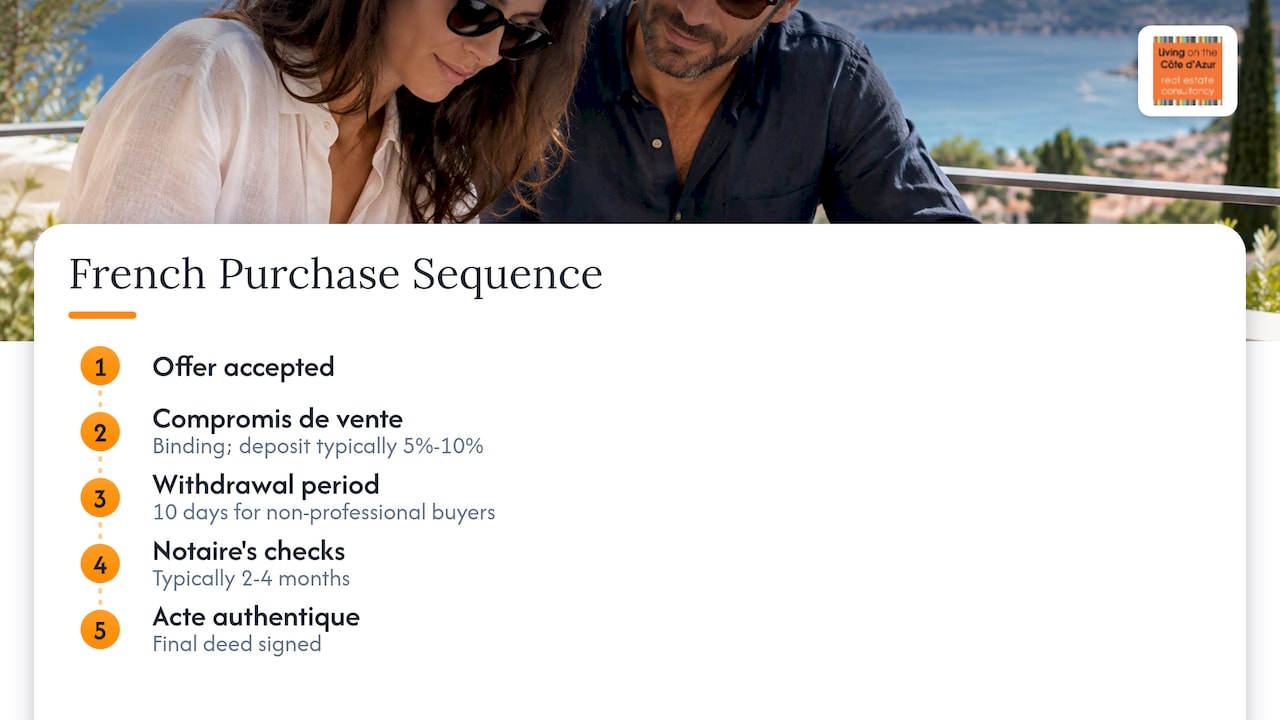
The same guide stresses a point many overseas buyers miss: the notaire acts as a public officer and does not advise on whether the purchase is commercially wise, so you should have your own legal counsel. A buyer’s agent is not a substitute for that counsel, but the agent keeps the whole process moving and makes sure questions reach the right professional.
For overseas buyers, French Notaires describes a deposit at compromis stage typically of 5% to 10%, and notes that you can sign in person or through a representative holding a power of attorney. That last option is why many of our clients complete a purchase without being in France on the day of signing.
The checks that matter before you make an offer
This is where we spend a great deal of our time, and where buyers working alone from abroad are most exposed. None of these checks is exotic, but each needs someone to read the detail.
Read the compromis properly
Maître Kohen’s guide gives specific points to review with a lawyer before signing: that the deposit matches the indemnité d’immobilisation clause, that financing conditions have clear deadlines and a defined way to prove a loan refusal, and that the notaire’s escrow account is properly identified. It also notes that an English translation can help you understand the text, but only the French version binds legally. Read the compromis with a lawyer before you sign, not after.
Go through the diagnostics, then go further
French sellers must supply a bundle of diagnostic reports. FrenchEntrée explains that these cover energy performance, electrics, drainage, flood and subsidence risk, lead, asbestos and insects, but that they rarely paint the whole picture. A subsidence report may flag a risk without saying whether the property has been affected, and a termite report may confirm pests without showing structural damage. For older homes or ambitious renovations, it recommends adding a structural survey and a renovation cost estimate, and checking planning and zoning with the mairie.
Apartments: the co-ownership records
For apartments, French Notaires advises overseas buyers to request the full diagnostics file before offering, read the copropriété minutes and charge history, check the energy rating (DPE) because F and G classes face rental restrictions, and confirm local short-term rental rules if you plan to let. It also suggests checking the Carrez surface area and asking the notaire to summarise key pages if the French is difficult.
That rental point deserves attention. Many Riviera buyers assume holiday income will pay for the home. A poor energy rating, a restrictive building or a local rule can change that. Our approach is to run these checks before a buyer falls in love, so the decision stays clear-headed.
Coastal and hillside risk
Coastal and hillside homes bring their own questions: flood zones, erosion, fire risk, drainage. French Notaires points buyers to the natural-risk (ERP) maps within the diagnostics. If you are weighing a seafront home, it also helps to understand how buyers think about sustainable coastal communities when judging long-term resilience, even though the planning rules there differ from those in France.
Ownership structure and tax
How you hold the property matters as much as which property you choose. Two points are worth knowing early, and both need an adviser for your own situation.
- Non-French tax residents who own French real estate are liable to the real estate wealth tax (IFI) if the net value of their French property exceeds €1,300,000 on 1 January, with progressive rates from 0% to 1.5%, according to Taylor Wessing’s investment guide (October 2023). Thresholds and rates can change, so confirm the current position with a tax adviser.
- Entities that own French property, directly or indirectly, can face a 3% annual tax on its market value unless they disclose the ownership structure up to the beneficial owners, as Dentons’ tax guide explains. That is one reason holding structures such as an SCI need proper advice before you buy, not afterwards.
We do not give tax advice ourselves. What we do is make sure the question is asked early and that a qualified French tax adviser or notaire is in the room before you sign.
How buyer’s agent fees work in France
Fees are the first question most buyers ask, so here is the straightforward answer.
In France, the regulated principle is that a property professional is entitled to fees when mandated and when the sale is concluded thanks to their intervention. The national housing information agency ANIL also notes that where an advertisement shows fees payable by the buyer, they must be stated as a percentage of the sale price including tax.
For chasseurs specifically, the Fédération des Chasseurs Immobiliers states that remuneration is linked to the result, with nothing payable in advance, and that charging dossier, exploratory or similar fees before the sale is concluded is formally prohibited. Payment falls due when the definitive deed is signed.
At Living on the Côte d’Azur, the service is free to the buyer: we are paid through commission shared with the selling agent on each completed purchase. Our published rate for the buyer broker service is 2%, and the same 2% applies to higher-segment searches. If you want to see how the full-service model is set up, our page on the full-service buyer broker approach explains it. Whatever arrangement you consider, ask for it in writing and read it before signing, as you would with any French contract.
Who uses a buyer’s agent, and why
The buyers we work with fall into recognisable groups, and each uses the role differently.
- Second-home buyers want the right place without spending a year of weekends searching. They value filtering and local honesty.
- Families relocating care about schools, commuting, healthcare and year-round life, not just views. They need someone who knows how each town feels in February.
- Investors look at rental rules, yields, building quality and resale. They need the numbers and the risks laid out clearly.
- High-net-worth and legacy buyers are often looking for homes that are never publicly marketed. For them, discretion and access matter most; see our guide to buying high-end luxury real estate on the Riviera.
- Americans buying in Europe face questions about financing, tax and process that differ from home. We wrote a dedicated guide for American buyers on the French Riviera.
Our perspective
Most people we meet have spent months looking at the same properties on the same portals, and they come to us a little tired and a little unsure of what they are really seeing. That is the moment a buyer’s agent is most useful.
We are an independent buyer agent. We do not hold our own listings to sell, so there is no property we need you to like. We search through local agents, developers and our off-market contacts, and our network gives us access to more than 100,000 properties across the Riviera. Our job is to narrow that to the few that suit you, and then to buy well.
Our Dutch way of working is personal, transparent and efficient. We tell you what we think of a property, including when a place is lovely but wrong for your plans. We would rather lose a viewing than have you buy a problem.
The Riviera rewards patience and local knowledge. With the right brief and the right people around the table, buying here is not stressful. It is a rather enjoyable discovery of where you want to spend your time.
Ab Kuijer
How to choose a buyer’s agent
Not every agent offering this service works the same way. These are fair questions to put to any candidate, us included.
- Who do you represent, and how are you paid? You want a clear answer, in writing, with nothing payable before the sale is concluded.
- How do you find properties? Look for a real network across agencies, developers and off-market sources, not one agency’s list repackaged.
- Do you cover the area I care about? Nice and Cannes are very different from Saint-Tropez or the Var.
- Who handles the legal, tax and financing side? A good agent coordinates specialists such as notaires, tax advisers and mortgage brokers, without pretending to be them.
- Can I speak to your clients’ process, not just your listings? Ask how a typical purchase runs from search to keys.
- Do you work in my language and time zone? For overseas buyers this is a practical matter, not a luxury.
Our guide to the different types of buyer agent services sets out the options, from limited searches to full representation.
Work with us on your Riviera search
If you are considering a purchase between Nice and Saint-Tropez, or near Monaco, we would be glad to hear what you are looking for. We offer a search mandate for buyers who want us to run the hunt, and a full-service approach that carries you from brief to the notaire and, if you wish, into renovation and post-purchase support. Send us your brief through our website and we will reply personally.
FAQ
Should an international buyer use a buyer’s agent on the French Riviera?
For most overseas buyers, yes. A buyer’s agent gives you representation in a market where the person showing you homes usually acts for the seller, and where good properties may never be advertised. You still need a lawyer or notaire for the legal work, and a tax adviser for ownership structure.
Does a buyer’s agent cost extra on top of the purchase price?
It depends on the agent, so ask for the arrangement in writing. French chasseurs are paid on result, and nothing should be demanded before the sale is concluded. With us, the service is free to the buyer because we are paid via commission shared by the selling agent.
How is a buyer’s agent different from a French estate agent?
An estate agent is mandated by the seller and sells the properties they hold. A buyer’s agent is retained by you, searches across the wider market, advises on price and risk, and negotiates for you.
Can I buy on the Riviera without travelling there?
Often you can do much of the process remotely. French Notaires notes that buyers can sign through a representative using a power of attorney, but it also stresses that a remote purchase should never be a blind one. Proper diagnostics, documents and, for older homes, a local building inspection still apply.
Do I need a buyer’s agent for a small apartment?
The same issues apply at any price: co-ownership records, energy rating, rental rules and local price knowledge. The value of an agent is greatest when you are unfamiliar with the area or short of time, whatever the budget.
Sources
- Fédération des Chasseurs Immobiliers: lexicon and FAQ
- ANIL: ancillary costs of becoming a homeowner
- Kohen Avocats: the compromis de vente explained for foreign buyers
- FrenchEntrée: due diligence, surveys and planning checks
- French Notaires: buying French property from abroad
- French Notaires: French property diagnostics for foreign buyers
- Taylor Wessing: Building Blocks investment guide
- Dentons: international tax guide to French real estate
- Sustainable coastal communities: a luxury buyer’s guide
Recommended
 //