
TL;DR:
- Acquiring international property requires detailed preparation, legal verification, and understanding local regulations.
- Buyers should assemble documentation early, hire independent legal counsel, and model all costs before proceeding.
Acquiring property across borders is one of the most rewarding moves a discerning investor can make. It is also one of the most technically demanding. The international property acquisition process confronts buyers with a layered matrix of local law, currency risk, tax obligations, and procedural timelines that vary sharply from one jurisdiction to the next. Whether you are eyeing a sun-drenched villa above the Baie des Anges in Nice, a sleek apartment steps from Sainte-Maxime’s Garonette sands, or a prestige plot near the Monaco border, the principles underpinning overseas property buying remain consistent. This guide gives you the clarity, structure, and confidence to move forward decisively.
Table of Contents
- Key takeaways
- What every buyer needs before starting
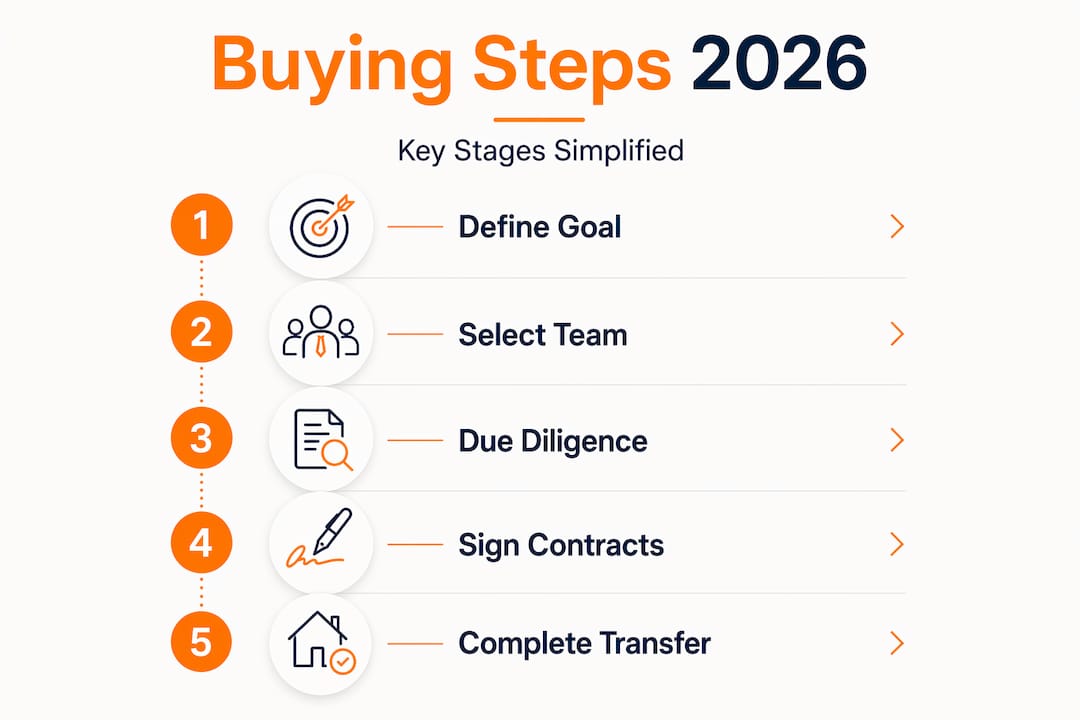
- Executing the acquisition process step by step
- Financing and managing the transaction
- Post-purchase verification and ownership formalities
- Common pitfalls and how to avoid them
- My perspective: what the process really demands
- Discover your next prestige acquisition with Livingonthecotedazur
- FAQ
Key takeaways
| Point | Details |
|---|---|
| Prepare documentation early | Gather identification numbers, funds-origin proof, and legal advisors before searching for property. |
| Hire independent legal counsel | Notaries in civil law countries act neutrally and will not protect your interests during due diligence. |
| Model all costs upfront | Budget between 2% and 20% of purchase price for closing costs and taxes, depending on jurisdiction. |
| Register the deed promptly | Post-completion registration typically takes 2 to 4 weeks and is critical to enforceable ownership. |
| Plan financing globally | Modern global underwriting models assess worldwide income, making mortgages accessible without local residency. |
What every buyer needs before starting
The international property acquisition process does not begin the moment you find a property you love. It begins weeks, sometimes months, earlier, with a sequence of administrative and strategic steps that determine whether your acquisition moves smoothly or stalls at the worst possible moment.
Start by defining your purpose with precision. Are you acquiring a legacy asset to hold across generations, a seasonal rental generating 3 to 5% annual yields, or a primary residence offering lifestyle rewards alongside capital appreciation? Your answer shapes everything from the legal structure you use to the financing product you pursue. A detailed total-cost model covering taxes, fees, currency exposure, and operational costs should be built before you ever view a property.
Next, understand ownership restrictions in your target market. Some countries limit foreign freehold ownership entirely. Others impose additional transfer taxes on non-residents. British Columbia, for example, applies an extra 20% transfer tax on non-resident buyers. France, by contrast, welcomes foreign buyers with few restrictions, though the tax and notary fee structure still requires careful modelling, particularly for Riviera properties above the €2 million threshold.
The essential prerequisites list for overseas property buying looks like this:
- Obtain any locally required identification numbers (the NIE in Spain, the NIF in Portugal, a tax identification number in Italy)
- Compile certified copies of passports and proof of address, typically covering the previous three months
- Prepare documented evidence of funds origin, a mandatory requirement under anti-money laundering regulations
- Appoint a qualified local property lawyer who acts exclusively for you, not for the vendor or the notary
- Engage a currency specialist early, since exchange rate movements on large transfers can materially affect your acquisition cost
Pro Tip: Appoint your lawyer and currency specialist simultaneously. The two disciplines interact constantly during an international real estate purchase, and misaligned timelines between them cause preventable delays.
Explore the key steps in luxury buying for a jurisdiction-specific overview of where each prerequisite applies most critically.
Executing the acquisition process step by step
Once preparation is complete, the foreign real estate process itself unfolds in a structured sequence. Understanding each stage removes the anxiety that often accompanies cross-border transactions and gives you the leverage to negotiate from a position of genuine knowledge.
- Property search and market positioning. Work with a specialist portal or local advisor who has access to off-market inventory. The most prestigious Riviera acquisitions, from Cap d’Antibes privacy estates to Èze clifftop retreats, rarely reach public listings.
- Reservation and deposit. Once a property is identified, a reservation agreement secures it while due diligence proceeds. Deposits typically range from 1% to 10% of the purchase price. Confirm the conditions under which your deposit is fully refundable before signing.
- Due diligence. This is the stage most buyers underestimate. Your lawyer must verify clear title, check for mortgages or encumbrances registered against the property, confirm compliance with planning permissions, and review community charges. Notaries in civil law countries act as neutral public officials. They do not conduct property due diligence or protect your interests. Independent legal counsel is not optional.
- Preliminary contract. A formal purchase agreement or compromis de vente locks in price, conditions, and timelines. Penalties for withdrawal by either party become enforceable from this point.
- Financing confirmation. Mortgage approval, if applicable, must be secured before the final deed. Build adequate time into your timeline for lender processing.
- Deed signing and completion. The final act takes place before a notary. If you cannot attend in person, a Power of Attorney grants your lawyer full authority to sign on your behalf, a practical necessity for remote international buyers.
| Stage | Typical duration | Key risk if rushed |
|---|---|---|
| Reservation to due diligence complete | 2 to 6 weeks | Encumbrances discovered post-deposit |
| Preliminary contract to deed | 4 to 12 weeks | Financing delays or ID number expiry |
| Deed signing to registration | 2 to 4 weeks | Title not enforceable against third parties |
Pro Tip: Never sign a preliminary contract until your lawyer has completed at least a preliminary title search. The enthusiasm of the moment is not worth the legal exposure.
Financing and managing the transaction
For many global investors, the financing dimension of an international real estate purchase carries the greatest complexity and the greatest risk of delay. The good news is that the landscape has shifted decisively in buyers’ favour.

Modern global underwriting evaluates your complete financial picture, worldwide income, assets, and liabilities, rather than demanding local residency or domestic tax returns. This approach is now available across more than 20 major markets, making non-resident mortgage access far more achievable than it was a decade ago. For Riviera buyers, the financing options for non-residents have expanded considerably alongside France’s easing interest rate environment in 2026.
When it comes to transferring funds internationally, discipline and early action are everything. Consider these principles:
- Verify all wiring instructions by telephone before any transfer, using contact details sourced independently from the email thread, since wire fraud targeting property transactions is a real and growing risk
- Send funds at least one week before closing, given that AML and KYC checks by receiving banks can delay credit by several business days
- Use a regulated currency specialist rather than your retail bank for large transfers; the difference in exchange rates on a €2 million purchase can exceed €20,000
- Confirm receipt with your notary or lawyer the moment funds arrive, and again 24 hours before the scheduled deed signing
Closing cost modelling deserves equal rigour. Buyers consistently underestimate the full acquisition cost when comparing property prices across borders. In France, notary fees and registration taxes together typically add 7 to 8% to the purchase price for resale properties, though new-build acquisitions under VEFA contracts benefit from lower notary fees, one of the most compelling financial arguments for Sainte-Maxime’s off-plan beachside developments or Nice’s Mont Boron sea-view towers. Building a tax and cost model before committing is not caution. It is professional discipline.
Post-purchase verification and ownership formalities
Signing the deed is not the end of the process. It is the beginning of a critical final chapter that too many buyers neglect, sometimes with serious consequences for the enforceability of their ownership.
| Obligation | Timeframe | Consequence of delay |
|---|---|---|
| Deed registration at Land Registry | 2 to 4 weeks post-completion | Title may not be enforceable against third parties |
| Local property tax registration | Within 30 to 90 days | Penalties and backdated assessments |
| Community fee notifications | Immediate | Liability for unpaid charges from prior owner |
| Rental licence application | Before first let | Illegal letting and potential fines |
Once registration is confirmed, your ongoing obligations as an international property owner take effect. In France, these include the taxe foncière, levied annually on all property owners, and, depending on occupancy, the taxe d’habitation for secondary residences. For rental activity, quarterly or annual declarations to the French tax authority are required, alongside compliance with local short-let regulations that have tightened considerably across the Côte d’Azur in recent years.
Additional post-purchase steps that are frequently overlooked include:
- Updating your home country tax declaration to reflect foreign property ownership, required in most jurisdictions
- Reviewing your will and succession planning in light of the new asset, particularly given EU Succession Regulation 650/2012 which may affect how French property is inherited
- Confirming that your property insurance covers the full replacement value, not simply the purchase price, for high-value Riviera villas
Common pitfalls and how to avoid them
Even experienced investors encounter friction in the international property acquisition process. Knowing where the pressure points lie allows you to pre-empt them rather than resolve them under time pressure.
The most recurring issues centre on the following:
- Identification number delays. In Spain, NIE certificate validity is only three months, meaning that if a purchase is delayed, the certificate expires and the entire application must be resubmitted. Build a minimum four-week buffer into any Spanish transaction timeline.
- Misplaced trust in the notary. Across civil law jurisdictions including France, Spain, and Italy, the notary authenticates and registers the transaction. The notary does not investigate the property’s legal history on your behalf.
- Wire transfer fraud and delays. A single miscommunication about account details can freeze a transaction at the worst possible moment. Always verify.
- Ignoring FIRPTA obligations in US purchases. Foreign owners of American real estate face a 15% withholding at sale under the Foreign Investment in Real Property Tax Act, with the buyer acting as the withholding agent. Unawareness of this rule has derailed otherwise smooth closings.
- Incomplete Power of Attorney documentation. For remote buyers, a poorly drafted or insufficiently apostilled power of attorney can prevent your lawyer from completing critical steps at the notary’s office.
“The buyers who navigate international acquisitions with the least stress are those who treat the legal and financial preparation as the main event, not the paperwork before the main event.”
Seek expert negotiation strategies as early as the offer stage to protect your position through every subsequent phase.
My perspective: what the process really demands
I have worked alongside global buyers acquiring properties from the sun-bleached ramparts of Èze to the yacht-lined quays of Antibes, and the pattern I see most consistently is this: the buyers who struggle are not the ones who lack funds or ambition. They are the ones who treat the acquisition process as a sequence of bureaucratic inconveniences rather than a design challenge that requires genuine architecture.
Every international property purchase is, at its core, an operating system. It has legal dependencies, financial sequencing, tax consequences, and ongoing obligations that interact with each other in ways that are not always visible at the start. The buyers I have seen lose deposits, miss completions, or face unexpected tax bills upon sale almost always share one characteristic. They outsourced the process to advisors they barely vetted and assumed the transaction would simply move forward on its own momentum.
My honest advice: spend as much time selecting your lawyer, your currency specialist, and your tax adviser as you spend selecting the property itself. A spectacular villa in Roquebrune Cap Martin or a sea-view estate above Menton’s lemon-scented promenade is a generational asset. The advisers who protect that asset deserve the same scrutiny you apply to the stone and mortar itself.
The investors who build lasting, multi-generational portfolios through the international real estate purchase process share one characteristic above all others. They plan for complexity, not despite it.
— ab
Discover your next prestige acquisition with Livingonthecotedazur
At Livingonthecotedazur, we have spent years curating a constellation of the world’s most sought-after properties, from Monaco-border prestige estates to biophilic new-builds steps from Sainte-Maxime’s Nartelle sands. Our team combines deep local expertise with a global reach spanning Dubai, Ibiza, Bali, Portugal, and Mauritius, offering you the rare combination of local intimacy and international perspective. We also accept cryptocurrency payments, reflecting the reality of today’s discerning investor. Explore our off-market Côte d’Azur listings for properties that never reach public portals, and discover why the Riviera’s finest estates are acquired, not simply purchased. Contact us for a personalised consultation tailored to your investment goals and legacy vision.
FAQ
What is the international property acquisition process?
The international property acquisition process is the complete sequence of legal, financial, and administrative steps required to purchase real estate in a foreign jurisdiction. It covers everything from initial preparation and due diligence through to deed registration and post-purchase compliance.
Do I need a local lawyer for overseas property buying?
Yes, independent legal counsel is non-negotiable. Notaries in civil law countries act neutrally and do not protect the buyer’s interests, meaning only a lawyer appointed exclusively by you can verify title and check for encumbrances.
How much should I budget for closing costs abroad?
Closing costs for international buyers typically range from 2% to 20% of the purchase price depending on the country, with France’s resale market sitting at approximately 7 to 8% when notary fees and transfer taxes are combined.
Can non-residents get a mortgage for a foreign property purchase?
Yes. Global underwriting models now assess a buyer’s worldwide income and assets across more than 20 major markets, removing the requirement for local residency or domestic tax returns to qualify for financing.
How long does property registration take after completion?
Post-completion deed registration at the local Land Registry generally takes between 2 and 4 weeks. Until registration is finalised, your title may not be fully enforceable against third parties.
Recommended
 //
//