TL;DR:
- Property values on the Côte d’Azur are primarily driven by micro-location, sea views, and heritage. External factors like taxes, regulations, and sustainability requirements significantly influence market prospects and future appreciation. Buyers who prioritize compliance, ownership efficiency, and timing secure stronger liquidity and long-term legacy value.
The sunlit shores of the Côte d’Azur have long been synonymous with prestige, drawing visionary investors who sense that stone and sea, when combined with the right provenance, become something far greater than bricks and mortar. Yet even in this rarefied landscape, where Cap d’Antibes villas command breathtaking sea-view premiums and Monaco-adjacent addresses carry the weight of global desire, property values are not impervious to external pressures. IFI taxes of 0.5–1.5% on property above €1.3M, tightening sustainability mandates, and shifting buyer profiles are reshaping the true hierarchy of value. This guide unpacks every decisive force, equipping you to invest with precision and protect your legacy for generations to come.
Table of Contents
- Core determinants of property value
- Taxation, regulation and market pressures
- Legacy, sustainability and future-proofing
- Liquidity, demand and market timing
- Our perspective: The overlooked forces that set true value
- Explore investment opportunities on the Côte d’Azur
- Frequently asked questions
Key Takeaways
| Point | Details |
|---|---|
| Location nuance | Micro-location and prestige amenities shape luxury value more than broad geography. |
| Regulatory pressures | Evolving taxes and rules can significantly impact net returns and long-term property worth. |
| Sustainability premium | Modern, eco-friendly features now drive both market value and future-proofing. |
| Liquidity matters | Quick resale opportunities and buyer demand are key to maximising investments. |
| Legacy thinking | Planning for generational value secures lasting returns beyond immediate market swings. |
Core determinants of property value
Having set the stage for what shapes value, we now break down the core elements and how they interplay on the Côte d’Azur. Understanding these forces is not merely academic; it is the foundation upon which every astute acquisition is built.
Micro-location remains the single most powerful driver of price on the Riviera, but it is far more nuanced than a simple postcode. Coastal frontage in Cannes, where the Croisette shimmers and superyachts line the horizon during the Festival, commands a different premium than an inland hillside villa above Èze, where Nietzsche once walked and lavender-laced breezes drift from the garrigue. Both are extraordinary. Both attract a distinct calibre of buyer. Yet the ceiling price and the pace of appreciation differ markedly.
The market value factors that seasoned investors monitor include:
- Direct sea frontage or panoramic sea views, which can add 20–40% to a comparable inland property
- Historic addresses and named estates, particularly those with Belle Époque or Provençal architectural heritage
- Proximity to marinas, private beaches, and five-star hospitality, notably in Antibes and Saint-Tropez’s Vieux Port quarter
- Privacy and discretion, the silent premium most visible in Cap d’Antibes, where walled estates offer seclusion that no apartment tower can replicate
- Connectivity to Monaco, where the border effect elevates values even in adjacent communes such as Roquebrune-Cap-Martin
What defines luxury real estate in this context goes beyond square metres. Architecture, build quality, and the narrative attached to a property carry extraordinary weight. A Provençal mas restored with antique limestone and original beams, set above the lemon-scented citadel rambles of Menton, will attract a buyer who values legacy as much as latitude. High-profile previous ownership is another often underestimated factor; a villa once inhabited by a celebrated artist or aristocrat carries a story, and stories, on the Riviera, command premiums.
Pro Tip: Many investors focus exclusively on first-row sea views, overlooking the remarkable growth potential of second-row properties in emerging neighbourhoods such as the hills above Sainte-Maxime or the western slopes of Nice’s Mont Boron. These addresses offer compelling drivers of luxury prices with considerably more room for appreciation over a five-to-ten-year horizon.
Taxation, regulation and market pressures
Yet there are external forces shaping the true market value. Taxation and regulations cannot be ignored, and on the Côte d’Azur, they are more consequential than many buyers initially anticipate.
The Impôt sur la Fortune Immobilière, universally known as the IFI, is France’s annual wealth tax applied specifically to real estate holdings. For international investors, the implications are material. IFI rates of 0.5–1.5% on net property values exceeding €1.3M translate into meaningful annual costs that must be factored into any yield calculation and exit strategy.
| Tax or charge | Rate or range | Threshold | Impact on investor |
|---|---|---|---|
| IFI (wealth tax) | 0.5% to 1.5% | Net property above €1.3M | Annual ownership cost reducing net yield |
| Taxe foncière (property tax) | Varies by commune | All property owners | Rising in coastal communes, up to 30% increases in some areas |
| Capital gains tax (non-residents) | 19% plus social levies | On sale of French property | Affects net proceeds at exit |
| Rental income tax | 20% for non-residents | Rental income | Reduces gross seasonal rental yield |
Beyond IFI, local property taxes in coastal communes have risen sharply. Cannes, Nice, and Antibes have all seen taxe foncière increases of 15–30% over recent municipal cycles, driven by infrastructure investment and tourism management pressures. For investors modelling net yields from elite seasonal lets, these incremental costs can shift a 4% gross yield to a 2.5–3% net return if not anticipated from the outset.
Regulatory change is an equally pressing consideration. Short-term rental platforms face tightening oversight in French coastal communes, with registration obligations and occupancy limits being introduced progressively. Foreign buyer frameworks, while currently permissive for EU nationals, are under periodic review, and non-EU investors in particular should engage specialist advisers to navigate ownership structures. Consulting a thorough luxury real estate tax guide and staying current with the French Riviera real estate tax investor guide for 2026 is not optional; it is essential stewardship.
“The investors who thrive on the Côte d’Azur are those who treat tax structuring as part of the acquisition strategy, not an afterthought. The numbers are rarely as simple as the asking price suggests.” — Riviera property advisory specialist
Legacy, sustainability and future-proofing
Beyond today’s taxes and rules, sustainable and legacy values are shaping future price trajectories in ways that will reward those who act early and penalise those who do not.
France’s energy performance requirements are escalating steadily. By 2028, properties rated F or G on the Diagnostic de Performance Énergétique will face restrictions on new rental agreements. By 2034, these ratings will effectively render properties unlettable without significant remediation. For a luxury villa investor in Cannes or Saint-Tropez, this is not a distant concern; it is a present-day valuation issue. Buyers today must assess energy ratings as rigorously as they assess sea views.
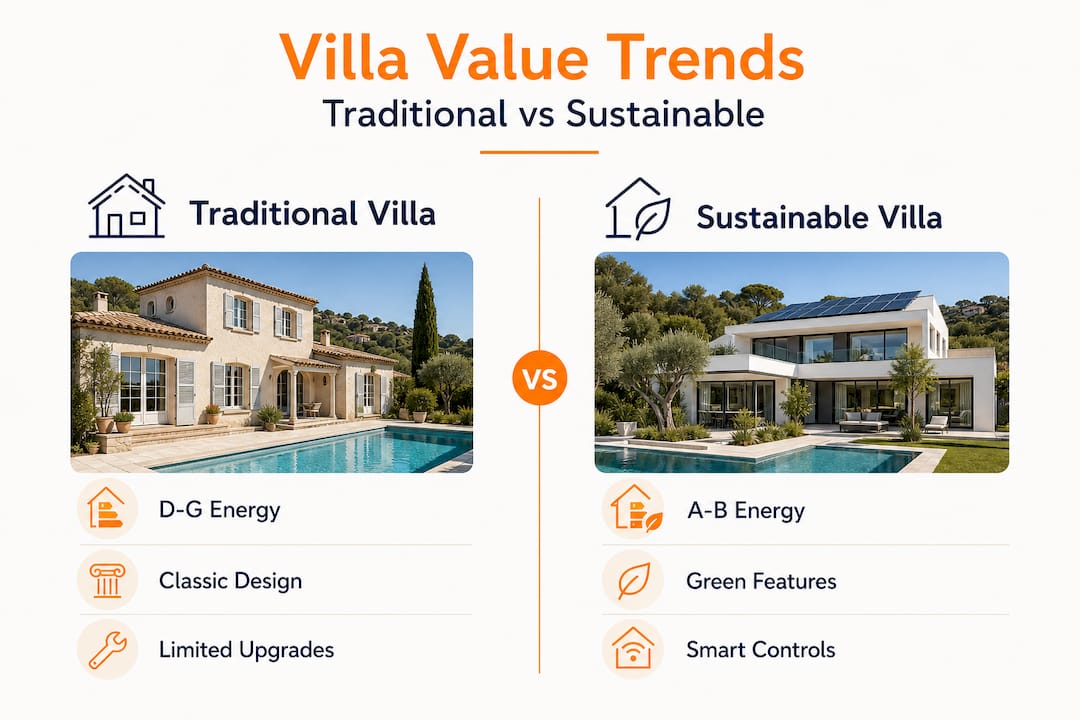
| Feature | Traditional Riviera villa | Modern sustainable villa |
|---|---|---|
| Energy rating | Often D to G | A or B with eco finishes |
| Heating system | Oil-fired or old gas | Geothermal, heat pump or solar |
| Insulation | Standard or period | High-performance triple glazing |
| Water management | Standard mains | Rainwater harvesting, grey water recycling |
| Smart home technology | Minimal | Integrated automation |
| Resale appeal in 2030+ | Vulnerable to regulation | Strongly positioned |
| Rental marketability | Declining for poor ratings | Premium lettable asset |
The most compelling legacy investments we see on the Riviera in 2026 are those that blend heritage character with modern performance. A restored Provençal mas above Menton’s Val Rahmeh botanical garden, fitted with solar arrays and a geothermal heating system, satisfies both the aspirations of a discerning family and the demands of regulators who will inevitably tighten further.
To future-proof your property appreciation and protect value across generations, we recommend addressing the following:
- Commission a full energy audit before acquisition, not after
- Budget for solar installation and heat pump conversion as part of your purchase negotiation
- Integrate smart home technology to attract younger, technology-fluent buyers and tenants
- Assess flood and coastal erosion risk using updated 2025 PPRI mapping data
- Seek properties with the highest possible DPE rating or factor remediation costs into your offer
- Structure ownership through a Société Civile Immobilière for multi-generational transfer efficiency
- Confirm BREEAM or equivalent green certification for new build acquisitions
The legacy dimension extends beyond environmental compliance. Apartment value prospects are also shaped by how well the building itself is managed and maintained across decades. A well-governed co-propriété with proactive sustainability investment retains far more value than an identical building with deferred maintenance and no green strategy.
Pro Tip: Prioritising compliance with post-2030 environmental regulations during your 2026 acquisition gives you a structural advantage. Properties already meeting future standards command a growing premium today, and that premium widens considerably as the regulatory deadline approaches.
Liquidity, demand and market timing
Having covered what builds value, it is vital to understand how you can realise it through liquidity and the dynamics of buyer demand that define this market.
Liquidity on the Côte d’Azur is not uniform. A four-bedroom villa with a private pool in Cap d’Antibes will typically attract multiple credible buyers within weeks of discreet market exposure. An over-specified, awkwardly configured penthouse in an inland town without sea views may sit for eighteen months. The distinction matters profoundly when you are planning an exit, a refinancing event, or a generational transfer of wealth.
Recent market trends reveal a significant evolution in buyer profiles across the Riviera. Millennial high-net-worth individuals now represent a growing proportion of acquisitions above €3M, drawn by lifestyle flexibility, remote working infrastructure, and the Riviera’s unrivalled combination of culture, climate, and connectivity. Digital entrepreneurs in particular are attracted by the ability to pay in cryptocurrency, a facility we offer across our portfolio. Non-EU buyers from the Gulf, the United States, and East Asia continue to exert strong upward pressure on prime prices, providing a demand floor that has insulated the market through broader European economic turbulence.
Côte d’Azur market resilience is a genuine and documented characteristic of this region, yet even the most prestigious markets experience cyclical softening. To maintain liquidity and maximise your ability to transact when opportunity presents itself, consider the following strategies:
- Position your property for the seasonal letting market to generate cash flow that offsets carrying costs during any holding period
- Maintain impeccable presentation standards, as first impressions at the Pampelonne paddleboard lifestyle level set buyer expectations before they ever step inside a property
- Retain flexibility on timing, and study when to invest across the calendar year, as late autumn and early spring often present acquisition opportunities before Festival season competition intensifies
- Ensure clear title, updated diagnostics, and complete regulatory compliance to remove friction from any future sale process
- Cultivate relationships with advisers who have access to the off-market ecosystem, where the most liquid transactions occur quietly, between trusted parties
Demand dynamics are also seasonal in character. The Cannes Film Festival, the Monaco Grand Prix, the Menton Lemon Festival, and the Antibes Jazz Festival each create distinct waves of buyer and tenant interest that a well-timed marketing campaign can harness. Understanding this rhythm is part of the investor’s craft on the Riviera.
Our perspective: The overlooked forces that set true value
Conventional wisdom on luxury property investment tends to fixate on the obvious: sea views, brand-name addresses, and headline square metreage. We have observed this pattern across hundreds of transactions, and it consistently leads sophisticated buyers to overpay for surface glamour while overlooking the forces that actually determine where value goes next.
The uncomfortable reality is that a stunning villa with a compromised energy rating in a commune facing rising taxe foncière and tightening rental regulations is not a premium asset. It is a liability dressed in beautiful stone. The properties that consistently outperform across five and ten-year horizons share a different set of qualities: regulatory compliance that anticipates future law rather than merely meeting today’s minimum, ownership structures designed for wealth transfer efficiency, and locations where international buyer demand remains structurally robust regardless of market sentiment.
We also observe that buyers who treat liquidity as an afterthought pay for that oversight at precisely the wrong moment. The Riviera is not immune to illiquid periods; it simply recovers faster than most markets. Those who position their assets correctly, with strong energy ratings, clear title, and lifestyle credentials that speak to the next generation of wealthy buyers, enjoy a materially shorter time to sale and a stronger negotiating position when the moment arrives.
The key features of value that will define the decade to come are not the marble floors or the infinity pool alone. They are the solar arrays humming quietly above them, the SCI structure protecting them for the next generation, and the energy rating that ensures they remain fully lettable when competitors’ properties cannot be offered on the rental market at all. Value for tomorrow is being created and protected today by those who are adjusting ahead of the curve.
Explore investment opportunities on the Côte d’Azur
With these insights in hand, exploring curated opportunities and tailored support will elevate your investment approach from informed to exceptional. At Living on the Côte d’Azur, we provide exclusive access to off-market luxury listings that never appear on public portals, connecting you directly to the estates and villas that define genuine legacy value. Our curated portfolio of villas and penthouses for sale spans the full arc of the Riviera, from Menton’s lemon-scented heights to Saint-Tropez’s storied Vieux Port. We accept cryptocurrency and we partner with specialist advisers to guide you through tax structuring, sustainability upgrades, and legacy-focused real estate strategies that endure across generations. Your next chapter on the Côte d’Azur begins here.
Frequently asked questions
How does the IFI wealth tax influence luxury property value?
The IFI tax at 0.5–1.5% on property above €1.3M creates meaningful annual ownership costs that reduce net yields and must be factored into acquisition price negotiations and long-term return modelling.
What sustainable features add the most value to Côte d’Azur property?
High energy performance ratings (A or B on the DPE), solar arrays, geothermal or heat pump systems, and integrated smart home technology are the features that most powerfully influence buyer appetite and future lettability.
Do market cycles affect luxury property values in this region?
The Côte d’Azur has historically proved more resilient than broader European markets, but cycle awareness still matters; strategic timing around seasonal demand peaks and regulatory milestones can meaningfully improve both acquisition pricing and exit returns.
Does international demand still drive up Côte d’Azur prices?
Sustained international interest from non-EU buyers across the Gulf region, the Americas, and Asia continues to provide a strong structural floor beneath prime prices, even as local taxation pressures increase the cost of ownership for all buyers.
Recommended
 //
//