Properties adorned with luxury finishes boost resale value by up to 25% on the Côte d’Azur, transforming acquisitions into legacy assets. Yet discerning investors often struggle to decode what separates genuine luxury craftsmanship from superficial embellishments. This guide clarifies the materials, artistry, and sustainability benchmarks defining premium finishes, equipping you to maximize ROI and secure heirloom estates in 2026’s competitive Riviera market. Master the framework that separates transient trends from timeless value.
Table of Contents
- Introduction To Luxury Finishes In Real Estate
- Defining Luxury Finishes: Materials And Craftsmanship
- Value Impact And ROI Of Luxury Finishes
- Legacy Value Through Premium Craftsmanship
- Sustainability Trends In Luxury Finishes
- Common Misconceptions About Luxury Finishes
- Comparative Framework: Luxury Vs Standard Finishes
- Case Studies Of ROI From Luxury Finishes
- Explore Côte D’Azur Luxury Real Estate Investments
- Frequently Asked Questions
Key Takeaways
| Point | Details |
|---|---|
| Value Premium | Luxury finishes deliver 15-25% resale premiums and 3% higher rental yields in Côte d’Azur properties. |
| Craftsmanship Primacy | Artisanal techniques and rare materials outweigh price tags in determining long-term value retention. |
| Sustainability Appeal | Eco-luxury finishes with LEED or WELL certifications capture 30% increased buyer demand in 2026. |
| Legacy Foundation | Heirloom-quality materials and bespoke design create intergenerational wealth through steady 5-8% annual appreciation. |
| Evaluation Framework | Five dimensions—material quality, craftsmanship, exclusivity, sustainability, certifications—guide informed investment decisions. |
Introduction to Luxury Finishes in Real Estate
Luxury finishes in real estate transcend aesthetics to become strategic investment components that drive financial performance and legacy value. In 2026’s Côte d’Azur market, where villas command €2M+ premiums for sea views and eco-conscious design, understanding these finishes separates astute investors from speculative buyers. They represent the intersection of superior materials, artisanal craftsmanship, and exclusivity that discerning high-net-worth individuals prioritize when securing family estates.
Grasping luxury finishes empowers investors to identify properties offering both immediate rental yields and multi-generational appreciation. This knowledge becomes particularly vital as digital millionaires channel cryptocurrency gains into tangible Riviera assets that promise ROI through seasonal letting and capital growth. The challenge lies in distinguishing genuine luxury from marketed illusions, especially when evaluating off-plan developments in hotspots like Cap d’Antibes or Monaco-adjacent plots.
This comprehensive examination explores five critical dimensions that define luxury finishes:
- Material quality and provenance, from exotic hardwoods to natural stones
- Artisanal craftsmanship techniques ensuring durability and uniqueness
- Exclusivity factors that preserve desirability across market cycles
- Sustainability credentials meeting evolving buyer expectations
- Certification standards validating green luxury claims
Mastering these elements transforms property assessment from subjective guesswork into confident, data-informed acquisition strategy. Common investor challenges include overvaluing cosmetic upgrades, underestimating maintenance requirements, and misreading market signals around eco-luxury trends. The framework presented here addresses each pitfall while illuminating pathways to properties that appreciate steadily, rent at premium rates, and transition seamlessly between generations.
Defining Luxury Finishes: Materials and Craftsmanship
Authentic luxury finishes begin with materials sourced for rarity, longevity, and aesthetic distinction. Exotic hardwoods and natural stones with durability exceeding 30 years form the foundation of premium interiors on the Riviera. Think Brazilian walnut flooring that darkens beautifully over decades, Carrara marble countertops from historic Italian quarries, or hand-hewn limestone from Provence’s ancient quarries. These materials carry inherent value through scarcity and time-tested performance.
Craftsmanship elevates raw materials into investment-grade features. Artisanal techniques such as hand-carved wood inlays, custom bronze metalwork, and traditionally troweled Venetian plaster transform spaces into singular expressions. A master artisan’s signature on cabinetry or tilework guarantees uniqueness that mass production cannot replicate. This human element resonates powerfully with buyers seeking properties that tell stories and reflect personal identity.
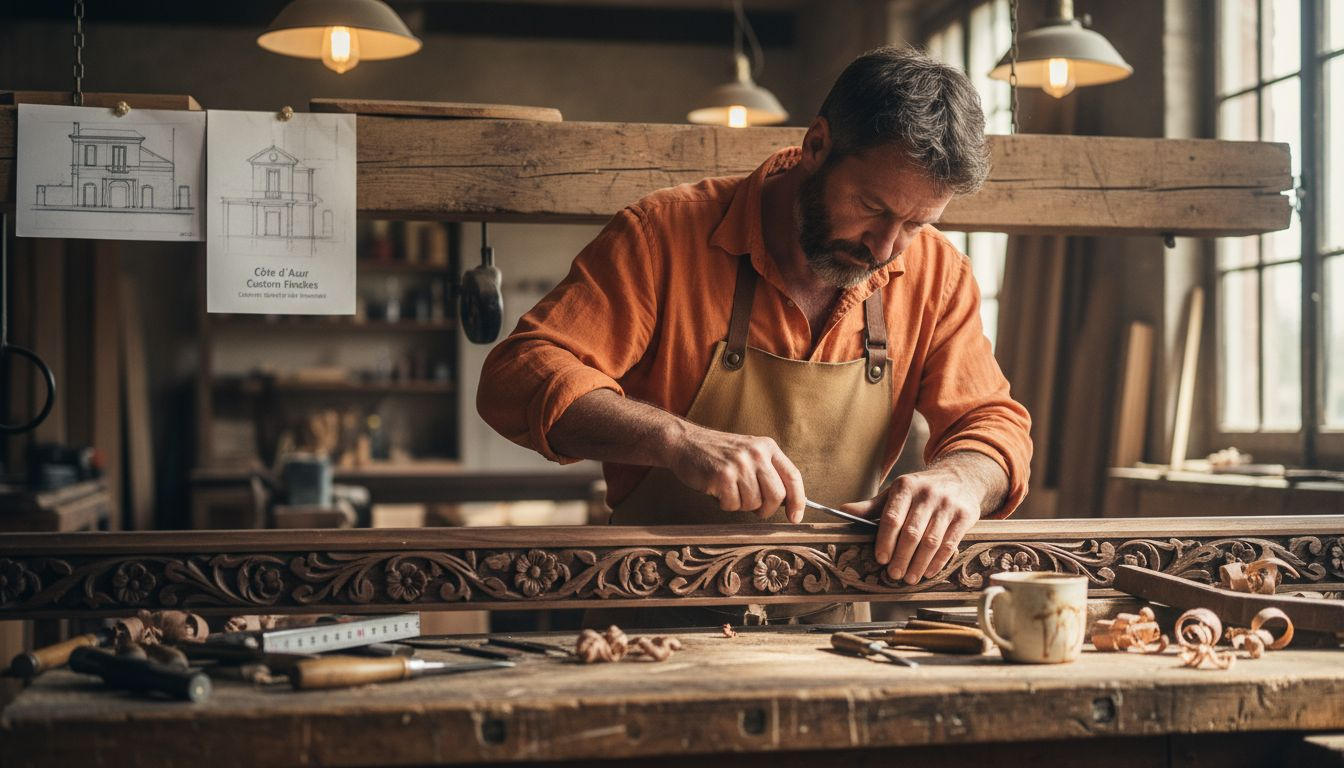
The relationship between craftsmanship quality and property longevity cannot be overstated. Superior workmanship ensures finishes withstand Mediterranean humidity, salt air, and intense sunlight without degrading. When driving factors behind luxury home prices are analyzed, durability emerges as a silent value multiplier. A villa with hand-laid terracotta tiles and mortise-and-tenon joinery requires minimal intervention for generations, reducing total ownership costs while maintaining pristine presentation.
Exclusivity stems from both material scarcity and artisan availability. Limited-edition stone batches, bespoke hardware forged by renowned metalsmiths, and commissioned art glass installations create differentiation impossible to duplicate. This exclusivity protects value during market downturns, as discerning buyers recognize irreplaceable features. Understanding luxury property terms helps investors articulate these distinctions during acquisitions and resales.
Pro Tip: Verify material origin certificates and request artisan portfolios during property viewings. Authentic luxury finishes come with documented provenance, including quarry sources for stone, forest management certifications for wood, and artisan credentials. This documentation not only validates quality but becomes a selling asset when transitioning the property to future buyers or heirs seeking assurance of heirloom status.
Value Impact and ROI of Luxury Finishes
Properties with luxury finishes yield 15-25% resale value premiums and 3% higher rental yields across the Côte d’Azur, transforming initial investment into compounding returns. A €4M villa with bespoke finishes in Antibes’ Cap appreciates to €5M-€5.2M over five years, while comparable properties with standard finishes plateau at €4.5M. This premium reflects buyer willingness to pay for authenticity, exclusivity, and reduced future renovation needs.
Annual appreciation rates tied to superior craftsmanship consistently outpace broader market trends. While generic luxury properties appreciate 3-4% annually, those featuring artisanal finishes achieve 5-8% growth as documented in luxury property appreciation factors. This differential compounds dramatically over holding periods. A €3M investment appreciating at 7% reaches €4.2M in five years, versus €3.65M at 4%, creating €550K in additional wealth.
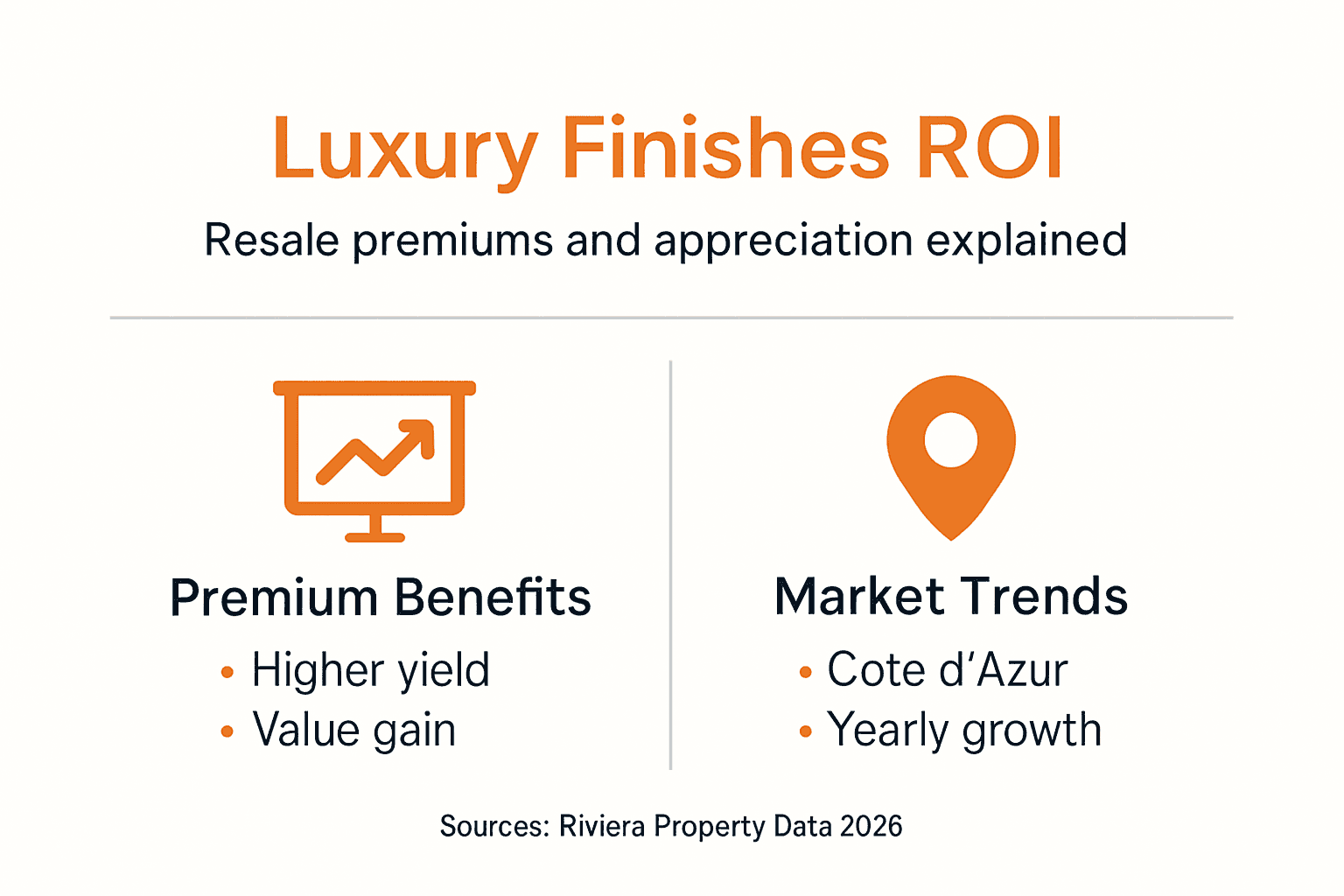
Rental yield improvements from premium finishes reach approximately 3% above market rates. Elite clientele seeking seasonal Riviera rentals actively filter for properties showcasing museum-quality interiors and eco-luxury features. A Cannes penthouse commanding €15K weekly versus €10K for standard luxury units generates €260K annually instead of €200K, purely through finish differentiation. Over a decade, this €60K annual premium delivers €600K in additional income.
Financial benefits justifying luxury finish investments include:
- Enhanced marketability reducing time-on-market by 30-40% during sales cycles
- Premium positioning attracting international buyers less sensitive to price fluctuations
- Reduced depreciation as quality materials maintain aesthetics without costly updates
- Stronger negotiating position during economic uncertainty when buyers prioritize certainty
- Higher appraisal values supporting favorable financing terms for purchasers
Durability amplifies ROI by deferring major capital expenditures. Standard finishes require replacement every 10-15 years at costs reaching €200K-€500K for Riviera estates. Luxury finishes maintain integrity for 30+ years, eliminating these expenses while the property continues appreciating. Exclusivity sustains demand across cycles, as truly unique properties attract buyers even during market contractions. Market demand for authenticated luxury remains inelastic, insulating investments from broader volatility.
Legacy Value through Premium Craftsmanship
Heirloom-quality finishes form the bedrock of intergenerational wealth strategies on the Côte d’Azur. When families channel inheritance into restored Provençal mas featuring hand-hewn beams, original terra-cotta floors, and artisan ironwork, they acquire assets that appreciate while serving as gathering places for descendants. Craftsmanship adds 5-8% yearly property appreciation, creating durable wealth that survives market turbulence and currency fluctuations.
This appreciation stems from craftsmanship’s intrinsic scarcity. As master artisans age without successors, their work becomes increasingly rare and coveted. A villa featuring tilework by a renowned ceramicist or woodwork by a fourth-generation ebeniste gains value not despite age but because of it. The property embodies irreplaceable human skill, positioning it as cultural artifact and financial asset simultaneously.
Investor mindset prioritizing heritage over quick returns aligns perfectly with legacy and ROI through craftsmanship. High-net-worth families recognize that properties passing to grandchildren must offer more than square meters and views. They must carry stories, demonstrate taste, and reflect values. A Monaco-adjacent estate with commissioned murals, bespoke cabinetry, and sustainable materials becomes a teaching tool about quality, patience, and stewardship.
Bespoke finishes appeal powerfully to next-generation buyers valuing authenticity and sustainability. Millennials and Gen Z heirs inheriting wealth seek properties aligning with environmental values while maintaining luxury standards. Eco-luxury villas featuring reclaimed wood, low-VOC finishes, and energy-efficient systems satisfy both criteria. These properties command premiums from buyers willing to pay for alignment between assets and identity.
“Premium craftsmanship transforms properties from mere investments into family legacies, delivering consistent 5-8% annual appreciation while serving as tangible expressions of heritage and values across generations.”
Key legacy advantages include:
- Tax-efficient wealth transfer as appreciating real assets rather than liquid holdings
- Emotional anchoring creating family continuity and shared identity
- Rental income funding maintenance without depleting principal
- Protection against inflation through tangible asset ownership
- Flexibility to adapt usage across generations without compromising value
Sustainability Trends in Luxury Finishes
Eco-luxury property trends show 30% increased demand for finishes combining environmental responsibility with uncompromising aesthetics in 2026. LEED Gold and WELL certifications no longer represent niche preferences but mainstream expectations among Côte d’Azur buyers. Properties lacking green credentials face pricing disadvantages as sustainability becomes inseparable from luxury positioning.
Green certification benefits extend beyond environmental virtue signaling to tangible financial advantages. LEED-certified villas achieve faster sales, higher appraisals, and premium rental rates. The certification process validates material sourcing, indoor air quality, energy efficiency, and water conservation, providing buyers objective assurance of claims. WELL certification focuses on occupant health through lighting quality, acoustic performance, and material toxicity standards, appealing to wellness-focused buyers.
Sustainability influences property desirability through multiple channels. Eco-conscious luxury finishes reduce operational costs via energy-efficient systems and durable materials requiring less frequent replacement. A Saint-Tropez estate with solar-integrated roof tiles, greywater recycling, and natural ventilation systems operates at 40% lower cost than conventional luxury properties, enhancing net rental yields. Lower operating expenses translate directly to higher NOI and valuation multiples.
Maintenance savings from sustainable finishes compound over ownership periods. Low-VOC paints maintain color longer, bamboo flooring resists humidity better than traditional hardwoods, and recycled glass countertops require minimal sealing. These materials reduce annual maintenance budgets by 20-30% while maintaining pristine condition. For investors holding properties 10-20 years, these savings total hundreds of thousands of euros.
Changing buyer demographics accelerate eco-luxury demand:
- Digital entrepreneurs valuing environmental alignment alongside financial returns
- Families prioritizing health and air quality for children’s wellbeing
- Retirees seeking low-maintenance, high-efficiency properties for aging in place
- International buyers from markets where green building is standard expecting similar quality
- Institutional investors requiring ESG compliance in real estate portfolios
The intersection of luxury and sustainability creates competitive advantage. Properties marketed as eco-luxury command 10-15% premiums while appealing to expanding buyer pools, reducing market risk and improving liquidity.
Common Misconceptions about Luxury Finishes
Investors frequently equate price with luxury quality, assuming expensive materials guarantee superior value. Luxury finishes are not defined by price alone; craftsmanship and maintenance requirements prove equally critical. A €50K marble installation executed poorly delivers less value than €30K limestone installed by master craftsmen. The artisan’s skill in material selection, cutting, and placement determines longevity and aesthetic success far more than raw material cost.
Misconception: All expensive finishes automatically qualify as luxury investments. Reality reveals that true luxury requires documented provenance, artisan credentials, and durability testing. Costly but poorly sourced materials fail performance standards, requiring premature replacement that destroys ROI. Verify material certifications, installation credentials, and warranty terms before accepting finish quality claims.
Misconception: Luxury finishes require no specialized maintenance to preserve value. Premium materials demand expert care protocols. Exotic hardwoods need specific humidity levels and cleaning products. Natural stone requires periodic sealing with compatible compounds. Neglecting these requirements accelerates deterioration, transforming luxury assets into liabilities. Budget 1-2% of property value annually for specialized maintenance when evaluating total ownership costs.
Misconception: Trendy finishes deliver equivalent returns to timeless luxury choices. Fashion-forward materials and colors date properties, limiting buyer appeal and necessitating expensive updates. Classic materials like marble, hardwood, and limestone remain desirable across decades, while contemporary synthetics lose value as trends shift. Prioritize materials with centuries of proven appeal over novelty when seeking legacy assets.
Successful due diligence on luxury finishes requires looking beyond surface appearances to underlying quality indicators. Examine joinery tightness, material consistency, and installation precision. Request maintenance records demonstrating proper care. Investigate artisan reputations and material sourcing through independent verification rather than relying solely on developer claims.
Pro Tip: During property viewings, ask specific questions revealing finish authenticity. Inquire about stone quarry locations, wood forest management certifications, artisan training backgrounds, and warranty coverage specifics. Genuine luxury providers answer confidently with documentation, while superficial luxury marketers deflect or provide vague responses. This questioning immediately separates authentic quality from marketing narratives.
Comparative Framework: Luxury vs Standard Finishes
A structured evaluation framework empowers investors to assess properties systematically across five investment-relevant dimensions. Material quality examines sourcing, rarity, and performance characteristics. Craftsmanship evaluates artisan skill levels and installation precision. Exclusivity measures uniqueness and replicability. Sustainability assesses environmental credentials and operational efficiency. Certifications validate claims through independent third-party verification.
This five-dimension approach from evaluating luxury real estate effectively transforms subjective impressions into objective assessments. Each dimension receives scoring based on documented evidence rather than marketing claims. Properties scoring highly across all dimensions justify premium pricing and promise superior long-term performance. Those excelling in only one or two dimensions may offer value but require realistic return expectations.
| Dimension | Luxury Finishes | Standard Finishes |
|---|---|---|
| Material Quality | Rare, documented provenance; 30+ year durability; exotic hardwoods, natural stones | Common materials; 10-15 year lifespan; engineered products, basic tiles |
| Craftsmanship | Hand-executed by master artisans; bespoke details; traditional techniques | Factory-produced or basic installation; standard patterns; minimal customization |
| Exclusivity | Limited availability; custom commissions; artisan signatures | Mass-produced; readily available; interchangeable with market inventory |
| Sustainability | LEED/WELL certified; low-VOC; reclaimed/responsibly sourced; energy-efficient | Basic efficiency; standard materials; minimal environmental credentials |
| Certifications | Third-party validated; forest stewardship; artisan guild memberships | Limited documentation; generic warranties; no independent verification |
Practical application tips for buyers employing this framework:
- Score each dimension 1-10 during property tours, creating comparable data across multiple acquisitions
- Require documentation supporting high scores, rejecting subjective claims without evidence
- Weight dimensions according to personal priorities, emphasizing sustainability for legacy estates or craftsmanship for immediate resale value
- Engage independent experts to verify scores in unfamiliar material categories or artisan specialties
- Compare scores against asking prices to identify undervalued opportunities or overpriced properties
This systematic approach eliminates emotional decision-making and anchoring biases. A €5M villa scoring 9/10 across dimensions justifies its price, while a €6M property scoring 6/10 signals overvaluation. The framework becomes particularly valuable when evaluating off-plan developments where physical inspection is impossible, forcing reliance on specifications and reputation.
Case Studies of ROI from Luxury Finishes
Cap d’Antibes villa data demonstrate 7% CAGR and 3% rental yield premiums over 8 years for properties featuring bespoke luxury finishes versus comparable standard-finish estates. A €4.5M acquisition in 2018 with hand-laid limestone floors, custom bronze fixtures, and artisan-painted ceilings reached €7.8M valuation by 2026, while neighboring standard properties appreciated only to €6.2M. Annual rental income averaged €225K versus €150K for standard comparables, driven by elite clientele specifically seeking authenticated luxury.
Bespoke finishes correlate directly with superior financial performance across multiple metrics. Properties featuring commissioned artwork, custom cabinetry, and rare materials maintain occupancy rates 15-20% above market averages during shoulder seasons. This consistency stems from differentiation that commands loyalty among repeat luxury renters. A Cannes waterfront apartment with Murano glass installations and hand-knotted silk rugs achieves 85% annual occupancy versus 65% market average, translating to €120K additional revenue over five years.
Market hotspots benefit disproportionately from luxury finish investments. Monaco-adjacent properties and Cap d’Antibes estates see the strongest premiums, as buyer pools in these locations specifically seek uncompromising quality. A Monaco border villa with €800K in luxury finishes commands €3M premium over equivalent square footage with standard finishes, representing 375% return on finish investment alone.
| Location | Avg Annual Appreciation | Rental Yield Premium | Finish Investment ROI |
|---|---|---|---|
| Cap d’Antibes | 7.2% | +3.1% | 340-380% over 8 years |
| Monaco Borders | 6.8% | +2.8% | 310-350% over 8 years |
| Cannes Croisette | 6.3% | +2.4% | 280-320% over 8 years |
| Saint-Tropez Peninsula | 5.9% | +2.2% | 250-290% over 8 years |
Real-world proof validates luxury finish investment thesis across market conditions. During 2020-2021 pandemic uncertainty, luxury-finish properties maintained values while standard inventory declined 8-12%. This resilience reflects buyer flight to quality during uncertainty, with authenticated luxury serving as safe haven. The pattern repeated during 2023 rate increases, when luxury-finish villas sold at ask or above while standard properties languished with price reductions.
Explore Côte d’Azur Luxury Real Estate Investments
Transform these insights into legacy assets through expert guidance focused on premium-finish properties across the Riviera. Our curated portfolio emphasizes estates meeting the five-dimension luxury framework, from Cap d’Antibes villas with artisan detailing to Monaco-adjacent new constructions featuring LEED certification and ten-year warranties. Understanding luxury real estate fundamentals positions you to capitalize on 2026’s unique market conditions, where easing rates and sustainable development converge.
Navigate luxury property acquisition complexities with specialists who verify finish authenticity, negotiate artisan documentation, and structure cryptocurrency transactions seamlessly. Our team conducts independent material provenance verification, artisan credential checks, and maintenance protocol development ensuring your investment maintains heirloom status across generations. We connect digital millionaires with off-plan opportunities in Sainte-Maxime and Nice’s Mont Boron, where sustainable luxury meets innovative payment flexibility.
Develop comprehensive real estate investment strategies balancing immediate rental yields with multi-generational appreciation. Whether channeling inheritance into restored Provençal estates or diversifying cryptocurrency gains into tangible Riviera assets, our approach prioritizes authenticated luxury finishes delivering measurable ROI and enduring family value.
Frequently Asked Questions
What defines luxury finishes in Côte d’Azur real estate?
Luxury finishes combine rare materials with artisanal craftsmanship and documented provenance, distinguishing them from standard high-end installations. Exotic hardwoods from certified sustainable forests, natural stones from historic quarries, and custom metalwork by guild-certified artisans exemplify this category. The defining characteristic is irreplicability, as true luxury finishes cannot be mass-produced or readily sourced, creating inherent scarcity that preserves value across market cycles and generations.
How do luxury finishes affect property maintenance requirements?
Premium materials demand specialized care protocols to maintain performance and aesthetics over decades. Exotic hardwoods require climate-controlled environments and specific cleaning products, while natural stone needs periodic sealing with compatible compounds. Budget 1-2% of property value annually for expert maintenance, including artisan-level repairs that preserve finish integrity. This investment protects the 15-25% resale premium luxury finishes command, making specialized care financially rational for legacy-focused owners.
Can eco-friendly certifications truly enhance luxury property value?
LEED Gold and WELL certifications deliver measurable financial benefits beyond environmental virtue, with certified properties achieving 10-15% price premiums and 30% faster sales in 2026. These third-party validations provide objective assurance of material quality, energy efficiency, and occupant health standards that buyers increasingly prioritize. Operational cost savings of 20-40% enhance rental yields, while growing ESG investor requirements expand buyer pools, reducing market risk and improving liquidity for certified luxury estates.
How do I differentiate genuine luxury finishes from marketing claims?
Demand documentation including material origin certificates, artisan credentials, and independent quality verification during property evaluations. Authentic luxury providers readily supply quarry sources for stone, forest management certifications for wood, and artisan portfolio evidence. Ask specific questions about installation techniques, warranty coverage, and maintenance requirements. Evasive or vague responses signal superficial luxury positioning, while confident detailed answers with supporting documentation indicate genuine quality worth premium pricing.
What ROI should I expect from luxury finish investments on the Riviera?
Data shows 15-25% resale value premiums and 3% higher rental yields for luxury-finish properties versus standard comparables across the Côte d’Azur. Annual appreciation rates of 5-8% for artisan-quality finishes exceed broader market growth of 3-4%, compounding significantly over holding periods. Cap d’Antibes case studies demonstrate 340-380% return on finish investment over eight years, combining appreciation, rental premiums, and maintenance cost savings. These returns justify initial finish premiums while creating durable intergenerational wealth through properties that serve as both family sanctuaries and appreciating assets.
Recommended
 //
//