
TL;DR:
- Ultra-prime French Riviera real estate offers valuable negotiation opportunities influenced by seller psychology, seasonality, and fee structures. Skilled, systematic negotiators can significantly reduce purchase costs by addressing agency fees, timing, and relationship-building strategies. Understanding emotional and legacy interests enhances success in this exclusive market where discretion and reputation are critical.
The assumption that ultra-prime real estate on the French Riviera is a take-it-or-leave-it affair is, frankly, one of the most expensive myths in high-net-worth property acquisition. From the bougainvillea-draped bastides above Èze to the palatial sea-view residences along Cap d’Antibes’ coastal sentiers, prices appear immovable at first glance. Yet beneath the polished surface of every asking price lies a negotiating landscape shaped by seller psychology, seasonal rhythms, tax architecture, and the subtle art of relationship-building. Elite buyers who understand this landscape consistently secure better terms, more favourable tax positions, and stronger long-term returns.
Table of Contents
- Why negotiation matters for luxury real estate on the French Riviera
- Core negotiation frameworks: What elite buyers do differently
- Practical strategies for negotiating French Riviera property deals
- Common pitfalls in luxury property negotiation and how to avoid them
- What most real estate negotiation guides miss about ultra-prime markets
- Connect with off-market French Riviera opportunities
- Frequently asked questions
Key Takeaways
| Point | Details |
|---|---|
| Negotiation saves costs | Even in luxury markets, strategic negotiation cuts fees, taxes, and boosts investment value. |
| Elite frameworks outperform | Structured approaches like stakeholder mapping and concession planning deliver better results than ad hoc tactics. |
| Timing matters | Negotiating in off-peak seasons or with motivated sellers increases your leverage and potential discount. |
| Avoid costly mistakes | Lowball offers and neglecting fee optimisation can ruin deals or add unnecessary costs. |
| Legacy and emotion count | Understanding identity and emotional drivers unlocks unique opportunities in ultra-prime deals. |
Why negotiation matters for luxury real estate on the French Riviera
The French Riviera remains one of Europe’s most coveted property markets, a constellation of prestige addresses where demand persistently outpaces supply. This reality leads many buyers, even sophisticated family offices, to assume that negotiation is futile. It is not.
Even in the tightest markets, skilled negotiation can reshape the economics of a transaction in meaningful ways. One of the most overlooked levers is how agency fees are structured. As noted in detailed market updates French Riviera analysis, negotiating agency fees separately from the purchase price can reduce the notary fee calculation base, which typically runs at 7 to 8 percent of the declared price. On a €1 million acquisition where agency fees amount to €60,000, structuring the fees outside the sale price can yield approximately €5,000 in immediate savings, before factoring in the compounding effect on annual property taxes.
The question of margin is equally nuanced. Supply constraints create slim margins of 5 to 10 percent in competitive conditions, but off-peak periods such as winter months or situations where a property has been overpriced by 10 percent or more open considerably more room. The key principle: never lowball to the point of breaking the dialogue.
| Purchase price | Typical negotiation range (5-10%) | Notary fee saving via agency fee separation | Combined potential saving |
|---|---|---|---|
| €1,000,000 | €50,000 to €100,000 | ~€4,800 | ~€54,800 to €104,800 |
| €3,000,000 | €150,000 to €300,000 | ~€14,400 | ~€164,400 to €314,400 |
| €7,500,000 | €375,000 to €750,000 | ~€36,000 | ~€411,000 to €786,000 |
The figures above illustrate why even a modest improvement in negotiating skill translates to material wealth preservation. For family offices securing luxury property growth as a multi-generational asset, this is not a peripheral concern. It is central to the investment thesis.
“In high-demand Riviera markets, the question is never whether to negotiate, but how to negotiate with enough intelligence that you preserve the relationship while securing real value. Every percentage point retained is compounded across decades of appreciation.”
Core negotiation frameworks: What elite buyers do differently
Most buyers approach property negotiation instinctively, guided by gut feeling and whatever leverage seems obvious at the time. Elite buyers approach it as a structured process, and the results reflect that discipline.

Research into elite negotiation methodology confirms that pre-briefs, stakeholder mapping, and formal concession planning reduce negotiation cycles by 33 percent, from an average of nine rounds to six, while boosting close rates by 11 percent. These are not marginal gains. They are the difference between securing a prized Cap d’Antibes villa and watching it transfer to a better-prepared buyer.
Equally revealing is the Harvard framework for negotiation, which prioritises rational, emotional, and identity interests simultaneously. Analyses of failed transactions, including data suggesting that 70 percent of high-value M&A deals collapse due to oversight of these layered interests, apply directly to ultra-prime real estate. A seller who has lived in a Provençal mas for thirty years is not merely transacting on price. They are also transacting on legacy, on who will inherit the light that fills those stone-walled rooms each morning.
Ad hoc negotiation vs. systematised approach
| Factor | Ad hoc approach | Systematised approach |
|---|---|---|
| Preparation | Reactive, price-focused | Structured pre-brief with stakeholder map |
| Concession planning | Improvised in the moment | Predefined boundaries and approval matrix |
| Relationship management | Variable, often neglected | Consistent rapport-building at each stage |
| Number of rounds | Average 9 | Average 6 (33% reduction) |
| Close rate | Baseline | 11% higher |
| Tax and fee optimisation | Rarely addressed | Built into the structure from outset |
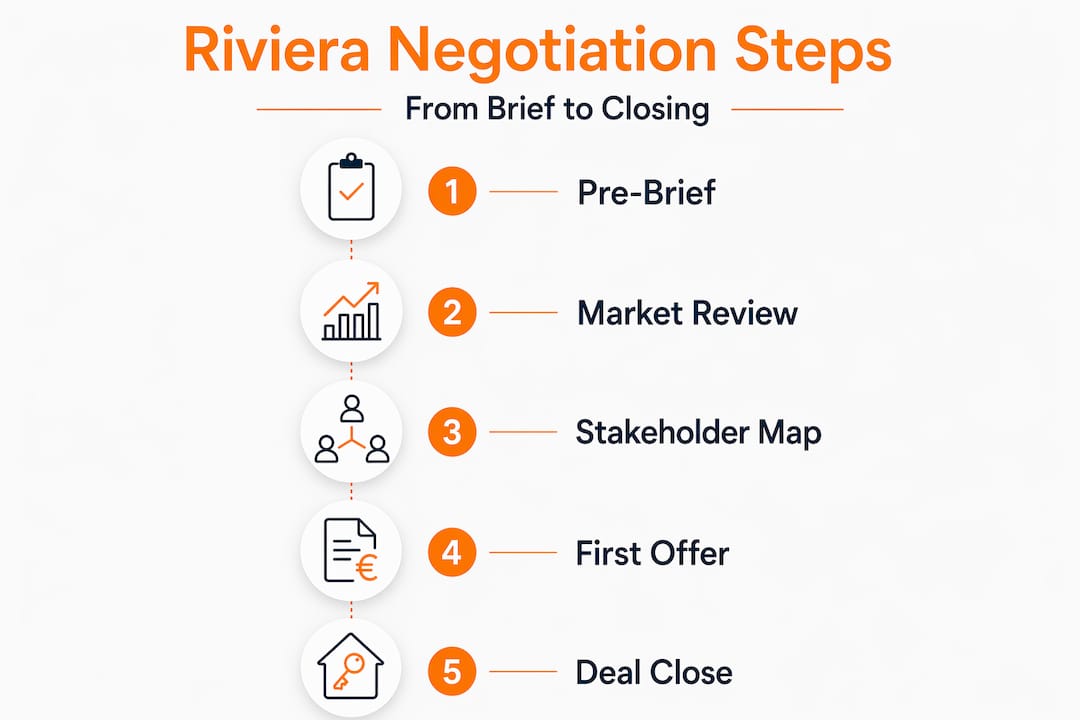
The five steps that top negotiators follow when pursuing private real estate sales tips in ultra-prime markets are as follows:
- Pre-brief: Establish your walk-away position, ideal outcome, and emotional priorities before any contact with the seller’s agent.
- Stakeholder mapping: Identify all decision-makers, including trustees, family members, or co-owners, since Riviera estates often involve complex ownership structures.
- Concession planning: Determine in advance which concessions you are willing to make (timing, deposit structure, furniture, crypto payment terms) and their relative value.
- Opening position: Place an offer that is credible and respectful, typically within 10 percent of asking unless there is a well-documented basis for a larger adjustment.
- Close with clarity: Confirm all agreed terms in writing immediately after any verbal agreement, ensuring no ambiguity enters the process.
Pro Tip: Always document your concession boundaries and approval matrix before your first offer. Knowing exactly what you will and will not trade prevents costly in-the-moment decisions that sellers and agents are trained to exploit. This preparation is especially critical when you are investing for lasting value as part of a broader family portfolio strategy.
Practical strategies for negotiating French Riviera property deals
The Côte d’Azur is not a monolithic market. The dynamics in Cannes, where Croisette-facing penthouses attract film-festival buyers each spring, differ meaningfully from those in Sainte-Maxime, where buyers arrive via summer ferry from Saint-Tropez and can be swayed by the romance of Nartelle beach sunsets. Timing, seller motivation, and local nuance all create leverage that a well-prepared buyer can use.
Here are the key strategies we have seen deliver consistent results:
- Separate agency fees from the purchase price. As confirmed by French Riviera transaction specialists, structuring fees separately removes them from the notary fee calculation and from the taxable base for property taxes. On larger acquisitions this alone justifies the effort.
- Analyse seller motivation before making any offer. A seller relocating for professional reasons, managing an estate, or facing liquidity pressures is structurally more flexible than one who is merely testing the market.
- Time your approach deliberately. Negotiation room widens in off-peak periods, particularly between November and February when fewer competing buyers are active and sellers who listed optimistically in summer begin to recalibrate expectations.
- Engage bilingual negotiators with verified local networks. The Riviera’s most compelling opportunities frequently never appear on public portals. A trusted local advisor with roots in the market provides access to motivated sellers before competing buyers arrive.
- Avoid lowball offers without supporting evidence. A low offer unsupported by comparable sales data, technical survey findings, or documented remediation costs is read as disrespect and can permanently close a seller’s willingness to engage.
Pro Tip: Notary fees on the French Riviera are calculated on the declared purchase price, typically at 7 to 8 percent. If the agency commission is declared separately and paid directly by the buyer outside the deed, the notary fees apply only to the net property price. On a €3 million purchase with €150,000 in agency fees, this structure can save approximately €10,500 to €12,000 in notary costs alone. Always confirm this structure with a French notaire before signing any mandate.
We recommend choosing a local agent with a specific track record in your target area and reviewing a market value guide before forming your opening position. Understanding existing property advantages, particularly the absence of construction risk and the immediate income potential from elite seasonal letting, also strengthens your negotiating rationale.
Common pitfalls in luxury property negotiation and how to avoid them
Even buyers with genuine wealth and good intentions make errors in Riviera negotiations that cost them significant value or, worse, the property entirely. The five most consequential mistakes, and the disciplines that neutralise them, are outlined below.
Lowballing without evidence. Offering 25 to 30 percent below asking on a well-priced Antibes villa, without documented justification, signals naivety or bad faith. The remedy is to ground every offer in comparable transaction data and independent valuation.
Neglecting tax optimisation from the outset. Many buyers focus exclusively on price and discover the full tax cost only at the notary’s office. The remedy is to engage a French tax adviser before making any offer, mapping the complete acquisition cost including notary fees, wealth tax implications (IFI), and the impact of agency fee structuring on luxury property tax strategies.
Failing to clarify agency fee arrangements early. Whether the agent represents the seller, the buyer, or both (dual mandate) has profound implications for loyalty and information flow. Clarify this before any substantive negotiation begins.
Poor timing, specifically listing-season urgency. Buyers who allow themselves to be pressured during peak summer season, when Cannes is alive with yacht regattas and Menton glows through its celebrated Lemon Festival, often overpay. The remedy is to operate on a calendar that prioritises your investment logic over seasonal excitement.
Neglecting the emotional dimension of the seller’s decision. Sellers of prestige Riviera properties frequently have a profound personal connection to the estate. Treating the negotiation as purely transactional, without acknowledging the history and identity embedded in the property, can destroy goodwill at a critical moment.
“In ultra-prime markets, the dialogue itself is an asset. Lose it through a reckless first offer and you may never recover access to the property, or the seller’s network of equally exceptional off-market opportunities.”
The limited supply environment on the Riviera means that sellers rarely need to entertain a buyer who has shown poor judgement. Your reputation as a credible, respectful counterpart travels through agent networks faster than any marketing campaign.
What most real estate negotiation guides miss about ultra-prime markets
Most guides on property negotiation treat it as a financial puzzle. Find the data, calculate the margin, submit the offer. In our experience advising family offices and private clients across Cap d’Antibes, Nice, and Monaco borders, the financial calculation is the easy part. The harder, more decisive work happens in the emotional and identity layers that the Harvard negotiation framework identifies as the root cause of 70 percent of high-value deal failures.
When a Niçois family has held a Belle Époque residence overlooking Baie des Anges for three generations, the seller’s core interest is not simply the highest number on the page. It is confidence that the home will be honoured, that its history will be respected, and that the new owners carry a sense of legacy into what those stone walls represent. We have witnessed negotiations where a better-funded buyer lost to a slightly lower offer from someone who communicated their vision for the estate with genuine warmth and specificity.
This is why we approach lasting legacy sales not merely as transactions but as introductions between one custodian and the next. Discretion matters enormously. The ability to conduct a negotiation entirely without public footprint, without press, without the performance of wealth, is a signal that resonates deeply with Riviera sellers who have seen every variety of high-profile buyer come and go. Rapport built quietly and consistently, over multiple conversations, across the lavender-laced months of an unhurried courtship, outperforms any aggressive financial tactic we have ever witnessed.
The practical implication: invest in the relationship as deliberately as you invest in the due diligence. Know the property’s story. Understand the family’s priorities. Arrive at the table with intelligence that goes beyond the price per square metre.
Connect with off-market French Riviera opportunities

If you are ready to move from strategy to acquisition, we invite you to explore the curated world of off-market luxury properties that never appear on public portals. At Living on the Côte d’Azur, our advisory team combines intimate market knowledge with a global network spanning Ibiza, Dubai, Italy, Bali, Portugal, and Mauritius, and we welcome cryptocurrency-enabled transactions for buyers who move at the pace of digital wealth. Browse our full portfolio of French Riviera villas and penthouses or deepen your understanding of what defines luxury real estate in today’s market. Your next heirloom awaits.
Frequently asked questions
How much can you typically negotiate on French Riviera luxury property?
Typical negotiation margins run 5 to 10 percent, with greater flexibility available on overpriced listings or during off-peak winter months when fewer competing buyers are active.
Why should agency fees be negotiated separately in French Riviera deals?
Separating agency fees from the purchase price reduces the declared sale price used to calculate notary fees at 7 to 8 percent, generating thousands in immediate savings on large transactions.
What is the best time of year to negotiate luxury property?
Winter and off-peak months create the most favourable conditions, as seasonal supply pressure eases and sellers who listed ambitiously during summer become more receptive to credible offers.
How do professional negotiators structure real estate deals?
They use systematic pre-briefs, full stakeholder mapping, and pre-planned concession boundaries, an approach that reduces negotiation rounds by 33 percent and raises close rates by 11 percent compared to improvised tactics.
What negotiation mistake do most luxury buyers make?
Submitting an aggressive lowball offer without documented justification risks closing the dialogue entirely, cutting off access to a coveted listing and, often, to the seller’s broader network of exceptional off-market properties.
Recommended
 //
//