
Mont Boron is a wooded hill of villas and sea-view apartments east of the port, quiet and green, where you will usually drive. The Carré d’Or is Nice’s central Golden Square, where you walk to the beach, the shops and the old town. Both are prestigious, and both sit in the same city. Yet they behave like two separate property markets, with different buildings, different daily rhythms and different reasons to buy.
We spend a lot of time walking both with international clients, and the question we hear most is a simple one: do I want to live on the hill, or in the middle of it all? This guide helps you answer it, with the published price data, the practical trade-offs and the checks to make before you sign anything.
TL;DR
- Mont Boron suits buyers who want villas, gardens, sea views and quiet, and who are happy to use a car or bus for daily errands.
- Carré d’Or suits buyers who want a walkable, central, apartment-led life with the seafront, the old town and luxury shopping on the doorstep.
- In January 2026, one professional data source put recorded apartment prices at €8,240/m² in Mont Boron and €7,417/m² in the Carré d’Or, against a Nice average of €5,139/m². Individual homes vary enormously around these averages.
- Neither is a high-yield rental play. Think capital preservation and lifestyle first, and check the short-term rental rules before counting on holiday income.
- An independent buyer agent can search both areas, including off-market homes, without a listing of its own to push.
Table of Contents
- The two areas at a glance
- Mont Boron: life on the hill
- Carré d’Or: the Golden Square
- What the price data says
- Getting around and everyday life
- Rental income and investment potential
- Which area suits which buyer
- Our perspective: choose the daily rhythm, then the property
- How we help you decide and buy
- Checks before you make an offer
- FAQ
- Sources
The two areas at a glance
Before the detail, here is the overview we give clients on a first call.
| Mont Boron | Carré d’Or | |
|---|---|---|
| Setting | Wooded hill east of the port, towards Villefranche-sur-Mer | Central grid between the Promenade des Anglais and Vieux-Nice |
| Typical homes | Villas, Belle Époque residences, sea-view apartments | Period apartments in Haussmann-style buildings, hotels, boutiques |
| Daily life | Quiet, green, few shops on the heights | Lively, walkable, restaurants and retail all around |
| Getting around | Car or bus for most errands | On foot, with the tram nearby |
| Main appeal | Space, views, privacy | Location, convenience, seafront access |
| Recorded apartment price, January 2026 | €8,240/m² (indicative) | €7,417/m² (indicative) |
The price row deserves a warning, which we come back to below: these are averages of recorded sales, and a Carré d’Or apartment with a terrace can cost far more than a Mont Boron flat without a view.
Mont Boron: life on the hill
Mont Boron is the green hill that rises between Nice’s port and the road towards Villefranche-sur-Mer. The City of Nice places it within its Nice Historique territory, alongside Vieux-Nice, the port and Riquier, which tells you how close the centre is even though the feel is completely different.
The heart of it is the Parc du Mont Boron, a 57-hectare Mediterranean forest with 11 km of marked trails and panoramic views of the coast. Having a municipal forest as your neighbour changes how a property feels. You hear birdsong rather than scooters, you can walk out of the gate and be among pines within minutes, and the hill’s villas sit in a sort of green hush that is hard to find so close to a city of this size.
Professional market descriptions agree on the character. Immover describes Mont Boron as a wooded hill with villas and upmarket residences, with few shops on the heights and most of the offer at the foot of the hill, at the port and in the centre. That matches what we see on viewings: you buy up here for the setting, and you go down for the baguette.
If you want to dig further into the hill’s character and its housing stock, our own piece on Nice Mont Boron as an exclusive mountain on the Côte d’Azur goes street by street.
What you can buy on Mont Boron
The range runs from sea-view apartments in small residences to proper villas with gardens and, sometimes, pools. Because plots on a steep hill are limited, supply is thin, and the best positions rarely stay long on the open market. That is one reason we spend time on off-market contacts here. The value of a home depends on things an average cannot capture:
- The view and its orientation. A true sea view over the bay is a different asset from a glimpse between two buildings.
- Access. Winding uphill roads mean you should drive the route at different times of day before falling in love with a house.
- Parking and garaging. On a hill, a private space is worth a great deal.
- The state of the building or villa. Older villas can be wonderful and expensive to renovate, which is where our renovation contacts earn their keep.
- Outdoor space. Garden, terrace and pool potential matter more here than anywhere else in the city.
The honest downsides
The quiet has a price in convenience. Shops are thin on the heights, buses cover the hills where the tram does not reach, and a trip into the centre is a planned journey rather than a stroll. Steep gradients also matter to some buyers as they age. If you picture yourself wandering out for an evening aperitivo without thinking about it, the hill may frustrate you.
Carré d’Or: the Golden Square
The Carré d’Or is Nice’s central upscale district. NissActu characterises it as lying between the Promenade des Anglais and Vieux-Nice, with immediate access to the seafront, the historic centre and luxury retail. Think grand Belle Époque façades, tree-lined streets, boutiques, and the sea at the end of the road.
What you buy here is a way of living. You step out of your building and the whole city is yours: the morning market in the old town, a swim from the pebble beach, an evening walk along the Promenade. Many of our clients describe it as the most “European” way to live in Nice, a café on every corner, neighbours you greet by name, and no car needed for most of the week.
What you can buy in the Carré d’Or
The market here is overwhelmingly apartments, in period buildings with high ceilings, mouldings and balconies, plus some more contemporary refurbishments. Villas are essentially absent. As a result, the detail inside the building drives price far more than the street itself. Floor level, a terrace, lift access, the condition of the common parts and whether the flat is south-facing can each move the value substantially. One local guide to the district makes the same point: valuations depend heavily on features such as floor and terrace rather than on the square-metre average alone (ChezNous).
If you are weighing a purchase here, our guide to tips for buying an apartment in Nice covers what to inspect in the building as well as the flat.
The honest downsides
Central means busy. Streets can be noisy at night, many are one-way, and driving and parking are a nuisance. You will not find a garden, and a parking space, where one exists, is a premium feature. If silence and privacy matter more to you than convenience, the Golden Square may feel too lively.
What the price data says
Prices in Nice vary by source, method and period, so we treat any single figure with care. Using one consistent dataset gives a fair comparison. In January 2026, Immover’s apartment table, built from recorded transactions in the French DVF database, showed Mont Boron at €8,240/m², down 3.2% over the previous 12 months, and the Carré d’Or at €7,417/m², down 0.8%. The page presents these as indicative. The same source gives a citywide benchmark of €5,139/m² for Nice apartments, so both districts sit well above the city average.
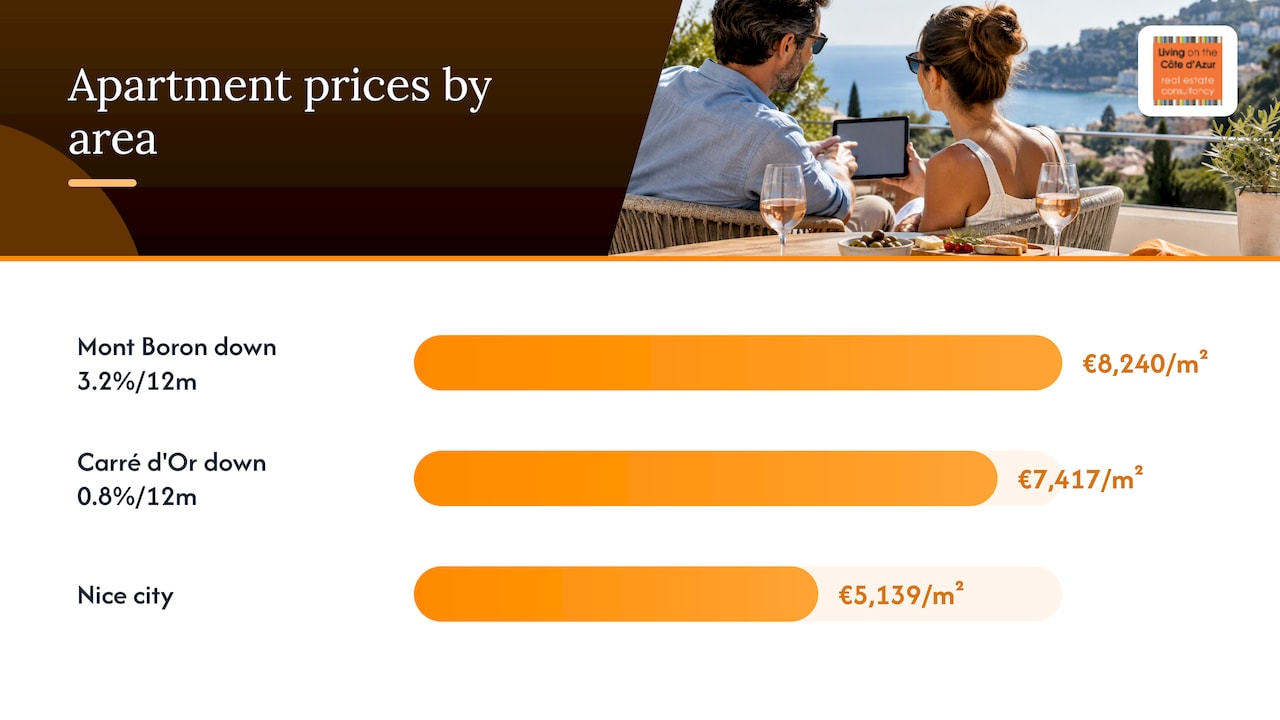
The spread inside Mont Boron is wide. Immover’s neighbourhood page reports a range of 5,912 to 10,406 €/m² around that average. That gap is the real story: a modest flat at the bottom of the hill and a sea-view residence near the top are not the same product.
Other sources use different methods and sample sizes. VALORIS, for example, reports a median of €6,500/m² for apartments in the Carré d’Or and Rossini area, based on transactions from 2024 and 2025 across nine statistical zones. It is a different perimeter and period from the figure above, which is exactly why you should never compare numbers from two websites directly.
Asking price versus recorded price
An important nuance for foreign buyers: Immover notes that listing prices are generally 10 to 20% above the prices ultimately recorded in the deed. That does not mean every property can be negotiated down by that amount. Well-presented, correctly priced homes in these two districts can sell close to asking. But it does mean the price on a portal is a starting point, and that data on recorded sales is what your offer should be anchored on.
This is one of the clearest places an independent buyer agent earns its place. We look at comparable recorded sales, not just advertised prices, before you make an offer. For a wider view of how Nice’s districts compare, see our guide to the best Nice neighbourhoods for international property buyers.
How to read a price per square metre
A few habits protect you from misleading averages:
- Ask for comparable sales, not just a district average. Same street, same floor band, similar condition.
- Separate the view premium. A sea-view terrace may account for a large part of the price on its own.
- Check the year of the data. Figures from 2024 and figures from 2026 describe different markets.
- Allow for works. A tired apartment in a fine building can be a bargain or a trap, depending on the renovation budget and the building’s collective works.
- Remember acquisition costs. French purchase costs on top of the price are real; your notaire will confirm the figures for your specific deal.
Getting around and everyday life
This is where the two areas diverge most clearly.
Carré d’Or: on foot
A hotel in the district, facing the sea and the Albert 1er gardens, states that Nice-Ville railway station is ten minutes away on foot, with tram line 2 giving direct access from the airport to Jean Médecin. That gives you a sense of the connectivity: the beach, the old town, the station and the tram are all close enough that a car becomes optional. For international owners who spend only part of the year in Nice, that matters. You can arrive, leave the car at home and live on foot.
Mont Boron: the car, the bus and the port
On the hill, daily life flows down towards the port, where cafés, restaurants and the harbour promenade are. Buses complement the tram where it does not run, including Mont Boron and the hills. Most owners nonetheless keep a car. The compensation is outdoors life that few city districts can match: the forest park, and the City of Nice’s free 11-km Mounta cala bicycle route that runs from Rauba Capèu past the port to the Mont-Boron battery. If you run, cycle or walk the dog, Mont Boron is a daily gift.
A simple test
Spend a long weekend in each area before you decide. Walk to buy bread, find parking at 8pm on a Friday, and notice how you feel at 7am. We often find that buyers who arrived convinced of one area leave favouring the other.
Rental income and investment potential
If you are buying purely for yield, neither area is the obvious answer. Published estimates are modest and, importantly, not official statistics. One 2026 investment analysis compiled indicative gross yields of around 3.4 to 3.6% for Carré d’Or and Masséna, and 3.5 to 4% for a wider Mont Boron and Cimiez grouping, and describes them as market estimates rather than transaction data. Treat these as ballpark figures at best. Gross yields are before charges, taxes, vacancy and works, so net returns will be lower.
The better way to think about both districts is as stores of value. The Carré d’Or is central, scarce and always in demand from people who want to live in Nice. Mont Boron offers rare villa-style plots with sea views in a city that cannot build many more of them. These are lifestyle assets that tend to hold their appeal, rather than machines for cash flow, and we say so plainly to clients, because over-promising yield is the quickest way to a disappointing purchase.
If you do plan to let the property, run the numbers properly. A structured approach to evaluating an investment flat’s yield helps you compare purchase price, rent, costs and return in one place. For Nice-specific advice, our piece on buying to rent in Nice covers what investors need to know, and our secondary residence guide looks at the second-home angle.
Short-term lets and tax: check before you buy
Nice regulates tourist rentals of furnished secondary homes, and the rules are strict. Local guides note that such lets are capped and subject to conditions (ChezNous), but rules change, so confirm the current position with the City of Nice and your notaire before assuming you can let a flat by the week. Also check the building’s own rules (the règlement de copropriété), which can ban or limit short lets regardless of city policy.
On tax, non-resident owners of furnished lets should take advice. The French tax administration’s guidance notes that the Finance Law for 2026 updated how professional activity is assessed for furnished rental taxation. We are not tax advisers, and we do not give tax advice. We connect clients with French tax specialists who model the options for their personal situation, including whether to hold through a company or personally.
Which area suits which buyer
Here is how we usually match profiles to districts, based on conversations with clients rather than any statistic.
Mont Boron suits you if you:
- want a villa, a garden or a terrace with a sea view;
- value privacy, silence and nature, with a forest on your doorstep;
- are happy to drive and plan your day;
- have a family or regular guests who need space;
- see the home as a long-term base or a legacy property.
The Carré d’Or suits you if you:
- want to walk to the sea, the market, restaurants and boutiques;
- prefer an apartment you can lock up and leave;
- split your year between Nice and elsewhere;
- like city energy, culture and evening life;
- want the ease of resale in the most central part of the city.
There is a third group: buyers who cannot choose. For them, we sometimes suggest the border zones, such as the port area at the foot of Mont Boron, where you get harbour life on foot and the hill behind you.
Our perspective: choose the daily rhythm, then the property
We have watched many buyers arrive in Nice with a list of square metres and a budget, and almost all of them end up deciding on something else: how their mornings will feel. As a Dutch team living and working on the Riviera, we are used to cycling, walking and being outdoors, and so Mont Boron has always felt like a natural home to us. Yet we also love an evening in the Golden Square, where the city is at its most alive.
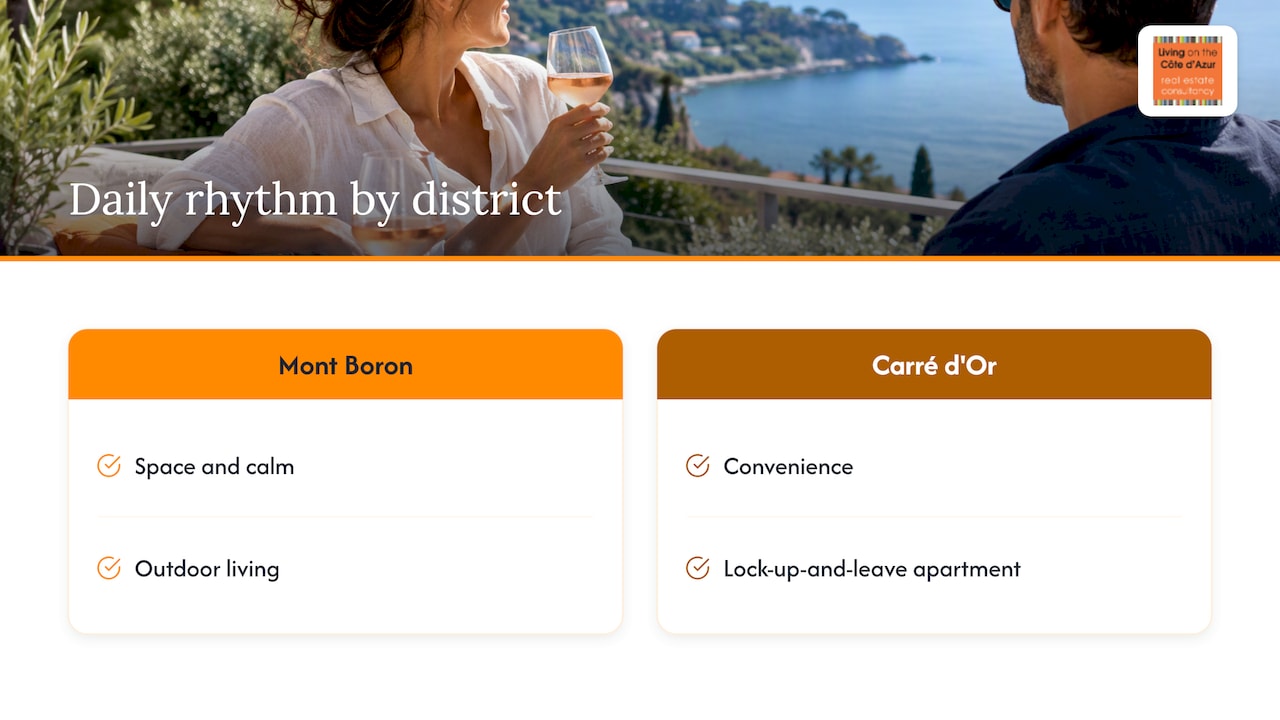
The lesson from years of searches is that the two districts are not rivals so much as answers to different questions. If the question is space and calm, the hill wins. If it is convenience and a lock-up-and-leave apartment, the Carré d’Or wins. The price per square metre matters, but less than buyers expect, because both are priced for what they offer.
We also encourage people to be sceptical of tidy averages. The Mont Boron range is wide, and the best homes in either area often trade quietly. Because we represent the buyer and search the whole market through local agents, developers and off-market contacts, we are not tied to any one agency’s stock. That independence is what lets us tell you plainly when a home is overpriced, or when the better option is a street away.
— Ab Kuijer
How we help you decide and buy
If you are torn between the hill and the Golden Square, the simplest first step is a search mandate. We define your brief, shortlist properties in both districts, arrange viewings back to back so you can feel the difference in one trip, negotiate on your behalf and coordinate the purchase through to the notaire. Our search mandate explains how it works, and our full-service approach adds the legal, tax, financing and renovation coordination that international buyers usually need.
Our buyer broker service and our higher-segment searches are both listed at 2%. We will confirm in writing exactly how that applies to your purchase before you commit to anything. If you would like to start, contact us through our website with your budget, your timing and a few lines about how you want to live, and we will come back with a shortlist from both areas.
For a first read on the whole process, see our guide to buying a property in France, and browse current villas and apartments for sale in Nice.
Checks before you make an offer
Whichever district you pick, a few steps apply to every French purchase by an international buyer:
- Fix your budget in euros including costs. Ask your notaire for the acquisition-cost estimate on the specific property.
- Read the building papers. In an apartment, that means recent general-assembly minutes, planned works and charges. In a villa, it means planning permissions, any extensions and the state of drainage and retaining walls, which matter on a hillside.
- Confirm rental rights. If income matters, check city rules and the building’s own regulations before the offer, not after.
- Decide the ownership structure early. Personal ownership, a company or an SCI have different consequences for tax and inheritance. Take advice from a French tax specialist for your own situation.
- Plan financing. If you need a mortgage, speak to a broker who works with non-residents before you start viewing. Specific French schemes such as the PTZ zero-interest loan carry income and zoning conditions, so do not assume they apply to you.
- Compare recorded sales. Insist on comparable deeds, not just portal adverts.
Our article on the buying process in the South of France walks through these steps in order.
FAQ
Is Mont Boron more expensive than the Carré d’Or?
On one professional dataset for January 2026, recorded apartment prices averaged higher in Mont Boron (€8,240/m²) than in the Carré d’Or (€7,417/m²). The range inside each district is wide, though, so the specific apartment, floor, view and condition matter more than the average. Different sources also use different perimeters, so compare like with like.
Do I need a car on Mont Boron?
Most owners keep one. Shops are limited on the heights, the roads wind uphill, and buses complement the tram in the hills rather than replace a car for every errand. The port at the foot of the hill has restaurants and the harbour promenade, which makes it the natural everyday destination.
Which area is better for rental income?
Neither is a high-yield area, and published yield figures are estimates rather than official statistics. Nice also regulates short-term lets of secondary homes, so check current city rules, your building’s regulations and your tax position before relying on rental income. We see both districts mainly as lifestyle and capital-preservation purchases.
Can a foreign buyer purchase in either district?
Yes, international buyers purchase across Nice, and the process runs through a notaire. Financing, ownership structure and tax depend on your personal situation, so we connect you with mortgage brokers, notaires and tax advisers who work with non-residents.
Why use a buyer agent rather than a local estate agent?
A selling agency represents the seller and its own listings. A buyer agent works for you, searches across agencies, developers and off-market contacts, and negotiates on your side. You can read more in our explanation of what a buyer agent does.
Sources
- Nice Historique, Ville de Nice
- Parc du Mont Boron, Ville de Nice
- Parcours, Ville de Nice
- Mont Boron property prices, Immover
- Prix au m² Mont Boron, Immover
- Prix au m² Nice par quartier, Immover
- Immobilier à Nice : prix par quartier, NissActu
- Prix immobilier Nice, VALORIS
- Nice Carré d’Or : guide du quartier, ChezNous
- Investissement locatif Nice 2026, Ateis Patrimoine
- Maison Albar, Le Victoria, contact
- Plan du tram et du bus de Nice, Nicetrotter
- BOFiP, location meublée, actualité 2026
- Prêt à taux zéro, Service-Public
Recommended
 //