
TL;DR:
- Negotiating on the Côte d’Azur requires understanding micro-markets, value drivers, and off-market opportunities.
- Successful luxury deals depend on preparation, expert team assembly, thorough due diligence, and clear objectives.
- Legacy preservation is achieved through strategic legal structuring, post-deal verification, and articulating a compelling future vision.
Picture this: a magnificent Belle Époque villa perched above the sapphire waters of Cap d’Antibes, jasmine drifting through iron-latticed windows, a private garden sloping gently toward the sea. You have the capital. You have the appetite. Yet, without a mastery of the Riviera’s nuanced negotiation landscape, that estate slips quietly into another family’s portfolio, becoming their heirloom instead of yours. On the Côte d’Azur, where sellers are as sophisticated as the buyers, negotiation is not merely a transactional formality. It is a strategic art form that distinguishes enduring legacy from costly missed opportunity. This guide arms you with the frameworks, intelligence, and insider perspective to negotiate with precision and confidence.
Table of Contents
- Understanding the Côte d’Azur luxury market
- Preparing for successful negotiation
- Executing negotiation: Strategies for luxury deals
- Verifying success and preserving legacy
- A seasoned negotiator’s perspective: Legacy-first approach
- Next steps: Connect with Côte d’Azur luxury experts
- Frequently asked questions
Key Takeaways
| Point | Details |
|---|---|
| Know your market | Understanding the Côte d’Azur luxury real estate landscape is vital before entering negotiations. |
| Prepare thoroughly | Proper due diligence, financial readiness, and expert advice make negotiation outcomes stronger. |
| Negotiate legacy-first | Focus on long-term value, generational suitability, and wealth preservation rather than just price. |
| Verify and safeguard | Always check contracts and plan post-acquisition stewardship to protect inheritance and legacy. |
Understanding the Côte d’Azur luxury market
Before a single offer is placed, you must understand the forces shaping property value along this sun-gilded coastline. The Côte d’Azur is not a monolithic market. It is a constellation of distinct micro-markets, each with its own prestige hierarchy, buyer profile, and pricing logic. Monaco’s border communes command extraordinary premiums anchored by tax efficiency and proximity to principality status. Cap d’Antibes draws those who prize discretion and scale. Sainte-Maxime, with its Nartelle beach sunsets and easy ferry to Saint-Tropez, attracts lifestyle-driven buyers seeking both prestige and rental yield.
Market trends and value drivers on the Riviera are shaped by several converging forces:
- Sea view premiums: Properties with unobstructed Mediterranean panoramas command between 30% and 50% more than comparable inland estates.
- Architectural heritage: Pre-war villas with original Belle Époque or Art Deco features carry irreplaceable scarcity value.
- Eco-luxury credentials: In 2026, green certifications and solar infrastructure are no longer optional extras. Buyers increasingly factor them into their headline offer.
- Proximity to amenities: Walking distance to Antibes’ Provençal markets, the Cannes Croisette, or Menton’s lemon festival promenades adds tangible, quantifiable value.
- International buyer concentration: Russian, American, British, and Gulf-state buyers continue to underpin demand, insulating prime stock from domestic economic cycles.
| Micro-market | Typical price range | Key premium driver | Average annual appreciation |
|---|---|---|---|
| Cap d’Antibes | €5M to €30M+ | Privacy, coastal sentiers | 6 to 8% |
| Monaco border (Beausoleil, Cap Martin) | €3M to €20M+ | Tax jurisdiction proximity | 7 to 9% |
| Cannes (Californie, Super-Cannes) | €2M to €15M | Festival prestige, sea views | 5 to 7% |
| Sainte-Maxime | €1.2M to €8M | Beach access, golf, ferry links | 4 to 6% |
| Menton | €1M to €5M | Botanical gardens, Italian border | 4 to 6% |
Off-market properties deserve particular attention. A significant proportion of elite estates never appear on public portals. They circulate through a privileged network of agents, notaires, and family office advisers. These invisible deals often carry the most compelling legacy potential precisely because they attract less competitive pressure. The buying luxury estate guide we have prepared details how to position yourself for access to this rarified tier.
Understanding market cycles is equally vital. The Riviera has demonstrated remarkable resilience through global downturns, yet seasonal rhythms still create windows of opportunity. Properties listed in late autumn, after the summer season fades and before the spring regattas reignite demand, frequently offer the most negotiating room. The French Riviera investment guide breaks down these seasonal patterns with granular regional data.
Pro Tip: Commission a comparative market analysis specific to your target commune, not merely the broader Riviera. A €6M asking price in Èze village carries entirely different underpinnings from a €6M asking price in central Cannes.
Preparing for successful negotiation
Once you understand the market, preparation is the step that separates informed buyers from ordinary negotiators. The Côte d’Azur’s elite sellers and their agents are adept at reading buyer readiness. Arriving underprepared signals either naivety or lack of serious intent, and either impression can cost you leverage before the first conversation begins.

Step 1: Assemble your expert team
Secure a bilingual buyer’s agent who specialises exclusively in luxury assets and maintains genuine off-market relationships. Expert buyer agent representation is not a luxury on the Riviera. It is an absolute prerequisite. Pair this with a notaire experienced in high-value transactions and an independent legal adviser who can scrutinise title deeds, servitudes (right-of-way easements), and planning permissions.
Step 2: Conduct property and legal due diligence
French property law is layered and occasionally counter-intuitive for international buyers. Due diligence must cover:
- Title clarity and absence of encumbrances or unresolved servitudes.
- Planning history, including any unauthorised extensions or pool constructions that could complicate future sales.
- Cadastral survey verification to confirm stated land boundaries.
- Technical diagnostics: asbestos, lead, energy performance ratings, and seismic vulnerability assessments.
- Syndic records for co-owned properties, revealing hidden costs or deferred maintenance.
Step 3: Secure your financing before approaching sellers
| Financing route | Advantage | Consideration |
|---|---|---|
| French mortgage (up to 70% LTV) | Preserves capital, interest-deductible | Slower process, requires local bank relationship |
| Offshore lending against global portfolio | Speed and discretion | Currency risk management essential |
| Cryptocurrency-backed finance | Innovative, capital-efficient | Volatility of crypto assets requires robust collateral structuring |
| All-cash acquisition | Maximum leverage in negotiation | Capital deployment opportunity cost |
Sellers of trophy estates respond viscerally to proof of funds. A confirmed financial position, whether a letter of credit, a bank attestation, or a cryptocurrency wallet verification accepted by forward-thinking agencies like ours, transforms you from an interested prospect into a credible counterparty.
Step 4: Intelligence gathering
Understand why the seller is selling. A family resolving an inheritance dispute will respond differently to timelines and terms than a developer offloading a completed project. Knowing the seller’s motivation is arguably more valuable than knowing the comparable transaction data. If you are buying a second home in France for the first time, read carefully about notaire timelines and cooling-off periods under French law. For structuring the financial side elegantly, explore financing luxury property options tailored to the Riviera.
Pro Tip: Request the property’s full rental history if it has been let seasonally. A villa that achieves €25,000 per week during the Cannes Film Festival season transforms the yield conversation during negotiation.
Executing negotiation: Strategies for luxury deals
With your groundwork in place, it is time to deploy negotiation techniques that distinguish elite buyers. The most common error at this stage is treating the negotiation purely as a price conversation. On the Côte d’Azur, the finest deals are structured around an architecture of value that extends far beyond the headline figure.
Establish your full negotiation objectives
- Define your walk-away price with mathematical precision, not emotional approximation.
- Identify which chattels, artworks, or furnishings you wish to include in the sale.
- Clarify your preferred completion timeline, which can be a powerful non-price lever.
- Determine whether a phased payment structure, common in VEFA off-plan purchases, better suits your capital deployment strategy.
- Assess which eco or renovation commitments the seller might make as conditions of sale.
Leverage legacy, amenities, and future potential
Position yourself as the natural custodian of the property, not merely its next owner. Sellers of heritage estates, particularly those in families for generations, often respond emotionally to buyers who articulate a vision for the property’s future. A family office explaining that Cap d’Antibes coastal walks and the estate’s lemon-scented terraces will be enjoyed by three generations carries more persuasive weight than a pure price adjustment.
“The finest Riviera negotiations we have witnessed were not won on price. They were won on vision, patience, and the quiet confidence of a buyer who understood exactly what they were acquiring and why it mattered.”
Curating high-value real estate for legacy requires that you see beyond the transaction to the narrative arc of the estate itself.
Handling counteroffers and structuring for value
When a counteroffer arrives, resist the instinct to respond immediately. A measured 48 to 72-hour response window signals deliberateness, not disinterest. Use that window to revisit your due diligence, consult your legal adviser, and reassess whether the counteroffer reflects genuine seller flexibility or a negotiating position.
Structured concessions work powerfully here. Offer to move on price in exchange for inclusion of specific assets, accelerated timelines, or vendor finance on the notaire fees. The art is in assembling a package that feels generous to the seller while preserving value for you. When investing for lasting value, every euro of acquired asset must be purposeful.
Know when to walk away. The Riviera’s market depth means alternatives exist. A disciplined exit from an overpriced negotiation protects your capital for the right asset. For those securing Riviera real estate for the first time, establishing this discipline early is transformative.
Pro Tip: Never negotiate directly with the seller’s agent without your own representation present. Information asymmetry in luxury deals is significant, and an unrepresented buyer is at a structural disadvantage.
Verifying success and preserving legacy
Once the deal is struck, verifying its integrity and protecting your legacy is paramount. Many sophisticated buyers invest heavily in the negotiation phase, then underinvest in post-deal verification and long-term stewardship. This is where fortunes are quietly eroded.
Post-negotiation checks you must not skip
- Confirm the compromis de vente (preliminary sale contract) reflects every negotiated term, including chattels, conditions precedent, and completion dates.
- Verify that all diagnostics disclosed during due diligence are formally acknowledged in the contract.
- Instruct your legal adviser to conduct a final title search immediately before completion, as encumbrances can emerge late in the process.
- Confirm compliance with any local planning obligations, particularly for coastal properties subject to the Loi Littoral coastal development law.
- Ensure that any agreed renovation or eco-upgrade commitments by the vendor are secured with financial penalties for non-completion.
Strategies for legacy preservation on the Riviera are most effective when structured from the moment of acquisition. The French legal framework offers several tools for generational transfer:
Optimising for generational wealth
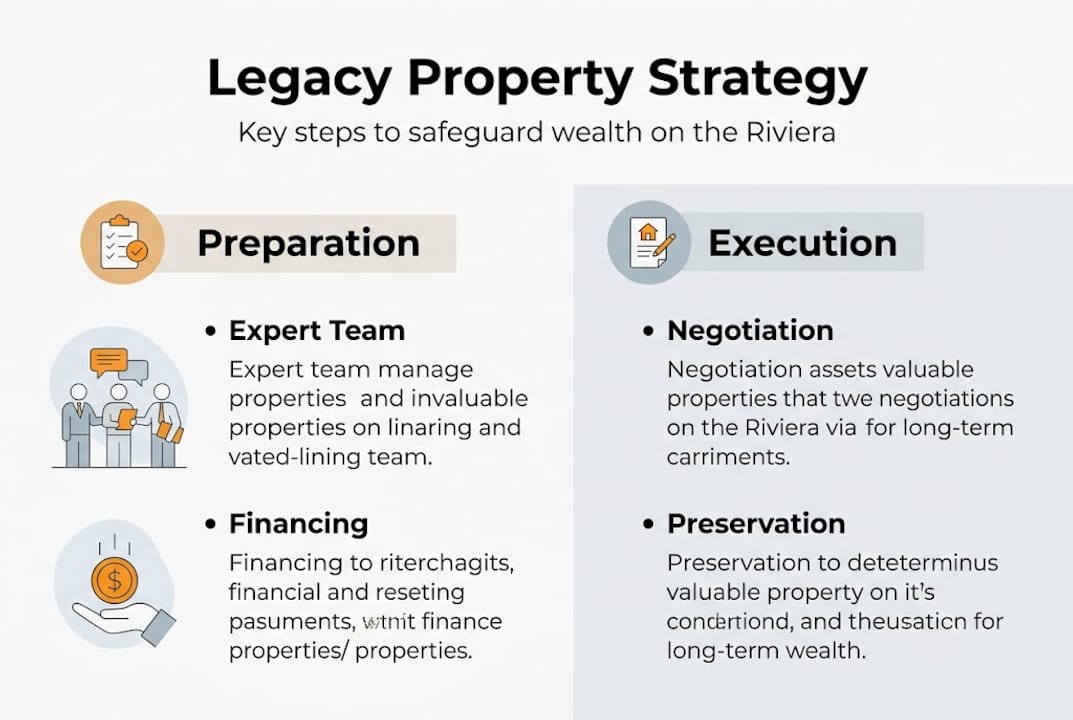
Properties held through an SCI (Société Civile Immobilière), a French civil property company, allow phased transfer of ownership shares to heirs over time, significantly reducing inheritance tax exposure. Elite seasonal rentals, generating 3 to 5% annual yields on prime Riviera assets, can fund ongoing estate costs while the underlying asset appreciates. A villa near Cannes during the Film Festival or Antibes’ sailing regattas can command exceptional short-term rental premiums that would astonish buyers accustomed to other European markets.
Common mistakes to avoid after closing
- Failing to register the property correctly with French tax authorities.
- Neglecting to update insurance to reflect the full replacement value of the estate.
- Overlooking the annual taxe foncière (property tax) calendar and its implications for cash flow planning.
- Delaying the establishment of an SCI or equivalent legal structure, thereby complicating future inheritance.
For families seeking to protect the next generation, safeguarding inheritance through proper legal structuring is as important as the negotiation itself. The Riviera legacy guide we have assembled provides a full roadmap for this critical phase.
Pro Tip: Engage a French wealth adviser (conseiller en gestion de patrimoine) within six months of completion. Their insight on SCI structuring, gift taxation, and rental yield optimisation pays dividends far exceeding their fee.
Riviera estates that appreciate 5 to 8% annually, held within a properly structured legal vehicle, compound generational wealth in ways that few other asset classes can match.
A seasoned negotiator’s perspective: Legacy-first approach
Here is a perspective that most negotiation guides will not share with you: the buyers who secure the finest Riviera estates are rarely those who fight hardest on price. They are the ones who fight most clearly on purpose.
We have observed family offices from Singapore to São Paulo approach the same Cap d’Antibes listing. The buyers who ultimately acquired it were not the highest bidders at the preliminary stage. They were the family who communicated, through their agent and through the texture of their offer, that this estate would become a place of gathering, of celebration, of continuity. The seller, an elderly widow parting with a property her father had built in 1938, chose legacy over liquidity.
This is the contrarian truth of Riviera luxury negotiation. Patience, discretion, and a clearly articulated vision consistently outperform aggressive price manoeuvring. The step-by-step luxury investment frameworks we advocate always begin with the question: what story does this estate need to tell next? When you answer that question compellingly, you become the buyer the seller has been waiting for.
Next steps: Connect with Côte d’Azur luxury experts
Transforming negotiation knowledge into a signed compromis requires more than frameworks. It requires a trusted partner who has walked these sun-warmed lanes, opened these shuttered gates, and negotiated across these candlelit dining tables. We bring exactly that intimacy to every engagement. Explore our curated portfolio of Riviera luxury villas, from Monaco border penthouses to Provençal mas that embody timeless glamour. Discover how we are curating high-value properties for discerning family offices, and explore the full spectrum of Côte d’Azur investment options tailored to your legacy ambitions. We also welcome cryptocurrency transactions for the forward-thinking investor. Reach out, and let us begin your Riviera story together.
Frequently asked questions
What is the first step in negotiating luxury property deals on the Côte d’Azur?
Begin with thorough market research and secure experienced buyer representation familiar with luxury assets and off-market deal flows; without this foundation, every subsequent step is structurally compromised.
How do you spot high-potential off-market opportunities?
Work with established local agents who maintain privileged seller relationships, and study invisible luxury properties that never reach public portals; these quiet listings carry the greatest legacy potential and the least competitive pressure.
What are common negotiation mistakes for family offices?
Failing to plan for generational transfer from day one, overlooking French tax and inheritance law, and neglecting post-deal stewardship are the three most costly errors, all of which erode the legacy wealth potential that motivated the acquisition in the first place.
How can you ensure wealth preservation through property negotiation?
Focus on rigorous contract verification, engage a French wealth adviser for SCI structuring, and align every deal clause with your long-term inheritance safeguarding strategy so that the estate serves your heirs as powerfully as it serves you today.
Recommended
- How to Finance Luxury Real Estate on the Côte d’Azur
- Luxury real estate French Riviera: Villa or penthouse on the Côte d’Azur – Living on the Côte d’Azur
- High-end property explained: Côte d’Azur luxury guide 2026
- The invisible luxury real estate properties on the Cote d’Azur – Living on the Côte d’Azur
 //
//