
TL;DR:
- New construction in Côte d’Azur offers full design flexibility and modern energy standards.
- VEFA legal framework ensures buyer protections with staged payments and long-term warranties.
- Tax incentives like the 2026 Relance Logement scheme suit certain portfolios but limit luxury rent potential.
There is a quiet orthodoxy in luxury real estate circles that insists only a Provençal mas or a Belle Époque villa can carry the weight of a family legacy. We believe that orthodoxy deserves a second look. Along the Côte d’Azur in 2026, a new generation of off-plan residences — biophilic terraces above Sainte-Maxime’s Nartelle sands, sea-view towers on Nice’s Mont Boron ridge, sun-drenched retreats near Cap Ferrat — are redefining what it means to build lasting wealth. This guide unpacks new construction property for high-net-worth and international investors: the terminology, the legal framework, the tax landscape, and the strategic moves that separate visionary buyers from the crowd.
Table of Contents
- What is new construction property? Core concepts for investors
- Key advantages and risks of new construction property
- Understanding French tax incentives for new construction in 2026
- Selecting, acquiring, and maximising value: the new build investor journey
- Why true legacy is often forged in new builds
- Explore luxury new builds — elevate your Côte d’Azur legacy
- Frequently asked questions
Key Takeaways
| Point | Details |
|---|---|
| New build definition | New construction on the Côte d’Azur uses VEFA contracts with staged ownership and delivery. |
| Tax incentives | The 2026 Relance Logement scheme offers major tax deductions, especially for rental-focused investors. |
| Legacy strategy fit | Luxury new builds in prime locations blend control, capital preservation, and generational appeal. |
| Risk management | Staged payments and French legal protections de-risk new construction compared to older properties. |
What is new construction property? Core concepts for investors
In the French market, new construction property refers to any residential building completed within five years of its first sale or occupancy. For investors, the most relevant vehicle is off-plan purchase, where you acquire a property before or during construction. This is where the French legal framework known as VEFA (Vente en l’État Futur d’Achèvement) becomes your essential companion.
VEFA is not merely a purchase contract. It is a structured, legally protected acquisition journey with clear stages and robust buyer safeguards. Per VEFA mechanics, the process begins with a reservation contract and a deposit of 5 to 10% of the purchase price, followed by the signing of the authentic deed at a notary. Staged payments are then released as each construction milestone is met, all secured by a bank guarantee. Crucially, the buyer owns the land from the moment the deed is signed, with ownership of the building transferring progressively as construction advances.
Key buyer protections under VEFA:
- A mandatory 10-day reflection period after signing the reservation contract
- Staged payments secured by a financial institution’s guarantee
- A one-year garantie de parfait achèvement (perfect completion warranty) post-delivery
- A two-year garantie biennale covering equipment and fixtures
- A ten-year garantie décennale protecting against structural defects
| Stage | Action | Investor note |
|---|---|---|
| Reservation | Sign contract, pay deposit | 5-10% of price, refundable in certain cases |
| Notary deed | Formalise purchase | Land ownership transfers here |
| Construction | Staged payments | Each tied to verified milestone |
| Delivery | Final payment, inspection | Snagging list submitted within 30 days |
| Post-delivery | Warranty period begins | 1, 2, and 10-year cover applies |
Pro Tip: Always instruct an independent French property lawyer to review the reservation contract before signing. The notary acts for both parties and cannot replace your personal legal counsel.
For those evaluating the full range of luxury investment options along the Riviera, VEFA offers a uniquely controlled entry point. Lower notary fees (roughly 2 to 3% versus 7 to 8% for existing properties) and zero-interest staged payment plans further enhance the financial case. These are not incidental benefits — for a €3M apartment above the azure sweep of Sainte-Maxime bay, the saving on acquisition costs alone can be substantial.
Key advantages and risks of new construction property
Once you have grasped the mechanics, the strategic calculus becomes clearer. New construction on the Côte d’Azur carries a suite of advantages that are particularly compelling for legacy-focused investors.
Advantages worth noting:
- Full customisation of layouts, finishes, and smart-home integration
- Compliance with the latest RT2020 energy standards, reducing future maintenance costs
- Biophilic design elements — living walls, natural materials, panoramic glazing — that command premium resale prices
- Staged payment plans that manage capital exposure across a multi-year timeline
- Lower notary fees and, frequently, ten-year structural warranties at no additional cost
The VEFA reservation deposit structure, typically €2,500 to 10% of the purchase price, also grants a 10-day reflection window, giving sophisticated investors room to pause, consult advisors, and proceed with confidence.
Risks to assess carefully:
- Delivery delays are not uncommon; build in a six to twelve-month buffer on projected occupancy
- Price premiums over comparable existing stock, though partly offset by lower notary fees
- Rental income is deferred until completion, affecting short-term yield forecasting
- Rent caps under certain fiscal schemes (more on this shortly) may limit luxury-segment returns
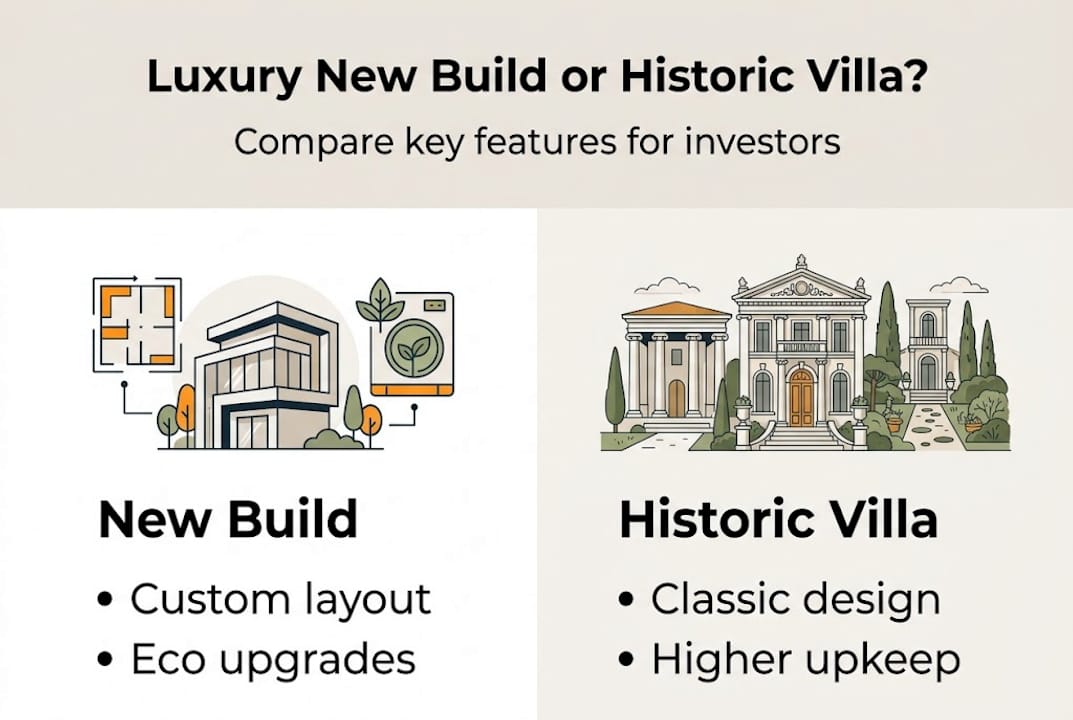
| Factor | New construction | Historic villa |
|---|---|---|
| Customisation | High | Low to medium |
| Maintenance costs | Low initially | Potentially high |
| Acquisition costs | 2-3% notary fees | 7-8% notary fees |
| Structural warranty | 10-year decennial | None by default |
| Rental potential | High (post-delivery) | Immediate |
| Prestige cachet | Emerging | Established |
Locations such as Sainte-Maxime — where ferry rides to Saint-Tropez and Nartelle beach sunsets frame daily life — and Cap Ferrat consistently outperform the broader market for capital appreciation. We have seen specific off-plan projects in these corridors appreciate 12 to 18% between reservation and delivery, even before rental income is considered.

Pro Tip: When comparing new build versus historic property for a legacy portfolio, weight the ten-year structural warranty heavily. For a property intended to serve your children and grandchildren, eliminating early structural liability is worth more than the prestige of aged stone alone.
For a sharper read on where 2026 luxury market trends are heading, sustainable and biophilic new builds are recording a 15% demand spike. Tomorrow’s trophy assets are being poured today.
Understanding French tax incentives for new construction in 2026
With the pros and cons clearly mapped, understanding the 2026 tax landscape is pivotal for modelling your return on investment and long-term legacy strategy.
The most significant current scheme is the Relance Logement framework (also known as the Jeanbrun scheme), running from 2026 to 2028. Key parameters:
- Applicable to new VEFA properties rented unfurnished as a tenant’s primary residence
- Annual amortisation deduction of 3.5% to 5.5% on 80% of the purchase price, excluding land value
- Rent capped at €14.49 per square metre in qualifying zones
- Maximum annual deduction capped between €8,000 and €12,000 depending on zone and income thresholds
- Deficit on rental income can be carried forward and offset against future rental revenues
| Scheme element | Detail |
|---|---|
| Scheme name | Relance Logement / Jeanbrun |
| Active period | 2026 to 2028 |
| Amortisation rate | 3.5% to 5.5% per annum |
| Rent cap (zone A) | €14.49/m² |
| Annual deduction cap | €8,000 to €12,000 |
| Deficit carryforward | Yes, against future rental income |
Here is the nuance that traditional advisors often gloss over: for ultra-high-net-worth buyers targeting luxury seasonal lets, this scheme’s rent cap sits well below Riviera market rates. A prestige apartment near Cannes’s Croisette or Antibes’s Cap coastal paths can command multiples of €14.49 per square metre during the summer season. The Relance Logement scheme therefore suits investors building diversified portfolios with a mix of mid-market and premium assets, or those prioritising tax-efficient wealth transfer over maximum short-term yield. The demand for luxury apartments in uncapped seasonal rental markets remains exceptionally robust, offering an alternative income strategy entirely outside this fiscal framework.
Selecting, acquiring, and maximising value: the new build investor journey
Tax considerations shape financial outcomes, but execution is where enduring value is created. Here is how seasoned investors approach each phase.
- Search and shortlist: Focus on developers with proven Côte d’Azur track records. Assess location for both lifestyle and liquidity. Sainte-Maxime’s proximity to Saint-Tropez, Nice’s Promenade des Anglais, and Menton’s lemon-festival charm all attract distinct buyer profiles.
- Reservation: Engage a French notary and an independent legal adviser simultaneously. Review the reservation contract for delivery penalties, force majeure clauses, and escrow conditions.
- Due diligence: Commission a technical audit of the developer’s financial standing and prior project delivery history. Verify the bank guarantee instrument before transferring any funds.
- Staged payments: Monitor construction milestones against the contractual schedule. Each payment release should be triggered by verified progress, not calendar dates alone.
- Handover: Conduct a detailed snagging inspection within 30 days of delivery. Lodge all defects formally in writing to activate the one-year perfect-completion warranty.
- Asset management: Decide early between seasonal luxury letting (uncapped, higher yield) and long-term tenancy (potentially Relance-eligible, steadier income). Position the asset with professional property management for immediate rental activation.
“For HNWI legacy investments, prioritise VEFA luxury villas in Sainte-Maxime and Cap Ferrat for appreciation over yields; the Relance scheme suits rental-focused strategies but caps rents below luxury market rates.”
Pro Tip: Build a clause into your reservation contract specifying financial penalties for delivery delays exceeding six months. Developers will often agree to this during negotiation, and it aligns their incentives with yours.
For a curated view of legacy and ROI strategies and a complete international investment guide tailored to the Riviera, we have assembled the frameworks that our most discerning clients rely upon. Whether your focus is Antibes’s yacht-dotted marina lifestyle or the botanical serenity of Menton’s Val Rahmeh gardens, the right new build in the right location becomes far more than a financial instrument. It becomes a family story, told in light and stone.
Why true legacy is often forged in new builds
Step back from the conventional narrative for a moment. The Riviera’s most celebrated estates — feted in auction house catalogues and whispered about at Cannes regattas — are historic, yes. But heritage is not the only path to legacy. We have worked with clients who shaped genuinely generational wealth through precisely targeted new construction acquisitions, choosing location and design intent over age and patina.
The ability to specify a property from the ground up — its orientation to catch Èze’s morning light, its terrace engineered for Baie des Anges panoramas, its energy systems future-proofed for the heirs who will inherit it — is a form of creative legacy rarely available in the resale market. Traditional advisors, wedded to the prestige of period properties, often underestimate how powerfully design control and capital protection compound over decades. New builds on the Côte d’Azur are not a compromise. In the right hands, they are a declaration.
Explore luxury new builds — elevate your Côte d’Azur legacy
If you are ready to consider what a thoughtfully chosen new build could mean for your portfolio and your family’s future, we are here to guide each step. At Living on the Côte d’Azur, we curate access to the most compelling off-plan opportunities across the Riviera, from biophilic apartments above Sainte-Maxime’s sands to prestige sea-view residences near Nice. We also accept cryptocurrency payments, placing us firmly in the world of forward-thinking, digitally fluent investors. Explore what defines luxury real estate in this market, refine your understanding of legacy investment strategies, or simply contact our team to begin a conversation that could shape your family’s next chapter.
Frequently asked questions
What legal protections do buyers have for new construction property in France?
Buyers benefit from a 10-day withdrawal period, staged payments secured by bank guarantees, and post-delivery warranties covering perfect completion, equipment, and structural integrity for up to ten years.
Can I maximise rental returns with a luxury new build under the 2026 Relance Logement scheme?
The Relance scheme caps rents at €14.49/m², which suits mid-market portfolios and tax-optimisation strategies but typically falls short of luxury seasonal rental rates achievable on the open Riviera market.
How do staged payments and delivery risks work in French new construction?
Payments are released at verified construction milestones, with bank guarantees securing buyer funds against non-completion; land ownership transfers at deed signing, reducing exposure throughout the build phase.
Is it better to invest in new construction or a historic villa for long-term legacy?
New builds offer full design control, lower acquisition costs, and ten-year structural warranties, while historic villas deliver established prestige; the right choice depends on your family’s priorities, with luxury investors comparing customisation benefits against heritage cachet.
Recommended
 //
//