
TL;DR:
- The property acquisition process involves complex legal, financial, and logistical steps that ensure lawful ownership.
- Thorough preparation and early coordination among professionals significantly increase the chances of a successful transaction.
The property acquisition process is the structured sequence of legal, financial, and logistical steps that leads to lawful ownership of real estate. In the industry, this is formally known as a real estate transaction or conveyancing process, and it applies equally to residential buyers, families seeking a legacy home, and investors building a portfolio. Professional fees typically run 2%–5% of the transaction value, and timelines range from 60–90 days for commercial deals to 3–6 months for residential purchases. Understanding the full sequence before you begin protects your capital, your timeline, and your peace of mind.
What does the property acquisition process involve?
The property acquisition process is a multidimensional undertaking, not a single transaction. Acquisition requires legal, tax, and financing coordination from the very start, with an interdisciplinary team working in parallel rather than in sequence. This is the insight that separates buyers who close confidently from those who scramble at the last moment.
Three groups of professionals shape every acquisition. Your legal adviser reviews title, zoning, and contract terms. Your financial adviser or mortgage broker structures funding and models returns. Your buyer’s agent or acquisition specialist identifies suitable properties and manages negotiations. Each role is distinct, and none can substitute for another.
Timelines vary by property type and jurisdiction. Residential purchases typically take 3–6 months, with mortgage pre-approval taking 1–3 days initially and 30–45 days to finalise. That gap between initial approval and final confirmation is where many buyers lose momentum. Knowing it exists lets you plan around it.
How do you prepare before starting a property search?
Preparation is the phase that determines whether your acquisition succeeds or stalls. Buyers who skip it tend to make offers they cannot honour, or they discover deal-breaking issues after they are emotionally committed to a property.
Assess your financial position
Start with a clear picture of your borrowing capacity, liquid reserves, and total acquisition budget. Your budget must cover the purchase price, professional fees, taxes, and a contingency reserve. Speak to a lender early. Mortgage pre-approval gives you a credible ceiling and signals seriousness to sellers.

Define your goals with precision
A family buying a primary residence has different priorities from an investor seeking rental yield. Write down your non-negotiables: location, size, condition, timeline, and intended use. Vague goals produce vague searches. Specific criteria produce shortlists.
Assemble your professional team
Your team should include, at minimum:
- A licensed buyer’s agent or acquisition specialist with local market knowledge
- A property solicitor or notaire (for French acquisitions) to handle legal review
- A mortgage broker or lender specialist to manage financing
- A tax adviser or CPA to model ownership structure and post-acquisition obligations
- A surveyor or structural engineer for physical inspections
Livingonthecotedazur assembles this network for clients acquiring property on the French Riviera, connecting buyers with over 100,000 curated listings and a roster of vetted local specialists. That kind of pre-built infrastructure shortens the preparation phase considerably.
Understand local legal requirements
Every jurisdiction has its own rules on foreign ownership, transfer taxes, and permitted use. In France, for example, the notaire is a state-appointed official who manages the legal transfer and holds funds in escrow. Understanding these requirements before you search prevents surprises that derail otherwise sound deals. For buyers considering international markets, a dedicated international acquisition guide is worth reviewing early.
Pro Tip: Request a mortgage agreement in principle before viewing properties. Sellers and agents take pre-approved buyers far more seriously, and it gives you a firm budget ceiling to work within.
What are the steps in the property acquisition process?
The buying steps follow a logical sequence, but experienced buyers treat pricing, financing, and due diligence as concurrent workstreams rather than a linear checklist. Each influences the others.
Step 1: Property search
Define your search criteria precisely before approaching agents or browsing listings. Criteria should include location, property type, size, condition, budget ceiling, and intended use. A focused brief produces better results than a broad one. Work with an agent who has genuine off-market access, because the most desirable properties in prestige locations rarely appear on public portals.
Step 2: Offer and Letter of Intent
Once you identify a suitable property, the next step is structuring your offer. For commercial and high-value residential acquisitions, this takes the form of a Letter of Intent (LOI). The LOI sets non-binding terms including price, deposit, due diligence period, and contingencies, and it secures critical buyer protections before the formal contract is signed. Many buyers undervalue this document. A well-drafted LOI gives you the right to withdraw if due diligence reveals problems, without forfeiting your deposit.
Step 3: Due diligence
Due diligence is the investigative phase where you verify everything the seller has represented. It covers four core areas:
- Title review: Confirm the seller holds clear, unencumbered title and that no third-party claims exist.
- Legal and zoning compliance: Verify the property’s permitted use matches your intentions and that no planning violations are outstanding.
- Structural and environmental inspection: Commission a qualified surveyor to assess the physical condition of the building and identify any environmental liabilities.
- Financial review: For investment properties, examine rent rolls, operating costs, lease terms, and vacancy history.
Due diligence accounts for roughly 30% of transaction failures when buyers treat it as a procedural checkbox rather than a decision tool. Use it to confirm your offer price, renegotiate if issues arise, or walk away with clarity. For luxury acquisitions, Livingonthecotedazur provides dedicated due diligence support that covers legal audits, structural assessments, and title verification.
Pro Tip: Commission your structural survey and title search simultaneously, not sequentially. Running them in parallel saves two to three weeks and keeps your due diligence period on schedule.
Step 4: Financing coordination
Financing should be treated as a framework that influences your offer price, cash reserve requirements, and return thresholds. It is not a separate task to address after the contract is signed. Share your due diligence package with your lender as soon as it is assembled. Lenders need the same title, valuation, and structural information that you do, and delays in providing it push back your closing date.
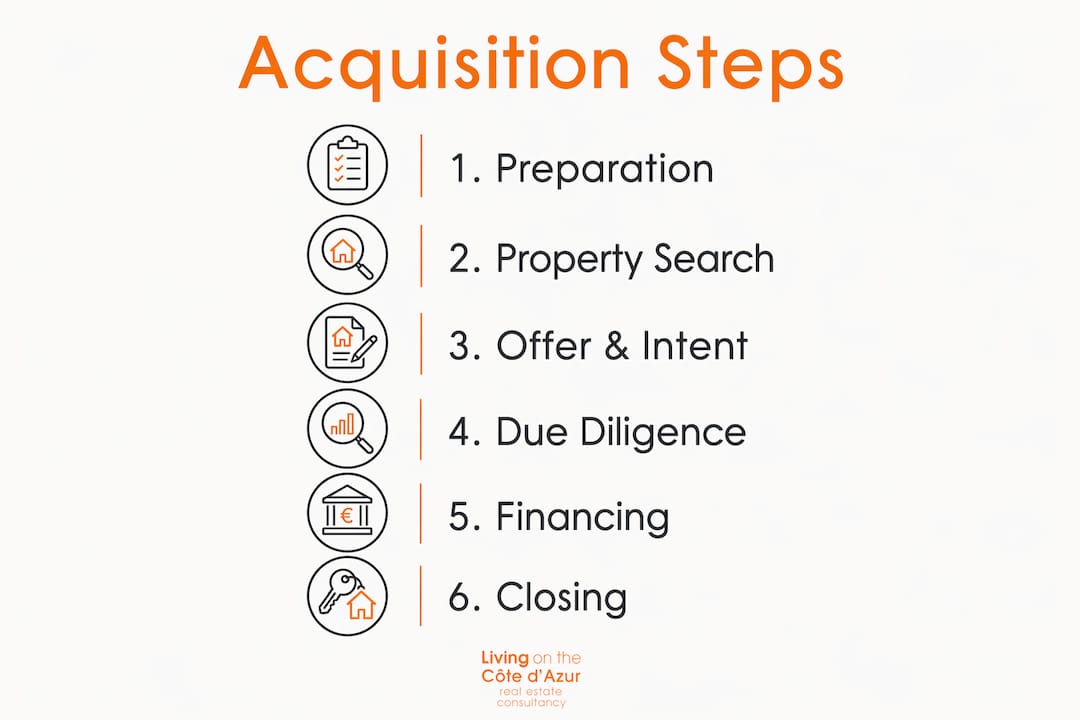
The table below outlines the key phases of the acquisition process and the primary buyer actions at each stage.
| Phase | Buyer actions |
|---|---|
| Preparation | Secure pre-approval, assemble team, define criteria |
| Property search | Brief agent, review listings, visit shortlisted properties |
| Offer and LOI | Structure offer, negotiate terms, agree due diligence period |
| Due diligence | Commission surveys, review title, verify zoning and financials |
| Financing | Submit lender package, satisfy loan conditions, confirm funds |
| Contract exchange | Sign purchase agreement, pay deposit, set completion date |
| Closing | Transfer funds, sign final deed, register ownership |
| Post-acquisition | Organise documentation, plan occupancy or leasing, file tax returns |
Step 5: Contract exchange and closing
Closing requires detailed coordination of documentation, fund transfers, and risk management. Ignoring the sequencing of these tasks produces last-minute delays that can jeopardise the entire transaction. Your solicitor or notaire will prepare the final deed, confirm that all conditions have been satisfied, and manage the transfer of funds. You sign, funds transfer, and ownership registers in your name.
For a practical overview of the luxury apartment buying steps in prime locations, the process mirrors this sequence with additional layers of discretion and specialist legal review.
What are the biggest risks in the property acquisition process?
Risk in property acquisition concentrates in three areas: insufficient due diligence, financing delays, and title or zoning defects. Each is avoidable with early action.
“Title defects and zoning non-compliance cause approximately 25% of failed transactions. Discovering these issues late in the process forces costly renegotiations or, worse, complete withdrawal. The solution is proactive legal review at the start of due diligence, not at the end.”
The most common pitfalls buyers encounter include:
- Treating due diligence as a formality. Buyers who rush this phase to meet a seller’s deadline often discover structural defects or title problems after they have exchanged contracts and lost their leverage to renegotiate.
- Late-stage financing surprises. Submitting a lender package after the contract is signed, rather than during due diligence, creates a dangerous gap. If the lender’s valuation comes in below the agreed price, you face a shortfall with no time to resolve it.
- A poorly drafted LOI. An LOI without clearly defined contingencies leaves you exposed. If the seller’s solicitor drafted it, assume it favours the seller. Have your own legal adviser review it before you sign.
- Ignoring zoning and planning history. A property may look perfect but carry an outstanding planning enforcement notice or a restriction on permitted use. These defects do not disappear at closing. They transfer with the title.
- Negotiation missteps that add hidden costs. Agreeing to take on the seller’s existing service contracts, outstanding repairs, or tenant disputes without price adjustments transfers liabilities you did not price in.
For expert guidance on acquisition risk management, particularly in commercial real estate contexts, independent advisory resources can provide a valuable external perspective alongside your core team.
What happens after you acquire a property?
Post-closing operational tasks are critical to long-term success. The decisions you make in the weeks after completion shape your tax position, your asset’s performance, and your ability to exit profitably in the future.
The essential post-acquisition actions are:
- Organise your documentation. Store your title deed, survey reports, planning permissions, warranties, and insurance policies in a single, accessible location. Audits and future sales both depend on this archive.
- Register for relevant taxes. In France, property ownership triggers taxe foncière (land tax) and, for rental properties, income tax obligations. Register with the relevant authority promptly. For a full breakdown, the French property tax guide for Riviera investors covers the key obligations in detail.
- Plan your occupancy or leasing strategy. If you intend to let the property, appoint a managing agent, draft compliant tenancy agreements, and set a realistic rental yield target. If it is a second home, arrange a property management service to maintain it during your absence.
- Review your ownership structure. Strategic decisions during acquisition shape audit readiness, tax efficiency, and operational results far beyond closing. If you acquired through a personal name rather than an SCI (Société Civile Immobilière) or another holding structure, review whether restructuring makes sense for inheritance planning or tax efficiency. The tax planning guide for real estate investors covers the key options.
- Protect and maintain asset value. Schedule regular maintenance, keep insurance current, and monitor the local market. Properties in prestige locations hold value when they are well maintained and correctly positioned.
Key takeaways
The property acquisition process succeeds when legal review, financing, and due diligence run concurrently from the earliest stage, not sequentially after an offer is accepted.
| Point | Details |
|---|---|
| Start with preparation | Secure mortgage pre-approval and assemble your full professional team before viewing properties. |
| Use the LOI as a shield | A well-drafted Letter of Intent protects your deposit and preserves your right to withdraw if due diligence reveals problems. |
| Run due diligence in parallel | Commission title searches, surveys, and lender packages simultaneously to avoid costly delays. |
| Act on title and zoning early | Title defects and zoning issues cause roughly 25% of failed transactions; identify them at the start, not the end. |
| Plan post-acquisition from day one | Documentation, tax registration, and ownership structure decisions made at closing determine long-term returns. |
Why the acquisition process rewards patience, not speed
I have worked with buyers across the French Riviera for long enough to recognise a pattern. The buyers who close the best deals are rarely the fastest. They are the most prepared.
The pressure to move quickly is real, particularly in prestige markets where desirable properties attract multiple interested parties. But speed without preparation is how buyers end up with title defects they did not check for, financing gaps they did not anticipate, and post-acquisition tax bills they did not model. I have seen transactions unravel at the closing table because a buyer skipped the LOI review or submitted their lender package three weeks too late.
The counterintuitive truth is that thorough preparation actually accelerates the process. When your financing is confirmed, your legal team is briefed, and your due diligence checklist is ready before you make an offer, you can move decisively when the right property appears. Sellers and their agents recognise a prepared buyer immediately. That credibility is worth more than any negotiating tactic.
My advice to families and individuals planning an acquisition is this: treat the preparation phase as the most important phase. The search, the offer, and the closing are all easier when the groundwork is solid. And if you are acquiring in an unfamiliar market, the value of local expertise cannot be overstated. A trusted local adviser who knows the off-market inventory, the local notaires, and the planning history of specific areas is not a luxury. It is a necessity.
— Ab Kuijer
How Livingonthecotedazur supports your property acquisition
Acquiring property on the French Riviera carries its own particular elegance and complexity. Livingonthecotedazur works with discerning buyers from the earliest stages of preparation through to post-closing management, providing access to exclusive off-market properties in Saint-Tropez, Monaco, Cannes, and beyond. Our network of over 100,000 curated listings, combined with longstanding relationships with local notaires, tax advisers, and specialist lenders, means your acquisition is guided by people who know this market intimately. Whether you are acquiring a legacy family home or a prestige investment, we provide the legal audit, tax structuring, and financing coordination that transforms a complex process into a confident decision.
FAQ
How long does the property acquisition process take?
Residential acquisitions typically take 3–6 months from initial search to completion. Commercial transactions often close in 60–90 days when financing and due diligence run concurrently.
What is a Letter of Intent in property acquisition?
A Letter of Intent is a non-binding document that sets the agreed terms of a purchase, including price, deposit, due diligence period, and contingencies. It protects the buyer’s right to withdraw if due diligence reveals material problems.
What does due diligence cover in a property purchase?
Due diligence covers title review, zoning and planning compliance, structural and environmental inspection, and financial analysis of the property. It is the phase where buyers verify every material fact before committing to the final contract.
What causes most property transactions to fail?
Title defects and zoning non-compliance account for approximately 25% of failed transactions, while insufficient due diligence contributes to roughly 30% of failures. Late-stage financing surprises and poorly structured offers are also frequent causes.
Do I need a solicitor to buy property in France?
Yes. In France, a notaire is legally required to oversee the transfer of property ownership. The notaire is a state-appointed official who prepares the final deed, holds funds in escrow, and registers the transfer with the land registry. Buyers may also appoint their own independent legal adviser alongside the notaire.
Recommended
 //
//