
TL;DR:
- Property investment risks include market, financial, legal, environmental, and liquidity factors that can damage returns. Effective risk management involves thorough due diligence, scenario stress-testing, diversification, and maintaining reserves to safeguard wealth. The interconnected nature of these risks requires continuous oversight and disciplined operational practices.
Property investment risks refer to the potential financial losses and operational challenges investors face due to market volatility, legal changes, financing terms, tenant dynamics, and environmental factors. The industry term for this discipline is real estate risk management, and understanding it thoroughly is the difference between a portfolio that compounds wealth and one that quietly erodes it. In 2026, UK landlords face a reshaped legal environment under the Renters’ Rights Act 2025, while mortgage rates hold stubbornly near 6.5%. Whether you are acquiring a first buy-to-let or adding a prestige villa on the Côte d’Azur, the types of investment risk you carry deserve the same rigour you apply to the purchase price itself.
What are the major property investment risks in 2026?
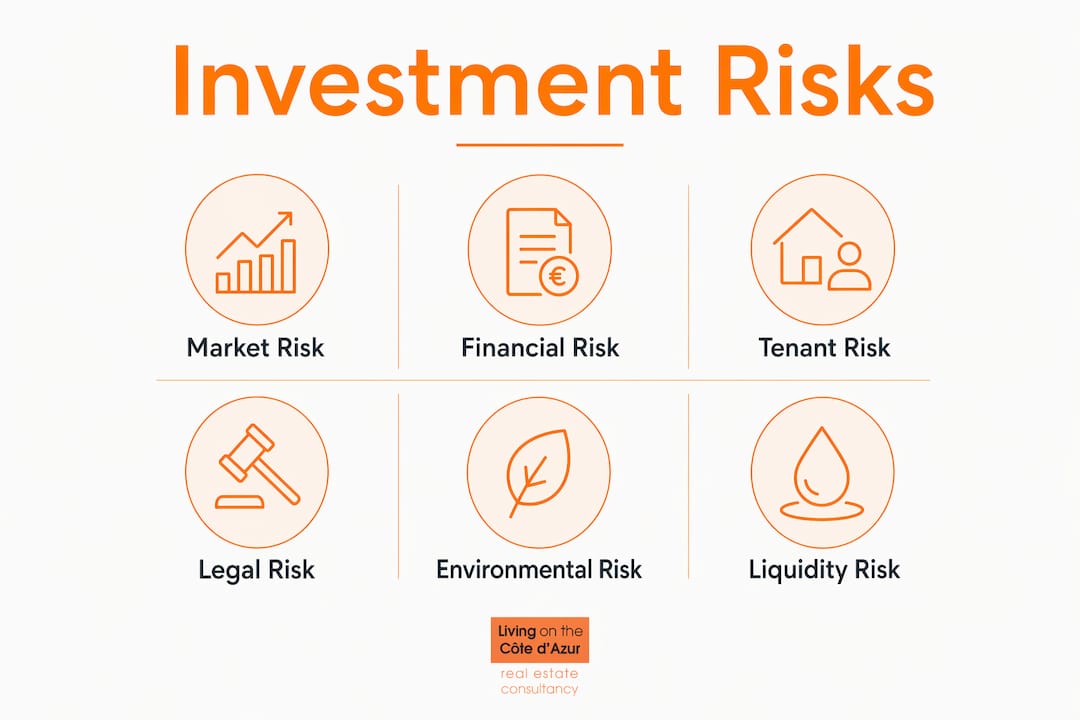
Property investment risk comprises six distinct categories: market risk, financing risk, tenant and occupancy risk, regulatory and legal risk, environmental risk, and liquidity risk. Each category can damage returns independently. When they interact, the damage compounds far faster than most investors model.
Market risk sits at the top of the list for most buyers. It describes the possibility that rental income falls, property values decline, or buyer demand shifts before you are ready to exit. Employment levels, new supply pipelines, and GDP growth all feed directly into local property demand. A city that loses a major employer can see vacancy rates rise and rents soften within a single letting cycle.
Interest rates amplify market risk considerably. When borrowing costs rise, fewer buyers qualify for mortgages, which suppresses demand and caps price growth. Investors who purchased at peak valuations using aggressive assumptions about rent growth find themselves squeezed from both sides: lower income and a higher cost of capital.
Pro Tip: Before committing to any acquisition, study at least five years of local employment data, planning applications, and population trends. Rent growth projections that exceed the local wage growth rate are almost always too optimistic.
Key drivers of market risk
- Supply pipeline: New developments entering the market within 12–24 months can suppress rents even in strong locations.
- Employment concentration: Markets dependent on a single employer or sector carry outsized demand risk.
- Interest rate sensitivity: Rising rates reduce buyer pools, which limits your exit options and can depress capital values.
- Overoptimistic underwriting: Projecting above-trend rent growth is one of the most common and costly property investment pitfalls.
Understanding property valuation dynamics on a micro level, not just a national one, is the foundation of sound market risk assessment.
How do financial risks like mortgage rates affect investors?
Financial risks in property centre on the cost and availability of debt. The average 30-year mortgage rate sits at 6.48% in mid-2026, tightly correlated with 10-year Treasury yields rather than short-term policy rates. That means central bank rate cuts offer investors less relief than many expect. A leveraged acquisition that pencilled out at 4% debt costs looks materially different at 6.5%.

Loan covenants introduce a second layer of financial exposure that many investors overlook entirely. DSCR triggers activate lender control rights before formal default occurs, including cash flow restrictions and enhanced reporting obligations. A ratio failure does not immediately trigger personal liability, but it hands the lender significant operational influence over your asset. That is a form of risk that does not appear on a simple cash flow spreadsheet.
Refinancing risk is equally serious. Risk dashboards used by institutional lenders monitor exposures for debts maturing within 12, 24, and 36 months, with DSCR thresholds flagging action below 1.20x. Private investors rarely track these metrics with the same discipline, which is precisely why they are caught off guard when a refinancing wall arrives.
Pro Tip: Model your DSCR under three scenarios simultaneously: base case, a 10% rent decline, and a 150-basis-point rate increase. If the stressed scenario breaches 1.20x, reduce leverage before you close.
Fixed vs adjustable mortgage risk: a comparison
| Factor | Fixed Rate Mortgage | Adjustable Rate Mortgage |
|---|---|---|
| Payment certainty | Payments are fixed for the term | Payments can rise with market rates |
| Refinancing risk | Lower during the fixed period | Higher; resets can cause cash flow shocks |
| DSCR stability | Predictable; easier to model | Volatile; stress-testing is essential |
| Best suited for | Long-hold, income-focused strategies | Short-hold or value-add strategies with clear exit |
| 2026 context | Preferred by conservative investors at 6.48% rates | Carries elevated risk given current rate environment |
Highly leveraged deals depending on perfect market conditions are structurally weak. Leverage improves returns when conditions cooperate, but it leaves almost no margin for error when vacancy rises or rates move against you.
What legal and tenant risks should UK landlords know in 2026?
The UK Renters’ Rights Act 2025 fundamentally changes the eviction process for private landlords. From 1 May 2026, all eviction notices must be served under section 8 only. Section 21 “no-fault” evictions no longer exist. This is one of the most significant housing investment challenges for UK landlords in a generation.
The new framework specifies notice periods by ground. Mandatory grounds, such as the landlord wishing to move in or mortgage repossession, require two months’ notice. Some discretionary grounds carry notice periods as short as two weeks, while others require one month. Each ground has specific evidential requirements, and errors in the notice invalidate the process entirely, sending landlords back to the start.
Court timelines add further exposure. Even a valid section 8 notice does not guarantee swift possession. County court backlogs mean that contested cases can take six months or longer to resolve. During that period, expenses continue regardless of whether rent is being paid.
Tenant-related risks that erode cash flow
- Vacancy: Vacancy risk erodes net operating income immediately because fixed costs persist with no offsetting income.
- Rent arrears: Arrears accumulate during the notice and court period, often reaching several months before possession is granted.
- Property damage: Damage beyond fair wear and tear can exceed deposit limits, leaving landlords with unrecovered costs.
- Regulatory compliance: Failure to maintain gas safety certificates, electrical installation condition reports, or energy performance certificates can invalidate a section 8 notice on certain grounds.
Operational discipline in lease enforcement and compliance documentation is not optional. NAI Global frames risk management as an ongoing operating discipline, not a one-time due diligence exercise. That framing is exactly right.
Which environmental and property-specific risks affect investment value?
Property-specific risks are often underestimated at the point of purchase because they are not visible in a headline yield calculation. Age-related repairs, structural defects, and outdated building systems can turn a profitable asset into a cash drain within a few years of ownership.
Environmental risks carry some of the heaviest financial consequences. Contamination, flood zones, and remediation requirements can limit property use or impose unexpected costs that materially reduce value. Title insurance does not always cover environmental and zoning risks, which means investors must commission independent environmental surveys before exchange. On the French Riviera, where coastal and hillside properties carry specific geological and flood-related exposures, this due diligence is non-negotiable.
Zoning changes represent a quieter but equally serious threat. A residential property adjacent to land rezoned for commercial or industrial use can see its appeal and value decline sharply. Conversely, an investor who identifies an upcoming zoning upgrade before the market prices it in gains a significant advantage.
Property-specific risk checklist
- Structural surveys: Commission a full structural survey, not just a mortgage valuation, on any property over 20 years old.
- Environmental assessments: Check flood risk maps, contamination registers, and coastal erosion data before purchase.
- Insurance coverage: Verify that your policy covers the specific environmental risks of the location, including subsidence and flooding.
- Zoning and planning: Review local authority development plans for the surrounding area, not just the property itself.
- Maintenance reserves: Budget a minimum of 1% of property value annually for maintenance, rising to 2% for older stock.
For investors considering overseas property ownership, environmental and zoning due diligence requirements vary significantly by jurisdiction and must be researched independently.
What liquidity challenges affect property risk management?
Liquidity risk is the risk that you cannot sell a property quickly without accepting a significant price reduction. Unlike equities, property cannot be liquidated in seconds. Specialised assets, such as commercial properties, rural estates, or ultra-prime coastal villas, can take 12–24 months to sell in a thin market. That illiquidity is not a flaw; it is a structural characteristic of the asset class. The risk arises when investors forget to account for it.
Concentration risk compounds liquidity risk. An investor with three properties in the same postcode, all let to tenants in the same sector, carries correlated exposure across market, tenant, and geographic dimensions simultaneously. A single local economic shock can affect all three assets at once.
Operational risk is the third dimension of this section. Risk management programmes that verify vendor insurance certificates, maintain life-safety logs, and enforce lease terms consistently protect both valuation and tenant retention. Poor documentation during a period of covenant pressure can worsen compliance problems even if cash flow recovers, as Kelley Clarke Law notes in its analysis of DSCR and recourse risk.
Practical steps for ongoing real estate risk management
- Maintain a liquidity buffer. Hold three to six months of gross rental income in accessible reserves at all times.
- Diversify geographically. Spread holdings across at least two distinct markets to reduce concentration risk.
- Track refinancing timelines. Flag any debt maturing within 24 months and begin refinancing conversations at least 12 months in advance.
- Document everything. Lease enforcement actions, maintenance records, and vendor compliance certificates must be filed systematically.
- Stress-test annually. Real estate risk analysis should test multiple interacting downsides together, not single variables in isolation.
- Review insurance annually. Coverage requirements change as property values, tenancy laws, and environmental conditions evolve.
For investors building a wealth preservation strategy around property, liquidity planning is as important as acquisition discipline.
Key takeaways
Effective property investment risk management requires simultaneous assessment of market, financial, legal, environmental, and liquidity risks before and throughout ownership.
| Point | Details |
|---|---|
| Market risk is local | Study employment, supply, and wage data for the specific micro-market, not national averages. |
| Mortgage rates bite hard | At 6.48% in 2026, stress-test DSCR at higher rates before committing to leverage. |
| UK tenancy law has changed | Section 21 is abolished; all UK evictions from May 2026 require section 8 grounds and correct notice periods. |
| Environmental risk is underpriced | Commission independent surveys for contamination, flooding, and zoning before exchange. |
| Liquidity requires planning | Hold cash reserves and track debt maturities 24 months ahead to avoid forced sales. |
Why i think most investors underestimate the interconnected nature of these risks
Having worked with high-net-worth buyers across the Côte d’Azur and beyond for many years, the pattern I see most often is not ignorance of individual risks. Most sophisticated investors understand that markets fluctuate and that tenants sometimes default. What they consistently underestimate is how these risks interact under stress.
A rising interest rate environment does not just increase your financing costs. It simultaneously suppresses buyer demand, reduces your exit options, and tightens the conditions under which you can refinance. If vacancy rises at the same moment, you face three compounding pressures at once. Stress-testing multiple interacting downsides together, rather than modelling each risk in isolation, is the single most important shift an investor can make in their underwriting process.
The 2026 UK tenancy reforms deserve particular attention. I have spoken with landlords who are aware of the Renters’ Rights Act 2025 in broad terms but have not yet updated their tenancy agreements, notice templates, or compliance documentation. That gap is a real estate investment danger that will materialise the moment a difficult tenancy arises. The time to prepare is before the problem, not during it.
On the financing side, I would caution against the assumption that central bank rate cuts will rescue overleveraged positions. The correlation between short-term policy rates and long-term mortgage rates is weaker than most people assume. Investors who are waiting for rates to fall before refinancing may be waiting longer than their debt maturities allow.
The most resilient portfolios I have seen share one characteristic: their owners treat risk management as a permanent operating discipline, not a pre-purchase checklist. They maintain reserves, document diligently, diversify thoughtfully, and revisit their assumptions every year. That discipline is not glamorous. It is, however, what separates enduring wealth from a cautionary tale.
— Ab Kuijer
How Livingonthecotedazur supports investors managing luxury property risks
At Livingonthecotedazur, we work exclusively with discerning buyers who understand that prestige properties on the Côte d’Azur carry their own distinct risk profile. From the sun-drenched hillsides above Cannes to the storied harbours of Saint-Tropez and Monaco, each acquisition demands legal audits, environmental due diligence, and tax structuring that goes well beyond a standard purchase. Our network of over 100 local specialists means that every risk category, from covenant compliance to coastal zoning, receives expert attention before you commit. Explore our curated collection of off-market luxury properties on the Côte d’Azur, where discretion and rigorous risk management are woven into every introduction we make.
FAQ
What are the main categories of property investment risk?
Property investment risk covers six categories: market risk, financing risk, tenant and occupancy risk, regulatory and legal risk, environmental risk, and liquidity risk. Each can affect returns independently, and they often compound when economic conditions deteriorate.
How does the UK renters’ rights act 2025 affect landlords in 2026?
From 1 May 2026, UK landlords can only serve eviction notices under section 8, with notice periods varying by ground from two weeks to two months. Section 21 no-fault evictions are abolished entirely, making correct documentation and compliance more critical than ever.
What mortgage rate should UK property investors model in 2026?
The average 30-year mortgage rate sits at approximately 6.48% in mid-2026. Investors should stress-test their debt-service coverage ratio at rates 150 basis points above their current rate to account for refinancing risk.
What is a DSCR trigger and why does it matter?
A DSCR trigger is a loan covenant that activates lender control rights when the debt-service coverage ratio falls below a specified threshold, often 1.20x. It does not immediately cause default but gives the lender significant influence over cash flow and operations.
How can investors reduce liquidity risk in property?
Investors reduce liquidity risk by maintaining three to six months of gross rental income in cash reserves, diversifying across at least two geographic markets, and beginning refinancing conversations at least 12 months before any debt maturity date.
Recommended
 //
//