
Start with four questions: why is the seller moving, how long has the property sat on the market, what evidence backs the asking price, and what condition issues has the agent disclosed. Those four answers, verified through a comparable market analysis and an official sales-history check, tell you whether to progress or walk away. Everything else in this checklist builds on those first four answers, and Living On The Cote d’Azur uses exactly this structure when vetting properties for international buyers.
TL;DR:
- Seller motivation and property history reveal whether the listing is serious or has underlying legal or repair issues requiring careful verification.
- Comparing asking prices with a detailed market analysis ensures the valuation is supported by recent sales and avoids overpaying in fluctuating areas like the French Riviera.
- Confirming chain status and seller readiness helps determine if the property is actually ready to exchange, preventing costly delays during the transaction.
- Asking for documented surveys, permits, and disclosure records reduces the risk of unexpected structural problems or legal restrictions after purchase.
- Using an independent buyer agent can uncover off-market opportunities, verify answers through documentation, and navigate complex legal or tax requirements more effectively.
Table of Contents
- Questions to ask a real estate agent when buying, grouped by theme
- What a buyer agent actually does with these questions
- An editor’s take on why buyers skip the hard questions
- How Living On The Cote d’Azur runs these checks for you
- Where to verify the answers yourself
- Sources
- FAQ
Questions to ask a real estate agent when buying, grouped by theme
Buying a property, especially from abroad, forces you into a strange position. You are relying on someone whose commission depends on the sale going through, yet you need honest answers about problems that could kill the deal. The way through this is not suspicion. It is structure. Ask the right question in the right order, on the viewing and again during the agent interview, and you will get further than any amount of general wariness.
Here is the checklist Living On The Cote d’Azur uses when vetting properties on behalf of clients, organised by theme so you can run through it on a single viewing without missing anything.
1. Seller motivation and sales history
Why the seller is moving tells you more than almost any other single fact. A relocation for work suggests a straightforward, motivated seller. A stalled renovation, a divorce, or an inherited property with several beneficiaries can mean either a bargain or a legal headache, sometimes both.
- “Why is the seller moving, and how urgent is that timeline?”
- “How long has this property been on the market?”
- “Have there been previous offers, and why didn’t they proceed?”
- “Can I see the sales history and any prior listing notes?”
A property that has been listed for several months with previous collapsed offers is telling you something the brochure will not. Buyer guides consistently flag seller motivation and time on market as the two questions that separate a genuine opportunity from an overpriced listing nobody wants.
2. Price, valuation and comparables
Never take an asking price at face value, however polished the listing photos are.
- “Can I see your comparable market analysis for this property?”
- “Has the price changed since it was first listed, and by how much?”
- “What evidence supports this valuation beyond the CMA?”
A good agent produces a CMA without hesitation. One who hedges, or offers only “similar properties nearby sold well,” is giving you an opinion dressed up as data. On the French Riviera, where villa pricing swings hard between similar-looking streets in Cannes or Cap d’Antibes, a proper comparables report matters more than almost anywhere else in Europe.
3. Chain, readiness and timeline
A perfect property attached to a broken chain can cost you months.
- “Is there a chain, and how many links are in it?”
- “Have the sellers already found their next home?”
- “What is the realistic timeline to exchange and completion?”
If the seller has not found anywhere to move to, ask directly what happens if their search drags on. That single answer often decides whether a property that looks ideal on paper is actually ready to transact.
4. Condition, surveys and disclosed defects
This is where buyers get burned, and where the right questions save real money.
- “Have there been any major works, structural repairs or insurance claims on this property?”
- “Are there recent surveys, structural reports or planning permissions I can see?”
- “Have you disclosed everything you’re legally required to?”
Ask for copies, not summaries. Buyer-advice guidance consistently recommends requesting building permits, survey reports and insurance history directly rather than relying on a verbal assurance. If an agent tells you “nothing major, just a bit of damp treated years ago,” that is precisely the sentence that should send you to a local surveyor before you go further.
5. Tenure and legal status
Freehold and leasehold carry very different obligations, and outside your home country the terminology and legal weight can shift entirely.
- “What is the tenure, and are there restrictions attached to it?”
- “Are there service charges, ground rent, or upcoming levies?”
- “Can I see the lease, management accounts, or recent HOA minutes?”
On the French Riviera, this translates into asking for the règlement de copropriété and the last two years of general assembly minutes for any apartment in a shared building. Unpaid charges or a looming roof-replacement levy can turn a fair price into a poor one overnight.
6. Running costs and utilities
- “What are typical utility bills and local property taxes?”
- “When were the boiler, heating system, or air conditioning last serviced?”
- “Can I see the energy performance certificate and recent bills?”
An EPC and a stack of recent utility bills give a far more honest picture of running costs than an agent’s verbal estimate, and they take two minutes to request.
7. Neighbourhood and planning
- “Are there any planning applications nearby that could affect this property’s value or views?”
- “What are transport links and school catchments like?”
For UK-based checks, Ofsted reports give an independent read on school quality rather than relying on an agent’s characterisation. For property near the coast or in a protected zone on the Riviera, always ask specifically about any plan local d’urbanisme restrictions, since these affect renovation rights far more than buyers expect.
9. Negotiation and closing costs
- “What price do you realistically expect this property to achieve?”
- “What contingencies would you recommend, given the survey, mortgage and title position?”
- “What are the likely closing costs, and who typically pays for what here?”
Contingency priorities shift depending on the property and the market, and professional buyer guidance suggests weighting survey and title checks more heavily on older or unusual properties, and mortgage contingency more heavily when financing is complex or cross-border.
Practical prompts for the viewing itself
Beyond the interview questions, use the walk-through to gather your own evidence:
- Ask where the boiler or heating system is located, and check the service sticker for the last maintenance date.
- Look for tide marks, bubbling paint or a musty smell in corners, which often signal damp before anyone mentions it.
- Check loft access and take a torch if you can. Roof problems hide up there long before they show downstairs.
- Photograph anything that looks recently patched, painted over, or oddly new against an otherwise old finish.
- Test water pressure and flush a toilet while you’re there. Small signals, but they matter.
Pro Tip: Ask the same question twice, once during the viewing and once in a follow-up email. A verbal answer that shifts in writing is the clearest red flag you’ll get before a survey confirms it.
A reassuring answer to a hard question is specific: a named date, a document offered without hesitation, a straight number on the CMA. A vague answer, “it’s nothing to worry about” without evidence attached, is the one worth escalating to a surveyor or, if you’re buying internationally, to a buyer agent who can push harder than you can from a distance.
What a buyer agent actually does with these questions
A buyer agent’s job is to ask every one of the questions above, verify the answers against documentation, and negotiate on the strength of what they find, rather than what the seller’s agent chooses to volunteer. That means running a whole-market search, including off-market opportunities the public listings never show, coordinating surveys and notaire steps, and making direct introductions to mortgage brokers and tax advisers when a purchase crosses borders.
Living On The Cote d’Azur has resolved cases where a disputed renovation claim on a Riviera villa only came to light once the sales ledger and prior planning permissions were requested directly from the mairie, rather than taken on trust from the listing agent. That is the kind of check a buyer rarely has the local access or language to run alone.
A competent buyer agent will typically obtain, on your behalf:
- The comparable market analysis and full sales ledger for the property
- The energy performance certificate and recent utility bills
- Service-charge accounts and general assembly minutes for shared buildings
- Copies of planning permissions and any relevant building permits
Living On The Cote d’Azur represents buyers exclusively, searching the entire market through a network with access to more than 100,000 properties, from apartments in Nice and Cannes to villas in Saint-Tropez, Mougins and Cap d’Antibes, rather than pushing a single agency’s own listings.
That structural difference, buyer-only representation against a whole-market search, is precisely why the questions above get sharper, better-documented answers when someone independent is asking them.
An editor’s take on why buyers skip the hard questions
Most buyers ask the easy questions and skip the hard ones, not through carelessness but because confrontation feels rude mid-viewing. That instinct costs money. On the Côte d’Azur and in Ibiza, where a meaningful share of the best inventory never reaches a public listing, the buyers who do well are the ones who treat every claim, “recently renovated,” “no issues with the roof,” “great rental history,” as a claim to verify, not a fact to accept.
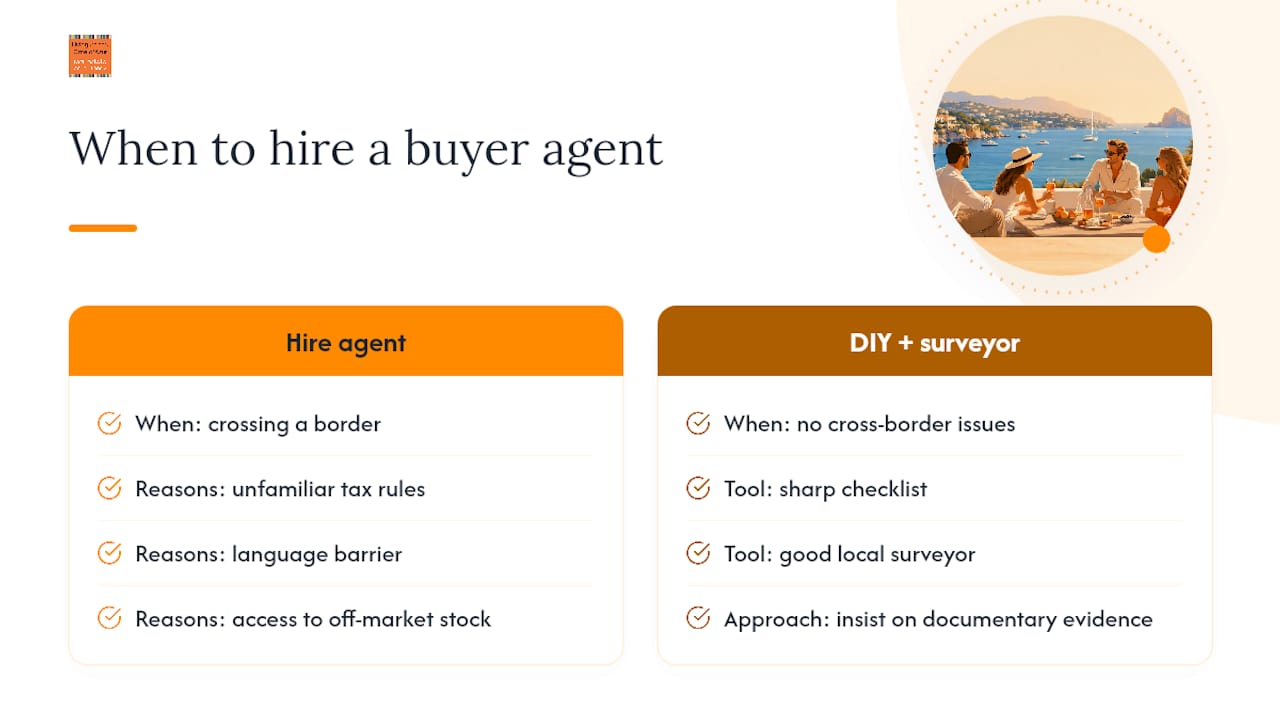
My one tactical principle: insist on documentary evidence for anything a seller or agent asserts, and check it through a local surveyor or a buyer agent who knows the difference between a notaire’s standard disclosure and one that is unusually thin. A verbal reassurance costs nothing to give and nothing to retract later.
Hiring a buyer agent earns its cost fastest when the transaction crosses a border: unfamiliar tax rules, a language barrier during negotiation, or access to off-market stock that never touches a public portal. If none of those apply, a sharp checklist and a good local surveyor will take you most of the way. If they do, the maths shifts quickly in favour of representation.
— Ab Kuijer
How Living On The Cote d’Azur runs these checks for you
Living On The Cote d’Azur exists precisely for buyers who would rather not chase CMAs, planning permissions and management accounts across three languages while also negotiating a price. As an independent buyer agent, the service works only for you, searching the entire Riviera and Ibiza market through local agents, developers and off-market contacts rather than promoting a single agency’s own inventory.
An initial engagement typically starts with a market briefing and a clear definition of what you’re searching for, followed by sourcing and comparing properties, coordinated viewings, and negotiation carried through to the notaire on your behalf. Where needed, you’re introduced to trusted mortgage brokers, tax advisers and surveyors already vetted through the network. Fees and arrangements vary depending on the market and the scope of the search, so it’s worth requesting a written engagement outline before committing to anything. If you’re weighing up why buyers use an agent at all, that’s the right place to start, and the property search process page walks through exactly what happens after that first conversation.

Where to verify the answers yourself
Before relying entirely on an agent’s word, a handful of official sources let you check the facts independently:
- Gov, for verifying UK sales history and prior sale prices.
- Ten questions to ask a buyer’s agent (NAR), for a professional benchmark on agent interview questions.
- Ofsted reports, for an independent read on school quality near a property you’re considering.
Sources
Interviewing the agent matters as much as interviewing the property.
Realtor and NAR guidance both recommend interviewing several agents before committing, comparing local track record and communication style rather than settling for the first friendly face at an open house. That guidance also flags something buyers underrate: agent-client fit often hinges on communication preferences as much as expertise, since misaligned communication style derails more negotiations than any pricing disagreement does.
FAQ
What are good questions to ask a real estate agent?
Start with seller motivation, time on market, and a request for the comparable market analysis. Those three answers, combined with a straight question about disclosed defects, tell you more than a full viewing checklist without them.
What should I ask estate agents when buying?
Ask about the sales history, chain status, tenure and service charges, running costs, and any planning applications nearby. Request documentation, not verbal summaries, for anything that affects price or legal status.
Is it okay to offer 10% below the asking price?
It depends entirely on time on market, prior offer history and the strength of the comparables. A property that has sat unsold for months with no prior offers supports a lower opening bid far more than one that just listed with strong local demand.
What are important red flags when buying a house?
Vague answers to direct questions, reluctance to share a CMA or sales history, undisclosed structural repairs or insurance claims, and a seller who hasn’t found their next home despite an urgent-sounding deadline. Any of these warrants a closer look from a surveyor or buyer agent before you proceed.
Recommended
 //
//