
The most effective real estate asset management strategies actively manufacture value rather than merely preserve it. Revenue optimisation, disciplined capital expenditure, rigorous risk management, a governed data layer, and a deliberate tenant strategy are the five levers that consistently separate high-performing UK portfolios from those that merely track the market. Treat your Asset Management Plan as a living financial model, not a static document filed away after acquisition.
The shortlist every UK investor should act on now:
- Revenue optimisation closes the gap between passing rent and market rent (loss-to-lease analysis), adds ancillary income streams, and controls service charge leakage — directly lifting Net Operating Income.
- Capex prioritisation protects yield-on-cost by sequencing refurbishment against lease events and EPC obligations, preventing value erosion at the wrong moment in the cycle.
- Capital structure management matches debt tenor to cash-flow profile, maintains liquidity buffers, and uses hedging instruments to insulate returns from rate volatility.
- Tenant strategy extends Weighted Average Lease Expiry (WALE), reduces void costs, and builds the rent-roll quality that lenders and valuers reward.
- A living risk register with governed data embeds early warning across financial, environmental, regulatory, and cyber exposures — turning reactive fire-fighting into a structured, measurable programme.
Pro Tip: Start this week by pulling your current rent roll and calculating two numbers: occupancy rate and the gap between passing rent and current market rent for each unit. These two figures alone will reveal where the highest-value interventions sit.
Key takeaways
The most effective real estate asset management strategies combine revenue optimisation, disciplined capex sequencing, a living risk register, and a governed data layer to manufacture returns rather than simply track the market.
| Point | Details |
|---|---|
| Start with loss-to-lease analysis | Calculate the gap between passing rent and ERV for every unit before committing any capex. |
| Build a living risk register in 90 days | Assign owners, set monthly check-ins, and produce a quarterly dashboard from day one. |
| Match debt tenor to cash-flow profile | Engage lenders 12–18 months before maturity and stress-test DSCR at 10% above current vacancy. |
| Audit EPCs across the full portfolio | Any asset below EPC E is a leasing liability and a financing risk under current UK MEES regulations. |
| Living On The Cote d’Azur | Supports portfolio diversification with off-market acquisition, legal audit, and tax advisory on the French Riviera. |
Table of Contents
- What does real estate asset management actually mean in the UK?
- Which KPIs should UK asset owners track, and how often?
- What are the highest-impact strategies for UK portfolio performance?
- How do you build a risk management programme that actually works?
- How should you manage financing risk in a stressed UK market?
- Which proptech tools genuinely improve UK portfolio decisions?
- What UK ESG and compliance obligations most affect asset value?
- A practical 90-day implementation plan you can start this quarter
- Case study: repositioning a UK mixed-use asset
- An asset manager’s daily and weekly checklist
- How Living On The Cote d’Azur supports your portfolio strategy
- Sources
- FAQ
What does real estate asset management actually mean in the UK?
Asset management is the discipline of making portfolio-level decisions that maximise risk-adjusted returns across the full property investment lifecycle — from acquisition through strategic improvement, refurbishment, governance, and ultimately disposal. It is not the same as property management, and conflating the two is one of the most expensive mistakes an investor can make.
How asset management differs from property management
Property management is operational: rent collection, maintenance scheduling, contractor oversight, tenant communications, and compliance with day-to-day landlord obligations. Asset management is strategic: it sets the investment thesis, determines when to refurbish or dispose, structures financing, monitors portfolio KPIs, and decides how capital is allocated across assets.
In the UK, the distinction carries regulatory weight. Landlord compliance obligations — from EPC minimum standards and fire safety remediation under the Building Safety Act 2022 to licensing requirements under the Housing Act 2004 — have escalated in complexity to the point where they now shape strategic decisions, not just operational ones. An asset manager who treats EPC remediation as a property manager’s problem will find it repriced into their exit valuation.
Typical responsibilities, split clearly:
- Asset manager: investment thesis, business plan approval, financing decisions, capex sign-off above threshold, lease strategy, disposal timing, investor reporting, risk register ownership.
- Property manager: rent collection, service charge reconciliation, maintenance, contractor management, tenant liaison, regulatory compliance at the building level.
Pro Tip: When outsourcing both functions, write a one-page RACI matrix before signing either contract. Define which decisions require AM sign-off versus PM authority. Ambiguity here costs money — usually in delayed capex approvals or missed lease events.
Which KPIs should UK asset owners track, and how often?
The answer is six to eight metrics, reviewed at four distinct cadences. More than that and reporting becomes noise; fewer and you lose early warning on the exposures that matter most.
The essential KPI set
Weekly operational flags from the property manager should cover void units, arrears above 14 days, and any maintenance items with a cost above the agreed threshold. Monthly operating variance reports compare actual NOI to budget. Quarterly board dashboards consolidate all KPIs with a written narrative and a forward-looking stress scenario. Annual revaluations and stress tests then reset the baseline for the coming year.
For benchmarking, the MSCI/IPD UK Property Index provides sector-level total return and income return data that asset managers use to contextualise portfolio performance against the market. CBRE and Savills publish quarterly rental and yield data by sector and geography, which feeds directly into ERV assumptions and loss-to-lease calculations.
What are the highest-impact strategies for UK portfolio performance?
Institutional-grade asset management treats the Asset Management Plan as a dynamic financial model, updated monthly after stress tests and whenever material interest-rate moves occur. The strategy taxonomy breaks into three risk-return profiles: core (stable cash flow, lower IRR target), value-add (mid-range IRR through operational improvement and refurbishment), and opportunistic (higher return targets through development or distressed acquisition). Each demands a different management intensity and a different KPI emphasis.
Value-add and repositioning
Loss-to-lease analysis is the starting point. Calculate the gap between passing rent and current Estimated Rental Value (ERV) for every unit, then rank interventions by NOI uplift per pound of capex. A 21-day unit turn target for residential assets, or a structured lease-up programme for commercial voids, converts that analysis into cash flow.
Refurbishment sequencing matters as much as the refurbishment itself. Align capex with lease expiry events so you are not spending money on a unit that a tenant will vacate in six months anyway. For commercial assets, consider whether a Cat A or Cat A+ fit-out is warranted given current occupier demand in that submarket.
Revenue optimisation
Beyond headline rent, ancillary income streams — car parking, storage, telecoms infrastructure, EV charging — can add meaningful NOI without requiring planning permission or significant capex. Service charge controls deserve equal attention: unrecovered service charge costs are a direct drag on NOI that many investors underestimate until they run a line-by-line reconciliation.
Capex planning and typical returns
Note: cost ranges are indicative for UK assets and will vary by location, specification, and procurement route. Always obtain at least three contractor quotes before committing.
For assets where VAT on refurbishment is a consideration, the distinction between repair (VAT-exempt) and improvement (potentially standard-rated) affects net capex materially. Where planning permission is required for change of use or extension, build a minimum 12-week programme buffer into the business plan.
Pro Tip: Sequence your capex so that the highest-YoC projects complete before your next refinancing event. A freshly refurbished, fully let asset commands a tighter cap rate and a higher gross asset value — both of which improve your loan-to-value position at the point of refinancing.
How do you build a risk management programme that actually works?
The single best practice is a living risk register with defined owners, a documented cadence, and a clear escalation path. A risk register that sits in a spreadsheet and is reviewed once a year is not a risk programme — it is a compliance exercise. The version that protects your portfolio is updated monthly, stress-tested quarterly, and audited annually.
Mapping exposures across four categories
Academic risk modelling in real estate consistently identifies market performance, asset size, and the risk-free rate as the most frequently used variables in quantitative frameworks. In practice, UK asset managers need to map four exposure categories:
| Risk Category | Typical Mitigations | Measurement Indicators |
|---|---|---|
| Financial (rate, refinancing, covenant) | Interest rate hedging (caps/swaps), liquidity reserve, covenant headroom monitoring | DSCR, LTV, ICR compared against well-defined covenant thresholds |
| Environmental (flood, climate, EPC) | Physical hardening, insurance review, EPC upgrade programme | Flood risk zone, EPC rating, insurance premium trend |
| Regulatory (planning, fire safety, licensing) | Compliance calendar, legal audit, Building Safety Act tracker | Outstanding remediation items, licence renewal dates |
| Cyber (BMS, tenant data, investor portals) | Network segmentation, MFA enforcement, immutable off-site backups | Penetration test results, incident log, backup verification |
Integrating cybersecurity into the risk register is not optional for assets with Building Management Systems (BMS) or smart metering. Segment BMS networks from corporate IT, enforce multi-factor authentication on all investor-facing portals, and maintain immutable off-site backups. Cyber risk is a core asset management control, not an IT department concern.
For practical guidance on commercial property risk controls, the sequence of physical hardening, insurance optimisation, and digital security forms a coherent programme that reduces both probability and severity of loss events.
90-day risk programme build
- Days 1–30: Conduct a full asset audit. Map all exposures across the four categories. Assign an owner to each risk item. Establish the register in a shared, access-controlled environment.
- Days 31–60: Prioritise risks by impact and cost-to-mitigate. Commission any urgent physical surveys (flood, fire, structural). Engage your insurer to review coverage gaps identified in the audit.
- Days 61–90: Complete the first monthly check-in. Produce a one-page risk dashboard for the investor report. Schedule quarterly stakeholder briefings and the annual full audit date.
Immediate actions to take this week:
- Pull your current insurance schedule and check flood zone classification for each asset.
- Confirm fire safety compliance status under the Building Safety Act 2022.
- Verify that all investor-facing portals require MFA.
- Check whether any debt facilities have covenant tests due within 90 days.
How should you manage financing risk in a stressed UK market?
The most durable financing strategy matches debt tenor to cash-flow profile and maintains a liquidity buffer equivalent to at least six months of debt service. In a market where UK base rates have moved materially, the cost of ignoring this principle shows up in covenant breaches and forced disposals at the wrong point in the cycle.
Alternative capital sources worth knowing
Non-bank lenders and private credit funds have filled a meaningful gap in UK commercial real estate lending since 2015, particularly for assets that fall outside mainstream bank appetite — short-lease commercial, mixed-use, or assets mid-refurbishment. Mezzanine finance can bridge the gap between senior debt and equity where a value-add business plan requires higher leverage during the improvement phase. Bridge financing suits acquisitions where speed of execution is the competitive advantage, with a clear exit into term debt once stabilisation is achieved.
For investment risk management in luxury and high-value assets, understanding which lender appetite aligns with your asset type and business plan is as important as the rate itself.
Refinancing tactics
- Engage lenders 12–18 months before maturity, not 6 months. The earlier conversation gives you optionality and negotiating leverage.
- Set covenant early warning triggers at 15% headroom above the covenant threshold — not at the covenant itself. By the time you breach, your options are already constrained.
- Run a stress-test checklist at every refinancing: what does the asset’s NOI look like at 10% vacancy above current, at a 50bps cap-rate expansion, and at a 100bps rate increase? If the DSCR falls below 1.10x under any of those scenarios, the capital structure needs adjustment before you sign.
Pro Tip: For retrofit projects, stack funding sources: a green loan from a sustainability-linked lender, any available government energy efficiency grant (check the current DESNZ scheme eligibility), and the reduced insurance premium that follows physical hardening. The net capex after stacking can be 20–35% lower than the gross project cost, which changes the YoC calculation materially.
Which proptech tools genuinely improve UK portfolio decisions?
Prioritise a governed data layer first. Everything else — dashboards, scenario models, early warning systems — depends on clean, validated, consistently structured data. A standardised rent-roll submission process with rules-driven validation and timestamped approval workflows eliminates the manual reconciliation that consumes reporting cycles and introduces errors into board-ready outputs.
The minimum viable tech stack for a UK portfolio
- Rent-roll ingestion and validation: automated checks that flag missing lease dates, inconsistent unit references, and passing-rent anomalies before they reach the investor report.
- KPI dashboards: a single source of truth for NOI, DSCR, occupancy, and WALE, updated on the reporting cadence defined in your governance framework.
- Stress-test modelling: scenario builders that run cap-rate shocks, vacancy spikes, and rate increases against the current portfolio in minutes rather than days.
- Tenant analytics and early warning: platforms that combine curated market news with portfolio-specific signals — lease expiry proximity, arrears trends, sector headwinds — to surface risks before they become income events.
- Document vault with role-based access: leases, title documents, planning consents, and compliance certificates in one searchable, permissioned environment.
For larger portfolios, a unified operating system that centralises deal pipelines, project management, and portfolio intelligence reduces the friction between acquisition analysis and asset management execution. AI-driven offering memorandum parsing and GIS overlays for site analysis are capabilities that materially speed up the front end of the investment process.
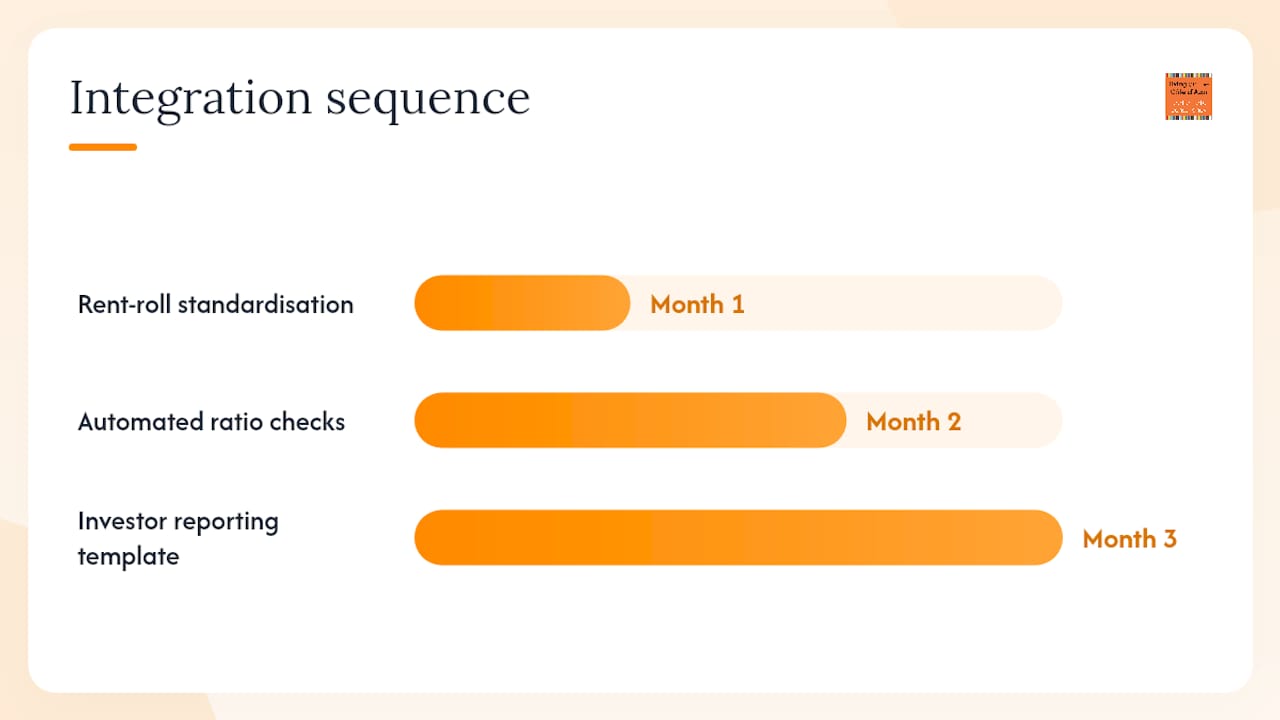
The integration sequence matters. Start with rent-roll standardisation. Add automated ratio checks in month two. Build the investor reporting template in month three. Resist the temptation to implement everything simultaneously — data quality degrades when teams are managing too many new workflows at once.
What UK ESG and compliance obligations most affect asset value?
The compliance items that most directly affect UK asset value right now are EPC ratings, Building Safety Act remediation, fire safety certification, and disclosure obligations for institutional investors. Missing any of them is not just a regulatory risk — it is a valuation risk, a financing risk, and increasingly a leasing risk as occupiers embed ESG criteria into their own procurement decisions.
EPC and building performance standards
From April 2025, the Minimum Energy Efficiency Standards (MEES) require commercial properties to achieve at least an EPC E rating to be legally let. The trajectory toward EPC B by 2030 for commercial assets is well-signalled, and lenders are already pricing EPC ratings into loan terms. An asset sitting at EPC D or below is not just a compliance liability — it is a future void risk as tenants with their own net-zero commitments decline to renew.
The retrofit decision framework is straightforward: quantify the cost of bringing the asset to EPC B, compare it against the rental premium and reduced void risk that rating commands, and weigh both against the alternative of disposal. For assets where the fabric-first retrofit cost exceeds the valuation uplift, disposal before the compliance deadline is often the more rational choice.
ESG credentials can command premium valuations in institutional markets, and that premium is widening as sustainability-linked lending becomes mainstream.
Immediate compliance actions
- Audit the EPC rating of every asset in the portfolio and map the gap to the 2030 target.
- Check Building Safety Act 2022 obligations for any residential building above 11 metres.
- Confirm fire safety remediation status and document the responsible person designation.
- For institutional investors and listed vehicles, review TCFD disclosure obligations and GRESB reporting requirements.
A practical 90-day implementation plan you can start this quarter
The three phases are: register and baseline (days 1–30), prioritise and plan (days 31–60), and execute pilots and embed governance (days 61–90). Each phase has a defined deliverable that feeds directly into the next.
Phase 1: Register and baseline (days 1–30)
- Collect all rent rolls, operating statements, and lease abstracts into a single, access-controlled data environment.
- Calculate baseline KPIs: NOI, occupancy, WALE, passing rent vs. ERV, and DSCR for each asset.
- Complete the initial risk register across all four exposure categories.
- Identify the top three value-creation opportunities by NOI uplift potential.
Phase 2: Prioritise and plan (days 31–60)
- Rank capex projects by YoC and sequence against lease events and refinancing dates.
- Engage lenders on any facilities maturing within 18 months.
- Commission EPC assessments for any assets not yet rated or rated below E.
- Draft the investor reporting template and agree the quarterly dashboard format with stakeholders.
Phase 3: Execute pilots and embed governance (days 61–90)
- Launch the highest-priority capex project and the first leasing initiative.
- Hold the first monthly risk register check-in with defined owners.
- Produce the first quarterly board dashboard using the agreed template.
- Schedule the annual full audit and the next quarterly stakeholder briefing.
Minimum data and people required to run this playbook:
- A complete, unit-level rent roll with lease expiry dates and passing rents.
- Operating statements for the trailing 12 months.
- One designated asset manager with sign-off authority on capex and leasing decisions.
- A property manager who can deliver weekly operational flags against agreed thresholds.
Case study: repositioning a UK mixed-use asset
Outcome summary: A 12-month value-add programme on a mixed-use asset in a regional UK city centre delivered a NOI increase of 18% and extended WALE from 2.1 years to 4.3 years, materially improving the asset’s refinancing position.
Baseline and interventions
The asset comprised ground-floor retail and upper-floor offices, acquired with a passing rent approximately 14% below ERV and two anchor tenants on leases expiring within 18 months. The asset manager’s business plan targeted three interventions: a Cat A office refurbishment timed to the first lease expiry, a service charge audit that recovered £28,000 in previously unrecovered costs, and a structured tenant engagement programme to secure early renewals on the retail units.
Technology integration was limited but deliberate: a standardised rent-roll submission process reduced monthly reporting time, and a scenario builder modelled the IRR impact of three lease-up timelines before the refurbishment budget was committed.
Before and after KPIs
The WALE extension positively impacted refinancing terms, reflecting the reduced income risk in the rent roll.
Lessons transferable to other UK assets
- Service charge audits are consistently underutilised. Run one before any other intervention — the recovered income is immediate and requires no capex.
- Tenant engagement before lease expiry, not after, is what secures renewals at market rent. Start conversations 18 months out.
- Sequencing the office refurbishment to coincide with the lease expiry avoided a void period entirely. Timing is the discipline that separates good capex from expensive capex.
An asset manager’s daily and weekly checklist
The daily objective is simple: protect cash flow and preserve value. Everything on the checklist flows from that.
Daily:
- Review arrears report from the property manager — flag any tenant more than 7 days overdue for direct contact.
- Check for any maintenance items flagged above the agreed cost threshold.
- Monitor any active capex projects for programme slippage.
Weekly:
- Review occupancy and void status across the portfolio.
- Check covenant headroom on any facilities with tests due within 60 days.
- Update the risk register for any new items raised by the property manager or legal team.
- Send a brief weekly update to investors — one paragraph, three numbers (NOI variance, occupancy, any material event).
Monthly:
- Produce the operating variance report and update the Asset Management Plan model.
- Run the risk register check-in with all owners.
- Review the rent roll for any lease events in the next 12 months that require action.
When delivering bad news to investors, lead with the mitigation plan, not the problem. “We have a tenant in arrears of £12,000; we have served a Section 8 notice and have two replacement tenant enquiries at market rent” is a very different communication from “we have a tenant in arrears.” The former demonstrates control; the latter creates anxiety. Investors can tolerate problems — what they cannot tolerate is the sense that no one is managing them.
How Living On The Cote d’Azur supports your portfolio strategy
For investors whose ambitions extend beyond the UK market, Living On The Cote d’Azur brings the same disciplined, value-focused approach to off-market property acquisition and portfolio curation on the French Riviera. With access to more than 100,000 properties across prestige locations from Saint-Tropez to Monaco, the firm connects discerning investors with assets that deliver both lifestyle and measurable ROI — supported by full legal audit, tax optimisation, and financing advisory from a team with deep local relationships.
Two services map directly to the strategies covered in this guide: retrofit and renovation project management for assets requiring EPC-equivalent improvement under French standards, and tenant sourcing for WALE optimisation in the luxury residential and commercial segments. For investors considering high-net-worth real estate as part of a broader legacy and wealth preservation strategy, the firm’s advisory extends to inheritance structuring and SCI arrangements.
To explore how these capabilities align with your portfolio objectives, request a portfolio review directly through the Living On The Cote d’Azur team.
Sources
Investors building or refining a UK asset management programme should consult these authoritative sources directly:
- Lexology — risk management programme and building hardening recommendations
- Real Estate Asset Management: The institutional‑grade how‑to guide for 2026 — Financial Modelling University
- Locurcio, Real‑Estate‑Risk (2026) — literature review of variables influencing real estate risk
- STREETS — real estate portfolio management software
- Intapp Properties — real estate operating system
- Moody’s CRE Portfolio Manager — commercial real estate portfolio management solution
- Five stages of managing real estate responsibly — Columbia Threadneedle
For property portfolio management across multiple geographies, understanding how UK compliance obligations compare to other high-value markets is an increasingly important part of capital allocation decisions.
FAQ
What is real estate asset management and how does it differ from property management?
Asset management operates at the portfolio and investment strategy level, making decisions on capital allocation, financing, and disposal timing. Property management handles day-to-day operations including rent collection, maintenance, and tenant communications.
What are the four main real estate investment strategies?
The four primary strategies are core (stable income, low risk), core-plus (modest value-add with limited risk), value-add (operational improvement and refurbishment for mid-range IRR), and opportunistic (development or distressed assets targeting higher returns). Each requires a different management intensity and capital commitment.
What is the 2% rule in property investment?
The 2% rule suggests that a property’s monthly rent should equal at least 2% of its purchase price to generate positive cash flow. It is a rough screening heuristic used in residential markets and is rarely applicable to UK commercial or luxury assets, where yield expectations and financing structures differ significantly.
What are the 5 P’s of asset management?
Definitions of the 5 P’s vary across frameworks; a common version used in real estate covers Plan (the asset management plan), Performance (KPI monitoring), People (team and governance), Process (reporting and risk cadence), and Portfolio (strategic allocation decisions). No single canonical standard governs this acronym.
How do you build a real estate risk register?
Map exposures across four categories: financial, environmental, regulatory, and cyber. Assign an owner to each risk, score by probability and impact, and set a review cadence of monthly check-ins, quarterly stakeholder briefings, and an annual full audit, as recommended by Lexology’s risk programme guidance.
Which KPIs matter most for UK real estate portfolios?
NOI, DSCR, WALE, occupancy rate, cash-on-cash return, and yield-on-cost are the six metrics that most directly signal portfolio health and early warning of income risk in UK assets.
What EPC rating do UK commercial properties need to be legally let?
From April 2025, commercial properties must achieve at least EPC E to be legally let under MEES regulations. The trajectory toward EPC B by 2030 is well-signalled, and lenders are already incorporating EPC ratings into loan pricing.
How does Living On The Cote d’Azur support real estate asset management strategies?
Living On The Cote d’Azur provides off-market acquisition, legal audit, tax optimisation, and renovation project management for investors diversifying into French Riviera assets, with advisory covering SCI structuring, inheritance planning, and WALE optimisation through curated tenant sourcing.
Recommended
 //
//