
TL;DR:
- Real estate safe havens preserve capital during market turmoil through durable income, legal clarity, and low market correlation.
- US and European markets offer structural advantages, with US properties benefiting from reserve currency status and European assets from legal transparency and demand-driven income streams.
Real estate safe havens are defined as properties and markets that retain or grow in value during periods of economic turbulence, geopolitical stress, or currency instability. Unlike equities or bonds, these tangible assets offer a combination of durable income, legal clarity, and inflation resistance that few other asset classes can match. For high-net-worth investors, the distinction between a genuine safe haven and a speculative property is not merely academic. It determines whether your capital survives a crisis or quietly erodes within it. This guide examines the markets, asset types, and property investment strategies that define the best real estate investments for wealth preservation in 2026.
What are real estate safe havens explained for global investors?
A real estate safe haven is not simply an expensive property in a desirable location. The term, borrowed from financial markets where gold and US Treasury bonds carry the label, refers to assets with three core qualities: low correlation to volatile markets, durable income from non-discretionary tenant demand, and a legal or regulatory environment that protects ownership rights. Real estate’s low market correlation and inflation hedge qualities provide effective geopolitical risk mitigation. That combination makes property a credible shield when equities fall and currencies weaken.

The industry term most professionals use alongside “safe haven” is capital preservation real estate. Both phrases describe the same goal: protecting purchasing power across market cycles. What separates safe haven properties from ordinary investments is the quality of the income stream, the strength of the legal framework governing ownership, and the depth of demand from creditworthy tenants or buyers. A villa in a fashionable resort town may be beautiful, but without those three pillars, it is a lifestyle asset rather than a safe haven.
For investors conducting real estate market analysis, the starting point is always the macro environment. In 2026, elevated interest rates, persistent geopolitical uncertainty, and currency volatility have pushed discerning capital toward markets with proven track records. The US and Western Europe dominate that shortlist, each for distinct structural reasons explored below.
Why does US real estate remain a primary global safe haven?
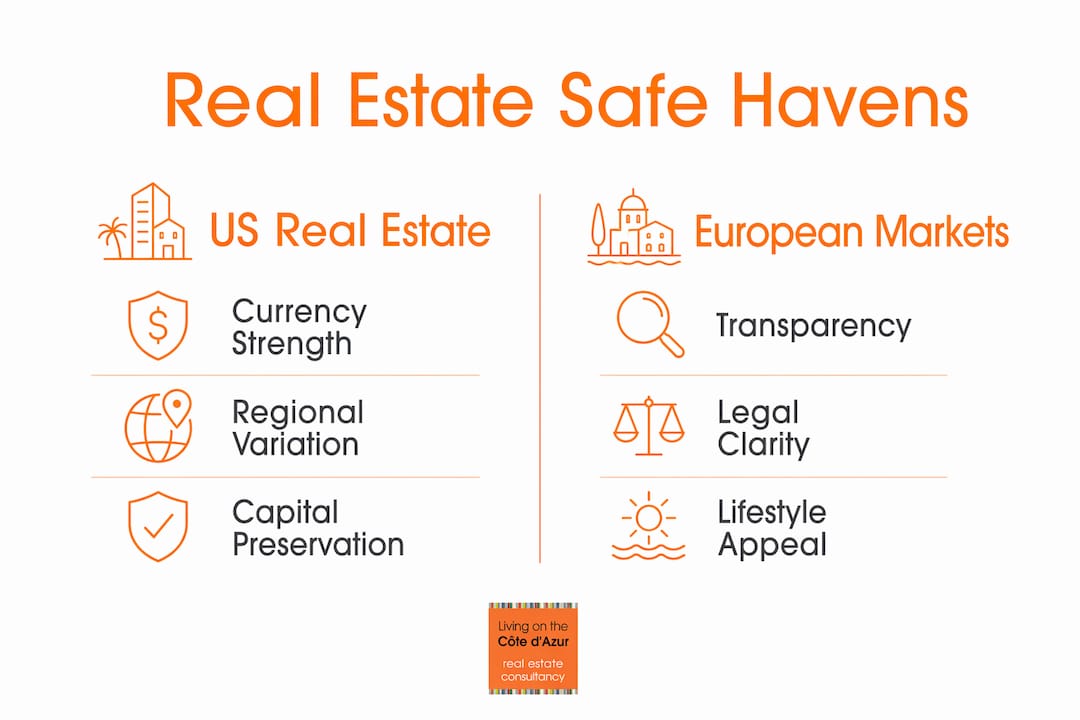
The United States property market holds a singular position in global real estate market analysis. The USD has sustained its reserve currency status for 80 years, benefiting investors when home currencies weaken. When the euro, pound, or yen depreciates, a USD-denominated property effectively appreciates in local currency terms without the underlying asset moving at all. That passive currency gain is a feature no other major market replicates at scale.
Regional performance within the US varies considerably, and that variation matters for where to invest in real estate. The Northeast has appreciated 12.6% since mid-2022, while the West has declined 7.3% over the same period. Mortgage rates ended june 2026 at 6.6% for 30-year fixed loans. Those rates constrain affordability for domestic buyers but create acquisition opportunities for cash-rich international investors who face no financing dependency.
DSCR loans as a currency hedge
One financing structure deserves particular attention from international investors. DSCR loans match USD income with USD debt, creating a natural currency hedge that eliminates the need for costly financial derivatives. The rental income services the debt in the same currency, so exchange rate movements do not erode the margin between income and repayment. For a European or Asian investor holding USD-denominated property with USD-denominated debt, the currency risk effectively cancels itself out.
Key advantages of US safe haven real estate for international investors:
- Reserve currency exposure: Property income arrives in USD, the world’s most liquid reserve currency.
- Regional diversification: Northeast and Midwest markets offer stability; Sun Belt markets offer growth potential.
- Financing access: DSCR loans allow non-resident investors to finance acquisitions based on rental income rather than personal income verification.
- Legal clarity: US property law, title insurance, and escrow systems provide transparent ownership structures.
- Inflation linkage: Rents in most US markets adjust annually, preserving real income over time.
Pro Tip: If you hold assets in a currency that has historically weakened against the USD, allocating a portion of your real estate portfolio to US property functions as a passive hedge without the complexity of currency derivatives.
How do European real estate markets offer transparency and resilience?
European real estate offers a transparency premium supported by strong legal frameworks and growing operational asset classes. Total returns in Europe have risen consistently over the recent four quarters, a performance that reflects structural demand rather than speculative momentum. The EU’s regulatory architecture, covering property rights, tenant law, and cross-border investment rules, gives international investors a level of predictability that emerging markets cannot match.
The European transparency advantage is reinforced by clear regulations, strong legal protections, and well-understood tax implications across most member states. France, for example, operates a notarial system where every transaction passes through a state-appointed notary, creating an unbroken chain of legal title. Portugal’s Golden Visa reforms and Spain’s non-habitual resident tax regimes have attracted significant high-net-worth capital, each backed by codified legal frameworks.
Emerging asset classes driving European returns
Four asset categories are generating consistent income independent of economic cycles across Europe:
- Data centres: Demand from cloud infrastructure providers has created long-lease, high-credit tenancies in locations from Frankfurt to Dublin.
- Healthcare facilities: Ageing demographics across Western Europe produce non-discretionary demand for medical real estate that persists through recessions.
- Student housing: University cities including Oxford, Amsterdam, and Barcelona maintain structural undersupply, supporting rental growth year after year.
- Long-lease commercial: Supermarket-anchored retail and logistics facilities with 15-year-plus leases deliver bond-like income with property upside.
| Asset class | Lease length | Demand driver | Cyclical sensitivity |
|---|---|---|---|
| Data centres | 10–20 years | Cloud infrastructure growth | Low |
| Healthcare | 15–25 years | Ageing population | Very low |
| Student housing | 1 year, recurring | University enrolment | Low |
| Long-lease commercial | 10–25 years | Essential retail and logistics | Low to medium |
For investors seeking top European hotspots for legacy capital, the combination of legal clarity and structural demand makes Europe a compelling complement to US holdings.
What types of real estate assets qualify as genuine safe havens?
Investors should focus on real estate with non-discretionary tenant demand to access truly resilient safe haven returns. Assets with 18–24 month leases and high-credit tenants generate durable income and outperform during periods of turmoil. The distinction between contracted income and discretionary demand is the single most important filter in any safe haven property investment strategy.
Real estate investment trusts, or REITs, illustrate this bifurcation clearly. Not all REIT assets qualify as safe havens; focus should be on long-lease, essential tenant contracts rather than short-term speculative properties. A REIT holding supermarket-anchored retail and NHS-contracted medical facilities behaves very differently from one holding boutique hotels or co-working spaces. The former produces income through recessions; the latter contracts sharply when discretionary spending falls.
Assets that qualify as safe havens
- Long-lease commercial property with investment-grade tenants
- Medical facilities and GP surgeries under NHS or equivalent contracts
- Logistics and last-mile distribution centres with 10-year-plus leases
- Residential property in supply-constrained cities with strong employment bases
- Student accommodation in top-tier university cities
Assets that carry elevated risk
- Short-term holiday lets in seasonal markets
- Boutique hotels dependent on leisure tourism
- Co-working and flexible office space with month-to-month contracts
- Speculative development land without planning consent
- Retail in declining high streets without anchor tenants
Pro Tip: Before acquiring any property marketed as a safe haven, request the full lease schedule and tenant credit ratings. A 20-year lease with a B-rated tenant is less secure than a 10-year lease with an AA-rated government body.
The property investment risks associated with short-lease or volatile asset types are frequently underestimated by investors entering the market for the first time. Liquidity constraints compound the problem: if you need to exit a distressed asset quickly, the discount required to attract a buyer can eliminate years of income.
How should you align investment strategies with your capacity and goals?
Misalignment between investor strategy and operational capacity is a key failure point; the best investments fit individual bandwidth. Three primary strategies dominate the safe haven property space, each suited to a different investor profile.
Buy-and-hold is the most straightforward approach. You acquire a property with strong fundamentals, place a creditworthy tenant, and collect income over a long horizon. This strategy suits investors who prioritise capital preservation over rapid growth and who have limited appetite for operational complexity. The trade-off is modest yield relative to more active strategies.
Value-add, or BRRRR (Buy, Refurbish, Rent, Refinance, Repeat), accelerates portfolio growth by recycling capital through refurbishment cycles. Capital recycling via Value-Add BRRRR accelerates portfolio growth but requires scale of operational capacity and contractor relationships rare among new investors. This strategy suits mid-journey investors with established contractor networks and the bandwidth to manage refurbishment projects across multiple assets simultaneously.
Specialised rental niches, including student housing, serviced apartments, and medical suites, offer premium yields but require sector knowledge and active management. The income can be highly resilient, particularly in healthcare, but the operational demands are significant.
Key considerations when selecting a strategy:
- Capital available: Buy-and-hold requires less working capital than value-add cycles.
- Time commitment: BRRRR demands active oversight; buy-and-hold can be largely passive.
- Experience level: New investors consistently overestimate their capacity to manage complex refurbishments.
- Exit horizon: Long-hold strategies suit investors with a 10-year-plus horizon; value-add suits those seeking liquidity within five years.
- Financing access: DSCR loans and interest-only mortgages change the return profile significantly.
Pro Tip: Map your available hours per month before selecting a strategy. If you cannot commit at least 20 hours per month to active management, a buy-and-hold structure with a professional property manager will almost always outperform a value-add approach you cannot execute properly.
How do lifestyle factors enhance safe haven appeal in Europe?
Lifestyle factors including international schools, quality infrastructure, cultural events, and beach access play a significant role in luxury safe haven real estate demand. Locations such as the Côte d’Azur combine lifestyle appeal with investment stability in a way that few markets worldwide can replicate. For high-net-worth investors, the property is not merely a financial instrument. It is also a place where life is lived, and that dual function commands a structural premium.
The Côte d’Azur, stretching from Menton to Saint-Tropez, concentrates an extraordinary density of lifestyle infrastructure within a compact geography. International schools including Mougins School and the International School of Monaco serve families relocating from London, Geneva, and New York. Nice Côte d’Azur Airport connects directly to over 100 destinations, making the region genuinely accessible for investors who split their time across multiple countries. The Cannes Film Festival, Monaco Grand Prix, and Art Basel satellite events sustain year-round cultural demand that keeps the market visible to the world’s wealthiest individuals.
From an investment perspective, lifestyle advantages translate into structural demand. Properties within walking distance of the Promenade des Anglais in Nice or overlooking the bay in Villefranche-sur-Mer attract buyers from across Europe, the Middle East, and Asia. That international buyer pool provides liquidity that purely domestic markets cannot offer. Tax considerations, including France’s wealth tax regime, SCI structures for inheritance planning, and the lump-sum tax option available in Monaco, require careful navigation but are well-understood by specialist advisers operating in the region.
Key takeaways
Real estate safe havens deliver capital preservation through non-discretionary income, legal transparency, and currency-resilient structures, making them the most reliable wealth protection tool available to high-net-worth investors in 2026.
| Point | Details |
|---|---|
| Define before you buy | A genuine safe haven combines durable income, legal clarity, and low market correlation. |
| Currency matters | USD-denominated property with USD debt creates a natural hedge for non-US investors. |
| Asset selection is critical | Long-lease, essential-tenant properties outperform short-lease or discretionary assets in downturns. |
| Match strategy to capacity | Buy-and-hold suits most investors; BRRRR requires operational bandwidth most new investors lack. |
| Lifestyle drives luxury premiums | Côte d’Azur and comparable European markets command structural premiums from international buyer depth. |
What I have learned about safe haven investing after years on the Riviera
The phrase “safe haven” gets used loosely, and that looseness costs investors money. I have watched clients arrive with a clear conviction that a particular property, usually beautiful, usually in a fashionable location, qualifies as a safe haven simply because it is expensive. Expense is not the criterion. Income durability and legal clarity are the criteria.
The investors who have built genuinely resilient portfolios through our work at Livingonthecotedazur share one habit: they assess their operational capacity honestly before selecting a strategy. A family office with a dedicated asset management team can run a BRRRR programme across three countries. A successful entrepreneur with two hours a week for property matters cannot, regardless of how compelling the projected returns look on a spreadsheet.
Currency dynamics are the most underappreciated element of international safe haven investing. I have seen European investors hold US property through periods of significant dollar strength and watch their net worth grow in euro terms without a single tenant paying more rent. That passive gain is real, and it is structural. It does not require market timing or active management.
My honest caution is this: over-leveraging in a high-rate environment destroys the safe haven quality of any asset. A property generating 5% gross yield financed at 6.6% is not a safe haven. It is a liability dressed in bricks. The wealth preservation principles that actually work are unglamorous: conservative leverage, long leases, creditworthy tenants, and markets with genuine legal protection. The Côte d’Azur satisfies all four criteria when approached with discipline rather than aspiration alone.
— Ab Kuijer
Livingonthecotedazur: your gateway to curated safe haven properties
Livingonthecotedazur connects discerning investors with over 100,000 properties across the French Riviera, from Saint-Tropez to Monaco, including a carefully curated portfolio of off-market luxury properties that never reach public listings. Our Dutch approach prioritises transparency at every stage: legal audits, tax optimisation, SCI and inheritance structuring, and financing assistance are all part of the service. For investors seeking high-net-worth real estate that delivers both legacy value and measurable ROI, our longstanding relationships with local notaries, agents, and specialists mean you access the market as an insider, not as a visitor.
FAQ
What defines a real estate safe haven?
A real estate safe haven is a property or market that preserves capital during economic or geopolitical stress through durable income, legal clarity, and low correlation to volatile asset classes.
Why is US real estate considered a global safe haven?
The USD has held its reserve currency status for 80 years, meaning USD-denominated property income retains or gains value when other currencies weaken against the dollar.
What types of property qualify as safe haven assets?
Long-lease commercial property, medical facilities, student housing, and residential property in supply-constrained cities with investment-grade tenants are the most reliable safe haven asset types.
How do DSCR loans help international investors manage currency risk?
DSCR loans match USD rental income with USD debt repayments, creating a natural currency hedge that eliminates exchange rate exposure without requiring financial derivatives.
Is the Côte d’Azur a genuine safe haven for luxury real estate investment?
The Côte d’Azur combines structural lifestyle demand, international buyer depth, and well-established legal frameworks, making it one of Europe’s most resilient luxury property markets for capital preservation.
Recommended
 //
//