
Securing a place on the Côte d’Azur through luxury real estate is more than a status symbol for discerning investors seeking long-term security and flexibility. The evolving appeal of the renewable golden visa lies in its promise of multi-year residency, allowing you and your family to establish meaningful roots without the hassles of annual visa renewals or reliance on local sponsors. This article reveals how the right investment strategy can transform your property aspirations into lasting residency and global mobility.
Table of Contents
- Defining The Renewable Golden Visa Programme
- Eligibility Criteria For High-Value Investors
- Application Process And Renewal Steps In France
- Investment Requirements For Côte d’Azur Properties
- Financial, Legal, And Tax Implications
- Comparing Permanent Residency And Golden Visas
Key Takeaways
| Point | Details |
|---|---|
| Renewable Golden Visa Advantages | Provides long-term residency with renewable terms, allowing for self-sponsorship and family inclusion without annual visa renewals. |
| Investment Criteria | Eligibility largely hinges on substantial capital investments, notably in property, with minimum thresholds typically ranging from EUR 500,000 to EUR 3 million. |
| Application Process | Requires meticulous preparation, including documentation of investments and residency intent, with a typical application timeline of 3 to 6 months. |
| Strategic Structuring | Investors should align their property acquisition with active economic contributions to strengthen visa approval prospects and ensure compliance. |
Defining The Renewable Golden Visa Programme
A renewable golden visa represents a modern pathway for high-net-worth individuals and qualified professionals to secure long-term residency in premium destinations whilst maintaining the flexibility their sophisticated lifestyles demand. Unlike traditional visitor visas that require annual renewal or extension applications, a renewable golden visa grants extended residency validity spanning multiple years—typically 5 to 10 years at a time—with automatic renewal provisions. This structure eliminates the uncertainty of annual visa processing and provides the stability that discerning international investors require when establishing lasting ties to a chosen location.
The fundamental distinction of a renewable golden visa lies in its dual advantages: permanent residency security combined with periodic renewal cycles. When you obtain renewable long-term residency visas valid for 5 to 10 years, you gain immediate access to live, work, and conduct business without requiring a local sponsor or intermediary. The “renewable” element means that once your initial visa term concludes, you can extend it again for another multi-year period, provided you maintain eligibility criteria. This differs fundamentally from standard residency permits that demand annual compliance checks and sponsor approvals. For property investors on the Côte d’Azur seeking the stability to build meaningful ties whilst protecting their business interests globally, this structure offers unprecedented peace of mind.
Key characteristics that define the renewable golden visa programme include:
- Multi-year validity periods allowing you to settle without constant administrative intervention
- Self-sponsorship capability enabling independent visa management without reliance on employers or property owners
- Family inclusion provisions permitting spouses and dependents to gain residency concurrently
- Extended absence allowances granting flexibility for business travel without jeopardising visa status
- Professional recognition for entrepreneurs, investors, and specialists who contribute meaningfully to their chosen jurisdiction
- Automatic renewal mechanisms eliminating the urgency of annual reapplication cycles
The golden visa system specifically targets individuals with substantial capital or expertise, including real estate investors, business founders, scientists, and healthcare professionals. For Riviera property purchasers, the real estate investment category often aligns most directly with their circumstances. The visa acknowledges that your financial contribution—whether through property acquisition or business establishment—merits extended security and preferential treatment. This positioning transforms residency from a temporary arrangement into a genuine long-term commitment, enabling you to build family legacy, establish cultural roots, and develop the professional networks that transcend typical holiday residence models.
Pro tip: Before pursuing any golden visa pathway, verify that your chosen programme explicitly supports property investment as a qualifying category and confirm minimum investment thresholds align with your Riviera acquisition plans—this ensures seamless alignment between your real estate strategy and residency objectives.
Eligibility Criteria For High-Value Investors
Becoming eligible for a renewable golden visa as a high-value investor hinges on demonstrating substantial financial capacity and a genuine commitment to establishing residency in your chosen destination. The criteria vary by jurisdiction, but they typically centre on your ability to invest meaningful capital—whether through property acquisition, business establishment, or direct financial contributions. For those seeking Riviera access through property investment, your eligibility fundamentally rests on your investment threshold and your capacity to sustain residency obligations over the multi-year visa term. This isn’t merely about possessing wealth; it’s about proving that your financial position enables genuine, long-term settlement rather than temporary speculative activity.
The most straightforward eligibility pathway for Côte d’Azur investors involves real estate investment capital. Most golden visa programmes recognise property ownership as a qualifying investment category, with specific minimum thresholds typically ranging from EUR 1.5 million to EUR 3 million depending on the jurisdiction and property characteristics. When you purchase a luxury villa in Cannes, Antibes, or Saint-Tropez meeting this threshold, you immediately satisfy the primary eligibility requirement. Beyond the purchase price itself, programmes often consider factors such as property location, condition, and whether it represents a genuine residential acquisition versus speculative holdings. Your investment must demonstrate authenticity—owning a fully furnished, move-in-ready estate carries more weight than holding an empty plot awaiting development.
Additional eligibility dimensions extend beyond capital requirements:
- Income verification demonstrating stable financial capacity to support residency without requiring employment income from the destination country
- Proof of funds documentation showing the origin of your investment capital meets anti-money laundering standards
- Business credentials if you’re establishing a professional enterprise alongside property investment
- Health and character clearance confirming your background poses no security concerns
- Family composition details if you’re including dependents in your visa application
- Prior residency history showing successful integration in other countries when applicable
When you secure renewable long-term residency through investment categories, your ongoing eligibility depends on maintaining your investment position throughout the visa validity period. This means your Riviera property must remain in your ownership—you cannot sell the villa immediately after obtaining the visa without jeopardising your renewal prospects. Programmes specifically designed for investors expect you to maintain your asset as evidence of genuine commitment. Additionally, many jurisdictions require periodic compliance verification, ensuring your financial position remains sound and your residency intent continues. This creates a natural alignment between your investment strategy and your residency security, preventing opportunistic visa abuse whilst rewarding committed investors.
Age considerations rarely present barriers for high-value investors, unlike many employment-based residency programmes. Whether you’re 45 or 75, investment capacity typically supersedes age restrictions. Professional credentials matter less than capital availability—you need not be an entrepreneur or scientist to qualify through property investment channels. This accessibility makes the investor pathway particularly attractive for established wealth holders seeking Riviera stability without reinventing their professional identity. Your financial portfolio speaks louder than your career history.
Pro tip: Request pre-application eligibility assessments from residency advisers specialising in your target destination before finalising your Riviera property purchase, ensuring your specific investment structure and capital source align perfectly with current programme requirements and avoiding costly post-purchase complications.
Application Process And Renewal Steps In France
Securing your renewable golden visa in France demands meticulous attention to procedural detail and timing precision. The application journey begins well before you submit your formal documentation—preparation is where success is genuinely won or lost. Your first critical step involves establishing your eligibility profile through the official French administration channels, gathering comprehensive supporting documentation that validates your investment capacity, property ownership, and financial soundness. This isn’t a rushed process; successful applicants typically allocate three to six months for the complete application cycle from initial documentation assembly through final approval.
The formal application process unfolds in distinct phases that require sequential completion. You’ll need to gather necessary information through the official France-Visas platform, where you’ll determine your specific visa requirements, applicable fees, and the precise supporting documents your application demands. The online wizard guides you through jurisdiction-specific requirements—these vary considerably depending on whether you’re applying as a Côte d’Azur property investor versus other investment categories. After determining your exact requirements, you complete the comprehensive online application form, providing detailed information about your investment, financial background, family composition, and proposed residency plans. You’ll upload recent passport photographs meeting specific technical standards, along with scanned copies of your original travel documents valid for your intended residency period.
Once your digital application is finalised and payment processed, you must book an in-person appointment at your designated visa application centre. This timing is critical—appointment slots fill rapidly, particularly during peak seasons. Here’s where patience intersects with strategy:
- Submit your digital application and payment through the official portal with all required documentation attached
- Book your appointment immediately after payment confirmation to secure your preferred date and time
- Prepare your supporting materials including original property deeds, investment verification documents, and proof of funds
- Attend your appointment in person for biometric collection and document verification—this cannot be delegated
- Undergo security screening and background verification following standard French administrative procedures
- Receive your initial visa once all documentation is verified and approved
The in-person appointment requirement means you must physically present yourself at the visa application centre in France or your designated regional office. During this visit, your fingerprints and facial biometrics are collected, and immigration officers verify the authenticity of your submitted documents. This verification step is non-negotiable and forms the foundation of your entire residency authorisation. Bring original documents alongside your digital submissions—officers will cross-reference submitted materials against originals to confirm accuracy and legitimacy. Inconsistencies between digital and physical documentation can trigger application delays or rejection.
Renewal Process For Ongoing Residency Security
Renewal procedures commence approximately 90 days before your current visa expires. You’ll submit renewal documentation demonstrating continued compliance with programme requirements—your Riviera property remains in your ownership, your financial position remains sound, and you’ve maintained genuine residency intent throughout your initial visa term. The renewal application typically requires less extensive documentation than your original submission, as your background check and basic eligibility have already been established. However, you must provide updated property valuations, current financial statements, and evidence of your continued residency presence in France.
The renewal timeline operates more smoothly than initial applications because your established profile reduces administrative complexity. Most renewals process within 60 to 90 days, compared to four to six months for first-time applications. You’ll follow similar procedural steps—completing the online form, scheduling your appointment, attending in person, and undergoing biometric re-verification. This cyclical process ensures that your ongoing eligibility remains verified and that your commitment to Riviera residency is regularly documented and validated.
Conseil pro: Begin your visa application preparation at least six months before your intended residency start date, ensuring sufficient time for property documentation, financial verification, and appointment scheduling whilst avoiding last-minute complications that could delay your arrival at your Côte d’Azur property.
Investment Requirements For Côte d’Azur Properties
Understanding the precise investment thresholds for Côte d’Azur properties is essential for discerning investors pursuing renewable golden visa pathways. France’s approach differs markedly from traditional golden visa models—the country emphasises genuine economic contribution rather than passive property acquisition alone. This distinction fundamentally shapes your investment strategy when acquiring a luxury villa in Cannes, Antibes, or Saint-Tropez. The minimum investment requirements are not arbitrary figures; they represent France’s commitment to attracting investors who demonstrate serious long-term commitment to the French economy and society.
The foundational investment threshold for residency-linked property acquisition in France centres on a minimum purchase price of EUR 500,000 for eligible real estate investments. This baseline establishes France’s entry point for property investors seeking renewable residency status. However, this figure represents merely the financial floor—properties in prestige locations like the Côte d’Azur typically far exceed this minimum, with desirable villas commanding EUR 2 million to EUR 10 million depending on location, condition, and amenities. Your actual investment will likely substantially exceed the minimum threshold, particularly if you’re acquiring waterfront estates, period properties with historical significance, or newly constructed luxury developments. The EUR 500,000 baseline exists primarily to filter out speculative or marginal investments, ensuring that approved investors demonstrate material financial capacity and genuine settlement intentions.
What distinguishes France’s investment model is its emphasis on active economic contribution rather than passive ownership. Property investment alone—simply purchasing a villa and leaving it unoccupied—does not guarantee renewable golden visa eligibility or renewal approval. French authorities examine whether your investment generates measurable economic benefits to the region. Consider these qualifying dimensions:
- Commercial property development creating jobs and generating business activity
- Restoration of heritage properties contributing to cultural preservation and local employment
- Investment in rental operations providing tourism revenue and local service employment
- Business establishment alongside property ownership, demonstrating entrepreneurial engagement
- Agricultural or wine-producing assets contributing to Provence-Côte d’Azur’s signature industries
Whilst residential villas represent legitimate investments, authorities scrutinise whether your property purchase genuinely reflects settlement intent or speculation. A fully furnished, move-in-ready estate where you maintain active residency throughout the visa validity period demonstrates authentic commitment. Conversely, purchasing a villa solely for capital appreciation, leaving it vacant except during holiday periods, or immediately attempting to lease it to tourists may trigger renewal complications. Your investment narrative must align with France’s vision—you’re not merely acquiring real estate; you’re participating in the Riviera’s economic and social fabric.
Beyond the property purchase itself, you’ll typically require demonstrating additional liquid capital reserves. The business investment route requires a minimum EUR 300,000 investment in tangible or intangible assets in France, and authorities generally expect renewable visa applicants to maintain financial reserves proving capacity to sustain residency without employment income. This might involve maintaining EUR 50,000 to EUR 150,000 in accessible liquid funds, depending on your property’s maintenance costs, local property taxes, and living expenses. These reserves demonstrate that your investment wasn’t financially exhausting—you maintain genuine economic stability and can meet ongoing obligations.
Below is a summary of the investment requirements for securing a renewable golden visa via Côte d’Azur property:
| Requirement Type | Minimum Threshold | Typical Range in Côte d’Azur | Additional Considerations |
|---|---|---|---|
| Property Purchase | EUR 500,000 | EUR 2m to EUR 10m | Location, villa amenities |
| Business Investment | EUR 300,000 | EUR 300,000+ | Must be in tangible assets |
| Liquid Capital Reserves | EUR 50,000 | Up to EUR 150,000 | For ongoing expenses |
| Economic Contribution | Active involvement required | Job creation or restoration | Not just passive holding |
Strategic Investment Structuring For Visa Success
Successful Côte d’Azur property investors structure their acquisitions strategically from the outset. Rather than treating property purchase and visa applications as separate transactions, integrating these activities amplifies your eligibility prospects. Consider acquiring properties requiring renovation, simultaneously demonstrating capital investment and employment generation for local contractors and specialists. Alternatively, combine residential villa ownership with professional activity—establishing a creative business, consulting firm, or boutique enterprise alongside your primary residence transforms your investment profile from passive ownership to active entrepreneurship.
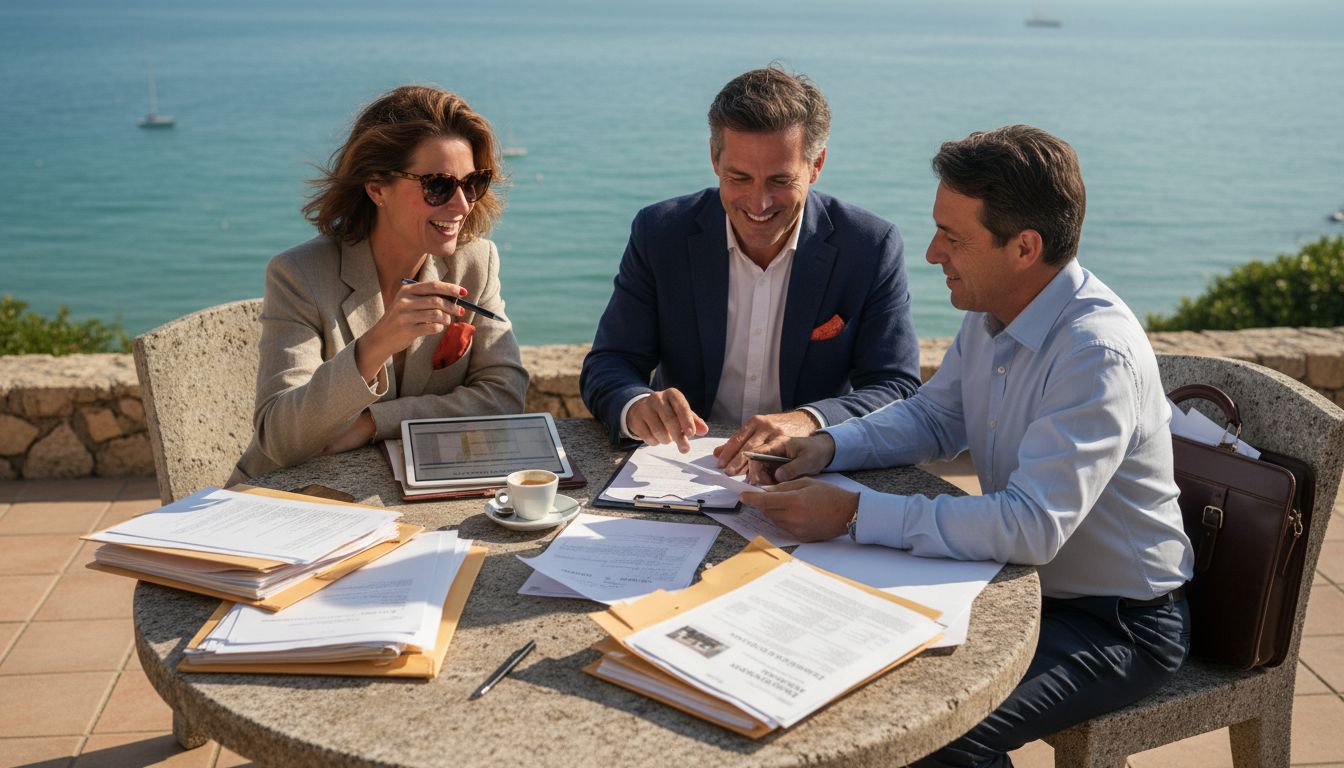
Timing matters significantly. Your property acquisition ideally precedes your formal visa application by sufficient months to demonstrate settlement commencement and genuine residency establishment. Purchasing a property weeks before submitting your visa application may raise administrative questions about your intentions; conversely, acquiring property six to twelve months before application demonstrates deliberate, well-considered commitment. Luxury real estate investments on the French Riviera require this longitudinal perspective—authorities examine whether your entire investment trajectory reflects authentic, sustainable engagement rather than rushed financial manoeuvres.
Conseil pro: Structure your investment to encompass both residential acquisition and some form of economic contribution activity—whether through property development, professional operations, or business establishment—as this dual approach significantly strengthens your visa renewal prospects and demonstrates France’s desired model of active investor commitment.
Financial, Legal, And Tax Implications
Securing a renewable golden visa for Côte d’Azur property ownership involves far more than financial investment—it demands rigorous attention to legal structures, tax obligations, and financial planning across multiple jurisdictions. Your decision to establish residency in France creates cascading implications for your global wealth management, tax position, and legal standing. These considerations require sophisticated professional guidance from specialists who understand both French regulations and your home country’s tax requirements. Overlooking these dimensions can transform what appears to be a sound investment into a complex compliance nightmare.
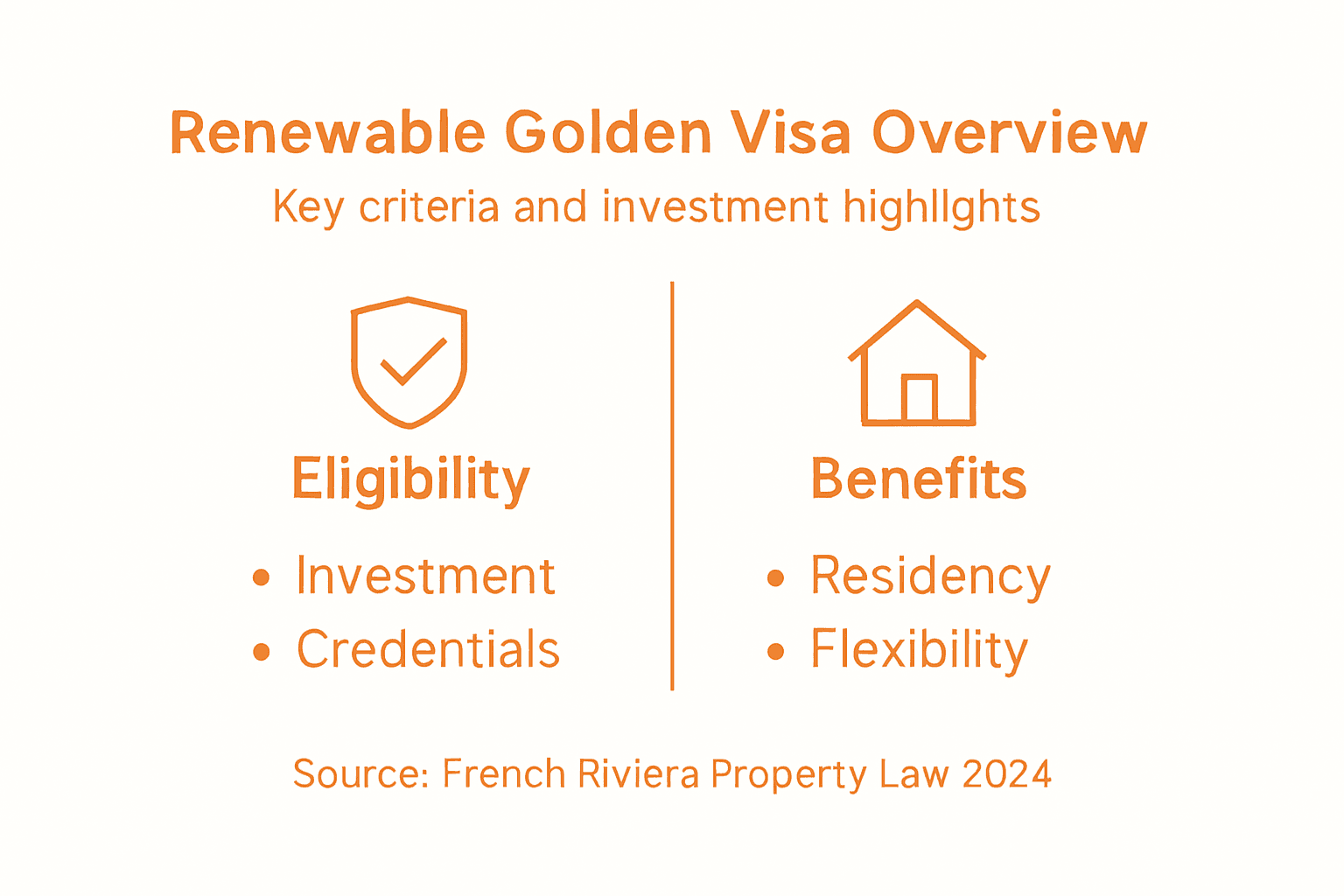
French law provides robust protection for your property investment through established contract enforcement and property rights protection under French civil law. When you purchase a Riviera villa, you’re acquiring an asset protected by centuries of refined legal precedent and a stable judiciary. France’s legal system ranks amongst Europe’s most reliable, meaning your ownership rights are secure against arbitrary seizure or political instability. However, this legal stability comes with corresponding obligations. The French administrative apparatus requires meticulous compliance with reporting requirements, tax declarations, and residency documentation. France maintains comprehensive systems tracking foreign ownership, investment origins, and financial flows—your investment transparency is non-negotiable.
The critical distinction between legal residency and tax residency fundamentally shapes your financial obligations. Holding a renewable golden visa grants legal residency status, but this does not automatically confer tax residency. Tax residency is determined separately, based on factors including the number of days you physically reside in France, your economic interests in France, and where your permanent home is located. Many international investors maintain legal residency in France whilst preserving tax residency elsewhere, but this requires meticulous documentation. If you spend more than 183 days annually in your Côte d’Azur villa or establish France as your centre of economic interest, you risk becoming a French tax resident. This distinction matters enormously because tax residency determines your obligations to report worldwide income and assets to French authorities, including property holdings, investment portfolios, and business interests globally.
Tax implications extend across multiple dimensions requiring strategic planning. France maintains wealth tax considerations for high-net-worth individuals, with potential obligations depending on your specific residency classification and income sources. Property ownership itself incurs annual property taxes, maintenance expenses, and potential capital gains taxation when you eventually sell. If you generate rental income from your villa—leasing it during summer months or as a holiday rental—that income becomes taxable in France. Additionally, you must navigate your home country’s tax requirements, as most nations tax their citizens on worldwide income regardless of residency location. A British national establishing French residency, for example, remains liable for UK tax on certain income sources whilst simultaneously managing French tax obligations. This dual taxation exposure requires sophisticated tax planning to optimise your position without creating legal vulnerabilities.
Strategic Legal And Financial Structuring
Successful high-net-worth investors structure their Côte d’Azur acquisitions through appropriate legal vehicles designed to balance asset protection, tax efficiency, and compliance. Rather than purchasing property directly in your personal name, consider acquiring through a French limited liability company (SARL) or similar structure. This approach provides liability protection, simplifies property management, and may offer tax advantages depending on your specific circumstances. However, such structuring requires careful design—poorly structured entities can create additional reporting obligations or trigger unexpected tax consequences.
You must obtain specialised legal and tax advice to navigate corporate structures, personal tax residency, and compliance with French tax regulations. This isn’t optional—it’s foundational. Engage French tax specialists and property attorneys before purchasing your villa, not after. These professionals can structure your acquisition optimally, advise on inheritance planning if you’re purchasing as a legacy asset, and establish compliance systems ensuring smooth renewals. The investment in professional advice typically costs EUR 5,000 to EUR 15,000 but prevents far costlier mistakes. Additionally, establish relationships with international tax advisers in your home country who understand cross-border compliance requirements. They’ll ensure your French property acquisition and residency don’t trigger unexpected liabilities in your jurisdiction of origin.
Annual compliance obligations demand rigorous attention. Every year you must file French property tax declarations, potentially complete worldwide asset disclosure forms, and ensure all documentation demonstrates legitimate residency. Your visa renewals depend partly on showing compliance—authorities examine tax records and financial documentation as evidence of genuine settlement and economic contribution. Missed deadlines or incomplete filings can jeopardise renewal prospects. Establish systems ensuring timely completion of all obligations; consider engaging a French accountant to manage annual compliance requirements, translating documents and submitting filings on schedule.
Conseil pro: Engage French tax and legal specialists at least three months before your property acquisition to structure your investment optimally, confirm tax residency implications, and establish compliance systems that prevent expensive complications during visa renewals.
Comparing Permanent Residency And Golden Visas
When pursuing lasting Riviera access, discerning investors frequently face a fundamental choice between renewable golden visas and traditional permanent residency pathways. Understanding the distinctions between these statuses is crucial, as they offer markedly different benefits, obligations, and long-term implications. A golden visa represents an investment-linked residency permit with predetermined renewal cycles, whilst permanent residency grants indefinite settlement rights with fundamentally different legal standing. Your choice hinges on your specific objectives, mobility requirements, and whether you envision eventual French citizenship or prefer maintaining flexibility across multiple jurisdictions.
The core distinction between these residency forms centres on duration, flexibility, and pathway to citizenship. A renewable golden visa typically grants residency validity for 5 to 10 years, after which you must reapply, demonstrating continued compliance with programme requirements. This cyclical renewal structure maintains an explicit link between your investment and your residency status—if you divest your Côte d’Azur property or your financial circumstances change substantially, renewal may be jeopardised. Conversely, permanent residency grants more stable, long-term settlement rights including welfare and civic benefits, often requiring longer residency periods, but once acquired, your status becomes independent of ongoing investment requirements. Permanent residency typically requires demonstrating sustained residence over five to ten years before becoming available, whereas a golden visa can be acquired immediately upon qualifying investment.
Golden visas attract international investors through explicit advantages that permanent residency cannot match. These programmes offer flexibility with less stringent physical presence requirements—you can secure renewable residency without maintaining continuous residence in France. A golden visa holder might spend only three months annually at their Riviera villa whilst maintaining residency status, enabling simultaneous property ownership across multiple countries. Permanent residency, by contrast, often requires demonstrating primary residence and substantial physical presence—many jurisdictions mandate 180+ days annually to maintain status. The application processes differ markedly as well. Golden visa pathways typically conclude within 4 to 6 months once you submit qualifying documentation, whereas permanent residency applications often span 12 to 24 months with substantially more rigorous vetting. For high-net-worth individuals seeking expedited access whilst preserving global mobility, golden visas offer compelling advantages.
However, permanent residency provides strategic benefits that golden visas cannot replicate. Permanent residency allows foreign nationals to live indefinitely in a country with most rights of citizens except voting and holding certain public offices, creating genuine long-term settlement security. Once granted, permanent residency status cannot be withdrawn due to investment fluctuations or market changes. Additionally, permanent residency typically establishes a clearer pathway to citizenship after meeting additional residency requirements—generally 5 to 10 years of continuous residence. If your ultimate objective is French citizenship and full political participation, permanent residency represents a more direct route. Conversely, renewable golden visas do not guarantee citizenship eligibility; France maintains discretion regarding whether visa holders eventually qualify for citizenship, and the renewable cycle can extend indefinitely without leading to permanent settlement rights.
For investors considering residency routes, here is a structured comparison of renewable golden visas and permanent residency in France:
| Aspect | Renewable Golden Visa | Permanent Residency |
|---|---|---|
| Validity Period | 5-10 years, renewable | Indefinite, once granted |
| Link to Investment | Must maintain qualifying assets | Unrelated after initial application |
| Physical Presence Required | Flexible, often less than 6 months/year | Typically 183+ days/year |
| Pathway to Citizenship | Indirect, may need further eligibility | Direct after several years |
| Application Timeline | 4-6 months on average | 1-2 years on average |
Strategic Considerations For Your Riviera Investment
Your choice between these pathways depends on several interconnected factors requiring honest assessment. First, clarify your long-term intentions. Are you seeking French citizenship eventually, or do you prefer maintaining international flexibility across multiple residences and nationalities? If citizenship is your goal, investigate whether France’s specific programmes offer clear citizenship pathways after golden visa tenure, or whether pursuing permanent residency from the outset accelerates your citizenship timeline. Second, evaluate your mobility requirements. If you anticipate spending significant periods outside France managing international business interests or maintaining multiple residences, a golden visa’s flexible residency requirements outweigh permanent residency’s stricter physical presence obligations. Third, consider investment permanence. If you’re acquiring your Côte d’Azur villa as a permanent family asset intended to remain in your ownership indefinitely, a golden visa aligns well with your intentions. Conversely, if your investment strategy anticipates eventually divesting the property, permanent residency might offer superior long-term stability independent of your property holdings.
The financial implications also merit consideration. Golden visa programmes typically command higher upfront investment requirements—EUR 500,000 to EUR 3 million in property acquisition—but deliver rapid residency access. Permanent residency often requires lower initial investment but demands extended residency periods before approval. For time-constrained investors seeking immediate Riviera access, the golden visa investment premium justifies accelerated processing. Additionally, examine renewal burden and costs. Golden visa renewals demand periodic reapplication and documentation review, generating administrative complexity and professional fees across multiple cycles. Permanent residency, once granted, eliminates such renewal requirements, though maintaining qualifying residency conditions remains necessary.
Conseil pro: Before committing to either pathway, consult with French immigration specialists to map your specific residency timeline and citizenship objectives, as the optimal choice depends entirely on whether you prioritise immediate flexible access via golden visa or long-term settlement security with eventual citizenship eligibility through permanent residency.
Secure Your Renewable Golden Visa with Trusted Côte d’Azur Expertise
Navigating the complexities of France’s renewable golden visa programme demands more than just financial commitment. From meeting stringent investment thresholds to managing detailed application procedures and understanding tax implications, high-net-worth investors face significant challenges in securing lasting residency on the French Riviera. This journey involves proving genuine economic contribution, maintaining property ownership, and meticulously planning your long-term residency strategy without jeopardising visa renewal prospects.
At Living on the Côte d’Azur, we understand that your investment is not only about acquiring a luxury villa but about securing a lifestyle and a legacy that transcends market cycles. Our expert guidance connects you with the finest properties in Cannes, Saint-Tropez, and Antibes while helping you structure your acquisition to align seamlessly with visa eligibility criteria. Whether you are focused on legacy investments or new eco-luxury constructions, our insights ensure your residency ambitions are supported by strategic legal, financial, and administrative planning.
Explore how to transform your property purchase into a secure gateway to the Riviera by consulting with our dedicated advisors. Discover more about purchasing luxury real estate on the French Riviera and legacy investment opportunities through our tailored services. Don’t leave your golden visa success to chance; take the decisive step today by contacting our team at Living on the Côte d’Azur.
Begin your journey now and secure your lasting access to the Mediterranean dream with confidence.
Frequently Asked Questions
What is a renewable golden visa?
A renewable golden visa is a long-term residency permit for high-net-worth individuals, allowing them to live, work, and conduct business in a given location, typically with validity periods of 5 to 10 years and automatic renewal provisions.
What are the eligibility criteria for obtaining a renewable golden visa?
Eligibility generally includes demonstrating substantial financial capacity through a significant investment, such as property acquisition, and meeting requirements like income verification and proof of funds.
How does the application process for a renewable golden visa work?
The application process involves gathering the necessary documentation, completing an online application, booking an in-person appointment for biometric verification, and then awaiting approval, which may take several months.
What are the investment requirements to qualify for a renewable golden visa?
Investment requirements vary but usually involve a minimum property purchase price of around EUR 500,000, with the actual amounts typically being higher in premium locations. Active economic contribution is also a factor in qualifying.
Recommended
 //
//