
TL;DR:
- A property buying concierge manages every operational, legal, and lifestyle aspect of luxury real estate acquisitions for high-net-worth buyers. It reduces buyer involvement by up to 75 percent, provides exclusive off-market property access, and coordinates legal, financial, and post-closing support. This full-service approach is essential for complex, high-value transactions, especially on the French Riviera.
A property buying concierge is defined as a dedicated professional who manages every operational, administrative, and lifestyle aspect of a real estate acquisition on behalf of the buyer. The role of concierge in property buying goes far beyond what a traditional agent provides. Where a standard agent facilitates a transaction, a concierge coordinates an entire ecosystem of professionals, from notaries and tax advisors to interior designers and relocation specialists. For high-net-worth buyers acquiring prestige property on the Côte d’Azur or in Monaco, this distinction is not merely convenient. It is the difference between a purchase that consumes months of personal attention and one that demands only your most considered decisions.
What does a property buying concierge actually do?
Concierge real estate services cover the entire support lifecycle, from an initial needs assessment through to move-in coordination. That breadth separates the concierge model from every other form of property assistance.

The service begins before a single property is viewed. A concierge conducts a detailed consultation to understand your acquisition goals, lifestyle requirements, budget parameters, and timeline. That intelligence shapes every subsequent decision, so no time is wasted on properties that do not fit your precise criteria.
Once the brief is established, the concierge takes on the following functions:
- Property discovery and access. The concierge searches both public listings and off-market inventory to surface properties that match your brief. Many of the finest Riviera estates never appear on public portals.
- Viewing coordination. Scheduling, logistics, and travel arrangements for property visits are handled entirely on your behalf.
- Vendor management. Trusted surveyors, architects, legal counsel, and staging professionals are engaged, briefed, and supervised by the concierge.
- Negotiation support. The concierge provides professional market comparables and pricing analysis, then leads or supports negotiations to protect your position.
- Legal and financial coordination. Notaries, mortgage brokers, tax advisors, and attorneys are aligned and kept on schedule throughout the closing process.
- Post-closing logistics. Renovations, furnishing procurement, home automation installation, and property management handover are all orchestrated after the keys are received.
For international buyers, the concierge also manages relocation logistics, school searches, and lifestyle introductions to the local community. This is where the role becomes genuinely irreplaceable.
Pro Tip: Ask your concierge for a written service scope before engagement. The most effective concierge relationships are built on a clear, agreed brief that covers both the acquisition phase and the post-closing period.
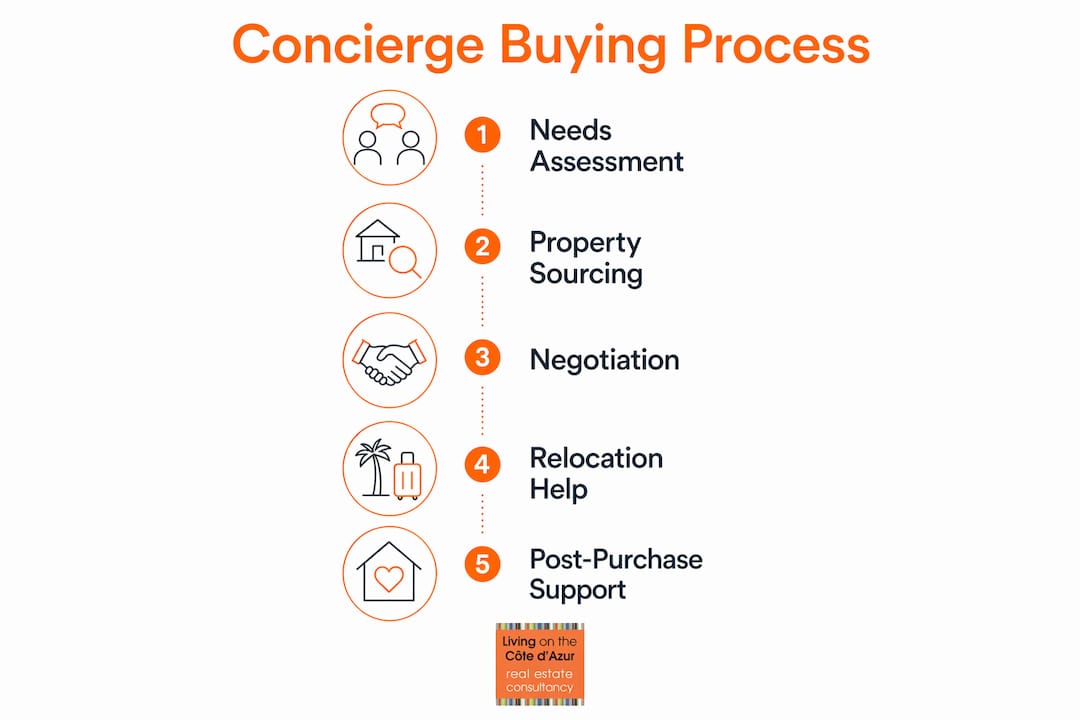
The contrast with a traditional agent is stark. An agent’s legal obligation ends at the point of sale. A concierge’s commitment extends as far as the client requires.
How does a concierge save time and reduce stress for buyers?
Concierge-led property buying can reduce client involvement from 60–100 hours per transaction down to 15–30 hours. That is a 70–75% reduction in the personal time a buyer must invest. For a chief executive or family principal managing international commitments, that saving is not a luxury. It is a necessity.
The hours saved come from a specific set of tasks the concierge absorbs entirely. Scheduling viewings, chasing solicitors, coordinating surveys, reviewing draft contracts, and managing vendor timelines are all removed from the buyer’s plate. What remains for the buyer is the genuinely strategic work: choosing between shortlisted properties, approving negotiation positions, and signing documents.
“The concierge model functions as a single point of contact managing the entire professional ecosystem, minimising friction rather than simply adding convenience.” This framing, drawn from 2026 luxury market analysis, captures why the model outperforms every fragmented alternative.
Proactive communication is the mechanism that reduces stress. A concierge anticipates problems before they reach the client. If a survey reveals a structural issue, the concierge has already sourced two remediation quotes before the client is informed. If a notary’s calendar creates a closing delay, the concierge has already identified an alternative date. The client receives curated information, not raw anxiety.
The contrast with the traditional model is instructive. In a conventional purchase, the buyer becomes the de facto project manager, fielding calls from solicitors, chasing mortgage brokers, and resolving scheduling conflicts personally. The concierge model inverts that dynamic entirely. You remain the principal. The concierge manages the process.
What exclusive advantages do concierge services offer luxury buyers?
The most valuable function a concierge performs in luxury markets is providing access to off-market and shadow inventory. These are properties whose owners have no intention of listing publicly, preferring to sell through trusted intermediaries to vetted buyers. The finest villas in Saint-Tropez and the most coveted penthouses above Monaco rarely appear on any portal. They are transacted quietly, between parties who know each other.
A concierge with deep local relationships holds the key to that inventory. Livingonthecotedazur, for example, maintains connections across more than 100,000 properties and works with a network of local agents and specialists built over many years on the Riviera. That network is not replicable by a buyer acting independently, regardless of budget.
The exclusive advantages of concierge services in luxury acquisitions include:
- Off-market access. Properties unavailable to the general public are surfaced through trusted professional networks.
- Privacy and discretion. Confidentiality throughout the acquisition is a central feature of the concierge model for ultra-high-net-worth buyers. Your identity, budget, and intentions remain protected.
- Secondary residence management. For international buyers acquiring a second or third home, the concierge coordinates ongoing property management, staff recruitment, and seasonal preparation.
- Lifestyle integration. The concierge facilitates introductions to private clubs, medical services, schools, and cultural institutions relevant to your life in the new location.
- Tax and legal alignment. Advisors across multiple jurisdictions are coordinated through a single point of contact, reducing the risk of conflicting advice or missed deadlines.
| Advantage | What it means in practice |
|---|---|
| Off-market access | Exclusive properties sourced before public listing |
| Privacy protection | Buyer identity and terms kept confidential throughout |
| Vendor coordination | Single contact manages all professional relationships |
| Post-purchase support | Property prepared for immediate occupation or rental |
| Lifestyle facilitation | Introductions to local services, schools, and community |
For ultra-high-net-worth buyers, a real estate acquisition is rarely a standalone transaction. It is part of a broader lifestyle transition, whether that means relocating a family, establishing a European base, or adding a prestige asset to a multi-jurisdiction portfolio. Concierge services are designed precisely for that complexity.
Pro Tip: When evaluating a concierge service, ask specifically about their off-market network and how many transactions they completed through private channels in the past twelve months. That number reveals the true depth of their relationships.
How do concierge services integrate with legal, financial, and post-purchase management?
High-net-worth buyers benefit from concierge models that manage the coordinated calendars of notaries, attorneys, banks, and tax advisors throughout the transaction. In a luxury acquisition, these parties rarely communicate with each other spontaneously. The concierge creates the connective tissue.
The legal and financial integration works through a structured sequence:
- Pre-purchase legal audit. The concierge engages a property lawyer to review title, planning permissions, and any encumbrances before an offer is made.
- Financing coordination. Mortgage brokers or private bankers are briefed on the acquisition timeline and required to deliver terms within a defined window.
- Notary alignment. In France, the notary holds a central role in property transfer. The concierge manages the notary’s schedule, document requirements, and communication with all other parties.
- Tax advisory integration. For international buyers, French property tax obligations, wealth tax implications, and capital gains considerations are addressed before contracts are signed. Livingonthecotedazur includes tax optimisation as a core part of its service, not an afterthought.
- Closing coordination. The concierge confirms that all conditions precedent are satisfied, funds are in position, and all parties are available before the final signing date is set.
Post-closing, the concierge’s role does not end at the notary’s office. Renovations, furnishing, and home automation are coordinated to prepare the property for immediate use or rental. For investment properties, tenant placement and property management handover are arranged through the same trusted network. The buyer receives a turnkey asset, not a project.
This long-term partnership model is what distinguishes a genuine concierge service from a transaction-focused agent. The advantages of using a buyer agent are amplified considerably when that agent operates within a full concierge framework, because the buyer’s interests are protected at every stage, not just during negotiation.
For buyers with complex asset portfolios spanning multiple countries, the concierge also acts as a liaison between the French acquisition and advisors in other jurisdictions. That cross-border coordination prevents the costly errors that arise when legal and tax teams operate in silos.
Key takeaways
A property buying concierge is the single most effective way for high-net-worth buyers to reduce personal time investment, access exclusive inventory, and manage legal and financial complexity in a luxury acquisition.
| Point | Details |
|---|---|
| Time reduction | Concierge involvement cuts buyer time from 60–100 hours to 15–30 hours per transaction. |
| Off-market access | The most prestigious properties are transacted privately through concierge networks, not public portals. |
| Single point of contact | One concierge coordinates notaries, tax advisors, attorneys, and vendors, removing friction. |
| Post-closing support | Renovations, furnishing, and property management are arranged after purchase for a turnkey result. |
| Privacy and discretion | Confidentiality is a structural feature of the concierge model, protecting buyer identity and terms. |
Why I believe concierge services are misunderstood by most luxury buyers
The most common misconception I encounter is that a concierge service is simply a premium version of an estate agent. It is not. An agent represents a transaction. A concierge represents you, across the entire arc of an acquisition and beyond.
What I have observed over years of working with high-net-worth buyers on the Côte d’Azur is that the buyers who resist concierge services tend to underestimate the operational complexity of a luxury acquisition in France. The French notarial system, the tax implications for non-residents, the coordination of international financing, and the management of post-closing works are each individually demanding. Together, they constitute a full-time project. Most buyers do not have a full-time project available.
The second misconception is that concierge services are only relevant for buyers who are new to the market. In my experience, the opposite is true. Repeat buyers with multiple properties across jurisdictions benefit most, because their complexity is greatest. A buyer acquiring their fourth European property has four sets of advisors to coordinate, four tax positions to protect, and four post-closing programmes to manage. A concierge absorbs that complexity so the buyer can focus on what genuinely requires their attention.
The confidentiality dimension is also undervalued. When a high-profile buyer enters a market without concierge protection, their identity and budget become known quickly. Sellers adjust their expectations accordingly. A concierge preserves your negotiating position by keeping your interest discreet until the moment it serves you to reveal it.
My honest view is that for any acquisition above €2 million on the Riviera, a concierge service is not an optional enhancement. It is the most cost-effective professional engagement in the entire transaction.
— Ab Kuijer
Exclusive property access and expert guidance on the Côte d’Azur
Livingonthecotedazur provides concierge-assisted acquisition services across the French Riviera, with access to invisible luxury properties that never reach the public market. Our service covers the complete acquisition lifecycle, from initial needs assessment and off-market property sourcing through legal audit, tax optimisation, financing coordination, and post-closing property preparation. We work with a curated network of notaries, attorneys, and specialists built over many years of Riviera transactions. If you are considering a prestige acquisition in Saint-Tropez, Monaco, Cannes, or anywhere along the coast, we welcome a personal consultation to discuss your brief and how we can serve it.
FAQ
What is the role of concierge in property buying?
A property buying concierge manages every operational and administrative aspect of a real estate acquisition on behalf of the buyer. The role covers property search, vendor coordination, legal and financial management, and post-closing logistics.
How much time does a concierge service save a buyer?
Concierge-led transactions reduce buyer involvement from 60–100 hours down to 15–30 hours per acquisition. That saving comes from the concierge absorbing scheduling, documentation, and vendor management entirely.
Do concierge services provide access to off-market properties?
Off-market access is one of the primary advantages of a property concierge service. The most prestigious luxury properties are sold privately through professional networks before any public listing is considered.
Is a concierge service different from a buyer’s agent?
A buyer’s agent focuses on representing the buyer during negotiation and purchase. A concierge service encompasses that role and extends it to include lifestyle support, post-closing management, and long-term property oversight.
Are concierge services relevant for repeat luxury buyers?
Repeat buyers with complex multi-jurisdiction portfolios benefit most from concierge services. The coordination demands of managing multiple advisors, tax positions, and post-closing programmes across several properties are precisely what the concierge model is built to handle.
Recommended
 //
//