
TL;DR:
- A financial advisor in real estate integrates property investments into a comprehensive financial plan to support long-term wealth.
- They coordinate tax strategies, financing, risk assessment, and estate planning, providing a systemic view beyond transaction-focused agents.
A financial advisor’s role in real estate is to integrate property investments into your broader financial plan, ensuring every acquisition, refinancing decision, and exit strategy supports your long-term wealth and security. This is distinct from what a real estate agent does. Agents execute transactions. Advisors build strategy. For individuals and families considering property as a serious asset class, understanding this distinction is the single most important step before committing capital. The right advisor brings together real estate market analysis, tax planning, cash flow modelling, and estate considerations into one coherent picture.
What is the role of financial advisors in real estate?
A financial advisor in real estate is a professional who places property decisions within the context of your entire financial life. This includes your retirement timeline, tax position, existing assets, and legacy intentions. The industry term for this discipline is “real estate financial planning,” and it sits at the intersection of investment advisory and property strategy.
The distinction matters because property is not a liquid asset. You cannot sell a villa in Saint-Tropez on a Tuesday afternoon to cover a cash shortfall. Advisors analyse cash flow, tax efficiency, and risk profiles for property holdings in ways that a transaction-focused agent simply does not. That broader perspective is precisely where the value lies.
Financial advisors in this space typically coordinate with mortgage brokers, certified public accountants (CPAs), and estate planning solicitors. They do not replace these specialists. They act as the conductor, ensuring every professional works from the same score. For families building a multi-generational portfolio, this coordination is not a luxury. It is a necessity.
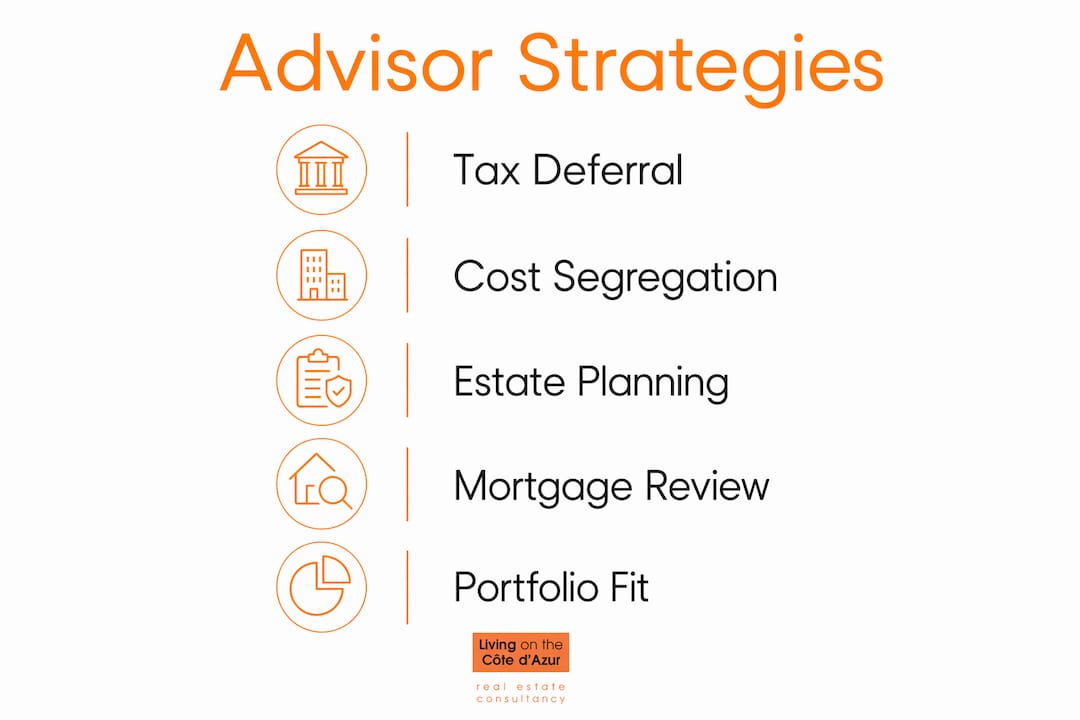
Named frameworks that advisors routinely apply include the IRS 1031 exchange (which defers capital gains tax on property sales in the United States), cost segregation studies, and portfolio diversification models. On the Côte d’Azur and across European markets, equivalent tax deferral and structuring tools exist under French and EU fiscal law. Livingonthecotedazur works with clients to connect these frameworks to real acquisition decisions.
How do financial advisors differ from real estate agents?
The core difference is mindset. Agents focus on transactions while advisors adopt a data-driven, strategic approach to real estate investing. An agent’s success is measured by a completed sale. An advisor’s success is measured by whether your net worth grew over a decade.
This difference in objective shapes everything about how each professional operates:
- Agents identify properties, negotiate purchase prices, manage viewings, and handle the legal paperwork of a transaction.
- Financial advisors assess whether a specific property fits your portfolio, model the after-tax returns, and evaluate the opportunity cost against other investments.
- Advisors consider your entire balance sheet, including pension assets, equity holdings, and existing debt, before recommending any property move.
- Agents are typically remunerated by commission on the sale price, which creates an inherent incentive to close deals.
- Advisors who operate on a fee-only basis have no commission incentive. Their advice is structurally more objective.
The collaboration between the two is where sophisticated investors gain an edge. An advisor who has reviewed your tax position and cash flow requirements can brief an agent with precise acquisition criteria. That precision saves time and prevents costly mistakes.
Pro Tip: Before engaging any property professional, ask directly: “Are you paid on commission?” A fee-only financial advisor with no product sales incentive is the gold standard for objective real estate investment guidance.
The advisor also engages long after the purchase completes. Refinancing decisions, rental yield reviews, and eventual disposal strategies all fall within the advisor’s remit. The agent’s involvement typically ends at the notary’s office.
What financial planning aspects do advisors address in property investments?
Financial advisors address six distinct areas when working with property investors. Each one affects your returns in ways that the purchase price alone cannot capture.
Market analysis and timing. Advisors review macroeconomic indicators, local supply and demand data, and interest rate trends before recommending entry or exit. The US housing market in mid-2026 illustrates this complexity: median home values reached $372,057 while existing-home sales fell to an annual rate of 4.09 million units. That combination of high prices and low transaction volume signals a market where timing and financing structure are critical. Advisors read these signals and translate them into specific recommendations.
Tax strategy. This is where advisors deliver some of their most tangible value. In the United States, cost segregation studies can generate £100,000–£500,000 in first-year deductions depending on property value. That is not a minor accounting adjustment. It is a material improvement to your after-tax return. Advisors also structure 1031 exchanges, which allow investors to defer capital gains tax by rolling proceeds from one property sale into another qualifying purchase within strict timelines. Missing those timelines is expensive. Advisors track them.
Financing structure. The choice between fixed and variable rate mortgages, the decision to refinance, and the optimal loan-to-value ratio all affect long-term cash flow. Advisors model these scenarios across multiple interest rate environments. Working with a specialist mortgage provider, such as Prosper Home Loans, alongside your financial advisor creates a joined-up approach to financing that protects your position when rates shift.
Risk assessment. Property is illiquid and leveraged. Both characteristics amplify losses as readily as they amplify gains. Advisors quantify concentration risk, meaning the proportion of your total wealth tied to a single asset or market, and recommend diversification where exposure is excessive.
Cash flow management. Rental income, maintenance costs, service charges, and void periods all affect the actual return on a property. Advisors build cash flow models that account for these variables rather than relying on headline yield figures.
Estate and legacy planning. For families, property often represents the largest single asset in an estate. Advisors coordinate with solicitors to structure ownership, whether through direct title, a société civile immobilière (SCI) in France, or a trust, to minimise inheritance tax and simplify succession.
Statistic callout: Cost segregation studies can generate £100,000–£500,000 in first-year tax deductions on qualifying properties. That figure represents real capital that can be redeployed into the next acquisition.
A well-structured tax planning approach is not optional for serious property investors. It is the difference between a good return and an excellent one.
Why does specialised real estate knowledge matter in financial advising?
Generalist financial advisors often lack the property-specific expertise that complex real estate decisions require. Complexities include IRC Section 1250 recapture and the precise timing rules governing 1031 exchanges. These are not minor technical details. Getting them wrong triggers significant tax liabilities.
Section 1250 recapture, for example, applies to depreciation claimed on real property. When you sell, the IRS taxes a portion of that depreciation at a higher rate than standard long-term capital gains. A generalist advisor who has never managed a direct property portfolio may not model this correctly. The result is a tax bill that erodes the return you thought you had locked in.
Regulatory complexity adds another layer. Property strategy advice is not considered a financial product under Australia’s Corporations Act, meaning it falls outside standard financial advisory licensing. Similar regulatory gaps exist in other jurisdictions. This matters because it means the consumer protections you assume are in place may not apply. Vetting an advisor’s track record and accountability framework is therefore not optional.
The pitfalls of relying on a non-specialist advisor are well documented:
- Steering clients away from direct property in favour of listed real estate investment trusts (REITs), which generate easier management fees for the advisor.
- Underestimating the tax drag from depreciation recapture on disposal.
- Failing to account for the illiquidity premium that direct property requires.
- Missing the coordination between property income and pension contribution limits.
Pro Tip: Ask any prospective advisor to walk you through a real example of how they handled a 1031 exchange or a cost segregation study for a previous client. Specific answers indicate genuine experience. Vague answers indicate the opposite.
Fee-only advisors with personal real estate investing experience tend to offer more objective advice than those motivated by commissions on financial products. The fee-only model removes the structural conflict of interest that commission-based advice creates. For high-value acquisitions, the cost of a fee-only advisor is negligible relative to the decisions they inform.
A long-term property value strategy built with a specialist advisor looks fundamentally different from one assembled without that expertise. The difference shows up in your net returns over a decade.
How do advisors support long-term real estate goals for families?
Financial advisors support families across every stage of a property investment’s life cycle. The involvement does not begin at acquisition and end at completion. It spans the entire holding period and beyond.
The stages where advisor input is most valuable are:
- Pre-acquisition: Portfolio fit assessment, financing structure, tax position review, and market timing analysis.
- Acquisition: Coordination with agents, solicitors, and mortgage brokers to align the transaction with the agreed financial plan.
- Holding period: Annual cash flow reviews, refinancing assessments, rental strategy adjustments, and tax filing coordination with CPAs.
- Disposition: Exit timing, capital gains tax planning, 1031 exchange structuring where applicable, and reinvestment strategy.
For families with complex or high-value portfolios, the advisor’s role extends into estate planning. Property held across multiple jurisdictions, such as a primary residence in London, a holiday villa on the Côte d’Azur, and a rental apartment in Lisbon, creates a web of tax obligations and succession considerations. An advisor maps these interactions and ensures the overall structure serves the family’s legacy intentions.
The table below illustrates how advisor involvement changes across the investment life cycle:
| Stage | Advisor’s primary focus | Key outcome |
|---|---|---|
| Pre-acquisition | Portfolio fit and tax position | Informed entry decision |
| Financing | Loan structure and cash flow modelling | Optimal debt structure |
| Holding period | Yield review and tax coordination | Sustained after-tax return |
| Refinancing | Rate environment and equity release | Improved cash flow or reinvestment |
| Disposition | Capital gains planning and exit timing | Maximised net proceeds |

Mortgage rates remain below last year’s peak but have risen significantly since pandemic lows. That shift affects both the cost of holding leveraged property and the attractiveness of refinancing existing debt. Advisors who monitor these conditions continuously can recommend refinancing windows that a family managing property independently would likely miss.
For families investing in prestige markets such as Monaco, Saint-Tropez, or Cap Ferrat, the property portfolio management challenge is compounded by currency exposure, local tax treaties, and the particular illiquidity of ultra-prime assets. Specialist advisors with direct experience in these markets add disproportionate value precisely because the stakes are higher and the complexity is greater.
The advisors who deliver the most value are those who treat property not as a standalone asset but as one thread in a wider financial tapestry. Advisors help families evaluate the ripple effects of property decisions across their entire financial plans. That systemic view is what separates genuine wealth management from property speculation.
Key takeaways
A financial advisor’s primary value in real estate is placing property decisions within the full context of your financial life, covering tax, cash flow, estate planning, and long-term portfolio strategy.
| Point | Details |
|---|---|
| Advisors differ from agents | Agents close transactions; advisors build long-term portfolio strategy aligned with your financial goals. |
| Tax strategy is material | Cost segregation and 1031 exchanges can generate six-figure tax savings that directly improve net returns. |
| Specialist knowledge matters | Generalist advisors often miss IRC Section 1250 recapture and 1031 exchange timing rules, creating costly errors. |
| Fee-only advisors are more objective | Advisors paid by fees rather than commissions have no incentive to favour products over direct property. |
| Advisor involvement spans the full cycle | From pre-acquisition analysis to estate planning, the advisor’s role extends well beyond the purchase date. |
The shift I have watched happen in real estate advisory
Ab Kuijer, Livingonthecotedazur
When I began working with clients on Côte d’Azur acquisitions, the conversation almost always started with the property. Which villa, which location, which view. The financial architecture came later, sometimes much later, and occasionally not at all. That approach has cost clients real money. Not in ways that show up immediately, but in tax bills on disposal, in estates that required years of legal untangling, and in portfolios that grew in value on paper but generated poor actual returns after leverage and tax.
The shift I have observed over the past decade is that the most successful buyers arrive with a financial advisor already engaged. They know their tax position. They know their target holding period. They know whether they are acquiring for yield, for capital growth, or for legacy. That clarity transforms the acquisition process from an emotional exercise into a disciplined one.
What I find most telling is the difference in how these clients respond to market volatility. When mortgage rates rise or when a prestige market softens, clients with a financial advisor in place do not panic. They have already modelled the downside. They know their cash flow holds. That composure is not personality. It is preparation.
The uncomfortable truth about financial advisory in real estate is that accountability is inconsistent. In many jurisdictions, the regulatory protections that apply to investment advice do not automatically extend to property strategy advice. That means the burden of vetting falls on you. Ask for track records. Ask for references from clients with similar portfolio profiles. Ask how the advisor is remunerated. These questions feel awkward. They are also the most important ones you will ask.
My recommendation is straightforward: engage a fee-only advisor with direct property investing experience before you begin viewing properties. Not after you have fallen in love with a particular terrace overlooking the Mediterranean. Before. The sequence matters enormously.
— Ab Kuijer
How Livingonthecotedazur supports your real estate investment planning
Livingonthecotedazur works with high-net-worth individuals and families who understand that a prestige property acquisition is also a financial decision of the highest order. Our network spans over 100,000 properties across the Côte d’Azur, Monaco, and Saint-Tropez, and our advisory approach coordinates legal audits, tax structuring, and financing assistance from the outset. We connect clients with the right specialists at every stage, ensuring that the property you acquire is not only beautiful but financially sound. For those seeking off-market luxury properties with full advisory support, we offer access to exclusive listings that never reach the open market. Speak with us to align your next acquisition with a financial strategy built for legacy.
FAQ
What is the main role of a financial advisor in real estate?
A financial advisor integrates property investments into your overall financial plan, covering tax strategy, cash flow, risk assessment, and estate planning. Their role extends across the full investment life cycle, from acquisition through to disposal.
How does a financial advisor differ from a real estate agent?
An agent focuses on executing transactions, while a financial advisor focuses on long-term portfolio strategy and financial health. Advisors assess tax implications, financing structure, and portfolio fit rather than simply facilitating a purchase.
What tax strategies do financial advisors use in real estate?
Advisors commonly apply cost segregation studies, 1031 exchanges for capital gains deferral, and IRC Section 1250 recapture planning. These strategies can generate substantial tax savings that materially improve after-tax returns on property investments.
How do I choose a financial advisor for property investments?
Seek a fee-only advisor with direct real estate investing experience and a verifiable track record. Ask how they are remunerated, request client references with similar portfolio profiles, and confirm they understand the tax rules specific to your target market.
Do I need a specialist advisor or will a generalist suffice?
A generalist advisor often lacks the property-specific expertise needed for complex tax interactions and illiquid asset management. A specialist with real estate experience will identify opportunities and risks that a generalist is likely to miss.
Recommended
 //
//