
For most homeowners with a south-facing, low-shade roof, solar panels are a genuinely cost effective way to cut electricity bills and shrink a household’s carbon footprint. The exceptions are properties with heavy shading, weak roof structures, or very low electricity use. On the French Riviera, strong year round sunshine pushes payback times down further, which matters if you are weighing solar potential as part of a property purchase.
TL;DR:
- The French Riviera’s abundant sunshine shortens solar payback periods and increases efficiency, making solar panels highly advantageous for suitable properties.
- A south-facing, minimally shaded roof between 15° and 40° pitch, under 15 years old, is ideal for solar installation, with ground-mounted options available for larger land plots.
- Costs vary by system size, roof complexity, and whether batteries are added, with incentives in France potentially reducing payback times.
- Solar panels with monocrystalline silicon cells provide higher efficiency in space-constrained roofs, while microinverters improve performance in shaded or uneven conditions.
- Installation generally takes one to two days, but delays often occur due to permitting, site assessments, and grid connection procedures.
Table of Contents
- Solar panels at a glance: sizes, savings and quick suitability checks
- How do solar panels work? The essentials worth understanding
- Is your home a good candidate for solar panels?
- Where can you actually install solar panels?
- What are the real benefits of solar panels?
- What do solar panels cost, and how do you work out payback?
- From quote to switch-on: the installation timeline
- Maintenance, warranties and protecting your investment
- Battery storage and EVs: how the economics shift
- How many panels do you actually need?
- How to choose a solar installer you can trust
- Why solar makes particular sense for French Riviera buyers
- How Living On The Cote d’Azur helps you find solar ready properties
- Sources
- FAQ
Solar panels at a glance: sizes, savings and quick suitability checks
Most homes run on a system sized to their electricity needs, typically within a moderate range, though larger properties with additional power demands often require bigger systems. Installed costs vary enormously by country, roof complexity, and whether you add a battery, so treat any headline price as a starting point for your own quotes rather than a fixed number.
Annual savings depend on three things: how much electricity you already use in daylight hours, your local tariff, and how much surplus you can export back to the grid. A household that shifts laundry, dishwashing, and EV charging into sunny hours will always save more than one that draws most of its power in the evening.
Before you request a single quote, run through this quick self-check:
- Does your roof face broadly south, southeast, or southwest, with no large trees or neighbouring buildings casting shade for most of the day?
- Is your roof pitch somewhere between 15° and 40°, which the ENERGY STAR rooftop solar guide identifies as the efficient range?
- Is your roof under 15 years old, or at least structurally sound enough to avoid needing replacement within the panel’s lifespan?
If you answered yes to all three, solar is worth investigating seriously.
How do solar panels work? The essentials worth understanding
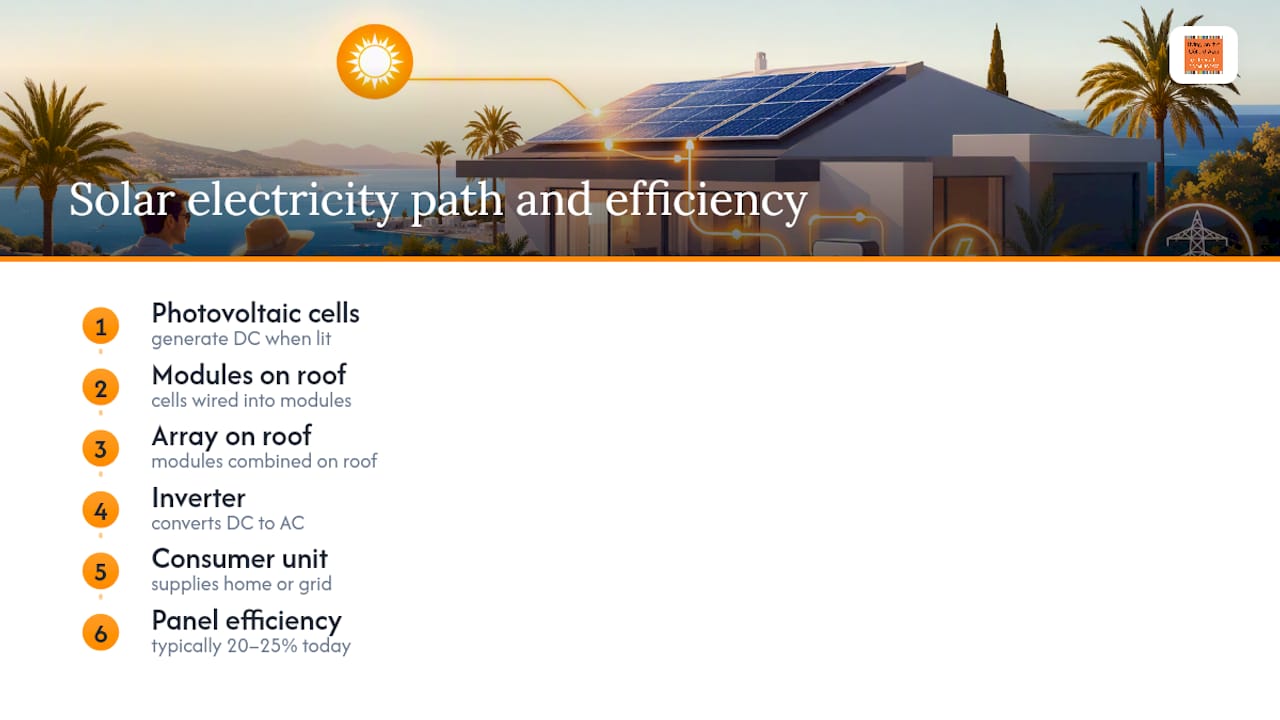
A solar panel is built from individual photovoltaic cells wired together into a module, and modules are combined into an array on your roof. Sunlight striking the cells knocks electrons loose, generating direct current electricity. Because homes and the grid run on alternating current, an inverter sits between your array and your consumer unit, converting that DC output into usable AC power. The U.S. Energy Information Administration notes that panel efficiency today typically falls between 20% and 25%, a meaningful jump from the panels installed a decade ago.
Two main cell technologies dominate the residential market. Crystalline silicon, split into monocrystalline and polycrystalline variants, accounts for the vast majority of installations. Monocrystalline cells, cut from a single silicon crystal, deliver the highest efficiency and the most output per square metre, which matters on a Riviera roof where space is often tight and tiles are pricey. Polycrystalline cells cost somewhat less but need more roof area for the same output, an important trade-off on a compact Nice apartment building or a Cannes rooftop terrace. Thin-film panels, the third category, are lighter and more flexible but generally less efficient, making them a niche choice for large flat commercial roofs rather than a typical family home.
The inverter deserves just as much attention as the panels themselves. A string inverter handles a whole array as one unit and is the most common, cheapest choice, but a single shaded panel can drag down the output of the entire string. Microinverters, fitted to each panel individually, cost more upfront but isolate shading problems and make monitoring far more precise. Racking, cabling, and the mounting hardware, often lumped together as the “balance of system,” rarely get much attention in sales conversations, yet poor quality racking is a common cause of long-term underperformance and voided warranties.
Is your home a good candidate for solar panels?
Run through this checklist before requesting quotes, ideally before you even put in an offer on a property.
- Check orientation and shading first. Stand in your garden at different times of day, or use a free tool such as Google’s Project Sunroof where available, to see how much direct sun your roof actually gets across the seasons.
- Estimate your usable roof area. A rough guide is that 1kWp of modern panels needs about 5 to 6 square metres of unobstructed roof, though this varies by panel efficiency.
- Assess roof age and structural condition. A roof needing replacement within five to ten years should be redone before, not after, panels go up, since removing and refitting an array adds significant cost.
- Check planning rules or co-ownership restrictions. Historic town centres along the Riviera, and many French copropriétés, impose rules on visible roof alterations, so confirm this before committing.
- Consider alternatives if your roof is unsuitable. Ground mounted arrays, carport canopies, or, where available, community solar schemes can still deliver savings without touching the roof at all.
Pro Tip: Ask any seller or agent for recent electricity bills covering a full year before you buy. Twelve months of consumption data tells you far more about real solar potential than a single summer reading ever will.
Where can you actually install solar panels?
Rooftop mounting is the default for good reason: it uses space you already own and keeps cabling runs short. On pitched roofs, panels sit in racking fixed to the rafters, tilted at the roof’s natural angle, which on the Riviera’s terracotta tiled roofs usually falls comfortably within the efficient 15° to 40° range.
Flat roofs, common on modern villas and apartment blocks around Cannes and Nice, need a different approach. Installers use tilt frames to angle the panels correctly, weighted down with ballast blocks to avoid penetrating the waterproof membrane, or in some cases fixed with roof penetrations for extra wind resistance.
Smaller structures offer options too:
- Garages, pool houses, and pergolas can carry a modest array, useful for powering a pool pump or EV charger without touching the main roof.
- Wiring runs from outbuildings need proper conduit and, in France, sign off from a qualified electrician under the relevant Consuel certification before connection.
- Shading from nearby trees is a frequent problem on these smaller structures, so check sun exposure separately from the main house.
Ground mounted systems suit larger properties with spare land, common on Riviera estates with generous gardens. They allow perfect orientation and easy access for cleaning and repairs, but they use land that might otherwise host a pool, tennis court, or garden, and they typically cost more per kWp installed due to additional structural work.
What are the real benefits of solar panels?
The most obvious benefit is a lower electricity bill, since every kilowatt hour your panels generate is one you are not buying from your supplier. Self-sufficiency improves further if you shift usage, running the washing machine or charging an EV during daylight hours rather than overnight.
Households pairing solar with battery storage and heat pumps see the strongest reductions in both bills and carbon output, according to the UK’s Get solar panels Clean Energy campaign, which tracks growing residential uptake in supportive policy environments.
Beyond running costs, solar increasingly influences resale value. Buyers researching property value drivers consistently find that lower running costs and visible energy upgrades support asking prices, particularly as energy performance labels become a bigger part of how buyers compare properties. On the Riviera, where the DPE energy label increasingly shapes buyer perception and, in some cases, legal obligations for landlords, a well-specified solar system is a genuine selling point rather than a nice extra.
What do solar panels cost, and how do you work out payback?
Installed costs depend heavily on system size, roof complexity, and whether a battery is included. Labour rates, the need for roof reinforcement or re-tiling, and the type of inverter chosen all move the price up or down, and adding storage typically adds the single biggest jump in upfront cost.
Ongoing costs are modest but real. Budget for an inverter replacement roughly ten to fifteen years into the system’s life for string inverters, though some modern units now carry warranties stretching toward 25 years. Occasional cleaning, particularly in dusty or pollen-heavy areas, and basic insurance cover round out the running costs.
To estimate your own payback, work through these steps:
- Pull your last twelve months of electricity bills and note total annual kWh consumption.
- Multiply your expected system output by your local electricity price to estimate annual savings.
- Subtract any expected export compensation rate for surplus power sent back to the grid, since this varies significantly by country and utility.
- Divide the total installed cost by your estimated annual saving to get a rough payback period in years.
- Check your national or regional government energy portal for current incentives, since rebates, tax credits, and feed-in rates change frequently and are always country specific.
For French properties, the ADEME and local mairie energy advisory services are the right starting points for current incentive schemes, since national programmes shift year to year and vary by region.
From quote to switch-on: the installation timeline
Physical installation is fast. Most residential roofs take just one to two days for the mechanical and electrical work, a fact that surprises many first-time buyers who assume solar means weeks of scaffolding.
The real timeline runs much longer once you count everything around the actual fitting:
- Quote and site survey. An installer assesses your roof, shading, and electrical setup, often combining a satellite assessment with an in-person visit.
- System design. The installer finalises panel layout, inverter choice, and cabling routes based on the survey findings.
- Permitting. Depending on your municipality and whether your property sits in a protected zone, this step alone can take several weeks.
- Installation. The one to two day on-roof phase, covering mounting, wiring, and inverter fitting.
- Inspection and commissioning. Many European markets now expect testing and documentation aligned with the IEC 62446 commissioning standard, which verifies the system performs as designed and provides paperwork for warranty claims.
- Permission to operate. Your utility must approve grid connection before the system can legally export power, a step that commonly adds further weeks to the overall project.
The gap between a one-day install and a project that takes six to eight weeks start to finish comes almost entirely from permitting and grid interconnection, not from the physical work. Early structural checks and prompt paperwork submission are the two most effective ways to keep delays to a minimum.
Maintenance, warranties and protecting your investment
Panels themselves are remarkably low maintenance. Manufacturers commonly offer warranties that cover two decades or more, reflecting the low degradation modern crystalline silicon panels experience over time, as the ENERGY STAR programme confirms. Inverters, being the system’s moving electronic components, typically carry shorter warranties, which vary depending on the model and manufacturer.
Routine care is minimal: an occasional rinse to clear dust or pollen, and a periodic visual check for debris or obvious damage after storms. Modern systems include monitoring apps that flag underperformance automatically, which is often the first sign something needs attention.
Warranty validity depends heavily on installer quality. Choosing a certified professional, as the Department of Energy’s homeowner guide recommends, and keeping full documentation of the installation and commissioning tests, protects you if you ever need to make a claim.
Battery storage and EVs: how the economics shift
Adding a battery changes the calculation. Instead of exporting surplus daytime generation to the grid for a modest per unit payment, a battery lets you store that power and use it after sunset, which the American Solar Energy Society notes increases both self-consumption and resilience during outages.
Batteries add meaningful upfront cost, so the payback maths only improves where export compensation is low and grid electricity prices are high, a combination increasingly common across parts of Europe. Where feed-in rates remain generous, a battery is more a resilience purchase than a purely financial one.
For homeowners who own or plan to buy an electric vehicle, pairing solar with a home charger is one of the most effective ways to put surplus generation to use. Sizing the system to cover both household consumption and typical EV charging needs, rather than the house alone, is worth discussing with your installer from the outset, since retrofitting extra capacity later costs more than specifying it correctly the first time.
How many panels do you actually need?
Start with your annual electricity consumption in kWh, found on your last year of bills. A rough method: divide your annual kWh usage by your region’s typical annual solar yield per kWp installed, which gives you an estimated system size in kWp. From there, divide by your chosen panel’s wattage to get an approximate panel count.
Several factors will shift that estimate up or down:
- Orientation and tilt away from due south reduce output, sometimes by 10% to 20% for east or west facing roofs.
- Shading from trees or neighbouring buildings can disproportionately cut output, especially with older string inverter setups.
- Latitude matters too, since the Riviera’s southern position and high number of annual sunshine hours generally produce more kWh per kWp installed than northern regions.
Treat any back of envelope calculation as a starting point only. A professional site survey, incorporating shading analysis and your roof’s exact geometry, is the only way to get a number you can actually budget against.
How to choose a solar installer you can trust
Credentials matter more than price alone. In the United States, look for installers certified by NABCEP, the industry’s recognised training body; equivalent national certification schemes exist across Europe, and France’s RGE (Reconnu Garant de l’Environnement) label is often required to access certain incentive schemes. Always confirm the installer carries public liability insurance.
Before signing, work through these points:
- Ask exactly what the warranty covers, and get written confirmation of who handles a claim if the panel manufacturer, inverter manufacturer, and installer are three different companies.
- Clarify who manages permitting and permission to operate. Some installers handle this fully; others leave paperwork to you, which can cause the delays discussed earlier.
- Request commissioning documentation, including test results aligned with recognised standards, as proof the system was properly signed off.
- Ask for references from installations at least two years old, not just recent projects, to see how the system and the company have held up over time.
Pro Tip: Treat any quote promising unrealistically high annual output, or pressuring you to sign within 24 hours, as a red flag. Reputable installers welcome time for you to compare quotes and check credentials.
Why solar makes particular sense for French Riviera buyers
The Riviera’s sunshine hours put it well ahead of most of northern Europe for solar yield, which shortens payback periods and makes an investment in panels more attractive than the same system installed in, say, Lyon or Lille. That advantage compounds when you are also weighing a property’s overall running costs as part of a purchase decision, not retrofitting after the fact.
When you view a property here, ask about roof orientation and the existing DPE energy rating just as carefully as you ask about square metreage or proximity to the beach. A south facing roof with minimal shading is a genuine asset, and renovation costs to add solar should factor into your offer if the current system is outdated or absent entirely. Buyers who treat energy potential as part of due diligence, alongside long-term investment fundamentals, tend to make better purchasing decisions than those who focus purely on aesthetics.
— Ab Kuijer
How Living On The Cote d’Azur helps you find solar ready properties
An independent buyer agent service searches the entire Riviera market, including off-market opportunities, rather than showing only what one agency has on its own books. When solar potential matters to you, roof orientation, shading, and DPE ratings are factored into the properties sourced, and coordination with local architects and renovation specialists can be arranged if a property needs retrofitting to make the most of its sun exposure.
We track market trends across the Riviera and can flag which neighbourhoods and property types tend to offer the strongest solar upside as part of your wider property search. If energy efficiency and long-term running costs are part of your buying criteria, get in touch and tell us what you are looking for. Read more about what a buyer agent actually does for you, then reach out so we can start a search that reflects your full list of priorities, solar potential included.
Sources
Consult these directly for local rules and technical detail beyond this guide:
- Photovoltaics and electricity | EIA
- Homeowner’s guide to solar | Department of Energy
- Solar electric systems | ASES
FAQ
How many solar panels are needed to fully power a house?
It depends entirely on your household’s annual kWh consumption, roof orientation, and local sunshine hours, but a typical UK or French home covering most of its usage needs a system somewhere between 3kWp and 6kWp.
What is the biggest drawback of solar panels?
The main drawback is the upfront cost combined with dependence on roof suitability. A shaded, poorly oriented, or structurally weak roof can undermine returns regardless of how efficient the panels themselves are.
Is it worth buying solar panels for your home?
For most homeowners with a well oriented, low shade roof and reasonable daytime electricity use, solar panels are worth it, cutting bills and adding resale appeal, though the exact payback period depends on local electricity prices and available incentives.
What is the difference between panel and inverter warranties?
Panels typically carry warranties around 20 years or longer, reflecting their low degradation over time, while inverters usually come with shorter warranties, often between 10 and 25 years, since they contain the system’s main moving electronic parts.
How long does the whole solar installation process take?
The physical fitting takes just one to two days, but permitting, design, and permission to operate from your utility typically stretch the full project timeline to several weeks from initial quote to switch-on.
Recommended
 //
//