
TL;DR:
- Touring a luxury property on the French Riviera without detailed preparation risks costly surprises from hidden defects and regulatory restrictions.
- Thorough verification of diagnostics, planning permissions, heritage status, and independent inspections is essential before making an investment.
Touring a luxury property on the French Riviera without a clear, step by step luxury property tour plan is one of the most expensive mistakes a high-net-worth investor can make. Hidden structural defects, heritage restrictions that freeze renovation ambitions, and legal pitfalls invisible to the untrained eye can transform a dream estate into a costly ordeal before the ink dries on any contract. Whether you are drawn to a sun-washed villa above Èze, a Belle Époque townhouse in Menton steps from the Lemon Festival, or an off-plan residence overlooking Sainte-Maxime’s Garonette sands, the difference between a legacy asset and a liability lies entirely in how methodically you approach the viewing process.
Table of Contents
- Preparing for your luxury property tour on the French Riviera
- Conducting the step by step luxury property tour
- Legal and financial verification after your tour
- Common pitfalls and expert tips for luxury property tours
- The critical role of thorough property tours in securing legacy investments
- How Living on the Côte d’Azur supports your luxury property journey
- Frequently asked questions
Key Takeaways
| Point | Details |
|---|---|
| Comprehensive preparation | Gather all mandatory diagnostics and legal documents before touring a luxury property to avoid surprises. |
| Structured touring method | Use a step-by-step inspection focusing on structure, systems, and heritage compliance during property visits. |
| Legal and financial diligence | Understand the compromis de vente, cooling-off period, and notary fees to protect your investment legally and financially. |
| Avoid common pitfalls | Check environmental risks and heritage restrictions early, and commission expert surveys promptly after signing contracts. |
| Engage expert guidance | Work with trusted local specialists and buyer agents to access exclusive properties and navigate complex regulations. |
Preparing for your luxury property tour on the French Riviera
Before you set foot inside any property, the groundwork you lay will determine everything that follows. A guided luxury home tour conducted without prior documentation review is not a tour at all; it is a gamble. We recommend treating preparation as a non-negotiable phase, equal in importance to the viewing itself.
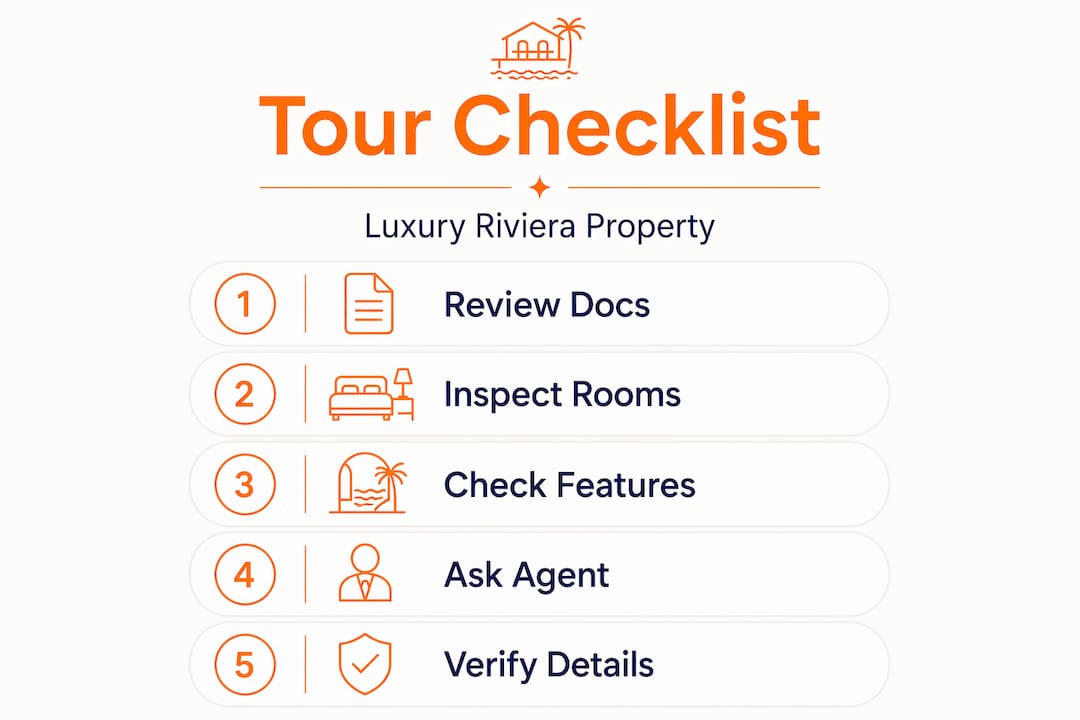
The first order of business is requesting the full diagnostics dossier from the seller. French law requires vendors to provide a package of technical reports, and a thorough European luxury listing evaluation confirms you should demand every report before stepping inside: the Diagnostic de Performance Énergétique (DPE, the energy rating), asbestos survey (amiante), lead paint report (plomb), termite certificate, electrical risk assessment, gas installation report, and the État des Risques et Pollutions (ERP) covering flood and seismic exposure. Missing even one of these can leave you blindsided.
Key documents and checks to request before any viewing:
- Full diagnostics dossier including energy ratings, asbestos, termites and electrical risks
- Planning permission history (permis de construire) for all structures and extensions
- Heritage protection status: is the property listed, partially listed, or situated within a protected perimeter?
- Urban planning certificate (certificat d’urbanisme) showing permitted uses and future development constraints
- Condominium (copropriété) accounts and minutes if applicable, covering the last three years
- Proof of compliance for any pool, terrace, or outbuilding additions
| Document | What it reveals | Risk if missing |
|---|---|---|
| DPE energy report | Running costs, insulation quality | Unexpected energy bills, future legal non-compliance |
| Amiante/plomb survey | Asbestos and lead presence | Health hazard, costly remediation |
| Termite certificate | Active infestation or historical damage | Structural integrity loss |
| ERP risk report | Flood, seismic and tech risk zones | Uninsurable property or restricted use |
| Certificat d’urbanisme | Building rights and planning constraints | Renovation blocked or fined |
Our essential checklists distil years of Riviera acquisition experience into a format you can carry into every viewing. Do not tour without them.
Also verify local urban planning rules, particularly in communes such as Antibes or Cap d’Antibes where coastal protection laws (Loi Littoral) restrict extensions and new builds. Heritage perimeters around Menton’s old town or Cannes’ Boulevard de la Croisette add further layers of restriction that can prevent you from altering even a window frame.
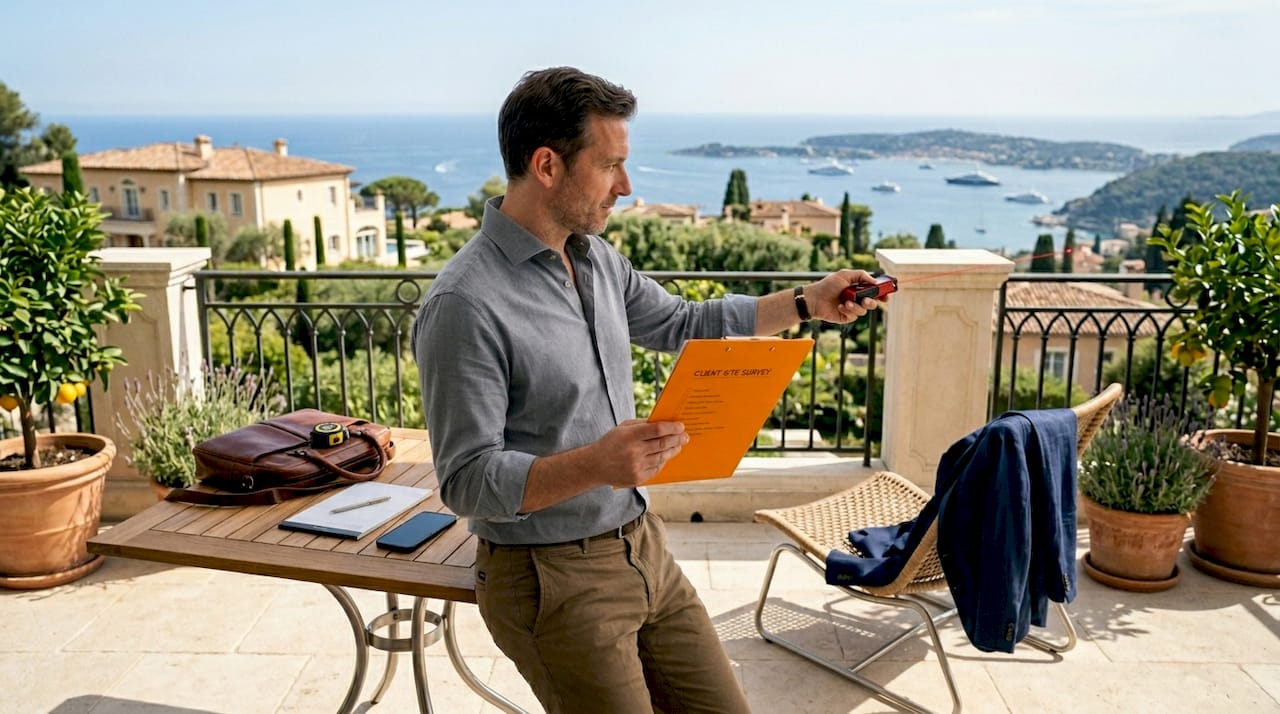
Pro Tip: Bring a laser distance measurer, a notebook for recording room dimensions, and a smartphone with a compass app to verify which rooms actually face the sea. Sellers’ brochures are aspirational documents; your measurements are facts.
With thorough preparation in place, let’s move on to how to conduct the property tour itself effectively.
Conducting the step by step luxury property tour
The luxury property walkthrough is where preparation meets reality. A stepwise luxury real estate tour is not a leisurely stroll through beautiful rooms; it is a structured inspection that separates emotional appeal from investment substance. We advise clients to approach each room with the detachment of a surveyor and the instincts of someone who has seen a hundred Riviera properties before.
Stepwise touring method:
- Begin outside. Walk the full perimeter before entering. Inspect the roof line from a distance for sagging, missing tiles, or staining that suggests water ingress. Examine retaining walls, terraces, and any poolside structures for cracking or subsidence.
- Assess the foundations and basement. Look for efflorescence (white salt deposits on walls), damp patches, and cracking at junctions. These are early indicators of water table issues, common in seafront properties from Nice to Saint-Tropez.
- Inspect timber structures in the roof space. Ask to access the loft. Darkening, bore holes, or powdery residue around beams indicates woodworm or, worse, active termite damage, a documented risk in coastal Provence.
- Test all MEP systems. MEP stands for Mechanical, Electrical, and Plumbing. Run every tap, flush every toilet, switch every circuit, and feel every radiator. Outdated electrical panels are one of the most common compliance failures in older Riviera villas.
- Evaluate heritage and planning compliance on site. Ask the agent directly: has any work been carried out without planning permission? Unauthorised additions are the seller’s liability until they are not, and once ownership transfers, they become yours.
- Document everything photographically. Every crack, every damp stain, every piece of outdated wiring. These photographs become your negotiation toolkit.
Independent structural surveys are strongly recommended, as 20 to 30% of Riviera properties require renovations exceeding €50,000 to achieve full legal compliance. That figure rarely appears in the listing.
Areas most frequently overlooked during a luxury property walkthrough:
- Condition of the under-tile waterproof membrane on pool surrounds
- Drainage and storm water management on steeply sloped plots, common in Èze and the arrière-pays above Cannes
- Adequacy of electrical supply for contemporary home automation and EV charging infrastructure
- Age and condition of the septic system (fosse septique) on non-mains-drainage properties
| Inspection area | Luxury feature priority | Compliance/renovation priority |
|---|---|---|
| Sea-view terraces | Views, materials, proportions | Structural fixing, waterproofing, planning authorisation |
| Kitchen and bathrooms | Finishes, brands, layout | Electrical compliance, plumbing condition |
| Pool and wellness | Size, heating, automation | Water treatment certification, fencing safety law |
| Roof and loft | Aesthetic character | Insulation rating, timber health, waterproofing |
| Heating system | Smart controls, radiant floors | Age, efficiency rating, fuel type compliance |
Our luxury property tour tips go deeper on every inspection category listed above, with region-specific guidance from Cap d’Antibes to Monaco’s borders.
Pro Tip: Never tour a Riviera property for the first time at sunset. The golden light is intoxicating and deliberately so. Visit once in the morning to assess natural light objectively, and once in the afternoon to evaluate privacy from neighbouring properties.
Now that you know how to perform a detailed property tour, you need to understand the key legal and financial verification steps to secure your purchase.
Legal and financial verification after your tour
The period between a successful viewing and signed ownership is where fortunes are protected or quietly eroded. France’s property acquisition process is orderly but unforgiving of those who misread its stages.
The compromis de vente is the preliminary sale agreement, and it is far more binding than many international buyers realise. Once signed by both parties, it legally commits the seller to sell. Crucially, after signing the compromis de vente, buyers benefit from a mandatory 10-day cooling-off period during which they may withdraw completely without financial penalty. This window is precious; use it deliberately.
Post-tour legal and financial checklist:
- Commission an independent structural and termite expert within the first 48 hours of the cooling-off period
- Verify that the seller’s title (titre de propriété) is clear of any mortgages, charges, or rights of way not previously disclosed
- Confirm local preemption rights: communes and the SAFER (agricultural land authority in rural zones) hold rights to purchase ahead of you in certain cases
- Review mortgage conditions carefully; French lenders require property valuations and may impose conditions on older buildings
- Clarify the timeline to acte authentique (the final deed signed before a notary), which typically falls 2 to 3 months after the compromis
Notary fees for resale luxury properties on the French Riviera average 7 to 8% of the purchase price, payable at the acte authentique signing. On a €3M villa near Monaco, that represents €210,000 to €240,000 in additional costs that must be budgeted from the outset.
| Cost component | Approximate percentage | Notes |
|---|---|---|
| Transfer taxes (droits de mutation) | 5.80% | Applies to resale properties |
| Notary professional fees | 0.814 to 3.945% (sliding scale) | Lower percentage on higher values |
| Administrative and registration fees | ~0.10% | Fixed administrative costs |
| Total notary fees (resale) | 7 to 8% | New builds attract lower fees (~2 to 3%) |
Pro Tip: For new-build purchases under VEFA contracts, notary fees drop to approximately 2 to 3% of the purchase price, a saving of tens of thousands of euros on prestige developments. This is one reason our off-plan portfolio in Sainte-Maxime and Nice commands such strong interest from legacy-focused investors. Explore our successful property buying steps to navigate the full timeline with confidence.
Review our luxury real estate checklists for a stage-by-stage legal verification guide mapped to the French conveyancing process.
With legal and financial prerequisites clarified, let’s consider some advanced tips and common mistakes that can ensure your investment is sound.
Common pitfalls and expert tips for luxury property tours
Even seasoned investors make predictable errors on the French Riviera. The most costly rarely involve the obvious; they involve what is missed during the touring phase and the days immediately following.
Frequent oversights among international buyers:
- Failing to review PPR (Plan de Prévention des Risques) maps for flood and seismic exposure before making an offer
- Underestimating the time and cost of heritage-restricted renovations: a reclassification of works as travaux soumis à autorisation (works requiring authorisation) can add 12 to 18 months to a renovation timeline
- Overlooking co-ownership (copropriété) debt or deferred maintenance charges that transfer with the property
- Accepting the agent’s assurances on planning compliance without independently verifying at the local mairie (town hall)
- Not factoring in seasonal rental licensing requirements if the investment strategy involves elite short-term lets
International buyers often miss checking PPR flood and seismic maps, and local heritage restrictions limiting renovations affect around 30% of Riviera villas. That proportion rises sharply in Belle Époque neighbourhoods of Nice and the medieval perimeters of Antibes’ Vieil Antibes.
“The most expensive square metre on the French Riviera is not the marble in the entrance hall; it is the undisclosed planning restriction that prevents you from ever changing it.” — A principle we share with every client we accompany on their first Riviera acquisition.
During the 10-day cooling-off period, commission an independent termite and structural expert immediately. Do not wait until day eight. Booking specialists on the Riviera during peak season (May through September, coinciding with Cannes Film Festival energy and summer regattas) can mean delays of several days.
Pro Tip: If diagnostics reveal issues such as active termite activity or an electrical installation requiring full rewiring, use these findings to negotiate seller credits or a price reduction before signing the acte authentique. The cooling-off period and the weeks following it are your leverage. Our luxury real estate checklists include a negotiation framework built specifically around diagnostics findings.
Having covered common pitfalls, we’ll now share our perspective on why rigorous property tours are essential for legacy investors on the French Riviera.
The critical role of thorough property tours in securing legacy investments
We have accompanied enough international buyers through the acquisition process to say something that the industry rarely articulates clearly: the tour itself is the investment decision. Everything signed afterwards merely formalises what the tour revealed, or concealed.
Many investors arrive on the Riviera with the conviction that prestige addresses, salt-kissed sea views, and trophy architecture speak for themselves. They do, but only up to a point. A villa above Èze with a Nietzsche Trail view and a crumbling fosse septique is not a legacy asset; it is a beautiful problem with a price tag attached. The emotional power of exploring high-end properties can, and frequently does, override the analytical rigour that wealth preservation demands.
What we observe consistently is that investors who treat the luxury home viewing guide process as a formality, rather than a cornerstone of due diligence, are precisely those who discover costly surprises six months into ownership. Local heritage regulations in communes from Menton to Antibes can restrict alterations to facades, shutters, and even the colour palette of exterior paintwork. Seismic zone designations affect structural reinforcement requirements that cascade directly into renovation budgets. None of this is visible at first glance, and none of it appears in a brochure photograph.
The investors who build genuine generational wealth on the Riviera are those who understand that a methodical tour, supported by independent experts and a clear verification framework, transforms risk into opportunity. A property with disclosed, negotiated defects and a clear remediation plan is frequently a stronger investment than an apparently pristine estate where nothing has been questioned. Involving local heritage architects and structural engineers before signing the compromis is not caution; it is competitive advantage.
We believe in this philosophy deeply. It is why our property investment process for legacy wealth places the tour and due diligence phase at the absolute centre of every client journey we lead.
How Living on the Côte d’Azur supports your luxury property journey
At Living on the Côte d’Azur, we do not simply list properties; we curate pathways to generational wealth along one of the world’s most coveted coastlines. Our expertise spans off-market acquisitions in Cap d’Antibes, new-build residences with sea views above Nice’s Mont Boron, and restored Provençal estates that become true family sanctuaries. Discover our invisible luxury real estate guide to access properties that never reach the open market. Our high-net-worth real estate legacy guide maps the full ROI picture for investors focused on multi-generational value. We also accept cryptocurrency payments, because the buyers reshaping the Riviera deserve a transaction process as forward-thinking as their portfolios. Contact our team to begin your curated journey today.
Pro Tip: Engage a trusted buyer’s agent before you visit a single property. Off-market opportunities on the French Riviera, the ones that appreciate 5 to 8% annually and never appear on public portals, are secured through relationships, not searches.
Frequently asked questions
What is the cooling-off period after signing the compromis de vente?
Buyers have a mandatory 10-day cooling-off period after signing the compromis de vente, during which they can withdraw from the purchase completely without incurring any financial penalty.
How much are notary fees for luxury property purchases on the French Riviera?
Notary fees for resale properties typically range from 7% to 8% of the purchase price, covering transfer taxes and professional fees, payable in full at the acte authentique signing. New-build purchases attract significantly lower fees of approximately 2 to 3%.
What essential documents should I request before touring a luxury property in the French Riviera?
Request the full diagnostics dossier including the energy rating, asbestos, termite and electrical risk reports, alongside heritage status confirmation, planning permissions for all structures, and the urban risk (ERP) certificate.
Why is it important to conduct independent inspections during a luxury property tour?
Independent structural surveys uncover hidden defects and compliance requirements that directly affect renovation budgets and future resale value, particularly on the Riviera where 20 to 30% of properties require works exceeding €50,000 for full legal compliance.
Recommended
 //
//