
TL;DR:
- Successful relocation property buying involves early financial preparation, building a local team, and careful negotiation. Buyers should obtain pre-approval, understand local legal and tax systems, and safeguard funds during closing. Patience and open-mindedness are crucial for making confident long-term investments in foreign markets.
Successful relocation property buying is defined as securing a property that aligns with your financial position, lifestyle goals, and long-term investment objectives before or shortly after your move. The process typically spans 3 to 6 months, from initial mortgage pre-approval through to closing. Financial benchmarks such as the 28/36 debt-to-income rule set the standard for what lenders and sellers expect. Whether you are moving to the French Riviera, Ibiza, or elsewhere in Europe, the principles of a well-executed relocation home purchase remain consistent: prepare early, build a local team, and never let urgency override diligence.
What financial preparations should you make for successful relocation property buying?
Sound financial preparation is the single most decisive factor in a successful relocation property purchase. Buyers who arrive at the market without pre-approval, clear documentation, or a realistic budget consistently lose out to those who have done the groundwork months in advance.
The 28/36 rule: your financial compass
The 28/36 rule is the standard benchmark in mortgage lending. It states that your monthly housing costs should not exceed 28% of your gross monthly income, and your total debt obligations should not exceed 36%. This rule matters because it determines not only what lenders will approve, but also what you can sustain comfortably after your move. A family relocating from London to the Côte d’Azur, for example, must account for French property taxes, maintenance costs, and potential currency fluctuation when applying this rule to their budget.
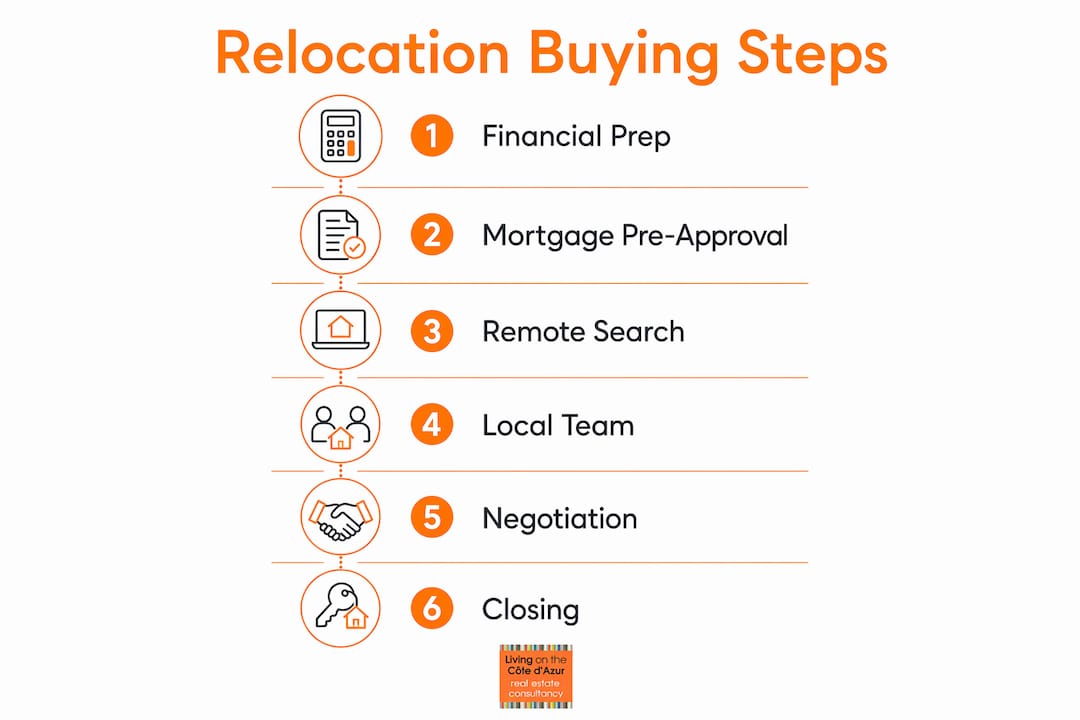
Mortgage pre-approval is not optional. Initial pre-approval reviews typically complete within 1 to 3 days, but full finalisation takes 30 to 45 days post-acceptance. Starting this process before you even begin viewing properties puts you in a far stronger position. Sellers in competitive markets such as Saint-Tropez or Cap d’Antibes treat pre-approved buyers with considerably more seriousness.
The documentation you need is specific. Lenders require proof of income, recent bank statements, tax returns for the past two years, and a full credit report. If you are relocating for work, a signed employment contract or formal job offer letter carries significant weight. Clear income documentation strengthens both lender and seller confidence in ways that many relocating buyers underestimate.
Pro Tip: Two financing structures are particularly useful for relocating buyers. Equity Unlock allows you to access funds secured against your current home before it sells, so you can purchase immediately without waiting on sale proceeds. A DTI Drop structure excludes your departing residence’s mortgage payment from your debt-to-income calculation, enabling a non-contingent offer even while you still own your previous home. Both tools are worth discussing with a specialist lender before you begin your search.
- Gather two years of tax returns and recent payslips before approaching any lender
- Obtain a full credit report and resolve any discrepancies at least three months before purchase
- Calculate your 28/36 ratios using your gross income, not your net take-home pay
- Confirm whether your employer’s relocation package covers any portion of closing costs or deposits
- Ask your lender explicitly about Equity Unlock and DTI Drop qualification criteria
How can you search and evaluate properties remotely during a relocation?
Buying from a distance is fundamentally a representation problem. Virtual tours and listing photographs tell you what a property looks like on its best day. They do not tell you about the noise from a nearby road, the condition of the plumbing, or the quality of the neighbourhood at 10 o’clock on a Tuesday evening. The solution is not more screen time. It is a trusted local team on the ground.

Building your local team
Local agents and lenders provide the market-specific knowledge that distinguishes a sound purchase from a costly mistake. An experienced local agent does not simply open doors. They know which streets flood in winter, which buildings have unresolved planning disputes, and which sellers are genuinely motivated. Experienced local agents also act as concierges, connecting you with trusted surveyors, notaires, and contractors who can assess a property’s true condition and costs.
When relocating to Europe, the legal and administrative landscape differs markedly from the UK or the United States. In France, for instance, the notaire plays a central role in property transactions, and their fees are regulated by the state. Understanding these local structures before you make an offer prevents expensive surprises at the closing table.
- Identify and interview at least two local agents with verifiable transaction histories in your target area
- Request a structured walkthrough protocol: a written checklist covering structural condition, utilities, planning permissions, and neighbourhood amenities
- Schedule an independent survey or inspection, separate from any assessment arranged by the seller
- Research local schools, transport links, and healthcare facilities before shortlisting properties
- Confirm that your chosen agent has relationships with local notaires and can coordinate the legal process on your behalf
Pro Tip: When vetting a local agent, ask for references from clients who purchased remotely. An agent accustomed to working with international buyers will have a clear process for video walkthroughs, written condition reports, and real-time negotiation updates. This is the standard you should expect, not a bonus service.
Working with a buyer’s agent who specialises in relocation purchases gives you a structural advantage. They represent your interests exclusively, not the seller’s, and their local knowledge reduces the risk of overpaying or missing critical property defects.
What negotiation strategies increase your chances of success when relocating?
Relocating buyers often believe they are at a disadvantage in negotiations because they are purchasing from afar or under time pressure. The opposite can be true, provided you structure your offer correctly. A documented job offer, clear financing, and a willingness to move quickly are genuine strengths in the eyes of a motivated seller.
Contingencies: protect yourself without losing the deal
A contingency is a condition that must be met before the sale completes. Common contingencies include financing approval, satisfactory survey results, and the sale of your existing home. Waiving contingencies entirely to appear more competitive is a risk that experienced buyers rarely take. The better approach is to tighten contingency timeframes rather than remove protections altogether. Reducing an inspection window from 14 days to 7 days, for example, signals commitment to the seller without leaving you exposed to undisclosed defects.
| Contingency type | Standard timeframe | Tightened timeframe | Negotiation impact |
|---|---|---|---|
| Survey and inspection | 14 days | 7 days | Signals urgency, retains protection |
| Financing approval | 21 days | 14 days | Reduces seller uncertainty |
| Sale of existing home | 30–60 days | Removed via Equity Unlock | Strongest possible offer position |
| Title and legal review | 10 days | 7 days | Demonstrates preparation |
Buy-before-you-sell strategies allow you to make a non-contingent offer on your new property while your existing home is still on the market. This removes the single biggest obstacle that relocating buyers face: the chain. Sellers in prestige markets, where properties attract multiple interested parties, respond strongly to offers free of a sale dependency.
Earnest money deposits typically range from 1% to 3% of the purchase price. A deposit at the higher end of this range communicates genuine commitment. In luxury markets on the Côte d’Azur, where properties in Saint-Tropez or Monaco regularly command seven-figure sums, a well-structured deposit combined with clean financing documentation can be the deciding factor.
Pro Tip: If you are relocating for work, present your signed employment contract alongside your offer. Sellers and their agents read this as financial certainty. It removes the ambiguity that surrounds buyers whose income is not yet established in the new location.
What steps protect you during closing when buying after relocating?
The closing period, typically 30 to 45 days after offer acceptance, is where many relocation purchases encounter their most serious risks. Distance, unfamiliar legal systems, and the pressure of coordinating a move simultaneously create conditions where errors and fraud can occur.
Protecting your funds and finalising the purchase
Wire transfer fraud is a documented and growing threat to property buyers. Securing wire transfers carefully before closing is not optional. Always verify bank account details by telephone with a number you have independently confirmed, never one provided in an email. Fraudsters specifically target buyers in the days immediately before closing, when large sums are moving and attention is divided.
The closing documents you will encounter include the final mortgage agreement, the title transfer deed, proof of building insurance, and any local tax declarations required by the jurisdiction. In France, the acte authentique de vente is signed before the notaire and constitutes the legal transfer of ownership. Your local agent or legal adviser should walk you through each document before the signing date, not on the day itself.
“The most common mistake relocating buyers make at closing is assuming that everything has been checked because they have been told it has. Read every document yourself, or have your legal adviser read it to you. Surprises at the closing table are almost always avoidable.”
- Confirm all wire transfer details by telephone at least 48 hours before the transfer date
- Arrange a final walkthrough of the property within 24 hours of closing to confirm its condition
- Verify that all agreed repairs or inclusions are in place before signing
- Confirm utility transfers, key handover logistics, and post-closing service arrangements in writing
- Retain copies of all closing documents in both digital and physical form
The property acquisition process in Europe carries specific legal and tax obligations that differ by country. Engaging a local legal specialist before closing, not after, is the standard practice among experienced international buyers.
Key takeaways
Successful relocation property buying requires financial preparation, a trusted local team, and disciplined negotiation, all completed before urgency forces a compromise.
| Point | Details |
|---|---|
| Apply the 28/36 rule early | Calculate housing and total debt ratios against gross income before approaching any lender. |
| Secure pre-approval before searching | Mortgage pre-approval signals credibility to sellers and clarifies your true budget. |
| Build a local team on the ground | A trusted local agent, surveyor, and legal adviser replace what you cannot assess remotely. |
| Tighten contingencies rather than waive them | Shorter inspection windows appeal to sellers while preserving your legal protections. |
| Protect wire transfers before closing | Verify all bank details by telephone independently to prevent fraud in the final days. |
What I have learned about buying property when relocating
Ab Kuijer’s perspective
After years of working with families and high-net-worth individuals relocating to the Côte d’Azur, I have noticed one pattern that separates those who close with confidence from those who regret their purchase within a year. It is not budget. It is not timing. It is the willingness to slow down when everything around you is pushing you to move fast.
Relocation creates a particular kind of pressure. You have a start date at a new job, children who need to be enrolled in school, and a removal company asking for a delivery address. That pressure is real. But it is also the exact condition under which buyers overpay, skip surveys, and ignore legal red flags that would be obvious in a calmer moment.
The buyers I have seen succeed are the ones who treat the property search as a separate project from the move itself. They begin their financial preparation three to four months before they need to be in the new location. They engage a local team before they have even shortlisted a property. They visit the area at least once, ideally twice, at different times of year. And they hold a clear line between what they need and what they merely want.
Flexibility in property selection is genuinely underrated. Buyers who arrive with a rigid specification often miss exceptional properties that fall just outside their mental picture. The villa that is slightly further from the coast than planned, or the apartment that needs a kitchen renovation, can represent far better value and a stronger long-term investment than the property that ticks every box on day one.
The Côte d’Azur, in particular, rewards buyers who approach it with an open mind and a well-prepared financial position. The market here is not forgiving of hesitation, but it is generous to those who arrive ready. That readiness is something you build before you arrive, not after.
— Ab Kuijer
How Livingonthecotedazur supports your relocation property purchase
Livingonthecotedazur connects relocating buyers with over 100,000 properties across the French Riviera, from curated villas in Saint-Tropez to prestigious addresses in Monaco. Our approach combines transparency with deep local knowledge, covering legal audits, tax optimisation, and financing guidance as part of every client relationship. For buyers seeking properties that never reach the open market, our off-market property access opens doors that most buyers never find. Whether you are purchasing a legacy family home or a prestige investment, our team provides the local representation that makes the difference between a good purchase and an exceptional one. Explore our step-by-step buying guide to understand exactly what the process looks like from first enquiry to closing.
FAQ
What is the 28/36 rule in property buying?
The 28/36 rule states that housing costs should not exceed 28% of gross monthly income, and total debt payments should not exceed 36%. Lenders use this as the standard benchmark for mortgage qualification.
How long does a relocation property purchase typically take?
The full process typically takes 3 to 6 months, with closing completing 30 to 45 days after offer acceptance. Starting mortgage pre-approval early shortens the overall timeline considerably.
What is a non-contingent offer and when should you use one?
A non-contingent offer removes conditions such as the sale of your existing home from the purchase agreement. Equity Unlock and DTI Drop financing structures make this possible for relocating buyers without requiring them to sell first.
How do you protect yourself from wire transfer fraud at closing?
Always verify bank account details by telephone using a number you have independently confirmed, never one sent by email. Fraudsters target buyers in the days immediately before closing, when large sums are in transit.
Why do relocating buyers need a local agent?
Buying from a distance is a representation problem that virtual tours cannot solve. A local agent provides real-time inspection oversight, negotiation support, and connections to trusted legal and technical specialists in the target market.
Recommended
 //
//