
TL;DR:
- Tax planning for real estate investors involves using legal strategies like depreciation, 1031 exchanges, and entity structuring to reduce taxes and boost returns. Effective management of tax consequences is crucial, especially as legislative changes in 2026 make timing and strategy more important than ever. Properly stacking these approaches can lead to significant tax savings and help build long-term wealth through property investments.
Tax planning for real estate investors is the deliberate use of legal strategies to reduce taxable income, defer taxes, and enhance investment returns through mechanisms such as depreciation, 1031 exchanges, and entity structuring. The difference between a good investment and a great one often comes down not to the property itself, but to how intelligently you manage the tax consequences around it. In 2026, with bonus depreciation phasing down and legislative shifts reshaping the landscape, the stakes for getting this right have never been higher. Whether you hold a single rental villa on the Côte d’Azur or a diversified international portfolio, the principles of real estate tax strategies remain consistent: reduce, defer, and compound.
What are the main tax strategies for real estate investors in 2026?
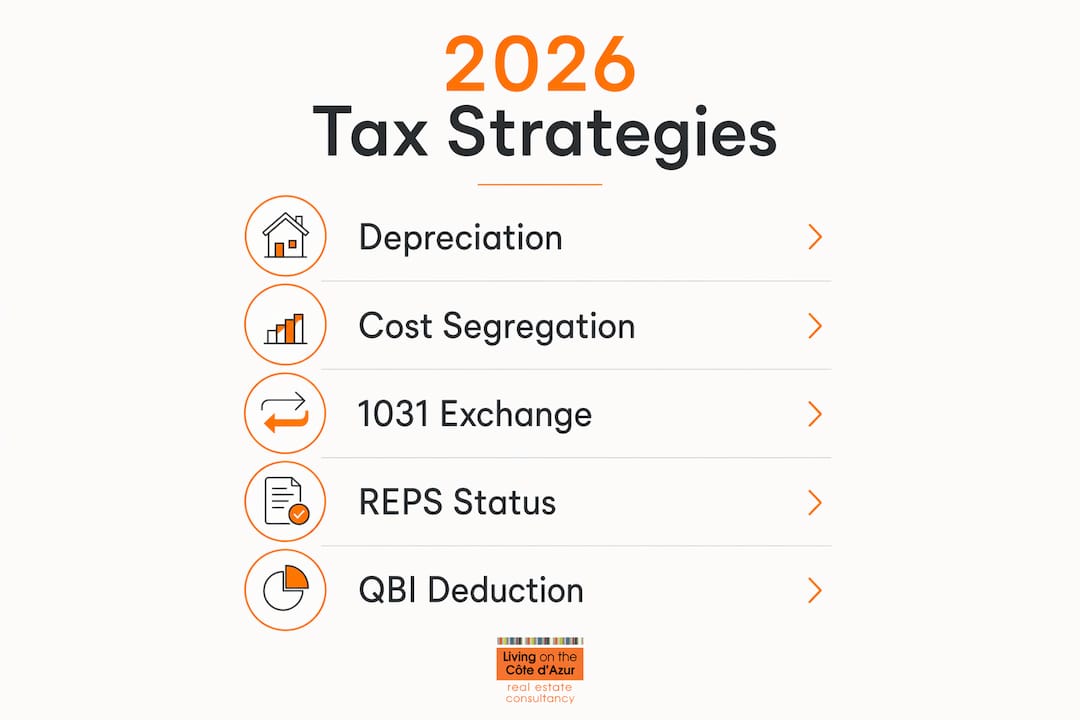
The most powerful tax strategies available to property investors in 2026 centre on depreciation, cost segregation, 1031 exchanges, Real Estate Professional Status (REPS), and the Qualified Business Income (QBI) deduction. Each works differently, but they are most effective when used together. Understanding each one individually is the first step to stacking them with precision.
Depreciation: the foundation of property tax planning
Depreciation is the annual deduction that accounts for the wear and tear of a property over time. The IRS assigns residential rental properties a 27.5-year recovery period and commercial properties a 39-year period under the Modified Accelerated Cost Recovery System (MACRS). A £1,000,000 residential property therefore generates roughly £36,363 in annual depreciation deductions, reducing taxable income without any cash outlay. That is a significant and often underestimated advantage for landlords at every level.
Cost segregation: accelerating your deductions
A cost segregation study allows investors to reclassify property components into shorter recovery periods of 5, 7, or 15 years, rather than the standard 27.5 or 39 years. This means 20–40% of a property’s cost can be deducted in the first year alone. For a high-value acquisition, that front-loaded deduction can be transformative for cash flow in the year of purchase. The study itself requires a qualified engineer and typically costs several thousand pounds, but the tax savings dwarf that fee many times over.
1031 exchanges, REPS, and QBI
A 1031 exchange allows investors to defer capital gains taxes indefinitely by reinvesting sale proceeds into a like-kind property. Done correctly, continuous 1031 deferral until death triggers a step-up in basis for heirs, effectively eliminating the deferred tax liability altogether. REPS converts rental losses from passive to active, allowing them to offset W-2 or business income directly. The QBI deduction offers up to 20% off pass-through rental income for eligible investors, adding another layer of relief. Opportunity Zones provide a further avenue for deferring and potentially reducing capital gains through qualifying fund investments.
Pro Tip: Commission a cost segregation study in the same tax year you acquire a property. Pairing it with bonus depreciation in the year of purchase produces the largest possible first-year deduction.
The table below summarises the core strategies and their primary benefit:
| Strategy | Primary benefit | Key requirement |
|---|---|---|
| MACRS depreciation | Annual income reduction | Property placed in service |
| Cost segregation | Front-loaded deductions | Qualified engineering study |
| 1031 exchange | Capital gains deferral | Like-kind reinvestment within 180 days |
| REPS | Passive loss becomes active | 750+ hours, 50%+ working time |
| QBI deduction | Up to 20% income reduction | Pass-through entity structure |
| Opportunity Zone fund | Gain deferral and reduction | Investment in qualified fund |
Investors who track more than 30 business expense categories, including management fees, repairs, insurance, and home office costs, save £5,000–£15,000 annually beyond depreciation alone. That figure compounds meaningfully across a multi-property portfolio.
How do passive vs active income rules affect property tax planning?
Rental income is classified as passive by default under IRS rules. That classification limits your ability to use rental losses to offset wages or business income, which is precisely where high-income investors feel the most pain. The passive activity loss rules exist specifically to prevent investors from sheltering ordinary income with paper losses from property, unless they meet specific criteria.

Qualifying for Real Estate Professional Status
REPS is the most powerful exception to the passive income default. To qualify, an investor must spend more than 750 hours per year in real estate activities and those activities must represent more than 50% of their total working time. Meeting both thresholds converts rental losses from passive to non-passive, allowing them to offset W-2 income directly. For a high-income professional with significant property holdings, this reclassification can be worth tens of thousands of pounds per year.
Qualifying for REPS demands more than simply logging hours. The IRS requires detailed documentation, including daily logs, calendars, and records of specific activities, to withstand audit scrutiny. Many investors claim REPS without adequate records and face disallowance during examination. The documentation burden is real, but so is the reward.
Short-term rental exceptions
Short-term rentals, typically those with an average guest stay of seven days or fewer, operate under a different set of rules. When an investor materially participates in managing a short-term rental, the activity is not classified as passive regardless of REPS status. This exception opens the door to active loss treatment for investors who actively manage holiday lets or serviced apartments. It is a particularly relevant consideration for those holding properties in high-demand leisure destinations such as the French Riviera.
The practical steps for protecting REPS qualification are:
- Track every hour spent on real estate activities in real time, not retrospectively at year end.
- Categorise activities specifically: property management, tenant communications, maintenance oversight, and acquisition research all qualify.
- Maintain a dedicated log, whether digital or paper, that records date, duration, and nature of each activity.
- Ensure your spouse’s hours are tracked separately if filing jointly, as the IRS evaluates each taxpayer individually.
- Consult a tax professional who specialises in real estate before the year ends to confirm your hour count is on track.
High-income investors who combine REPS with cost segregation can save £50,000–£150,000 or more annually by offsetting W-2 income with depreciation losses. That is not a marginal gain. It is a structural shift in how much of your income you actually keep.
Pro Tip: If you cannot qualify for REPS, explore whether your short-term rental qualifies for active treatment through material participation. The seven-day average stay threshold is the key test.
What practical steps make real estate tax planning effective all year?
Effective property tax planning is not a year-end exercise. The most impactful decisions, including acquisition timing, entity structuring, and expense acceleration, must be made in the first half of the year to produce results in that same tax period. Waiting until december to think about tax is the single most common and costly mistake investors make.
Timing acquisitions and improvements
Bonus depreciation eligibility depends on when a property is placed in service. Property placed in service after 19 january 2025 and before 1 january 2031 qualifies for accelerated expensing provisions, making acquisition timing a genuine tax variable. Completing a purchase in the first or second quarter gives you time to commission a cost segregation study, file the relevant elections, and capture the full benefit within the same tax year. Delaying a purchase to the fourth quarter compresses that window considerably.
Accelerating expenses and structuring entities
Deductible expenses such as repairs, insurance premiums, and professional fees can often be accelerated into the current tax year by paying them before 31 december. This is a straightforward technique that many investors overlook in favour of more complex strategies. The entity structure you use, whether a sole proprietorship, limited liability company, or S-corporation, affects both self-employment tax and the Net Investment Income Tax (NIIT) of 3.8%. Choosing the right structure at acquisition, rather than restructuring later, avoids unnecessary friction and cost.
The practical planning checklist for each year includes:
- Review your portfolio in january and identify properties eligible for cost segregation studies.
- Schedule a mid-year meeting with your accountant to review estimated tax payments and adjust for any acquisitions or disposals.
- Identify repair and maintenance projects that can be completed and paid before year end.
- Confirm your REPS hour count is on track by september, leaving time to increase activity if needed.
- Evaluate whether any properties are candidates for a 1031 exchange before year end to defer gains.
- Review your entity structure annually, particularly if your income or portfolio composition has changed.
Working with a tax professional who specialises in real estate investment strategies is not optional for serious investors. The complexity of stacking REPS, cost segregation, and 1031 exchanges requires coordinated planning across legal, accounting, and financial disciplines.
Pro Tip: Ask your accountant for a tax projection in september, not december. A projection with three months remaining gives you time to act. A projection in december gives you time to regret.
How do 2026 legislative changes affect real estate investor strategies?
Bonus depreciation is the most significant legislative variable affecting property investors in 2026. The rate has followed a clear downward trajectory: 60% in 2024, 40% in 2025, and 20% in 2026, with a full phase-out expected thereafter. That reduction directly compresses the first-year deduction available on newly acquired properties, making cost segregation studies even more critical as a complement to whatever bonus depreciation remains.
Impact on acquisition decisions and cash flow
The phase-down changes the arithmetic of property acquisition. An investor who purchased a £2,000,000 commercial property in 2024 and applied 60% bonus depreciation to segregated components could claim a first-year deduction of several hundred thousand pounds. The same acquisition in 2026 at 20% produces a fraction of that benefit. The implication is clear: investors who can accelerate planned acquisitions into the current year, before the rate falls further, should model the tax impact carefully before deciding on timing.
| Year | Bonus depreciation rate | First-year impact |
|---|---|---|
| 2024 | 60% | High first-year deduction |
| 2025 | 40% | Moderate first-year deduction |
| 2026 | 20% | Reduced first-year deduction |
| 2027 onwards | 0% (expected) | Standard MACRS only |
Capital gains, step-up in basis, and long-term planning
Capital gains tax rates on property held for more than one year remain at preferential long-term rates, making the hold-and-defer approach still compelling. The step-up in basis at death remains one of the most powerful estate planning tools available to property investors. An investor who uses 1031 exchanges throughout their lifetime to defer gains, and then passes the portfolio to heirs, effectively eliminates the accumulated deferred tax liability. The heirs receive the property at its current market value, with no inherited tax burden on the appreciation. This is not a loophole. It is a cornerstone of long-term legacy investment planning that every serious investor should understand and plan around.
Estate and inheritance tax considerations add another dimension for international investors, particularly those holding French property through structures such as a Société Civile Immobilière (SCI). The interaction between French succession law, local property taxes, and international treaty provisions requires specialist advice. Livingonthecotedazur works with clients to navigate precisely these intersections, ensuring that acquisition structures serve both current tax efficiency and long-term legacy goals.
Key takeaways
Stacking tax strategies, including REPS, cost segregation, 1031 exchanges, and the QBI deduction, is the most effective approach to minimising tax liabilities and building lasting wealth through real estate investment.
| Point | Details |
|---|---|
| Depreciation is foundational | Residential property depreciates over 27.5 years under MACRS, generating annual deductions without cash outlay. |
| Cost segregation front-loads savings | A qualified study can accelerate 20–40% of property cost into year-one deductions, maximising early cash flow. |
| REPS unlocks active loss treatment | Qualifying requires 750+ hours and 50%+ working time in real estate, with detailed documentation for audit defence. |
| Bonus depreciation is shrinking | The rate drops to 20% in 2026 and is expected to phase out entirely, making acquisition timing critical. |
| Step-up in basis eliminates deferred gains | Lifetime 1031 exchanges combined with inheritance planning can remove accumulated capital gains tax liability entirely. |
Why I believe most investors leave significant money on the table
Ab Kuijer’s perspective
After years of working with high-net-worth investors acquiring prestige properties across the Côte d’Azur and beyond, I have observed one pattern more than any other: investors who are meticulous about acquisition price are surprisingly casual about tax structure. They will negotiate hard on every euro of purchase price, then leave tens of thousands in avoidable tax on the table because they engaged their accountant in december rather than january.
The investors who genuinely build generational wealth through property do not treat tax planning as a compliance exercise. They treat it as a design discipline. They stack REPS with cost segregation in the year of acquisition. They time 1031 exchanges to align with estate planning objectives. They structure entities before they buy, not after. They understand that the step-up in basis is not a technicality but a cornerstone of how wealth transfers between generations without erosion.
The uncomfortable truth is that the tax code rewards those who plan proactively and penalises those who react. The phase-down of bonus depreciation in 2026 is not a surprise. It has been scheduled for years. Investors who acted in 2024 and 2025 captured rates of 60% and 40% respectively. Those who wait until 2027 will find the provision gone entirely. That is not bad luck. That is the cost of inaction.
My advice is simple: build your tax strategy before you build your portfolio. Work with advisors who specialise in real estate, not generalists who dabble in it. And revisit your plan every year, because the legislation changes, your income changes, and your strategy should change with it.
— Ab Kuijer
Curating your Côte d’Azur investment with tax efficiency in mind
At Livingonthecotedazur, we work with discerning investors who understand that a prestige property is only as valuable as the structure surrounding it. Our access to off-market luxury properties across Saint-Tropez, Monaco, and the wider French Riviera is matched by our network of specialist tax advisors, legal experts, and financing professionals. We help clients structure acquisitions from the outset, whether through SCI vehicles, international holding structures, or direct ownership, to align with both their lifestyle ambitions and their long-term tax planning goals. If you are considering a luxury property portfolio that works as hard as you do, we are ready to guide you through every dimension of the decision.
FAQ
What is tax planning for real estate investors?
Tax planning for real estate investors is the use of legal strategies, including depreciation, 1031 exchanges, and entity structuring, to reduce taxable income and defer capital gains on property investments.
How does Real Estate Professional Status reduce tax liability?
REPS reclassifies rental losses from passive to active, allowing them to offset W-2 or business income directly. Qualifying requires more than 750 hours and more than 50% of working time spent in real estate activities.
What is a cost segregation study and why does it matter in 2026?
A cost segregation study reclassifies property components into 5, 7, or 15-year recovery periods, accelerating 20–40% of property cost into year-one deductions. With bonus depreciation falling to 20% in 2026, cost segregation is the primary tool for maximising first-year tax relief.
How does a 1031 exchange work for property investors?
A 1031 exchange defers capital gains tax by reinvesting sale proceeds into a like-kind property within 180 days. Investors who use 1031 exchanges throughout their lifetime and pass property to heirs benefit from a step-up in basis, which eliminates the accumulated deferred tax liability.
What deductible expenses do real estate investors most commonly overlook?
Investors frequently miss deductions for management fees, repairs, insurance, and home office costs. Tracking more than 30 business expense categories can save £5,000–£15,000 annually beyond standard depreciation deductions.
Recommended
 //
//