
TL;DR:
- A property appraisal is an independent assessment of a property’s true market value that supports informed buying, selling, and financing decisions. It differs from a home inspection by focusing solely on market worth and is essential for lenders, buyers, sellers, and investors to manage risk and negotiate effectively. The appraisal process involves systematic steps, detailed documentation, and adherence to standards like USPAP and UAD 3.6 to ensure accurate, credible valuations reflective of current market conditions.
When you are preparing to buy, sell, or refinance a property, the role of property appraisal is far more consequential than most people realise. It is not simply a formality that confirms the agreed price. A professional appraisal, formally known as a real property valuation, is an independent, licensed assessment of what a property is genuinely worth in the current market. It protects buyers from overpaying, gives lenders the confidence to release funds, and gives investors the objective data they need to make decisions that hold up for years. Understanding how it works puts you in a far stronger position, whether you are acquiring a Riviera villa or refinancing a city apartment.
Table of Contents
- Key takeaways
- The role of property appraisal: what it is and why it matters
- The property appraisal process, step by step
- How appraisal outcomes shape financing and negotiations
- Specialised scenarios and nuances worth knowing
- Practical guidance for individuals and investors
- My perspective on appraisals and what they really tell you
- Your Côte d’Azur property valuation, handled with distinction
- FAQ
Key takeaways
| Point | Details |
|---|---|
| Appraisal versus inspection | An appraisal establishes market value; an inspection assesses condition. They are complementary, not interchangeable. |
| Lender protection | Lenders rely on appraisal values to confirm the loan amount is secured against a credible asset. |
| Three valuation methods | Appraisers use the sales comparison, income, or cost approach depending on property type and available data. |
| Specialised scenarios exist | Retrospective appraisals reconstruct past market conditions and must exclude any data that emerged after the effective date. |
| Preparation matters | Documenting upgrades and providing clear access significantly improves the accuracy and outcome of an appraisal visit. |
The role of property appraisal: what it is and why it matters
A property appraisal is, at its core, a licensed, impartial estimate of a property’s fair market value, conducted by a qualified professional who has no financial stake in the transaction’s outcome. That independence is the entire point. When significant sums of money change hands, everyone at the table needs a number they can trust.
One of the most persistent misconceptions is that an appraisal simply confirms the agreed sale price. It does not. It is an entirely separate analysis, and when the appraised value differs materially from the agreed price, the transaction can stall, terms can shift, and both parties must recalibrate.
It is equally important to understand what an appraisal is not. Appraisals focus on market value while home inspections assess property condition and safety as distinct exercises. An appraiser will note visible defects only if they affect value. A home inspector catalogues every repair need in detail. Both are valuable. Confusing the two can leave buyers exposed to costly surprises after the keys are handed over.
The importance of property appraisal extends across every party in a transaction:
- Buyers gain assurance that they are not paying above market rate for an asset.
- Sellers receive a credible benchmark that strengthens their position in negotiations.
- Lenders use the appraised value to determine how much risk they are taking on before releasing mortgage funds.
- Investors obtain objective evidence to model rental yields, capital appreciation, and exit values with confidence.
For those acquiring prestige properties along the Côte d’Azur, where a sea-view terrace or proximity to Monaco can add hundreds of thousands of euros to a listing price, understanding market value on the French Riviera is not optional. It is the foundation of every sound acquisition.
The property appraisal process, step by step
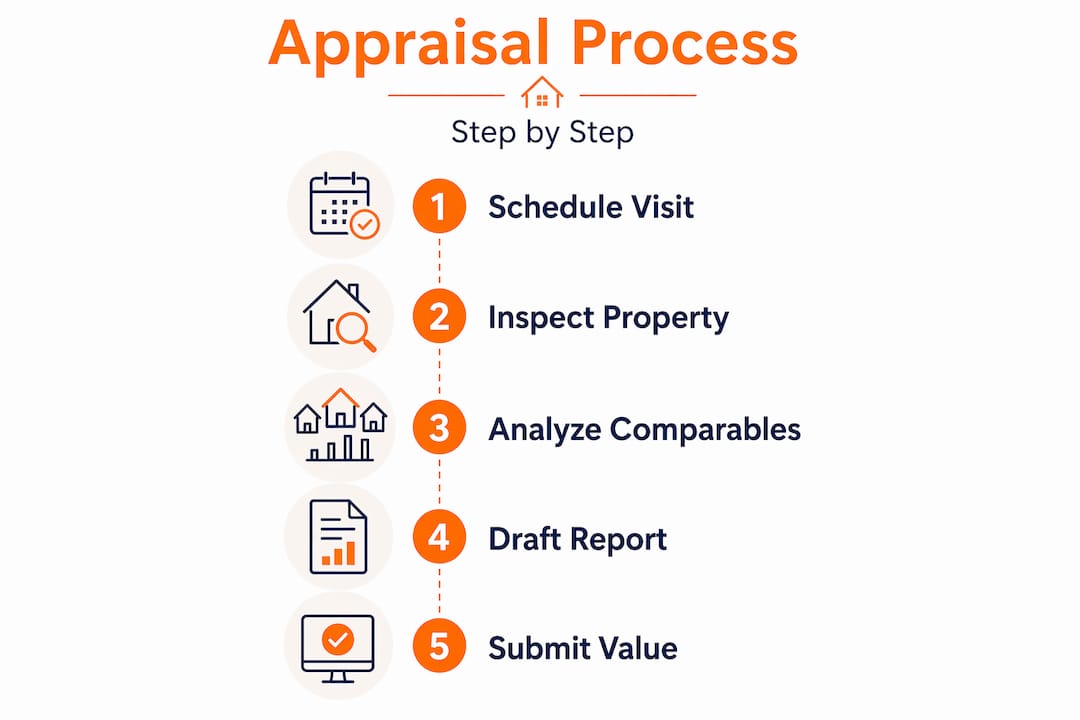
Professional appraisals follow a defined sequence. The process moves through five phases: assignment definition, data gathering, valuation application, reconciliation, and formal reporting. Each phase builds on the last, and skipping or rushing any of them undermines the credibility of the final figure.
- Assignment definition. The appraiser clarifies the purpose of the appraisal, the intended user (typically a lender or buyer), and the effective date of the valuation. This date matters enormously, as we will discuss shortly.
- Physical inspection. The appraiser visits the property, records its size, condition, layout, and features, and photographs key areas. Access is therefore critical.
- Data collection. Recent sales of comparable properties in the same area are gathered, along with local market trends, zoning information, and any income data if the property is tenanted.
- Valuation approach selection. The appraiser applies the methodology most appropriate to the property type. Appraisers select different approaches depending on available market data: the sales comparison approach for residential homes, the income approach for commercial or rental properties, and the cost approach where comparable sales are scarce.
- Reconciliation. Where more than one approach has been used, the appraiser weighs the results and arrives at a single, reasoned opinion of value.
- Report delivery. The completed report is submitted in a standardised format to the commissioning party, typically the lender.
Pro Tip: Before the appraiser arrives, compile a written list of every upgrade and improvement made to the property, including dates, costs, and contractor details. Appraisers cannot credit what they cannot confirm, and your documentation could directly influence the final valuation.
Regulatory standards such as the Uniform Standards of Professional Appraisal Practice (USPAP) govern how appraisers must conduct and report their work. In mortgage lending, the Uniform Appraisal Dataset (UAD) standardises how specific data fields are recorded, so that lenders, insurers, and regulators can compare appraisal data consistently across millions of transactions.
How appraisal outcomes shape financing and negotiations
This is where the appraisal’s practical power becomes most visible. If the appraised value is too low, the lender’s position in any subsequent foreclosure is weakened, so they will not lend against a number they cannot defend. That constraint cascades directly into the transaction.
The financing implications are significant:
- Loan size. Lenders typically cap loans at a percentage of the appraised value, not the purchase price. If the two figures diverge, the buyer must either cover the gap in cash or renegotiate.
- Private mortgage insurance. A higher appraised value may eliminate PMI on a refinance, reducing monthly costs, while a lower-than-expected value can reduce available loan amounts or trigger a full denial.
- Refinancing capacity. On a cash-out refinance, the appraised value determines the maximum loan. A property that has appreciated substantially since purchase unlocks capital; one that has not may leave the owner with fewer options than anticipated.
- Negotiation leverage. When an appraisal comes in below the agreed price, buyers have a documented, independent basis to request a price reduction. Sellers, equally, may wish to challenge the valuation with a second opinion or provide additional comparable sales data.
For investors assessing Riviera investment strategies, the appraisal figure feeds directly into yield calculations and projected returns. A property generating €80,000 per year in seasonal rental income reads very differently when appraised at €1.8 million versus €2.4 million. The cap rate, the financing terms, and the long-term legacy value all shift accordingly.
Specialised scenarios and nuances worth knowing

Not all appraisals are straightforward. Some situations introduce complexity that even experienced buyers and investors can overlook.
Retrospective appraisals
A retrospective appraisal values a property as it stood on a past date rather than today. These arise in legal disputes, estate settlements, and tax matters. The critical discipline here is that appraisers must use only data available on that historical date, filtering out any market movements or sales that occurred afterwards. The integrity of the analysis depends on eliminating hindsight. Valuation disputes in legal contexts frequently turn on whether the correct comparable sales were selected and whether the effective date was strictly observed.
Automated valuations versus professional appraisals
It is worth understanding how different forms of valuation compare, particularly as digital tools become more prevalent.
| Valuation type | Conducted by | Accuracy | Best use case |
|---|---|---|---|
| Professional appraisal | Licensed appraiser | High; based on physical inspection and market data | Mortgage lending, legal matters, formal transactions |
| Broker price opinion | Estate agent | Moderate; based on agent’s market knowledge | Informal pricing guidance, quick market assessment |
| Automated valuation model | Algorithm | Variable; no physical inspection | Initial research, portfolio monitoring |
The differences are not merely academic. For a lender releasing €3 million against a Cap d’Antibes villa, an automated valuation model carries no legal weight whatsoever. Only a licensed appraiser’s report will do.
Regulatory changes in 2026
The new UAD 3.6 format becomes mandatory for appraisals submitted from 2 November 2026 onwards. The submission date, not the inspection date, determines which standard applies. Incorrect format submissions can delay loan underwriting and closing, sometimes by weeks. If you are transacting near that deadline, confirm with your lender and appraiser which format governs your specific submission.
Pro Tip: When reviewing an appraisal report, pay close attention to the comparable sales selected. If the appraiser has drawn comparables from a different neighbourhood or a significantly different price tier, that is a legitimate basis for a formal reconsideration request.
Finally, borrowers typically cannot select their appraiser in lender-ordered appraisals. This is by design: independence is the safeguard. Direct your energy towards preparation and documentation, not towards influencing who conducts the assessment.
Practical guidance for individuals and investors
Knowing how the process works is one thing. Knowing how to position yourself within it is another. Whether you are a first-time buyer or a seasoned investor with properties in multiple jurisdictions, these habits make a material difference:
- Prepare the property before inspection. Clear access to all rooms, loft spaces, and outbuildings. Appraisers who cannot access an area must make assumptions, and assumptions rarely favour the owner.
- Document all improvements. Renovated kitchens, upgraded electrical systems, solar installations, and structural works all contribute to value, but only if the appraiser is aware of them. A well-organised folder of receipts and specifications can shift the final number.
- Understand the report. Ask your adviser or agent to walk you through the appraisal report before you sign anything. Look at the comparables used, the adjustments made, and the appraiser’s stated rationale for the concluded value.
- Leverage results strategically. If the appraisal comes in above the agreed price, you have immediate equity. If it comes in below, use expert negotiation guidance to understand your options before walking away or conceding ground unnecessarily.
- Factor appraisal cycles into investment planning. For luxury properties with seasonal rental income, timing an appraisal to capture peak market evidence, such as strong spring sales on the Riviera ahead of the summer season, can meaningfully influence the outcome.
My perspective on appraisals and what they really tell you
I have seen buyers fixate entirely on the number at the bottom of an appraisal report, missing everything of value above it. The concluded figure is the headline. The methodology, the comparable selection, and the adjustments are the story.
In my experience, the most costly errors in real estate transactions occur when buyers or investors treat the appraisal as a box-ticking exercise rather than a source of genuine intelligence about the asset they are acquiring. I have watched a well-prepared investor use an appraisal report to renegotiate €180,000 off a villa in Mougins, not because the appraiser had made an error, but because the report revealed that three of the seller’s stated upgrades had not actually been completed.
What I have learned about the evolving standards, particularly UAD 3.6, is that they raise the bar for data quality across the entire process. That is good for buyers and investors in the long run, even if the transition period introduces friction. Treat the new standards as a signal that the industry is maturing, not as bureaucratic inconvenience.
The appraisal is also, at its most useful, a mirror held up to the market at a precise moment in time. Understanding that moment, and how to read what it reflects, is one of the most transferable skills a property investor can develop. It applies equally whether you are acquiring a beachfront apartment in Sainte-Maxime or a historic mas in the hills above Grasse.
— ab
Your Côte d’Azur property valuation, handled with distinction
At Livingonthecotedazur, we work with individuals and investors for whom a property is not merely a purchase but a statement of legacy. The importance of property appraisal becomes especially pronounced when you are acquiring prestige assets along the French Riviera, where value is shaped by sea views, provenance, and the quiet alchemy of location. Our guidance covers every stage of the process, from initial luxury real estate transactions to understanding the nuances of valuation in a market as particular as the Côte d’Azur. Explore our portfolio of luxury real estate features and values to understand what truly drives worth in this extraordinary corner of the world. We are here when you are ready to make your move.
FAQ
What is the role of property appraisal in buying a home?
A property appraisal provides an independent, licensed estimate of a home’s fair market value, protecting both the buyer from overpaying and the lender from financing an asset worth less than the loan amount.
Why is property appraisal necessary for a mortgage?
Lenders require an appraisal to confirm that the property’s value supports the loan amount. If the home is worth less than the loan, the lender’s security in a foreclosure scenario is significantly weakened.
How does a property appraisal differ from a home inspection?
An appraisal determines market value; an inspection assesses physical condition and safety. Both serve distinct purposes and are typically required in separate stages of a property transaction.
Can a buyer challenge a low appraisal?
Yes. A buyer can request a formal reconsideration of value by providing additional comparable sales data or highlighting inaccuracies in the report. A second independent appraisal is also an option, though it must be accepted by the lender.
What is a retrospective appraisal and when is it used?
A retrospective appraisal values a property as of a past date and is used in legal disputes, estate settlements, and tax assessments. Appraisers must rely solely on data that was publicly available on the historical effective date, excluding any subsequent market information.
Recommended
 //
//