
TL;DR:
- Trust in property buying on the Côte d’Azur is essential; it influences every decision, from choosing agents to legal structures. Establishing trust requires thorough documentation, transparency, and careful legal practices, especially when using trusts or buying remotely. Building genuine human relationships and verifying professionals’ credibility secure long-term investment success and protect against loss of trust.
When you commit millions to a property on the Côte d’Azur, trust is not a courtesy extended in good faith. It is the architecture beneath every decision you make. The role of trust in property buying is far more layered than most buyers anticipate: it shapes which agent you choose, how contracts are structured, whether your investment holds its value, and even how title is legally vested when purchasing through a trust entity. Most buyers assume trust will simply materialise once a handshake occurs. The reality is that trust must be built, documented, and protected at every stage of a transaction.
Table of Contents
- Key takeaways
- Why trust matters so much in property buying
- Legal foundations of trust in property transactions
- Buying property through a trust: how it works
- Building trust with real estate professionals
- Trust in remote and off-market purchases
- Our perspective on trust as the invisible architecture of great investments
- Discover trusted luxury property on the Côte d’Azur
- FAQ
Key takeaways
| Point | Details |
|---|---|
| Trust is earned, not assumed | Reputation and honesty rank among the top reasons buyers choose one agent over another. |
| Legal documentation underpins trust | Written contracts are a statutory requirement; informal agreements risk being unenforceable, regardless of goodwill. |
| Trusts as buying vehicles carry obligations | When a trust purchases property, trustees hold legal title and must operate with meticulous documentation. |
| Remote buyers need verified intermediaries | International buyers who cannot visit in person depend on third-party verification and trusted agents more than anyone. |
| Trust lost is rarely recovered | Transparency and consistency build credibility over time, but a single lapse in honesty can dissolve it permanently. |
Why trust matters so much in property buying
Buyers rarely articulate what they mean when they say they “trust” their agent. But the data is revealing. 35% of sellers named agent reputation as the decisive factor in their choice, while 21% cited trustworthiness and honesty specifically. These are not soft preferences. They are the primary filters through which buyers and sellers evaluate who is worthy of guiding a decision worth several years of income, or in luxury markets, several decades of wealth accumulation.
The importance of trust in real estate comes down to something simple: property transactions are inherently asymmetric. Your agent knows the market, the seller, and the history of the building. You do not. That information gap is where trust either closes the deal or poisons it. When your agent fills that gap with transparency, you move forward with confidence. When they withhold, delay, or deflect, anxiety replaces clarity and deals collapse.
60% of agents say referrals and repeat clients are their most effective source of business, and nearly 60% of their income flows from those channels. This is not an accident. It is proof that trust reduces friction so dramatically that satisfied clients become unpaid advocates. For you as a buyer, this means an agent who depends on referrals is structurally incentivised to treat you well, not just close your deal and disappear.
Trust factors in home buying also include the micro-behaviours that agents rarely advertise. Do they return calls promptly? Do they explain the small print without being asked? Do they tell you when a property does not suit your brief, even at the risk of losing the commission? These seemingly minor acts accumulate into a portrait of professional integrity that no marketing brochure can manufacture.
Pro Tip: Before signing with any agent, ask them directly: “Can you share a situation where you advised a client not to buy a property you had listed?” Their answer will tell you everything about where their loyalty actually sits.
Legal foundations of trust in property transactions
The human dimension of trust is real, but it will not protect you in a dispute. This is where many buyers make a costly mistake: they extend personal trust to situations that require legal formality.
Under the UK Law of Property Act 1989, contracts for the sale of land must be in writing and signed by both parties to be enforceable. The Conway v Conway case illustrates the risks of relying on informal family arrangements, even when all parties acted in good faith. In that case, the courts significantly limited the application of proprietary estoppel, meaning that a promise made without a written contract could not be relied upon to establish property rights. Goodwill and good intentions, without documentation, are legally meaningless.
For buyers acquiring property in France, the notarial system provides a layer of statutory oversight that the UK market does not automatically replicate. The compromis de vente and the final acte authentique before the notary are not bureaucratic formalities. They are the legal embodiment of trust made enforceable. Skipping or rushing these steps is not a time-saving measure. It is an exposure.
Here is a practical sequence that establishes credibility in property deals and protects your interests:
- Verify title clearly. Confirm the seller holds unencumbered title and that no undisclosed mortgages, servitudes, or co-ownership arrangements exist.
- Conduct a technical survey. A physical inspection by an independent expert is non-negotiable, particularly for older stone properties on the Riviera where structural nuance matters.
- Review all planning permissions. Extensions, pools, and terraces added without permits can become your liability the moment you sign.
- Insist on written representations. Any verbal assurance from a seller or agent about the property’s condition or rental history should be captured in writing before exchange.
- Confirm notarial independence. In France, the notary may act for both buyer and seller. You are entitled to instruct your own notary without additional cost to verify the transaction independently.
“Trust improves buyer outcomes by providing clearer signals through disclosures and proper documentation, reducing reliance on goodwill alone.” — Property24, April 2026
Buying property through a trust: how it works
A growing number of high-net-worth buyers on the Côte d’Azur and across global luxury markets choose to acquire property not in their own name, but through a legal trust structure. The reasons are compelling: privacy, probate avoidance, asset protection, and orderly intergenerational wealth transfer. But this approach demands an especially rigorous application of the principles we have discussed.
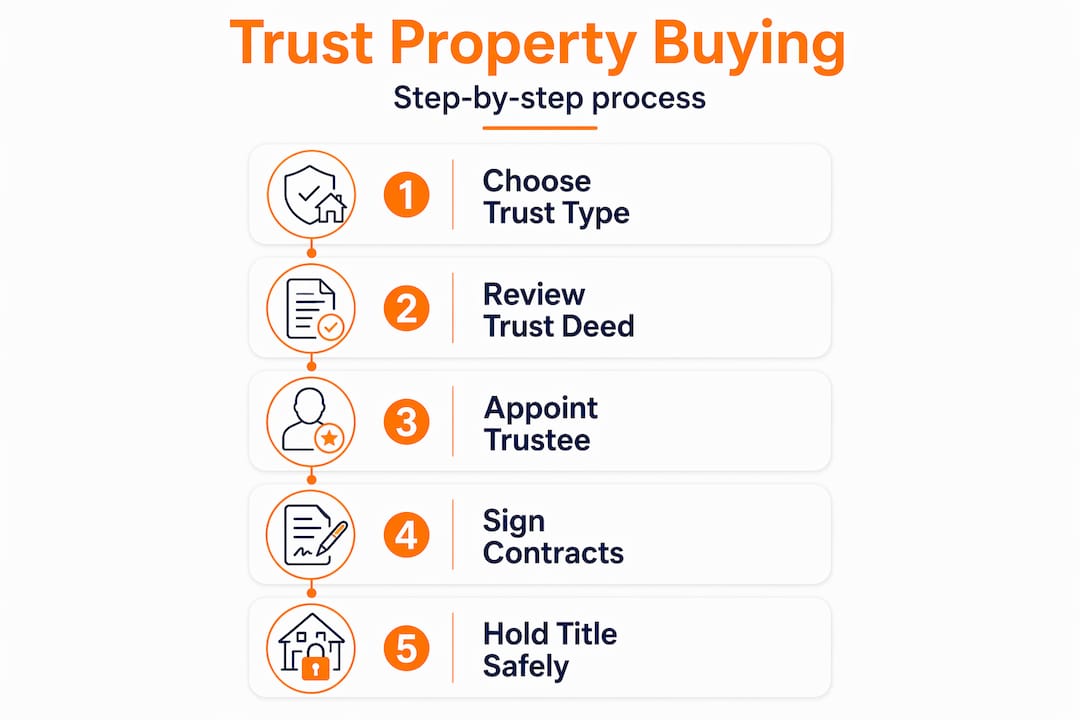
When a trust buys real estate, the trustee acts as the legal purchaser. They sign contracts, hold title, and are named on all documentation. The beneficiaries of the trust hold the equitable interest but are not the legal owners on paper. This distinction matters enormously, particularly when it comes to financing. Lenders assess the trustee’s creditworthiness and the trust deed’s terms before approving a mortgage, which adds a layer of complexity that buyers using personal names do not face.
| Buying method | Privacy level | Probate required | Financing complexity | Estate planning benefit |
|---|---|---|---|---|
| Personal name | Low | Yes | Standard | Limited |
| Through a legal trust | High | No | Higher | Significant |
| Through a company | Moderate | No | Variable | Moderate |
However, trusts are not foolproof. Poor governance, documentation lapses, or related-party handling can compromise the protection a trust is designed to provide. Insolvency law may still reach trust-held assets in certain circumstances, and jurisdictional differences add further complexity when international buyers are involved. If you are considering discreet property buying through a trust or holding structure, the quality of your legal counsel is as important as the quality of the property itself.
Pro Tip: Always have a specialist property lawyer review the trust deed before the purchase contract is signed. The trustee’s powers must explicitly include the authority to acquire real estate, or the purchase may be challenged.
Building trust with real estate professionals
Knowing that trust matters is one thing. Knowing how to assess and cultivate it with the professionals advising you is another. The importance of trust in real estate rests on behaviours that agents demonstrate consistently, not just on first impression.
Here are the qualities and practices that distinguish genuinely trustworthy real estate professionals from those who merely perform trustworthiness:
- They listen before they speak. A credible agent asks detailed questions about your lifestyle, your family’s needs, your investment horizon, and your appetite for renovation before showing you a single property.
- They offer honest pricing assessments. Inflating a property’s value to win your instruction, or dismissing your concerns about price, are red flags that signal misaligned incentives.
- They know the micro-market intimately. On the Riviera, an agent who genuinely understands buyer agent value will know the difference in rental yield between a sea-view villa above Cannes and a comparable property facing north towards the Esterel.
- They facilitate, not pressure. A trustworthy agent creates space for your decision-making process. The moment you feel rushed, the relationship deserves scrutiny.
- They have verifiable track records. Ask for client references. Request evidence of recent comparable transactions. An agent with nothing to hide will welcome the question.
Long-term relationships with trusted professionals also deliver measurable financial returns. When you work with an agent who knows your portfolio, your preferences, and your discretionary thresholds, they will contact you first when the right off-market opportunity arises, before it is ever listed publicly.
Trust in remote and off-market purchases
For international buyers acquiring property on the Côte d’Azur, in Mauritius, Dubai, or Bali without being physically present, the challenge of trust intensifies dramatically. You are placing confidence not only in an agent but in an entire ecosystem of intermediaries, legal processes, and documentation chains you cannot personally oversee.
Verified trust systems have made remote purchases more practical, but they must be approached with sober realism. Consider these safeguards essential, not optional:
- Use an independent local solicitor or notary. Do not rely solely on the agent or developer’s legal representative. Independence is the bedrock of objectivity.
- Request video walkthroughs and drone footage. Visual evidence authenticated by a trusted third party reduces the risk of misrepresentation, though it does not replace a physical survey.
- Verify credentials publicly. Licensed agents in France are registered with the Chambre de Commerce. Their carte professionnelle number can be checked independently.
- Insist on a pre-purchase survey by an independent expert. This applies whether you are buying a Belle Époque villa above Menton or a contemporary apartment in Nice’s Mont Boron district, with its panoramic views over the Baie des Anges.
- Understand the payment structure. Releasing funds in staged tranches tied to documented milestones is far safer than a single upfront transfer, particularly in off-plan or developer transactions.
The lavender-scented quietude of a Provençal village or the salt-kissed terraces of Cap d’Antibes may feel like reason enough to act quickly. Patience, in remote buying, is the most trusted adviser of all.
Our perspective on trust as the invisible architecture of great investments
I have observed, across years of working with discerning buyers in the luxury market, that the clients who experience the most regret are rarely those who paid too much. They are those who moved too fast with someone they had not yet earned the right to trust.
Trust in property buying is not a feeling. It is a structure. Legal documentation is not bureaucracy. It is trust made permanent. An agent’s referral network is not a marketing metric. It is a record of trust repaid, transaction by transaction. And the uncomfortable truth I have seen play out repeatedly is that trust in real estate is asymmetric in its consequences. It takes years to establish and a single act of non-disclosure to destroy.
What I have found actually works, beyond the frameworks and the checklists, is human engagement. The buyers who fare best are those who invest time in the relationship before they invest capital in the property. They ask difficult questions. They listen to the answers with scepticism and warmth in equal measure. They treat their legal advisers as partners, not functionaries. And they understand that building lasting client relationships in luxury real estate is not transactional. It is the foundation on which generational wealth is quietly, deliberately built.
— ab
Discover trusted luxury property on the Côte d’Azur
At Livingonthecotedazur, we have built our reputation on a single principle: that the finest properties deserve the finest counsel, delivered with complete transparency. Our clients acquire Riviera estates as heirlooms, not simply as assets, and that distinction demands a standard of trust that extends from the first conversation to the final notarial signature. Whether you are drawn to an exclusive off-market villa above the Croisette in Cannes, a legacy mas amid the perfumed hills of Grasse, or a prestige apartment overlooking Menton’s lemon-gold coastline, we guide every acquisition with the discretion and rigour it deserves. We also accept cryptocurrency payments, reflecting our commitment to serving the world’s most forward-thinking buyers. Speak with our team and experience trust not as a promise, but as a practice.
FAQ
Why is trust so important when buying property?
Trust reduces the information gap between buyer and agent, enabling faster, more confident decisions. Without it, buyers face heightened anxiety, slower processes, and greater exposure to misrepresentation.
What legal protections should buyers rely on beyond personal trust?
Written contracts signed by both parties are a statutory requirement under the UK Law of Property Act 1989, and similar formalities apply in France. No verbal assurance, however sincerely given, substitutes for documented legal agreement.
Can you buy property through a trust, and what does that involve?
Yes. When a trust purchases real estate, the trustee acts as the legal buyer and holds title on behalf of the beneficiaries. Proper documentation of the trustee’s authority and the trust deed’s scope is non-negotiable for the purchase to be legally sound.
How do you assess whether a real estate agent is truly trustworthy?
Ask for verifiable references, check their professional registration, and pay close attention to whether they advise against unsuitable properties as readily as they promote suitable ones. Agents whose income depends on referrals are structurally incentivised to earn your trust.
What additional safeguards should remote buyers use?
Remote buyers should appoint an independent local legal adviser, insist on third-party surveys, verify all agent credentials through official registers, and release funds in staged payments tied to documented milestones rather than in a single transfer.
Recommended
 //
//