
TL;DR:
- A UK REIT is a company that owns income-producing property and distributes most rental profits to shareholders without double taxation.
- Investors can benefit from regular, property-backed income while avoiding the capital commitment of direct ownership by holding REITs in tax-efficient wrappers like ISAs or SIPPs.
A Real Estate Investment Trust (REIT) is a company that owns, operates, or finances income-producing property and distributes most of its qualifying rental profits directly to shareholders. For UK investors, that single structural feature unlocks something genuinely useful: regular, property-backed income without the capital commitment, legal complexity, or illiquidity of buying bricks and mortar outright. The REIT regime removes double taxation by making qualifying rental profits tax-exempt at the company level, then taxing them in investors’ hands when distributed as Property Income Distributions (PIDs).
At a glance — what every UK investor should know:
- REITs must distribute at least 90% of their tax-exempt property rental profits as PIDs each year.
- PIDs are taxed as property income at your marginal rate, not as dividends — the dividend allowance does not apply.
- Holding REITs inside an ISA or SIPP shelters those distributions from immediate income tax.
- Listed REIT shares trade on the London Stock Exchange, giving you liquidity that direct property cannot match.
- The UK regime has been amended to allow single-asset REITs where the acquisition value is at least £20 million, widening access for institutional structures.
Table of Contents
- What is a REIT in real estate, precisely?
- How do REITs work day to day?
- What types of REITs can you invest in?
- How do REITs make money and deliver returns to you?
- What are the benefits and risks of investing in REITs?
- What are the UK REIT regime’s qualifying conditions?
- How can UK investors buy REIT exposure?
- What should you check before buying a REIT?
- Named UK REITs worth researching further
- Why ISA and SIPP wrappers change the REIT equation
- Key takeaways
- How REITs fit into a diversified UK investor portfolio
- Useful sources and further reading
- FAQ
What is a REIT in real estate, precisely?
A REIT is a corporate vehicle — a company or group — whose primary activity is owning and letting income-producing property. The defining legal feature is the tax pass-through: the qualifying property rental business sits outside the normal corporation tax charge, and the tax liability shifts to investors when profits are distributed. This is what the Chartered Institute of Taxation describes as the regime’s core purpose — to avoid the double taxation that would otherwise apply when a property company pays corporation tax on rental profits and investors then pay income tax on dividends from already-taxed earnings.
To qualify under the UK regime, a REIT must satisfy several statutory conditions:
- At least 75% of profits must come from the qualifying property rental business (the “profits test”), simplified to an 80% threshold under recent amendments.
- At least 75% of assets must be held within the qualifying property rental business (the “assets test”).
- The company must be UK-resident and listed on a recognised stock exchange, though GOV.UK amendments now remove the listing requirement where institutional investors hold at least 70% of ordinary share capital.
- At least 90% of tax-exempt property rental profits must be distributed annually as PIDs.
The UK regime has grown considerably since its introduction in 2006. Industry guides estimate that the regime now encompasses a broad range of registered entities, from large diversified groups to specialist single-asset vehicles.
Statutory note: The balance-of-business and distribution rules are set out under the Corporation Tax Act 2010. HMRC’s published guidance and GOV.UK amendments pages are the primary authorities — always verify current thresholds directly with those sources before making investment decisions.
How do REITs work day to day?
The operational cycle is straightforward. A REIT acquires properties, lets them to tenants, collects rent, pays running costs and finance charges, and then distributes the qualifying net rental profit to shareholders as PIDs. What investors receive is, in effect, a pass-through of the property’s rental economics — minus management costs and debt service.
The key distinction lies in the type of REIT:
- Equity REITs own and operate physical property. Returns come from rental income and, over time, capital appreciation in the underlying assets. This is the most common structure in the UK.
- Mortgage REITs lend against property rather than owning it directly. Their income is the interest spread between borrowing costs and the rates charged on property loans. They carry different risk — credit and interest-rate exposure rather than vacancy and lease risk.
- Hybrid REITs combine both activities, holding physical assets and extending property finance simultaneously.
A REIT’s qualifying rental profits are tax-exempt at the company level, but residual activities — development for resale, management fees, and non-qualifying interest income — remain taxable at standard corporation tax rates. That distinction matters when you are reading a REIT’s annual report: not every pound of profit flows through the tax-exempt channel.
Pro Tip: When reviewing a REIT’s distribution statement, check whether each payment is labelled as a PID or an ordinary dividend. PIDs and ordinary dividends carry different tax treatment in your hands — mixing them up is one of the most common errors beginner investors make.
What types of REITs can you invest in?
The taxonomy has three useful dimensions: what the REIT owns, how it is structured, and which sector it targets.
By activity:
- Equity REITs (own and let property) dominate the UK market and offer the most straightforward income profile.
- Mortgage REITs suit investors comfortable with credit and rate risk in exchange for potentially higher yield.
- Hybrid structures blend both, though they require more careful analysis of the income split.
By listing status:
- Listed REITs trade on public exchanges — the London Stock Exchange for most UK names — giving daily liquidity and transparent pricing.
- Unlisted (private) REITs offer less liquidity but may access off-market assets or niche strategies unavailable to public vehicles.
- Closed-end vehicles, such as investment trusts structured as REITs, trade at a premium or discount to net asset value, adding a layer of market sentiment to the return profile.
By sector specialism:
BDO’s analysis highlights a clear market shift towards thematic, specialist REITs — logistics, life sciences, healthcare, and social housing — allowing investors to target structural economic trends rather than broad commercial exposure. A logistics REIT, for instance, benefits from e-commerce growth rather than the fortunes of the high street. This thematic evolution has made REITs a more precise tool for impact and specialist real estate strategies than the generalist vehicles of a decade ago.
How do REITs make money and deliver returns to you?
Revenue flows from several sources, and understanding each one helps you assess quality of income.
Primary revenue lines:
- Rental income from tenants — the core, recurring stream that underpins PID distributions.
- Service and asset management fees, which sit in the taxable residual business.
- Capital gains on property disposals, which may be distributed or reinvested.
- For mortgage REITs, the interest spread between cost of funds and lending rates.
How investors receive returns:
- PIDs, paid from tax-exempt rental profits — the dominant income stream for most UK equity REITs.
- Ordinary dividends from residual taxable profits, which carry different tax treatment.
- Capital appreciation in the share price as underlying property values rise.
Interest rates shape all three channels. When rates rise sharply, REIT borrowing costs increase, compressing net rental income and often pushing share prices lower as income-seeking investors compare yields against bonds. Leverage amplifies this effect in both directions: a REIT with high gearing delivers stronger returns in a low-rate environment and sharper drawdowns when rates climb. Understanding a REIT’s real estate liquidity profile and debt structure is therefore as important as the headline yield.
What are the benefits and risks of investing in REITs?
REITs offer a genuinely distinctive combination of income, access, and liquidity — but they carry risks that direct property does not.
Benefits
- Professional management: — Specialist teams handle acquisitions, lettings, and asset management — removing the operational burden from the investor.
Risks
- Interest-rate sensitivity: Rising rates compress margins, reduce valuations, and make REIT yields less attractive relative to fixed income.
- Sector and tenant concentration: A REIT focused on a single sector or a handful of anchor tenants carries concentrated risk — a retail REIT with one dominant anchor is exposed if that tenant vacates.
- Leverage and refinancing risk: Geared structures amplify losses in downturns and face refinancing pressure when credit conditions tighten.
- Management and agency risk: REIT managers may pursue growth strategies that serve their fee income rather than shareholder returns.
| Benefit | Risk |
|---|---|
| Regular PID income (at least 90% distribution rule) | PIDs taxed at marginal rate, not dividend rate |
| Listed shares offer daily liquidity | Share price can trade at discount to NAV |
| Low minimum investment | Leverage amplifies downside in rate rises |
| Diversification across many properties | Sector concentration in specialist vehicles |
| Professional asset management | Management fees reduce net returns |
Income reliability in a REIT portfolio depends partly on how rental income streams are secured at the property level — long leases with creditworthy tenants underpin the most consistent distributions.
What are the UK REIT regime’s qualifying conditions?
The UK REIT regime operates under the Corporation Tax Act 2010, with HMRC as the primary administrative authority. Several conditions must be met continuously for a company to retain REIT status.
Balance-of-business tests:
- The profits test requires that at least 75% of profits arise from the qualifying property rental business. Recent GOV.UK amendments introduced a simplified 80% threshold as an alternative route to compliance.
- The assets test requires that at least 75% of total assets are held within the qualifying rental business.
Distribution obligation:
- At least 90% of tax-exempt property rental profits must be distributed within 12 months of the accounting period end, as PIDs.
- PIDs are taxed in investors’ hands as property income at their marginal income tax rate. They do not qualify for the dividend allowance.
Single-asset REITs:
Since 2023, a UK REIT may operate as a single-asset vehicle provided the acquisition value of that asset was at least £20 million. This change opened the regime to institutional single-property structures that were previously excluded.
“The REIT regime is designed to remove the double taxation that commonly affects property companies by making qualifying rental profits tax-exempt at the company level and taxable when distributed to investors.” — Chartered Institute of Taxation
For tax planning across your property portfolio, understanding the PID treatment is the single most consequential detail — it determines whether your REIT income is sheltered or exposed to your highest marginal rate.
How can UK investors buy REIT exposure?
Gaining exposure is straightforward once you understand the four main routes and the wrapper logic that sits above them.
Step-by-step buying routes:
- Direct listed REIT shares: Open a share-dealing account or stocks and shares ISA, search for the REIT by ticker on the London Stock Exchange, and buy shares as you would any equity. Minimum investment is effectively the price of one share.
- REIT funds and ETFs: Funds tracking REIT indices (such as FTSE EPRA/NAREIT indices) give instant diversification across dozens of REITs in a single transaction. Total Expense Ratios vary by provider — check the Key Investor Information Document before investing.
- Closed-end investment trusts: Several UK investment trusts are structured as REITs. These trade at premiums or discounts to NAV, adding a valuation dimension absent from direct share purchases.
- Platform access: Most major UK investment platforms (including ISA and SIPP providers) offer access to listed REITs and REIT funds. Confirm that your platform correctly classifies PIDs for tax reporting.
Tax wrapper advice:
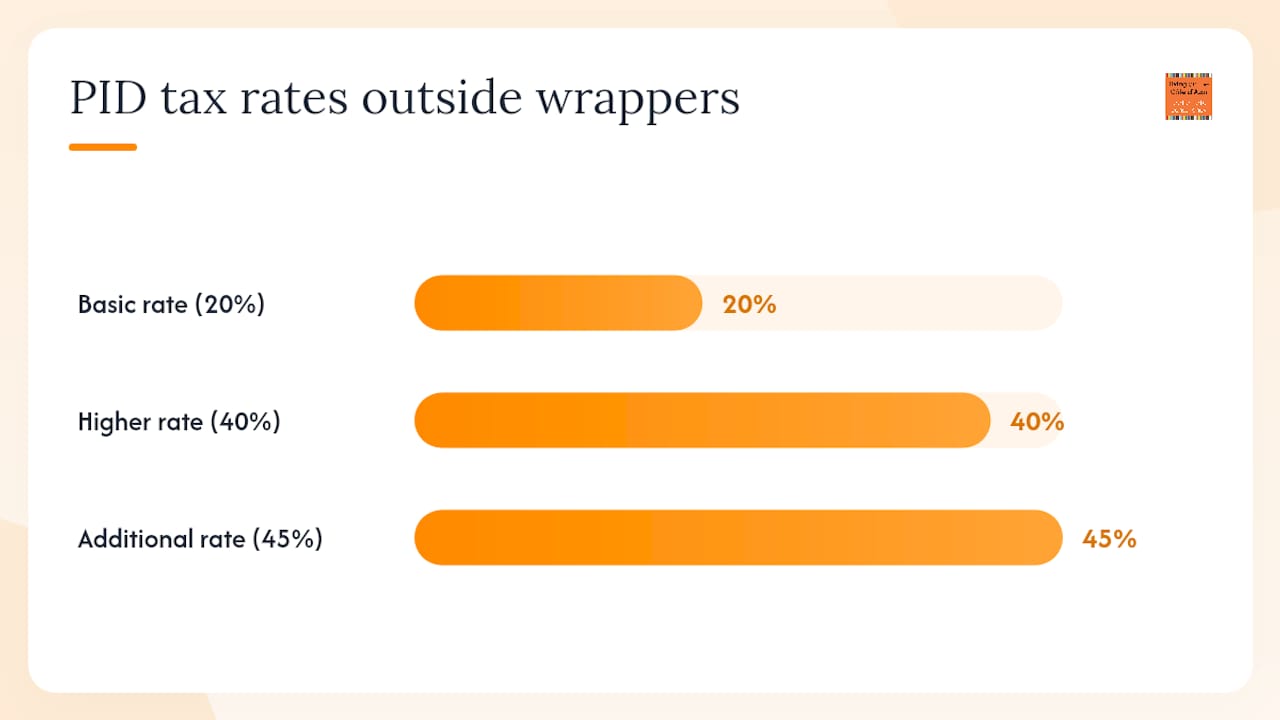
Holding REITs inside an ISA or SIPP is the most tax-efficient route for most UK investors. Wealth managers routinely recommend ISA and SIPP wrappers for REIT exposure because PIDs received inside a wrapper are sheltered from immediate income tax and the administrative complexity of cross-border withholding is eliminated. Outside a wrapper, PIDs are taxed at your marginal rate — 20%, 40%, or 45% depending on your income band.
Practical checklist before you invest:
- Confirm your platform supports gross PID treatment inside your ISA or SIPP.
- Check the REIT’s gearing ratio and refinancing schedule.
- Review the split between PID and ordinary dividend income in recent annual reports.
- Assess sector concentration and the top-five tenant list.
- Understand the liquidity profile — listed shares vs. unlisted vehicles have very different exit timelines.
What should you check before buying a REIT?
A few targeted questions separate a well-structured REIT from one carrying hidden risks.
Due diligence checklist:
- What proportion of income is qualifying rental income versus residual activities? A high residual proportion signals lower tax-exempt income and potentially higher corporation tax drag.
- How concentrated is the tenant base? A single tenant representing more than 20% of rental income is a material concentration risk.
- What is the weighted average unexpired lease term (WAULT)? Shorter lease profiles increase re-letting risk.
- What is the loan-to-value ratio, and when do major debt facilities mature? Refinancing risk is most acute when rates are elevated.
- Are distributions composed primarily of PIDs or ordinary dividends? The tax treatment differs significantly.
Fees and liquidity:
- For REIT funds and ETFs, the Total Expense Ratio (TER) directly reduces net return — compare across vehicles before committing.
- Listed REIT shares carry bid-ask spreads that widen in volatile markets; for smaller or less liquid REITs, this cost can be material.
- Unlisted vehicles may impose lock-up periods or redemption gates — read the fund documentation carefully.
Red flags:
- Heavy development-for-sale activity within the REIT structure (this sits in the taxable residual business and can distort reported profits).
- Unexplained or growing residual profits that are not distributed as PIDs.
- Excessive related-party transactions between the REIT and its manager or sponsor.
Pro Tip: Ask your platform or adviser to confirm how PIDs are reported on your annual tax statement. Some platforms aggregate PID and ordinary dividend income under a single “dividend” label, which leads investors to under-report property income — a costly error if HMRC queries your return.
Named UK REITs worth researching further
The following are well-known UK REITs listed on the London Stock Exchange. They are included here as signposts for further reading, not as investment recommendations.
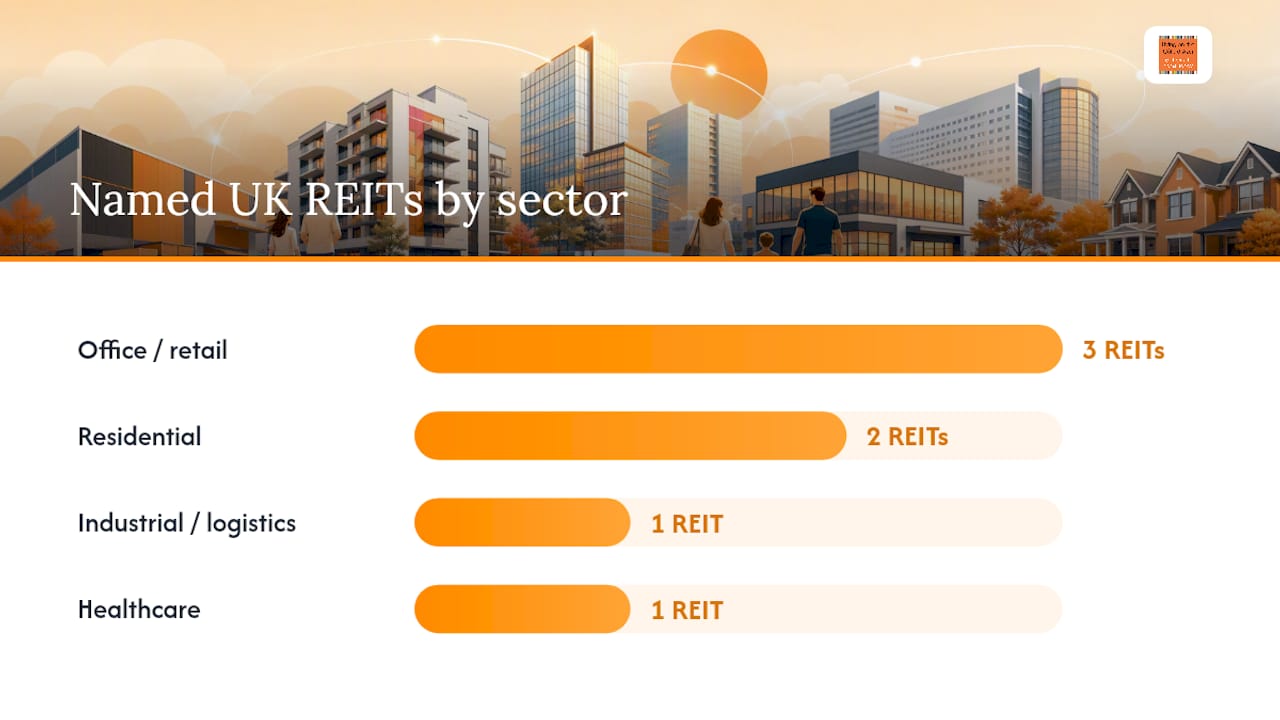
- SEGRO: One of the UK’s largest industrial and logistics REITs, focused on warehousing and urban distribution centres across the UK and Europe.
- Landsec (Land Securities): A diversified commercial REIT with significant exposure to London offices and retail destinations.
- British Land: Major office and retail park portfolio, with a growing focus on mixed-use urban campuses.
- Unite Group: The UK’s leading purpose-built student accommodation REIT, with properties near major universities.
- Grainger: The UK’s largest listed residential landlord, operating as a REIT with a portfolio of private rental homes.
- Target Healthcare REIT: A specialist vehicle focused on modern care homes, offering exposure to the healthcare property sector.
- Derwent London: A London-focused office REIT known for design-led workspace in creative and technology districts.
| REIT | Listing status | Primary sector |
|---|---|---|
| SEGRO | Listed (LSE) | Industrial / logistics |
| Landsec | Listed (LSE) | Office / retail |
| British Land | Listed (LSE) | Office / retail |
| Unite Group | Listed (LSE) | Residential (student) |
| Grainger | Listed (LSE) | Residential (private rental) |
| Target Healthcare REIT | Listed (LSE) | Healthcare |
| Derwent London | Listed (LSE) | Office |
The thematic range here is instructive. From logistics infrastructure to student housing to care homes, the UK REIT market now covers structural trends that would have been inaccessible to most private investors a generation ago.
Why ISA and SIPP wrappers change the REIT equation
The PID tax issue is the single most overlooked detail for UK retail investors approaching REITs for the first time. PIDs are not dividends in the conventional sense — they are property income, taxed at your marginal rate with no dividend allowance offset. For a higher-rate taxpayer, that means 40% on every PID received outside a wrapper.
Inside an ISA, PIDs accumulate free of income tax. Inside a SIPP, they benefit from tax relief on contributions and tax-free growth until drawdown. Wealth managers consistently recommend these wrappers for REIT exposure precisely because the income tax saving on PIDs can be substantial over a multi-year holding period.
Pro Tip: Before purchasing REIT shares or a REIT fund, log into your platform and confirm that it identifies and reports PIDs separately from ordinary dividends. Not all platforms do this correctly, and the distinction is your responsibility to declare accurately on a self-assessment return if you hold REITs outside a wrapper.
The income protection dimension of a REIT portfolio extends beyond tax wrappers — the underlying rental income security of the assets held by the REIT determines the reliability of distributions over time.
Key takeaways
UK REITs offer income, diversification, and liquidity that direct property cannot match, but the PID tax treatment and wrapper choice determine how much of that income you actually keep.
| Point | Details |
|---|---|
| Core definition | A REIT owns or finances income-producing property and distributes at least 90% of qualifying rental profits as PIDs. |
| PID tax treatment | PIDs are taxed as property income at your marginal rate; the dividend allowance does not apply outside a wrapper. |
| Use ISA or SIPP | Holding REITs in an ISA or SIPP shelters PID income from immediate income tax and simplifies reporting. |
| Know your REIT type | Equity, mortgage, and hybrid REITs carry different risk profiles; specialist REITs add sector concentration. |
| Due diligence first | Check gearing, tenant concentration, WAULT, and the PID/ordinary dividend split before investing. |
How REITs fit into a diversified UK investor portfolio
The conventional framing positions REITs as a property substitute — a way to “own” real estate without the hassle. That framing undersells them and, more dangerously, can lead investors to over-allocate. REITs are not a replica of direct property ownership. They are listed equities whose underlying assets happen to be property, and they behave accordingly: they correlate with equity markets in periods of stress, they are sensitive to interest rates in ways that a freehold property is not, and their valuations reflect sentiment as much as underlying asset values.
The more useful framing is REITs as an income and diversification sleeve within a broader portfolio. A 10–15% allocation to a mix of equity REITs — perhaps a generalist UK vehicle alongside a specialist logistics or healthcare name — can meaningfully improve income consistency without concentrating the portfolio in a single asset class. Mortgage REITs deserve a separate assessment: their return drivers are closer to fixed income than to property, and they belong in a different part of the allocation conversation.
Thematic REITs are where the most interesting opportunities sit right now. Logistics, life sciences, and social housing are all benefiting from structural demand shifts that are largely independent of the economic cycle. For investors with a longer time horizon, a curated position in two or three specialist REITs can provide both income and genuine portfolio differentiation — something a broad equity index simply cannot replicate.
The decision between REIT exposure and direct property ultimately comes down to scale, liquidity needs, and tax position. For those drawn to the prestige and permanence of direct ownership — particularly in markets like the Côte d’Azur, where off-market luxury properties represent a category of asset entirely beyond what any listed vehicle can offer — REITs are a complement, not a substitute.
Useful sources and further reading
Official and regulatory sources:
- Real Estate Investment Trusts: amendments — GOV.UK — Primary authority on UK REIT qualifying conditions, balance-of-business tests, and recent amendments including the single-asset £20m rule.
- REITs (real estate investment trusts): an explainer — Chartered Institute of Taxation — Authoritative tax commentary on the PID mechanism and double-taxation rationale.
Industry and advisory guides:
- REITs: a comprehensive guide — BDO — Covers distribution rules, thematic REIT trends, and practical structuring considerations.
- UK REITs and private equity real estate funds — Greenberg Traurig — Advisory note on taxable residual activities and structuring considerations for mixed-income REITs.
- REITs explained: how US and UK investors earn rent from shares — NIFM Academy — Practical guidance on ISA/SIPP wrapper benefits for UK REIT investors.
Living On The Cote d’Azur resources:
- Tax planning for real estate investors — Practical guidance on tax wrappers, inheritance planning, and cross-border property investment.
- What is real estate liquidity? — Explains the liquidity trade-offs between REITs and direct property ownership.
- Property portfolio management: a guide for investors — Portfolio allocation guidance and how REITs can function as a diversification sleeve.
This article is general information, not financial or tax advice. Verify current REIT regime rules with HMRC or GOV.UK and consult a qualified adviser for decisions specific to your tax position.
FAQ
Is a REIT a good investment for UK investors?
REITs offer reliable income, diversification, and liquidity that direct property cannot match, but PIDs are taxed at your marginal income tax rate outside a wrapper — making ISA or SIPP holding essential for most UK investors to retain the income advantage.
What are the top UK REITs to research?
Well-known UK-listed REITs include SEGRO (logistics), Landsec and British Land (office/retail), Unite Group (student accommodation), Grainger (private rental), Target Healthcare REIT (care homes), and Derwent London (London offices) — each covering a distinct sector of the property market.
Can I invest £1,000 in a REIT?
Yes. Listed REIT shares and REIT ETFs allow you to gain property exposure with a small initial sum, making REITs one of the most accessible entry points into real estate investment for investors without large capital reserves.
How do beginners invest in REITs in the UK?
Open a stocks and shares ISA or SIPP with a UK investment platform, search for a listed REIT or REIT ETF, and invest. Holding inside a wrapper from the outset avoids the income tax complexity of PIDs and simplifies your annual tax reporting.
How are REIT distributions taxed in the UK?
Property Income Distributions (PIDs) are taxed as property income at your marginal rate — 20%, 40%, or 45% — and do not qualify for the dividend allowance. Ordinary dividends from a REIT’s residual taxable profits are taxed under normal dividend rules. Holding in an ISA or SIPP eliminates the immediate tax charge on both.
Recommended
 //
//