
TL;DR:
- Private listings are properties marketed exclusively within selective agent networks, bypassing public platforms. They often achieve higher prices and greater privacy but require legal seller consent and limited buyer pools. Success depends on trusted agents, clear objectives, and thorough legal compliance in 2026.
A private listing is defined as a property intentionally withheld from public real estate platforms and marketed only to a select group of agents, brokers, or buyers. Also known as a pocket listing or off-market listing, this approach is legal across U.S. states in 2026 provided the seller consents in writing. The moment a seller permits public marketing, MLS listing requirements apply within one business day. For luxury buyers and investors, understanding this distinction is the foundation of accessing properties that never appear on Rightmove, Zillow, or any public portal.
What is a private listing, and how does it differ from other property types?
A private listing is a deliberate marketing strategy, not simply an unsold property. Not all off-market listings are pocket listings. An off-market property may be quietly available because the seller has not yet engaged an agent. A pocket listing, by contrast, is actively marketed within a restricted circle of agents or buyers. The distinction matters because the strategy, the access routes, and the legal obligations differ significantly between the two.
Public listings sit on the Multiple Listing Service (MLS), a shared database used by agents across a region. Private listings bypass this entirely. They circulate through agent networks, brokerage-internal databases, and invitation-only platforms rather than appearing on public property websites. This limits the buyer pool but preserves the seller’s control over who sees the property and when.
The table below clarifies the key distinctions between the three main listing types.
| Feature | Public MLS listing | Off-market listing | Private (pocket) listing |
|---|---|---|---|
| Visibility | Full public access | Not publicly listed | Restricted to select agents or buyers |
| Marketing strategy | Active, broad | Passive or none | Active, but within a closed network |
| Seller consent required | Standard agreement | Varies | Written waiver of MLS benefits required |
| Buyer pool | Maximum | Minimal | Curated and selective |
| Price negotiation exposure | High | Low | Low to none |
| Regulatory oversight | MLS rules apply | Minimal | Clear Cooperation Policy applies |
The exclusive listing concept is closely related but distinct. An exclusive listing grants one agent sole rights to market a property, which may still appear publicly. A private listing adds the layer of deliberate non-disclosure to the wider market. Both serve sellers who want control, but private listings go further in restricting exposure.
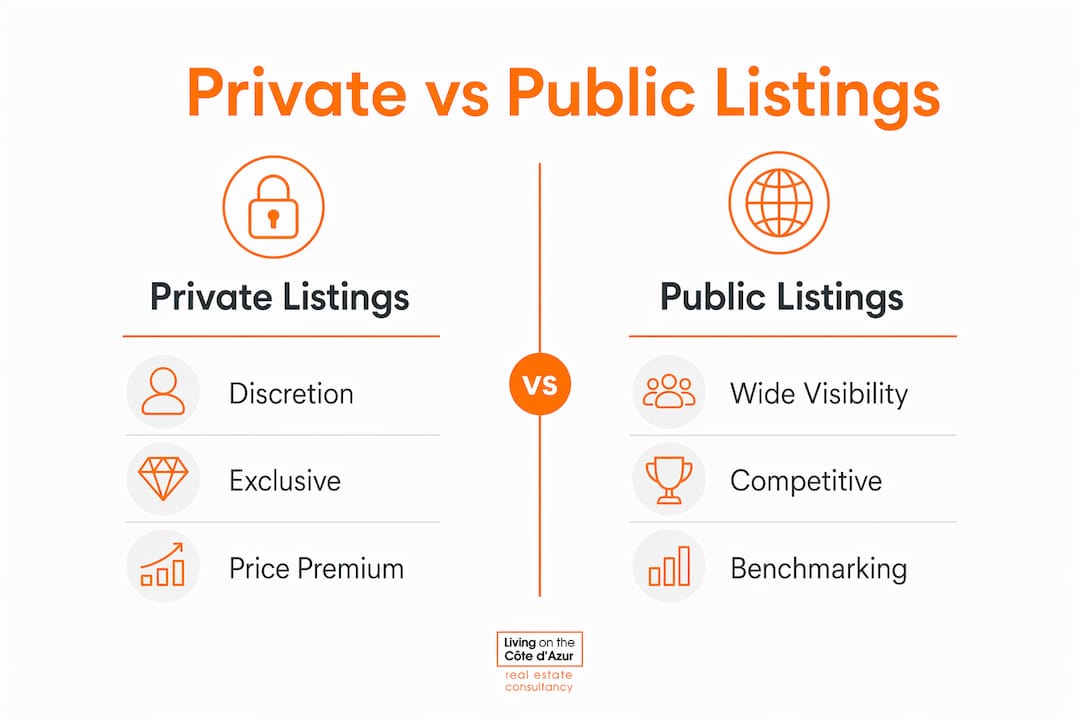
What are the main advantages and disadvantages of private listings?
Private listings offer sellers a set of benefits that public listings structurally cannot. A 2026 study found that private and pre-marketing sales achieved a 1.7% price premium overall, rising to as much as 8% in luxury segments. That premium exists because sellers avoid the downward pressure of public negotiation, visible price drops, and extended days-on-market counts that signal weakness to buyers.
Benefits for sellers
- Price integrity. Sellers hold their list price more effectively because buyers cannot track price reductions or time on market.
- Privacy and discretion. High-profile individuals, families navigating divorce or estate transitions, and owners of trophy properties avoid unwanted public attention.
- Reduced stress. Fewer viewings, no open houses, and no public negotiation theatre. The process is quieter and more controlled.
- Market testing. Sellers can gauge buyer appetite and refine pricing before committing to a public launch.
- Avoiding listing stigma. A property that sits publicly for 90 days acquires a stigma. Private listings sidestep this entirely.
Limitations sellers must accept
- Restricted buyer pool. Fewer buyers see the property, which reduces competitive tension and may result in a lower final offer than a full public campaign would generate.
- Longer timelines. Without broad exposure, finding the right buyer takes longer.
- Agent dependency. The quality of the agent’s network determines everything. A weak network means near-zero exposure.
- Legal compliance burden. Sellers must sign disclosure forms waiving MLS benefits. Errors in documentation create legal risk.
Buyer considerations
Buyers accessing private listings pay a premium for the privilege of early or exclusive access. That premium is real. The same 2026 study describes the arrangement as a rational win-win rather than unethical. Buyers avoid bidding wars and gain certainty. Sellers gain price stability and discretion. The trade-off is that buyers must trust their agent’s valuation without the market comparisons that public listings provide.

Pro Tip: If you are a buyer accessing a private listing, commission an independent valuation before making an offer. Without public comparable sales data, the asking price has no external anchor.
Private listings are particularly effective in luxury markets and transitional sales where sellers require discretion above all else. A villa in Cap Ferrat or a penthouse in Monaco rarely benefits from mass-market exposure. The right buyer for such a property is already within a curated network.
How do private listings fit within regulatory and market frameworks in 2026?
Private listings are legally accepted in 2026 across U.S. markets and, with local variations, across EU jurisdictions including France. The legal framework hinges on informed seller consent. Sellers must sign disclosure forms that explicitly waive the benefits of MLS marketing. Without that written waiver, proceeding with a private listing exposes the agent and seller to regulatory and legal challenge.
The National Association of Realtors (NAR) in the United States governs MLS participation through its Clear Cooperation Policy, introduced in 2020. That policy limits off-MLS marketing to a window of 24 hours before the property must be submitted to the MLS if publicly marketed. This constraint directly affects the price premium achievable through private listings, because the window for selective exposure is narrow.
The two primary compliant routes for sellers in 2026 are:
- Office exclusive listing. The property is marketed only within the listing brokerage. No external agents or public portals are involved. The seller signs a written acknowledgement of restricted exposure.
- Delayed marketing exempt listing. The seller limits syndication to public websites for a defined period. This balances exposure and privacy and is useful for sellers who want to test the market before going public.
- Seller-directed private sale. The seller instructs the agent to approach a pre-approved list of buyers directly, bypassing both MLS and public portals entirely.
- Invitation-only network listing. The property circulates through a curated agent or brokerage network, with access controlled by the listing agent.
“Seller motivations for private listings include privacy, price certainty, and controlled market exposure. These are rational, legitimate goals rather than attempts to circumvent fair market practice. The data confirms that sellers who choose this route often achieve better outcomes than those who default to public listing.”
Buyers in private transactions carry their own due diligence obligations. Without public listing data, price benchmarking requires independent valuation. Legal audits, title searches, and structural surveys remain as critical as in any public sale, and arguably more so given the absence of competitive market scrutiny. For luxury property due diligence on the Côte d’Azur specifically, the legal and tax landscape adds further complexity that demands specialist guidance.
How can buyers and investors use private listings for luxury properties?
Access to private listings is the primary challenge for buyers. These properties do not appear on public portals by design. The route in is almost always through a trusted agent with an established network. Livingonthecotedazur, for example, maintains relationships with over 100,000 properties across prestigious locations including Saint-Tropez and Monaco, many of which circulate exclusively within its agent network.
Strategies for gaining access
- Build agent relationships before you need them. Agents share private listings with buyers they know and trust. A buyer who registers interest, meets in person, and demonstrates financial credibility moves to the front of the queue.
- Work with a specialist brokerage. General agents rarely hold private listings in the luxury segment. A brokerage that specialises in exclusive listings in your target market is the most direct route.
- Attend private viewings and invitation-only events. Luxury brokerages host curated events where properties are presented to pre-qualified buyers. These events are the social infrastructure of the private listing market.
- Declare your criteria clearly. Agents match private listings to buyers whose criteria they know precisely. Vague interest generates no introductions.
- Maintain financial readiness. Sellers in private transactions expect speed. A buyer who cannot move quickly loses the opportunity to one who can.
Evaluating a private listing without public data
The absence of public comparable sales data is the defining challenge for buyers. Without MLS history, you cannot see prior asking prices, price reductions, or days on market. This information asymmetry favours the seller. The mitigation is straightforward: commission an independent surveyor or valuation specialist before entering negotiation.
Pro Tip: Request the seller’s original purchase price and any planning or renovation history. This context does not replace a formal valuation, but it anchors your understanding of the property’s trajectory.
Negotiation in private transactions differs from public sales. There is no competing offer pressure to reference, and no public record of the seller’s urgency. Buyers who understand this dynamic negotiate from a position of quiet confidence rather than reactive bidding. The advantages of private listings for buyers on the Côte d’Azur include access to properties that simply never reach the open market, which in a supply-constrained luxury market is a significant advantage in itself.
What are the seller’s best practices for marketing via private listing?
Sellers who choose a private listing strategy achieve the best results when they treat it as a deliberate campaign rather than a passive withholding of the property. The following sequence reflects best practice for 2026.
- Define your objective before instructing an agent. Decide whether your priority is maximum price, speed, privacy, or market testing. Each objective implies a different private listing structure.
- Select an agent with a demonstrable private network. Ask the agent to name the types of buyers in their network and describe how they would circulate your property. Vague answers indicate a weak network.
- Execute all required legal documentation. Sign the written disclosure waiving MLS benefits. Confirm whether you are proceeding as an office exclusive or a delayed marketing listing. Errors here create legal exposure.
- Set a clear timeline. Private listings without a defined endpoint drift. Agree with your agent on a review date, typically four to six weeks, at which point you assess offers received and decide whether to extend the private phase or move to public listing.
- Control the information released. Decide in advance what photography, floor plans, and financial information you will share and with whom. In a private sale, information is a currency. Release it selectively.
- Manage offers discreetly. Instruct your agent to communicate offers in writing and to avoid creating a competitive atmosphere that could unsettle a serious buyer. Private transactions reward calm, professional process.
Sellers in the luxury segment who use discreet property buying strategies on the Côte d’Azur frequently find that the right buyer emerges within the first two to three weeks of quiet circulation. The market for exceptional properties is small, and the buyers within it are well-connected. A well-briefed agent with genuine relationships reaches them quickly.
Key takeaways
Private listings deliver measurable price advantages and genuine discretion, but only when executed with the right agent network, proper legal documentation, and a clear seller objective.
| Point | Details |
|---|---|
| Private listing definition | A property marketed exclusively within a closed agent or buyer network, bypassing public platforms entirely. |
| Price premium evidence | A 2026 study found private sales achieve a 1.7% overall premium, rising to 8% in luxury segments. |
| Legal compliance is non-negotiable | Sellers must sign written disclosures waiving MLS benefits before proceeding with any private listing. |
| Buyer access requires agent relationships | Private listings are not publicly searchable; access depends on trust and credibility within specialist networks. |
| Best suited to luxury and transitional sales | Discretion, price integrity, and controlled exposure make private listings most effective for high-value properties. |
Why I believe private listings are misunderstood by most buyers
After years of working within the luxury real estate markets of the Côte d’Azur, I have watched private listings attract two equally mistaken reactions. Some buyers assume they are being offered something underhand. Others assume that “off-market” automatically means “better value.” Neither is accurate.
The reality is more nuanced. A private listing is a tool, and like any tool, its value depends entirely on how it is used. I have seen sellers achieve genuinely superior outcomes through private channels, particularly when the property is exceptional and the agent’s network is genuinely curated. I have also seen sellers lose months and money by treating a private listing as a way to avoid the discipline of proper marketing.
The misconception I encounter most often from buyers is that a private listing implies a motivated or distressed seller. In the luxury segment, the opposite is usually true. The seller of a private listing in Saint-Tropez or Monaco is typically someone with no urgency whatsoever. They are testing the market on their own terms. That changes the negotiation dynamic entirely, and buyers who do not recognise this tend to approach the conversation with the wrong assumptions.
My advice to buyers is simple: treat every private listing as if the seller has all the time in the world, because they usually do. Do your valuation work independently, build your relationship with the agent before the property appears, and move with quiet confidence rather than visible enthusiasm. The sellers who use private listings are sophisticated. The buyers who succeed in this market are equally so.
For sellers, the lesson I keep returning to is this: a private listing is not a shortcut. It requires more trust in your agent, more patience with the process, and more rigour in your legal documentation than a standard public sale. When those conditions are met, the results speak clearly.
— Ab Kuijer
Livingonthecotedazur and the world of invisible luxury real estate
Livingonthecotedazur occupies a distinctive position in the Côte d’Azur market. With access to over 100,000 properties across Saint-Tropez, Monaco, Cannes, and beyond, the firm’s network reaches properties that never appear on public portals. For buyers seeking invisible luxury properties on the Côte d’Azur, this access is the defining advantage. Livingonthecotedazur’s approach combines transparency with discretion, pairing buyers with curated private listings through personalised guidance, legal audit support, and tax optimisation expertise. Whether you are acquiring a legacy estate or a prestige investment, the firm’s longstanding relationships with local agents and specialists mean the right property reaches you before it reaches anyone else.
FAQ
What is a private listing in real estate?
A private listing is a property marketed exclusively within a closed network of agents or buyers, bypassing public platforms such as the MLS. It is legal in 2026 provided the seller signs a written consent waiving MLS marketing benefits.
What is the difference between a private listing and an off-market listing?
All pocket listings are off-market, but not all off-market properties are pocket listings. An off-market property may simply be unavailable publicly, while a private listing is actively marketed within a restricted, curated circle.
Do private listings achieve higher sale prices?
A 2026 study found private and pre-marketing sales achieved a 1.7% price premium overall, with luxury segment premiums reaching up to 8%. The premium reflects the avoidance of public negotiation pressure and negative MLS metrics such as price drops.
How do buyers access private listings?
Buyers access private listings through specialist agents with established networks, invitation-only brokerage events, and by registering detailed criteria with agents who hold private inventory. There is no public search route.
Are private listings legal in France and Europe?
Private listings are legally accepted across EU jurisdictions including France, subject to local regulations and seller consent requirements. The legal framework differs from U.S. MLS rules, but the principle of written seller consent and transparent agent conduct applies throughout.
Recommended
 //
//