
TL;DR:
- A real estate mandate is a legal contract that authorizes an agent to act for a property owner or buyer. It defines the agent’s authority, commission terms, and marketing obligations, with enforceable rights only if signed in writing. Properly structured mandates protect both parties and ensure accountability during property transactions.
A real estate mandate is defined as a legally binding contract that grants an agent the authority to act on behalf of a property owner or buyer in a real estate transaction. Known formally as an agency agreement in many jurisdictions, the mandate is the foundational instrument that regulates agent authority and sets out the terms under which commission becomes payable. Without a signed mandate, no legitimate agency relationship exists. For investors and property buyers operating in markets such as the French Riviera, understanding what a real estate mandate means in practice is the difference between a protected transaction and a costly dispute.
The mandate specifies the price, fees, duration, marketing obligations, and methods of remuneration agreed between owner and agent. In France, the Hoguet law mandates that every agency agreement be written, signed, and registered before an agent can legally represent a seller or buyer. This legal framework exists across many European markets in equivalent forms, and its purpose is to protect both parties from ambiguity. Livingonthecotedazur works exclusively within these frameworks, ensuring every client relationship rests on a clear, compliant contractual foundation.

What is a real estate mandate and what are its main types?
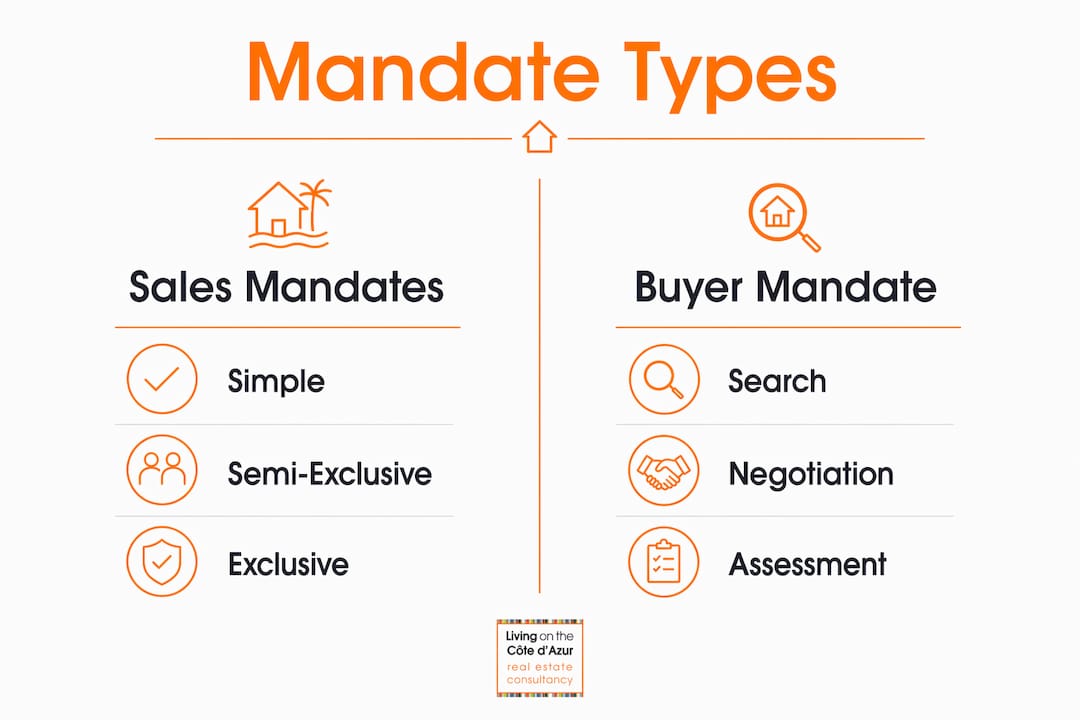
Three primary types of sales mandate govern how property is marketed and sold: simple, semi-exclusive, and exclusive. Each type distributes rights and restrictions differently between the owner and the agent. Choosing the wrong type for your circumstances can cost you time, money, and negotiating power.
Simple mandate
A simple mandate allows the owner to appoint multiple agents simultaneously and to sell the property independently without paying any commission. This sounds attractive on paper. In practice, agents working under a simple mandate have little incentive to invest heavily in marketing, because any one of several competing agents, or the owner directly, could close the deal first.
Semi-exclusive mandate
A semi-exclusive mandate restricts the listing to one agent, but the owner retains the right to find a buyer independently and complete the sale without paying commission. This arrangement offers a middle ground. The agent receives a degree of exclusivity that encourages more effort, while the owner keeps a personal exit route.
Exclusive mandate
An exclusive mandate grants sole selling rights to one agent, typically for an irrevocable period of three months. The owner cannot sell independently during this period without triggering a commission obligation. Exclusive mandates are the most common choice in the luxury segment, where curated marketing and discretion are paramount.
Search mandate for buyers
A search mandate works differently. Here, a buyer contracts an agent to actively locate, assess, and negotiate properties matching specific criteria. Search mandates include market research, negotiation authority, and a service fee payable upon successful purchase completion. For investors acquiring prestige property on the Côte d’Azur, a well-drafted search mandate is one of the most powerful tools available.
| Mandate type | Who can sell | Agent exclusivity | Commission trigger |
|---|---|---|---|
| Simple | Multiple agents or owner | None | Successful sale by that agent |
| Semi-exclusive | One agent or owner | Partial | Successful sale by the agent |
| Exclusive | One agent only | Full | Any sale during mandate period |
| Search mandate | Agent acts for buyer | Full (buyer side) | Successful purchase completion |
Pro Tip: Before signing any mandate, ask the agent to confirm in writing whether the agreement is simple, semi-exclusive, or exclusive. Verbal assurances carry no legal weight under the Hoguet law or equivalent regulations.
How do real estate mandates work legally and financially?
A mandate is a performance contract, not an upfront payment agreement. Agents earn commission only upon a completed transaction. Any arrangement that demands fixed fees before a sale or purchase concludes is classified as a service contract, not a mandate, and carries different legal implications. This distinction matters enormously for investors who want to align agent incentives with their own outcomes.
The legal requirements for a valid mandate are non-negotiable in most jurisdictions. The contract must be written, signed by both parties, and must specify:
- The agreed sale or purchase price range
- The agent’s commission rate and who pays it
- The duration of the mandate and its start date
- The marketing methods and obligations the agent will fulfil
- The conditions under which the mandate can be terminated
- The consequences of a sale occurring outside the mandate terms
Without a signed mandate, an agent cannot legally claim commission and risks regulatory penalties. This rule protects owners from phantom agents claiming fees after the fact. It also protects agents from owners who attempt to bypass them after introductions have been made.
Financially, the mandate shapes your entire negotiation position. A clearly drafted agreement that specifies price, fees, and duration reduces the risk of disputes and creates defined expectations on both sides. Vague mandates invite conflict, particularly when multiple parties claim credit for a sale.
Pro Tip: Always request a copy of the agent’s professional card and registration number before signing. In France, agents must hold a carte professionnelle issued under the Hoguet law. An unregistered agent cannot hold a valid mandate.
The mandate also defines the agent’s duties. Professional obligations typically include providing regular progress reports, arranging professional photography, and conducting viewings to a defined standard. These obligations are only enforceable if they appear in the signed contract. Verbal promises about marketing activity are worth nothing once a dispute arises.
What are the advantages and disadvantages of each mandate type?
Understanding the trade-offs between mandate types is where investors gain a genuine edge. Each structure suits different circumstances, and the wrong choice can undermine an otherwise sound property strategy.
Exclusive mandates incentivise agent investment. When an agent holds the sole right to sell, they have a compelling reason to spend on professional photography, targeted advertising, and private network outreach. The risk is that the owner surrenders control. If the agent underperforms, the owner is contractually bound for the duration of the irrevocable period, typically three months.
Exclusive mandates do not guarantee superior marketing effort. Contracts must explicitly detail the agent’s obligations, including activity schedules and reporting frequency. An exclusive mandate without these clauses gives the agent exclusivity with no accountability. This is one of the most common and costly misunderstandings in luxury property sales.
Simple mandates offer flexibility but dilute commitment. When five agents hold the same listing, none of them will invest heavily in marketing a property they may not sell. The result is often a race to the bottom on price, with agents encouraging the owner to reduce the asking price rather than improving their own marketing effort.
Semi-exclusive mandates work well for sellers who want one point of contact but retain personal selling rights. This structure suits owners with strong personal networks, such as those selling a family villa where a private buyer is already a possibility.
Search mandates give buyers a structured acquisition process. Rather than responding reactively to listings, a buyer with a search mandate has an agent actively working their brief. This is particularly valuable in the off-market segment, where the finest properties on the Côte d’Azur never appear on public portals. Livingonthecotedazur’s access to over 100,000 properties, including off-market opportunities in Saint-Tropez and Monaco, is built precisely on this kind of structured mandate relationship.
Search mandates involve fees that must be budgeted. The service fee is payable on purchase completion, but buyers should understand the commission structure before signing. A well-negotiated search mandate aligns the agent’s fee with the buyer’s success, creating a genuinely shared interest in finding the right property at the right price. For guidance on commission structures, it pays to review the terms carefully before committing.
How to draft, review, and manage a property mandate effectively
The mandate you sign sets the terms for everything that follows. Reviewing it carefully before signing is not optional. It is the single most protective act available to any investor or buyer entering a property transaction.
Before signing any mandate, verify the following:
- Agent credentials. Confirm the agent holds a valid professional licence and is registered with the relevant regulatory body. In France, this means a carte professionnelle under the Hoguet law.
- Commission clarity. The rate, who pays it, and the precise conditions that trigger payment must all appear in writing. Ambiguity here is always resolved in the agent’s favour in a dispute.
- Marketing obligations. The contract should name specific marketing activities: professional photography, portal listings, private network outreach, and a reporting schedule. Generic language such as “best efforts” is unenforceable.
- Duration and termination rights. Know exactly when the mandate begins, when it ends, and what notice period applies. Exclusive mandates typically last three months and require explicit renewal. Missing a termination deadline can result in automatic continuation and unexpected obligations.
- Penalty clauses. Some mandates include penalties for early termination. These are negotiable before signing and non-negotiable after.
Pro Tip: Ask for a mandate with a monthly reporting clause. Require the agent to provide written updates on viewings, feedback, and marketing activity. This transforms the mandate from a passive agreement into an active performance contract.
Renewal terms deserve particular attention. Sellers frequently miss termination deadlines, resulting in unintended contract continuation. Set a calendar reminder at least two weeks before the mandate’s expiry date. If you wish to change agents or renegotiate terms, you must act within the notice window specified in the contract.
Consulting a property lawyer or independent advisor before signing a mandate is a sound investment, particularly for high-value transactions. Bespoke clauses protecting your interests, such as a minimum number of viewings per month or a price reduction protocol, can be inserted at the drafting stage. Once signed, the mandate governs the relationship entirely.
Key takeaways
A real estate mandate is the legal contract that defines agent authority, commission terms, and marketing obligations. Without a clear, signed mandate, neither party has enforceable rights or protections.
| Point | Details |
|---|---|
| Mandate definition | A signed legal contract granting an agent authority to act for a seller or buyer in a property transaction. |
| Three sales mandate types | Simple, semi-exclusive, and exclusive mandates each offer different levels of agent exclusivity and owner control. |
| Commission is performance-based | Agents earn commission only on a completed transaction; upfront fixed fees indicate a service contract, not a mandate. |
| Exclusivity requires accountability | An exclusive mandate must specify marketing obligations and reporting schedules to be enforceable and effective. |
| Termination terms are critical | Exclusive mandates typically run for three months; missing the termination window risks automatic renewal and penalties. |
Why clarity in mandates matters more than most investors realise
Ab Kuijer’s perspective
After years of working with buyers and investors across the French Riviera, the pattern I see most often is not fraud or bad faith. It is ambiguity. Owners sign mandates without reading the marketing clauses. Buyers accept search mandates without understanding the fee structure. Both parties then feel aggrieved when outcomes do not match expectations that were never written down.
The assumption that an exclusive mandate automatically produces superior service is the single most expensive misunderstanding in this market. I have seen exclusive agreements where the agent’s only obligation was to “use best efforts.” That phrase is legally meaningless. The agent did almost nothing for three months, and the owner had no contractual basis to complain.
My view is straightforward. A mandate is only as strong as the obligations it contains. Exclusivity without accountability is a gift to the agent and a risk to the owner. Buyers using search mandates should insist on a defined brief, a reporting schedule, and a clear fee structure tied to purchase completion. Nothing else.
The Hoguet law in France exists for good reason. It forces the relationship into writing. But the law sets a floor, not a ceiling. The best mandates go far beyond the legal minimum. They specify viewings per month, marketing budgets, feedback timelines, and price review protocols. These are not unreasonable demands. They are the mark of a professional relationship.
For investors acquiring prestige property, the mandate is not a formality. It is the instrument through which you hold your agent accountable. Treat it accordingly.
— Ab Kuijer
How Livingonthecotedazur supports your mandate strategy
Livingonthecotedazur works with buyers and investors who understand that the right mandate structure is as important as the right property. Our team negotiates, drafts, and manages both search mandates and exclusive agreements across the French Riviera, with access to curated off-market properties in Saint-Tropez, Monaco, and beyond. We bring legal audit support, tax guidance, and financing assistance to every transaction, ensuring the contractual framework protects your investment from the first signature. For buyers seeking personalised acquisition services in one of the world’s most prestigious markets, we are the trusted partner who knows where the finest properties are held, and how to secure them on the right terms.
FAQ
What is a real estate mandate in simple terms?
A real estate mandate is a signed legal contract that authorises an agent to represent a property owner or buyer in a transaction. It sets out commission terms, duration, and the agent’s obligations.
What is the difference between a simple and an exclusive mandate?
A simple mandate allows multiple agents and independent owner sales without commission. An exclusive mandate grants one agent sole selling rights, typically for three months, and the owner cannot sell independently during that period without triggering a commission obligation.
Can an agent claim commission without a signed mandate?
No. Without a signed written mandate, an agent has no legal basis to claim commission and risks regulatory penalties. The mandate is the primary legal instrument protecting both the agent’s payment rights and the owner’s leverage.
What is a search mandate and who uses it?
A search mandate contracts an agent to find, assess, and negotiate a property on behalf of a buyer. It includes market research, negotiation authority, and a fee payable on purchase completion. Investors acquiring luxury or off-market property use search mandates to access curated opportunities that never appear on public portals.
How long does an exclusive mandate last?
Exclusive mandates typically run for an irrevocable period of three months and require explicit renewal. Sellers who miss the termination deadline risk automatic contract continuation and potential penalties, so tracking the expiry date carefully is essential.
Recommended
 //
//