
TL;DR:
- An exclusive listing grants one brokerage sole authority to market and sell a property, typically for three to six months. While it offers privacy and dedicated marketing, it may reduce buyer reach, delay sales, and create conflicts from dual agency, often leading to eventual public listing and lower competition. Sellers should carefully evaluate their motivation, network strength, and contractual terms before choosing exclusivity to ensure it aligns with their strategic goals.
When discerning investors and high-net-worth sellers ask what is an exclusive listing, they often receive a polished but incomplete answer. The reality is more layered than “privacy and prestige.” An exclusive listing grants one brokerage sole authority to market and sell your property, and while that arrangement can suit certain sellers perfectly, it carries trade-offs that the brochure rarely mentions. Understanding those trade-offs, with clarity and without sentiment, is the difference between a well-structured sale and a quietly costly one.
Table of Contents
- Key takeaways
- What an exclusive listing actually means
- The genuine advantages for luxury sellers
- The drawbacks data rarely discussed openly
- Exclusive vs open listings: a clear comparison
- Strategic guidance for high-net-worth sellers and investors
- Our perspective on exclusive listings
- Discover exclusive listings on the Côte d’Azur with Livingonthecotedazur
- FAQ
Key takeaways
| Point | Details |
|---|---|
| Exclusive listing definition | A legally binding contract granting one brokerage sole selling rights, typically for three to six months. |
| Two contract types exist | Exclusive right to sell and exclusive agency differ significantly in commission obligations and seller flexibility. |
| Privacy has a price | Reduced market exposure can limit buyer competition and suppress the final sale price. |
| Brokerage incentives matter | Dual agency within exclusive arrangements can create conflicts between agent and seller interests. |
| Exclusivity is conditional | Treat exclusivity as a strategic choice to be evaluated, not an inherent mark of prestige. |
What an exclusive listing actually means
At its core, an exclusive listing agreement is a legally binding contract granting sole marketing and selling rights to one brokerage, typically for a period of three to six months. During that window, no other agent may list or market your property, and in most cases, you remain liable for the agreed commission even if you find the buyer independently.
Two principal contract types define the exclusive listing landscape:
- Exclusive right to sell. The most widely used form. The appointed brokerage earns its commission regardless of who ultimately sources the buyer, whether that is the agent, a referral network, or the seller themselves. This is the standard industry practice and the version most agencies will present as default.
- Exclusive agency. A less common arrangement in which the seller retains the right to find their own buyer without incurring a commission. Brokerages are generally less enthusiastic about this structure, as it reduces their financial certainty, and it can soften the level of marketing investment they provide.
Beyond these two forms, several related concepts are worth understanding clearly:
- Pocket listings (also called off-market listings): Properties shared only within a brokerage’s internal network or by direct invitation, never publicly advertised. They are the most discreet form of exclusive real estate listing.
- Office exclusives: Properties listed within a single brokerage but not exposed on public MLS, meaning only that agency’s agents and clients will see them.
- Coming soon listings: Properties announced publicly before formally entering the MLS, designed to build anticipation and generate early enquiries.
Pro Tip: Before signing any exclusive listing agreement, ask your solicitor to clarify the commission trigger clause. Knowing precisely when and how commission becomes payable protects you regardless of how the sale proceeds.
The genuine advantages for luxury sellers
For a certain profile of seller, the benefits of exclusive listings are real and worth pursuing. The question is whether your situation genuinely fits that profile.
Privacy is the most frequently cited reason high-net-worth individuals choose an exclusive arrangement. When a Cap d’Antibes villa or a Monaco-adjacent penthouse appears on public platforms, it attracts not only qualified buyers but also unwelcome attention. Brokers, journalists, and the merely curious begin circulating. For a seller whose identity, security, or business reputation warrants discretion, private listing advantages can justify the reduced exposure.
There are other genuine advantages beyond privacy:
- Dedicated marketing investment. When one brokerage controls the listing exclusively, they have both the incentive and the obligation to invest in bespoke photography, private viewings, curated buyer introductions, and targeted outreach to their high-net-worth network.
- Reduced disruption. Public listings on the Côte d’Azur often trigger a wave of viewings, some from buyers who are curious rather than committed. An exclusive arrangement filters access, preserving the seller’s time and the property’s atmosphere.
- Stronger agent relationship. A single point of contact means clearer communication, consistent messaging about your property, and a marketing strategy that does not get diluted across competing agents.
“Exclusivity, when chosen deliberately, is not about hiding a property from the market. It is about presenting it to precisely the right audience, at precisely the right moment, with the full weight of a single agency’s attention and network behind it.”
For sellers with genuinely time-sensitive situations, such as estate planning around the Côte d’Azur’s spring season or ahead of the Cannes Film Festival when ultra-wealthy visitors converge on the region, a focused exclusive approach can accelerate the right connection.
The drawbacks data rarely discussed openly

Here is where the conversation about exclusive listings deserves more honesty. The data is instructive and not always flattering.
Research shows that 90% of exclusive listings eventually enter the public MLS, which raises an obvious question: if public listing becomes necessary in the majority of cases, what was gained by the exclusive period? The answer, for many sellers, is very little beyond delay.
| Factor | Exclusive listing | Public MLS listing |
|---|---|---|
| Buyer reach | Limited to brokerage network | Broad market exposure |
| Time to sell | Typically longer | Generally faster |
| Price premium | No consistent advantage | Competitive bidding possible |
| Privacy | High | Low to moderate |
| Brokerage conflict risk | Elevated (dual agency likely) | Lower |
| Seller control | Contractually limited | More flexibility |
A further concern is the structure of brokerage incentives. When a brokerage holds an exclusive listing, they are highly motivated to control both buyer and seller sides of the transaction, a situation known as dual agency. This arrangement allows them to capture the full commission from both parties. The problem is that an agent representing both buyer and seller cannot fully advocate for either. As a seller, your interest is in achieving the highest possible price. The brokerage’s interest, when dual agency applies, is in closing the deal efficiently.
Sellers also lose the launch moment that public listings create. When a well-priced property enters the MLS fresh, it attracts simultaneous interest from multiple buyers, which is precisely the condition that generates competitive offers and price escalation. An exclusive listing forfeits that competitive energy by design.
Pro Tip: Ask your agent to show you comparable sales data for properties that sold via exclusive arrangement versus public listing in your specific area and price band. Anecdote is not evidence. Data is.
Exclusive vs open listings: a clear comparison
Understanding how exclusive listings compare to alternative approaches helps you make a genuinely informed decision rather than one shaped by marketing language.
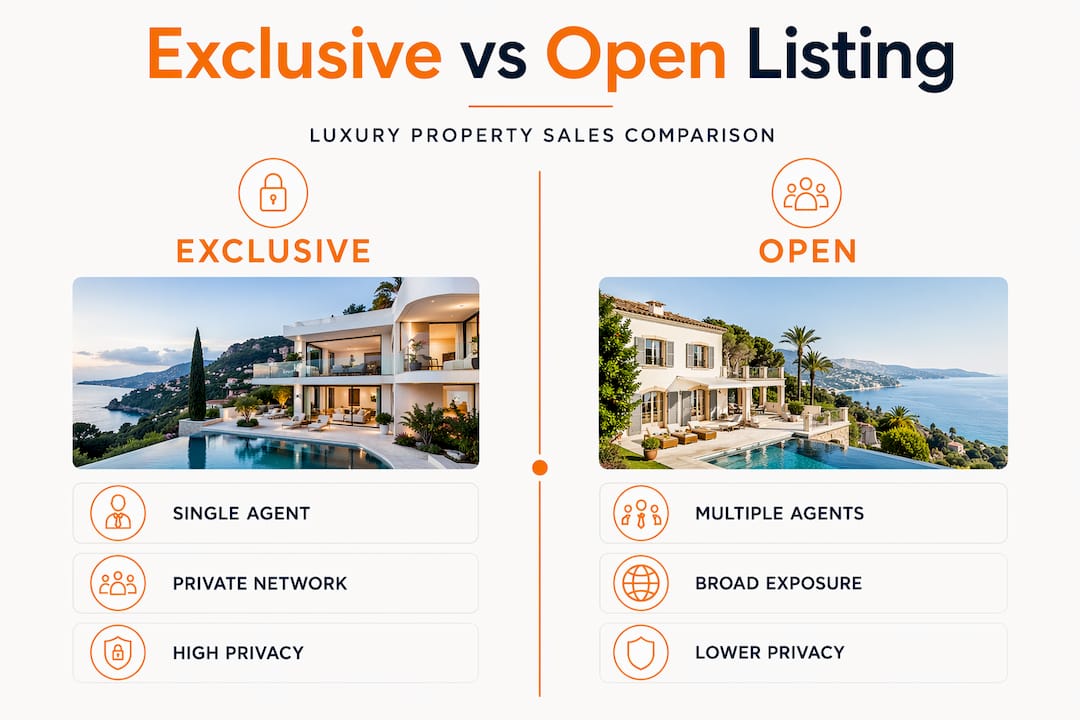
An open listing allows multiple brokerages to market your property simultaneously, with commission payable only to the agent who secures the buyer. It maximises exposure but typically reduces each individual agent’s motivation to invest heavily in your property’s marketing, since their effort may benefit a competitor.
| Listing type | Exposure | Agent commitment | Privacy | Best suited to |
|---|---|---|---|---|
| Exclusive right to sell | Low to moderate | High | High | Discretion-driven sellers with a patient timeline |
| Exclusive agency | Low to moderate | Moderate | High | Sellers who may source their own buyer |
| Office exclusive | Very low | High within brokerage | Very high | Ultra-high-net-worth sellers in sensitive situations |
| Coming soon | Building publicly | Moderate | Low | Properties benefiting from pre-launch anticipation |
| Public MLS listing | Very high | Variable | Low | Sellers prioritising speed and competitive pricing |
The distinction between office exclusives and coming soon listings matters more than most sellers realise. An office exclusive means zero public exposure, full stop. A coming soon listing is a public announcement that builds anticipation before the formal MLS entry date. Conflating the two is a common source of misunderstanding, and sellers should have their agent clarify which approach applies and why.
For properties on the French Riviera, where a Saint-Jean-Cap-Ferrat estate or a Mougins mas may attract a very specific international buyer profile, off-market Riviera opportunities can be the most elegant route to the right transaction. The key word is “can.” It depends entirely on the depth of the brokerage’s genuine buyer network.
Strategic guidance for high-net-worth sellers and investors
Treating exclusivity as a strategy rather than a status symbol changes how you evaluate the decision. Here is a practical framework:
- Test your privacy assumption. Ask yourself whether your situation genuinely requires off-market handling, or whether the preference for privacy is aesthetic rather than necessary. True privacy needs, such as those of public figures or families managing estate transfers, justify the trade-offs. Preference alone may not.
- Interrogate the brokerage’s buyer network. An exclusive listing is only as valuable as the qualified buyers your agent can actually reach. Ask for specific, verifiable examples of comparable properties sold through their private network within the past twelve months.
- Clarify every term in writing. The difference between listing types must be documented precisely. What does “exclusive” mean in your contract? Who can show the property? What triggers commission?
- Evaluate the dual agency risk. If your brokerage is also representing prospective buyers for your property, ask directly how they manage that conflict. The answer will tell you a great deal about their priorities.
- Set a market feedback mechanism. Agree in advance on how many weeks without a qualified offer will trigger a conversation about adjusting the strategy. Market fragmentation in private networks makes it harder to interpret silence. Do not let ambiguity erode your timeline.
Pro Tip: Luxury sellers on the Côte d’Azur should treat exclusivity as a conditional strategic choice rather than an inherent premium. The finest properties attract the right buyers through excellent presentation and a genuine network, not simply by withholding access from the broader market.
Our perspective on exclusive listings
I have worked alongside high-net-worth sellers and investors across the French Riviera long enough to observe a pattern that rarely makes it into the conversation between agent and client. Exclusivity is frequently framed as an act of refinement, a choice that elevates a property above the noise of the open market. In practice, it is a contractual arrangement with real financial consequences, and those consequences deserve the same scrutiny you would apply to any other significant decision.
What I have seen is this: the sellers who benefit most from exclusive arrangements are those who have a genuine, specific reason for limiting exposure, not a vague sense that privacy signals prestige. A family transferring generational wealth through a Provençal estate. A public figure selling a Cap d’Antibes property without wishing to alert the press. Those are legitimate exclusive listing scenarios, and in those contexts, a skilled brokerage with a genuine network delivers real value.
Where I have seen sellers lose is when they confuse exclusivity with quality. The brokerage held the listing. The private network was thinner than promised. Months passed. The property eventually entered the public market, sometimes at a reduced price to compensate for the perception of stagnation.
My advice is simple. Choose your agent before you choose your listing type. If the agent has a demonstrable, active network of qualified buyers for your property’s profile, exclusivity may serve you well. If the network is largely theoretical, a well-executed public launch will almost always serve your financial interests better. The salt-kissed prestige of the Riviera does not require secrecy to command its true value.
— ab
Discover exclusive listings on the Côte d’Azur with Livingonthecotedazur
At Livingonthecotedazur, we work with a curated portfolio of properties that never appear on public platforms, from Monaco-adjacent villas with panoramic sea views to restored Provençal mas surrounded by lavender-scented hills. Our private inventory is built on relationships forged over years with genuine buyers across Europe, the Middle East, Asia, and the Americas. We understand that for many of our clients, the finest transaction is the one that never becomes public knowledge.
We offer bespoke exclusive property services tailored to high-net-worth sellers and investors who demand both discretion and results. Our team guides you through every dimension of the process, from legal due diligence to legacy-conscious acquisition strategies. Whether you are considering a discreet sale or seeking access to our off-market Côte d’Azur properties, we welcome the conversation.
Contact our team to discuss your requirements in complete confidence.
FAQ
What is an exclusive listing in real estate?
An exclusive listing is a contract granting a single brokerage sole rights to market and sell a property, typically for three to six months. The seller is generally obligated to pay commission to that brokerage regardless of who finds the buyer.
What does exclusive listing mean for a luxury seller?
For a luxury seller, an exclusive listing means heightened privacy and dedicated marketing attention from one agency, but potentially reduced buyer competition and a longer time to sell compared to a public listing.
What is the difference between exclusive and open listings?
An exclusive listing ties marketing rights to one brokerage, while an open listing allows multiple agents to market the property simultaneously with commission payable only to whoever secures the buyer.
Are exclusive listings better for achieving a higher sale price?
Research indicates that exclusive listings offer no consistent price premium over public listings and may reduce competitive bidding. They are better suited to privacy-driven sellers than to those prioritising maximum sale price.
What is a pocket listing and how does it differ from an office exclusive?
A pocket listing is shared privately within a brokerage’s network or by invitation only. An office exclusive is formally listed within one brokerage but not advertised publicly on the MLS. Both limit market exposure, but office exclusives carry a more defined internal structure.
Recommended
 //
//