
For a high‑net‑worth buyer, “commercial real estate investing” in this context refers to something quite different from an office block or a warehouse. Here, it refers to acquiring high‑end villas, luxury apartments and second homes on the Côte d’Azur, Monaco, Ibiza, Portugal or Dubai for lifestyle use, rental income or long‑term capital growth. The bottom line: most HNWIs treat these purchases as five‑to‑fifteen‑year holds, balancing personal enjoyment against yield and appreciation, and legacy planning for the next generation.
The single most important early decision is not the villa itself. It is choosing the right ownership structure and advisor team before you sign anything, because unwinding a poor structure later costs far more than setting it up correctly at the outset.
- Lifestyle first, returns second — most buyers prioritise personal use, with rental income and appreciation as secondary benefits.
- Structure before search — decide on personal ownership, a société civile immobilière (SCI) or another vehicle before making an offer.
- Tax exposure matters from day one — the Impôt sur la Fortune Immobilière (IFI) applies to French property assets above the statutory threshold, and a notaire will factor this into your planning.
Pro Tip: Engage a fiscalist and a buyer’s agent in the same week you start viewing property, not after you find “the one” — structuring decisions shape which properties even make sense for you.
Key Takeaways
Luxury residential investing succeeds when structure, tax planning and off‑market access are addressed before a property search begins, not after.
| Point | Details |
|---|---|
| Definition matters | This asset class means villas, apartments and second homes bought for lifestyle, yield or growth, not office or industrial property. |
| Structure comes first | Choose between personal ownership, an SCI or a trust before making an offer, given succession and IFI implications. |
| Costs shape returns | Resale acquisition costs of 7 to 8.5% versus 2 to 3% plus VAT on new builds significantly affect break‑even timing. |
| Liquidity is limited | Prime coastal property can take four months to over a year to sell; plan holding periods accordingly. |
| Local expertise accelerates results | Living On The Cote d’Azur coordinates off‑market sourcing, legal audits, tax optimisation and financing introductions from one team. |
Table of Contents
- Why wealthy buyers choose luxury residential property
- Which markets and property types suit different investors?
- How are returns actually generated and measured?
- What risks and liquidity constraints should you plan for?
- How should you structure ownership, financing and tax?
- What should your due diligence checklist include?
- How does Living On The Cote d’Azur support this kind of purchase?
- What distinguishes commercial real estate investing from luxury residential property?
- Ready to explore luxury property on your terms?
- Sources
- FAQ
Why wealthy buyers choose luxury residential property
Four motivations drive most acquisitions we see: personal use during peak season, short‑let rental income to offset holding costs, long‑term capital appreciation, and legacy planning for children or grandchildren. Rarely does one buyer pursue only one of these. A villa above Beaulieu‑sur‑Mer might host family for six weeks a year and generate rental income the rest of the season, while quietly appreciating as prime Riviera stock tightens.
Luxury property behaves differently to standard residential investment. It carries an illiquidity premium (fewer buyers can afford or qualify for €3M+ assets), bespoke characteristics that make comparables harder to pin down, and genuine off‑market scarcity, since many of the best Mediterranean estates never reach a public listing at all.
- Total return blends net rental yield, capital appreciation and currency movement for international buyers.
- Diversification value is real: prime coastal property has historically moved differently to equities and bonds.
- IFI exposure and local taxes must be weighed against expected appreciation, not treated as an afterthought.
Pro Tip: Ask any seller’s agent how long the property has actually been marketed. A villa that has sat quietly for eighteen months tells you more about pricing reality than the asking price does.
Which markets and property types suit different investors?
Villas and estates dominate demand on the Côte d’Azur and in Portugal’s Algarve and Comporta regions, while Monaco and Dubai lean heavily towards luxury apartments and penthouses. Ibiza sits somewhere between the two, with finca‑style estates and modern villas both in strong demand. Heritage homes suited to restoration appear across all five markets, often at a discount that reflects the capital and patience required to bring them up to standard.
Each market has its own character:
- Côte d’Azur — deep market, strong international school access, established resale liquidity for prime coastal stock.
- Monaco — tax‑favourable for residents, extremely constrained supply, transaction sizes routinely above €10M for prime apartments.
- Ibiza — strong seasonal rental economy, tighter planning restrictions on new builds, growing off‑market activity among returning buyers.
- Portugal — comparatively accessible entry pricing versus the Riviera, expanding infrastructure, increasing interest from northern European buyers.
- Dubai — no annual property tax, freehold zones open to foreign buyers, rapid infrastructure delivery reshaping certain districts year on year.
Airport access and international school availability are practical signals of market depth. A property forty minutes from Nice Côte d’Azur Airport with a bilingual school nearby holds resale appeal that a remote equivalent simply cannot match.
How are returns actually generated and measured?
Total return on a luxury residential asset breaks into three components: net rental yield, capital appreciation, and currency effects for buyers purchasing outside their home currency. None of these should be assessed in isolation, because fees and taxes erode headline numbers more than most first‑time luxury buyers expect.
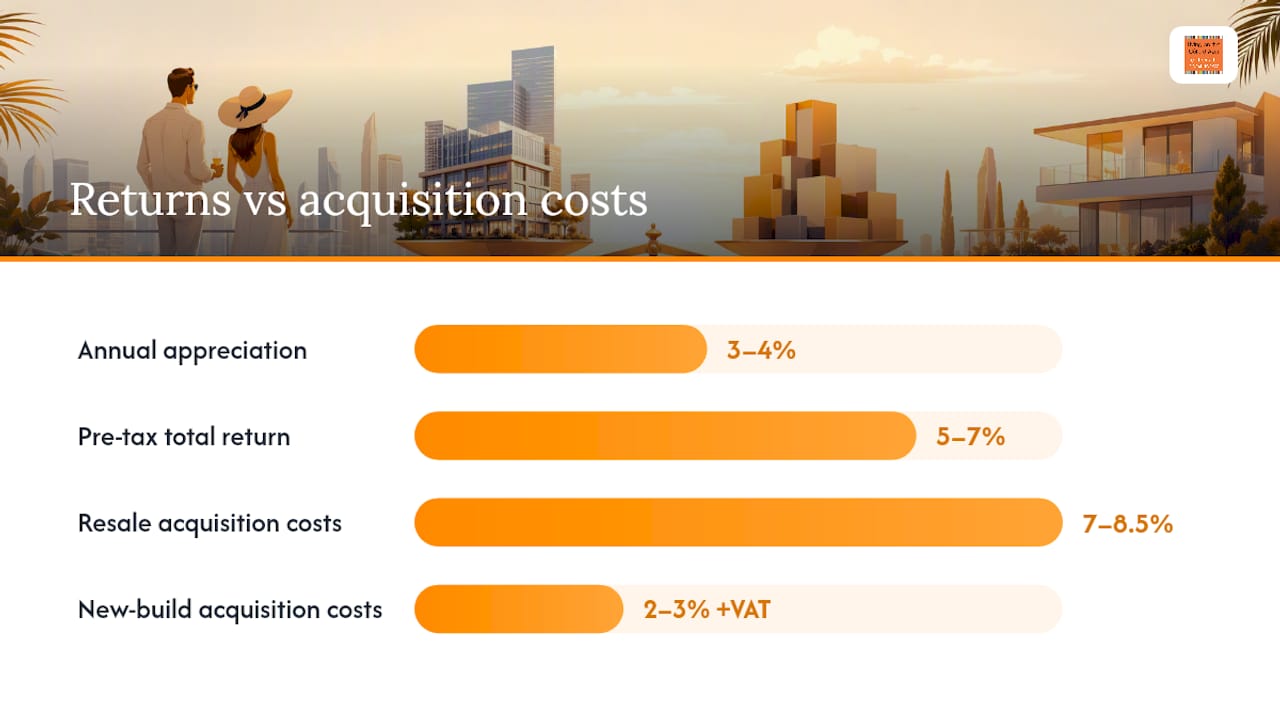
Take a €2 million villa on the Var coast, let for ten weeks a season at an average of €8,000 per week. That generates €80,000 in gross rental revenue. Add assumed annual capital appreciation of 3 to 4% in a strong prime segment, and total return before tax can reach 5 to 7% a year, before accounting for currency swings on the initial purchase or eventual sale proceeds.
Acquisition costs matter enormously here. On a resale property, notaire fees and transfer taxes commonly total 7 to 8.5% of the purchase price, while new‑build purchases typically incur only 2 to 3% plus VAT. On a €2 million resale villa, that is roughly €140,000 to €170,000 in upfront cost alone, before renovation or furnishing.
- Rental yield, appreciation and FX together form total return, not any single figure alone.
- Acquisition costs of 7 to 8.5% on resales versus 2 to 3% plus VAT on new builds materially change your break‑even horizon.
- International buyers should factor exchange rate movement into every return projection, not just the purchase price.
What risks and liquidity constraints should you plan for?
Luxury residential property is not a liquid asset, and pretending otherwise leads to poor decisions under pressure. Prime coastal markets can take anywhere from four months to over a year to sell at a fair price, longer during a downturn or for highly bespoke properties with a narrower buyer pool.
The principal risks worth planning around:
- Market cycles that compress or expand the buyer pool for €3M+ stock faster than mainstream residential markets.
- Local short‑let regulation. Some municipalities and co‑ownership bodies restrict or ban short‑term tourist rentals entirely, so verify this before assuming rental income.
- Maintenance and capex on older or heritage properties, which routinely exceed initial estimates on villas requiring restoration.
- Tenant and operational risk if you let the property through peak season.
Ongoing holding costs include property taxes, insurance, syndic or estate management fees, and staff wages where applicable. Budget realistically for 1 to 2% of property value annually in combined holding costs before any rental income offsets them. For a deeper look at how illiquidity affects exit planning, see this guide to real estate liquidity for investors.
How should you structure ownership, financing and tax?
Financing for non‑residents is available but selective. Loan‑to‑value ratios for €1 million‑plus purchases typically run lower than for domestic buyers, and lenders will scrutinise proof of funds closely. For the currency leg, a regulated FX provider and a forward contract locked in weeks ahead of completion protects against exchange rate volatility between offer and closing.
Tax planning deserves attention well before you sign a compromis de vente:
- The IFI threshold sits near €1.3 million in net real‑estate assets, assessed annually on 1 January.
- Non‑resident rental income faces a minimum withholding rate of 20% plus social contributions.
- Official guidance from the French tax authority covers non‑resident obligations, including appointing a tax representative where required.
Pro Tip: Bring your fiscalist into the structuring conversation before you choose between France, Portugal or Dubai. The right vehicle for one jurisdiction can be entirely wrong for another, and switching later is expensive.
Deeper structuring options are covered in our guide to structuring luxury property portfolios for legacy and yield.
What should your due diligence checklist include?
A rigorous due‑diligence phase protects you from the surprises that turn a promising villa into a costly mistake. Before exchanging contracts, insist on:
- A full structural survey and mechanical systems review, particularly on heritage properties.
- A title and servitude search confirming boundaries, easements and any third‑party rights.
- A pest and timber report, especially relevant on older Provençal or Ibizan farmhouses.
- A furniture and fittings inventory where the sale includes contents.
- Buyer’s agent (chasseur immobilier) to source and negotiate on your behalf.
- Notaire to handle the legal transfer and verify title.
- Chartered structural surveyor for technical assessment.
- Fiscalist or avocat fiscal for tax structuring.
- Regulated FX provider for currency execution.
Sequencing matters. Financing clauses typically run 30 to 90 days, and deposit funds should always move through an escrow or notaire‑controlled account, never directly to a seller.
How does Living On The Cote d’Azur support this kind of purchase?
Living On The Cote d’Azur connects buyers to over 100,000 properties across Nice, Cannes, Antibes, Saint‑Tropez, Menton and the wider Riviera, including listings that never reach public portals. Our Dutch approach favours transparency over the opacity that often frustrates international buyers navigating an unfamiliar market from abroad.
Beyond sourcing, the team coordinates legal audits, tax optimisation and financing introductions, drawing on longstanding relationships with local notaires, surveyors and lenders built over years of transactions on this coastline.
Access to off‑market inventory changes the negotiation dynamic entirely. When a seller has not tested the open market, there is far more room to structure favourable deposit terms and realistic contingency windows than in a competitive public listing.
Clients typically save weeks of searching by working through a single coordinated point of contact rather than juggling separate agents, lawyers and lenders across two or three countries.
What distinguishes commercial real estate investing from luxury residential property?
Commercial real estate investing, in its standard industry sense, refers to acquiring properties used for business activity rather than personal or residential occupation. That includes office buildings, retail units, warehouses, logistics facilities and industrial parks. Investors in this category earn returns primarily through long‑term commercial leases to businesses, with income tied to lease length, tenant covenant strength and market rent reviews rather than seasonal occupancy or personal use.

The mechanics differ substantially from the luxury residential model this article focuses on. Commercial leases typically run five to fifteen years with institutional tenants, valuation relies heavily on capitalisation rates applied to net operating income, and buyers are usually funds, REITs or corporate investors rather than individuals seeking a family home. Financing structures, regulatory oversight and exit routes (often a sale to another institutional investor rather than an open‑market resale) also follow a different playbook entirely.
For the high‑net‑worth buyer or family office reading this article, that world is largely irrelevant. Your interest lies in villas, apartments and second homes that deliver lifestyle value alongside financial return, not in office towers or distribution centres. Understanding the distinction matters mainly so you are not misled by generic “commercial real estate” content when researching your own luxury residential purchase, since the two asset classes share a label but almost nothing else.
A negotiation lesson worth remembering
I once watched a deposit negotiation stall for weeks over a contingency clause that, in the end, cost the seller nothing to grant. The lesson: sellers of off‑market luxury stock are often more flexible on timing than price, provided you ask early and clearly.
Pro Tip: Request a 60‑day financing contingency from the outset, even if you expect to move faster. It costs you nothing to ask and gives you room if valuation or FX timing shifts unexpectedly.
Ready to explore luxury property on your terms?
Where a traditional agency search leaves you chasing listings and negotiating alone, Living On The Cote d’Azur gives you direct access to off‑market inventory across the Côte d’Azur, Monaco, Ibiza, Portugal and Dubai, coordinated through one team rather than a patchwork of local contacts. That means fewer wasted viewings and a structuring conversation that starts before you fall in love with the wrong property for your tax situation.
To begin, prepare proof of funds, a valid passport and a clear statement of your investment objectives, whether that is lifestyle use, rental income or legacy planning. From there, our team coordinates off‑market sourcing, legal and tax structuring, FX execution and closing logistics under one roof. Browse off‑market Riviera properties or request a confidential consultation to discuss your objectives directly with the team.
Sources
- Property in France: what taxes should I pay?
- What are the taxes paid by a foreigner in France? | Service Public
- Impots
FAQ
What is commercial real estate investing in the luxury property context?
In this context, it refers to buying high‑end villas, apartments and second homes for lifestyle use, rental income or long‑term capital growth, distinct from office, retail or industrial property investment.
How much does it cost to buy a luxury villa in France?
Beyond the purchase price, expect acquisition costs of roughly 7 to 8.5% on resale properties, or around 2 to 3% plus VAT on new builds.
What is the IFI and does it affect foreign buyers?
The Impôt sur la Fortune Immobilière applies to net real‑estate assets above roughly €1.3 million, assessed annually on 1 January, and it applies to non‑residents as well as residents.
Should I buy property in France in my own name or through an SCI?
Personal ownership is legally permitted but carries succession and cross‑border legal risks; an SCI often offers more flexibility for multi‑generational planning.
How long does it take to sell a luxury property?
Prime coastal properties typically take four months to over a year to sell at a fair price, longer during weaker market cycles or for highly bespoke estates.
Can I rely on rental income to cover holding costs?
Rental income can offset costs, but some municipalities and co‑ownership bodies restrict or ban short‑term lets, so verify local rules before relying on it.
How does Living On The Cote d’Azur help international buyers?
Living On The Cote d’Azur provides access to over 100,000 properties, including off‑market listings, and coordinates legal audits, tax optimisation and financing introductions through longstanding local relationships.
What documents should I prepare before starting a search?
Prepare proof of funds, a valid passport and a clear statement of your investment objectives, whether that is lifestyle use, rental yield or legacy planning.
Recommended
 //
//