
Buying property in France can feel unclear at first, especially for foreign buyers and non-residents who are used to very different systems. One of the biggest sources of confusion is the role of the French notaire. Many buyers assume the notaire works like a real estate agent or a private lawyer, but that assumption often leads to misunderstandings about fees, responsibilities, and legal protection. This guide explains how the notaire fits into French property transactions, what they actually do for the buyer and seller, and how their work protects both sides. If you are considering a purchase through a platform like Living on the Côte d’Azur, understanding this role early can help you avoid delays, reduce risk, and make informed decisions.
What a French Notaire Is and Why They Matter
A French notaire is a public official appointed by the French State under the authority of the Minister of Justice. Unlike a typical lawyer or real estate agent, the notaire does not represent one party. Instead, they act as a neutral legal authority responsible for making transactions legally valid and enforceable. Every document signed before a notaire becomes an acte authentique (authentic deed), which carries strong legal weight. This means:
- It is officially recognized by the courts
- It is enforceable without further legal action
- It is stored and registered with the Land Registry
The profession is regulated by bodies such as Notaires de France and the Conseil Supérieur du Notariat (CSN), which ensures consistent standards across the country.
French Notaire vs Notary Public
| Aspect | French Notaire | U.S. Notary Public |
| Legal authority | High (state-appointed legal professional) | Limited (witnessing signatures) |
| Role in property | Mandatory | Not required |
| Legal advice | Yes (neutral guidance) | No |
| Document power | Enforceable legal deed | Basic certification |
This distinction is important for international buyers, especially expats from the U.S. or UK, where a notary plays a much smaller role.
Why the French Notaire Is Mandatory in Property Transactions
In France, property transactions cannot be completed without a notaire. This is a legal requirement under French law. The notaire ensures that the transfer of ownership is valid, properly recorded, and compliant with all regulations.
Their involvement protects both the buyer and the seller by:
- Verifying legal ownership
- Checking for debts, mortgages, or claims on the property
- Confirming compliance with local regulations and co-ownership (copropriété) rules
- Managing transfer taxes (droits de mutation) and registration fees
Without a notaire:
- The transaction cannot be registered
- Ownership cannot be legally transferred
- The sale is considered invalid
This is why the notaire is often described as the legal backbone of French property transactions.
The Complete Role of the Notaire in a French Property Purchase
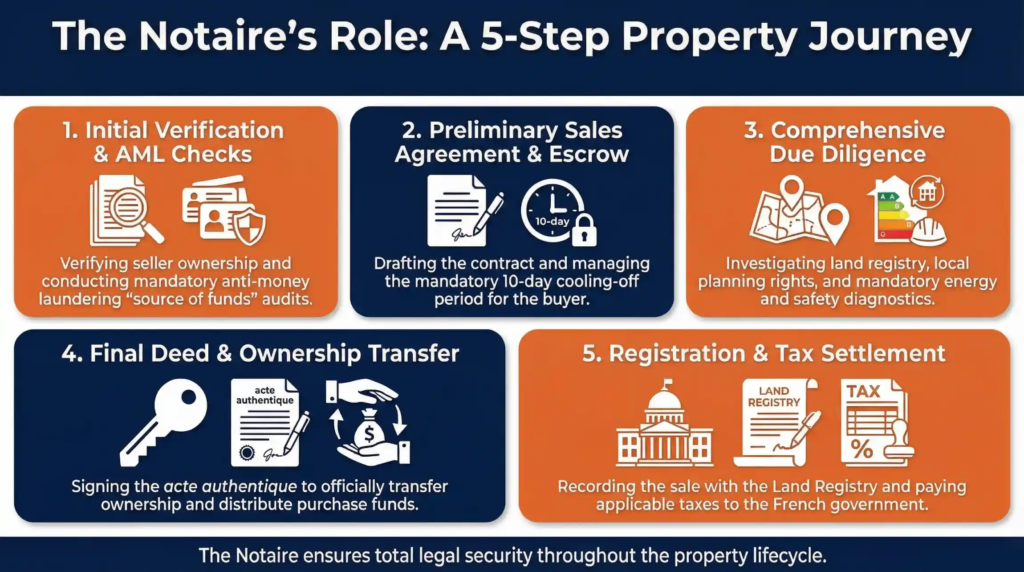
The notaire is involved from the early stages of the transaction through to final registration. Their role encompasses legal checks, contract preparation, financial management, and official record-keeping.
Before the Offer Is Accepted
Before any formal agreement is signed, the notaire begins by carrying out essential preliminary checks to ensure the transaction can proceed smoothly. This includes verifying the identity of the seller and confirming that they are the legal owner of the property with the right to sell it. The notaire also checks for any existing mortgages, debts, or legal charges attached to the property that could affect the sale. In addition, strict anti-money laundering procedures are followed in line with French and EU regulations. As part of this, buyers, particularly those from overseas, may be required to provide proof of funds, valid identification, and documentation explaining the source of their finances. These early checks help prevent legal complications later in the process.
During the Preliminary Sales Agreement
At this stage, the preliminary sales agreement is prepared, either in the form of a compromis de vente or a promesse de vente, both of which outline the agreed terms between the buyer and seller. The notaire plays a crucial role in drafting or reviewing this contract to ensure that it complies with French property law and accurately reflects the intentions of both parties. The agreement typically includes details such as the purchase price, payment conditions, and the deposit amount, which is held securely in escrow (séquestre). It also outlines specific clauses, including those related to financing, property inspections, or other conditions that must be met before completion. Importantly, buyers are granted a 10-day cooling-off period (délai de rétractation), allowing them to withdraw from the agreement without penalty if they change their mind.
Due Diligence Phase
The due diligence phase is one of the most critical parts of the property transaction, as it ensures that the buyer is fully informed about the legal and physical status of the property. During this stage, the notaire conducts comprehensive checks, including verifying details with the Land Registry and performing local authority searches to identify any planning restrictions or future developments that may impact the property. They also investigate whether the property is subject to a right of pre-emption (droit de préemption), which gives local authorities the option to purchase the property before the buyer. For apartments, the notaire carefully reviews co-ownership (copropriété) documents to assess shared responsibilities and financial obligations. Additionally, mandatory property diagnostics are examined, such as the energy performance report (DPE), asbestos and lead assessments, and the Carrez measurement, which confirms the accurate floor area. These steps are designed to protect the buyer from hidden risks and ensure complete transparency.
Signing the Final Deed (Acte Authentique / Acte de Vente)
The signing of the acte authentique marks the final and most significant step in the property transaction, as this is when legal ownership officially transfers from the seller to the buyer. This signing takes place in the presence of the notaire, who reads through the entire contract and explains its terms to ensure that both parties fully understand their obligations. At this point, the buyer transfers the remaining funds, and the notaire securely handles the financial transaction, including the distribution of payments and the collection of taxes and fees. Once the deed is signed, the buyer immediately becomes the legal owner of the property. If the buyer is unable to attend in person, they can appoint someone through a power of attorney to sign on their behalf, allowing the transaction to proceed without delay.
After Completion
After the sale has been finalized, the notaire continues to manage several important administrative tasks to formalize the transaction. This includes registering the sale with the Land Registry, ensuring that the change of ownership is officially recorded. The notaire also handles the payment of all applicable taxes and registration fees to the French government on behalf of the buyer. In addition, they arrange for the issuance of the official title deed, which serves as proof of ownership. Although the buyer becomes the legal owner from the date of signing, the full administrative process can take several months to complete due to the time required for registration and documentation.
Notaire Fees Explained Clearly
Notaire fees are often misunderstood. Many assume the notaire keeps the full amount, but most of these costs go to the French State.
What “Notaire Fees” Actually Include
| Component | Description |
| Transfer duties / taxes | Paid to the French government |
| Registration fees | Administrative charges |
| Disbursements | Payments to third parties (documents, searches) |
| Notaire emoluments | Regulated fee paid to the notaire |
Only a small portion is retained by the notaire as income. In 2026, transfer tax rates remain the primary driver of these costs, making buying new construction a popular choice for those looking to minimize upfront acquisition expenses.
Typical Costs by Property Type
- Older properties: Higher overall fees due to higher transfer taxes
- New-build properties: Lower fees because taxes are structured differently
The exact amount depends on the purchase price, property type, and location.
Who Pays the Notaire Fees?
In most cases:
- The buyer pays the notaire fees
This is standard practice in France, though exceptions can be agreed in specific cases.
Can Notaire Fees Be Reduced or Negotiated?
Notaire fees are regulated by the state. However:
- Small discounts on the notaire’s portion (emoluments) may be allowed in certain cases
- Taxes and disbursements cannot be negotiated
How to Choose the Right Notaire in France
Choosing the right notaire is an important step in ensuring your property transaction in France runs smoothly and without unnecessary stress. While all notaires are legally qualified and operate under strict regulations, their level of experience, communication style, and familiarity with international buyers can vary significantly. Taking the time to select a notaire who understands your needs, especially if you are a non-resident, can make the entire process more efficient, transparent, and easier to navigate.
Key Selection Criteria
When selecting a notaire, it is essential to consider their experience with French property transactions, as this ensures they are well-versed in the legal, administrative, and procedural aspects of property law. Equally important is their ability to work with expats and non-residents, as international buyers often face additional requirements such as language barriers, cross-border financial checks, and unfamiliar legal systems. A notaire who regularly works with overseas clients will be better equipped to guide you through these complexities. Clear communication and responsiveness are also critical factors; a good notaire should be able to explain legal terms straightforwardly, keep you updated throughout the process, and respond promptly to your queries.
Where to Find a Notaire
There are several reliable ways to find a qualified notaire in France. One of the most trusted sources is the official directories provided by organisations such as Notaires de France, where you can search for registered notaires by location and specialization. You can also seek referrals from a real estate agent or buyer’s agent, particularly those experienced in assisting international clients, such as Living on the Côte d’Azur. Additionally, recommendations from other international buyers can be valuable, as they often provide insight into real-world experiences, including communication quality, efficiency, and overall professionalism.
Red Flags to Avoid
While many notaires provide excellent service, there are certain warning signs you should be aware of when making your choice. Slow or unclear communication can lead to confusion and delays, especially in a process that involves complex legal documentation. A lack of transparency about fees is another concern, as all costs should be clearly explained upfront to avoid unexpected expenses later. Finally, limited experience with international clients can be a disadvantage if you are a non-resident, as the notaire may not fully understand the additional requirements involved. Being mindful of these red flags can help you avoid complications and choose a notaire who will support you effectively throughout your property purchase.
Timeline of a French Property Purchase (With Notaire Involvement)
A property purchase in France follows a structured legal timeline, largely managed by the notaire. While each transaction differs, most follow a similar sequence that balances legal checks with financing and administrative steps.
- Offer accepted → informal agreement between buyer and seller
- Preliminary contract signed (compromis de vente / promesse de vente)
- Cooling-off period (délai de rétractation) → 10 days for the buyer
- Due diligence and financing period → legal checks, mortgage approval
- Final signing (acte authentique / acte de vente) → ownership transfer
In most cases, the full process takes 2 to 4 months, depending on financing, property type, and administrative factors. Delays often come from:
- Mortgage approval timelines
- Missing documents
- Local authority responses
- Complex copropriété (co-ownership) structures
The notaire coordinates all these steps while ensuring compliance with French government requirements and local regulations. Our tips on emigrating and the French healthcare system provide a holistic view of life in France.
Common Mistakes Foreign Buyers Make with French Notaires
Many issues in French property transactions do not come from the system itself but from incorrect assumptions. Foreign buyers often expect the notaire to act as a personal advisor, which is not the case.
One of the most frequent mistakes is assuming the notaire represents the buyer’s interests. In reality, the notaire is neutral and ensures legal compliance for both the buyer and seller. This means they will not negotiate on your behalf or highlight every risk from a buyer-focused perspective.
Another common issue is relying on verbal explanations without reviewing written documents. Contracts such as the compromis de vente and acte de vente are legally binding, and misunderstandings can lead to financial consequences.
Other frequent mistakes include:
- Not accounting for total acquisition costs, including transfer taxes (droits de mutation), registration fees, and disbursements
- Ignoring timelines and assuming quick completion
- Failing to arrange financing early
- Overlooking copropriété rules in apartment purchases
For international buyers, language barriers can also create confusion, which is why working with a multilingual team or a platform like Living on the Côte d’Azur can reduce misunderstandings. Properties in areas like Menton or Roquebrune-Cap-Martin often have specific coastal or heritage protections. Ensure your notaire is familiar with living in Menton as an American or other expat-heavy zones.
Key Risks the Notaire Helps You Avoid
The notaire’s role is largely preventative. Their checks reduce legal and financial risks that may not be obvious at first glance.
Some of the main risks they address include:
- Hidden debts or mortgages attached to the property
- Ownership disputes or unclear title history
- Violations of local planning rules
- Issues with right of pre-emption (droit de préemption)
- Errors in property size or legal description
Without these checks, a buyer could inherit liabilities along with the property. The notaire ensures that the transaction is clean before the acte authentique is signed.
Final Thoughts: What the Notaire Really Protects You From
The notaire is not there to sell property or negotiate deals. Their role is to ensure that everything behind the transaction is legally sound and properly recorded. They verify ownership, handle contracts like the compromis de vente and acte authentique, manage escrow (séquestre), and ensure that all taxes, registration fees, and disbursements are correctly processed.
For the buyer, this reduces exposure to hidden debts, legal disputes, and administrative errors. For the seller, it guarantees that the sale is valid and that funds are secured. Because the notaire operates under the authority of the French government, their work carries legal certainty that private agreements cannot provide.
For those purchasing through platforms like Living on the Côte d’Azur, the process becomes more efficient when combined with guidance from a real estate agent and a multilingual team familiar with foreign buyers and non-residents. The notaire remains central, but the overall experience improves when each professional handles their specific role.
Frequently Asked Questions (FAQs)
1. Is a notaire required to buy property in France?
Yes. A French notaire is legally required to complete any property transaction. Without their involvement, the sale cannot be registered with the Land Registry, and ownership cannot be transferred.
2. Can foreign buyers choose their own notaire?
Yes. Foreign buyers and expats can appoint their own notaire, and it is common to choose one who speaks their language. The buyer and seller can each have a notaire, and the total fee does not increase.
3. How long does the notaire process take?
Most transactions take 2 to 4 months from signing the compromis de vente to the final acte de vente. The timeline depends on financing, legal checks, and administrative steps handled by the notaire and local authorities.
4. What do “notaire fees” actually include?
Notaire fees are made up of several components:
- Transfer taxes (droits de mutation) paid to the French government
- Registration fees
- Disbursements for administrative costs
- Notaire emoluments (the notaire’s regulated fee)
Most of the total amount goes to the French State, not the notaire.
5. Does the notaire protect the buyer or the seller?
The notaire protects the transaction itself. They act as a neutral legal authority for both the buyer and seller, ensuring that the sale is valid, compliant, and free from legal issues. They do not act as a personal advisor for either party.
 //
//