
Impact investing in real estate means deploying capital into property assets with the explicit intention of generating measurable, positive social and environmental outcomes alongside a financial return. It is not a softer version of traditional investing, nor simply a rebranding of ESG compliance. The Global Impact Investing Network (GIIN) defines impact investments as those “made with the intention to generate positive, measurable social or environmental impact alongside a financial return.” In real estate, that definition carries particular weight: buildings shape communities, consume energy, and determine who has access to safe, dignified housing.
For UK investors, this is a growing and increasingly well-structured field. The global impact investing market reached approximately $1.571 trillion USD in assets under management by january 2025, with housing identified as one of the largest sectors by asset allocation. Understanding how impact investing applies to real estate, and how to do it credibly, is no longer a niche concern.
What is impact investing in real estate?
Impact investing in real estate is the deliberate allocation of capital to property projects that address recognised social or environmental challenges, while still meeting financial return objectives. The Bundesinitiative Impact Investing (BIII) describes it as going “beyond standard development” to reduce or eliminate negative impacts while initiating net positive contributions across social, societal, and environmental dimensions.
Four minimum criteria distinguish genuine impact investing from ESG-compliant or impact-oriented approaches:
- Intentionality: A clear, documented intent to address a specific social or environmental problem through the investment.
- Additionality: The investor provides capital or resources that would not otherwise have been available, creating outcomes that would not have occurred without their involvement.
- Financial return expectation: The investment targets a financial return, ranging from below-market to competitive market rates, rather than functioning as philanthropy.
- Impact measurement and management (IMM): Impacts are actively tracked, transparently reported, and cannot be arbitrarily changed throughout the asset lifecycle.
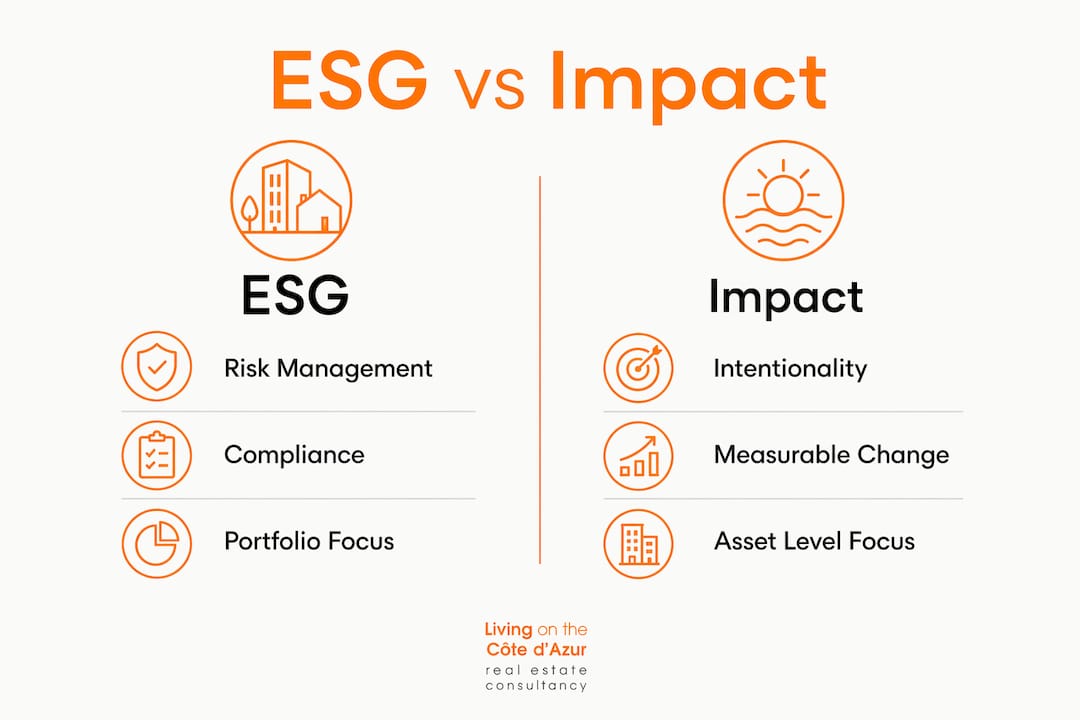
The distinction from ESG investing is worth stating plainly. ESG is a risk management process; impact investing is an outcomes-driven strategy. An ESG-screened fund avoids harmful companies. An impact fund actively seeks to create measurable benefit. The difference is the direction of intent: one filters out harm, the other builds in good.
| Dimension | ESG investing | Impact investing |
|---|---|---|
| Primary goal | Risk management and compliance | Measurable positive outcomes |
| Intent | Avoid negative factors | Create specific social/environmental benefit |
| Measurement | Ratings and screening | KPIs, stakeholder feedback, IMM frameworks |
| Additionality | Not required | Core requirement |
| Financial return | Market-rate focus | Below-market to market-rate spectrum |
How does impact investing actually work in real estate?

The mechanics begin before a single brick is laid. A genuine impact investor develops an explicit impact hypothesis during due diligence, aligned to the UN Sustainable Development Goals (SDGs) and grounded in a theory of change. That theory maps how specific actions within a development will address a specific social or environmental problem. Without it, the investment is aspiration, not impact.
Real estate impact investing operates across several structures:
- Impact funds: Pooled vehicles where capital is deployed across multiple properties with shared impact mandates, common in affordable housing and community regeneration.
- Direct development projects: Single-asset investments where the developer and investor co-design the impact strategy from planning through exit.
- Debt instruments: Green bonds and social bonds that finance specific property improvements, such as energy retrofits or accessible housing conversions.
Once capital is deployed, the work shifts to active management. Impact is not a one-time assessment at acquisition; it is tracked iteratively through the asset lifecycle using defined key performance indicators (KPIs). These might include rent affordability ratios, energy consumption reductions, tenant wellbeing scores, or community integration metrics. Feedback loops from residents and local stakeholders refine the strategy over time.
Pro Tip: Set your impact hypothesis in writing before you commit capital. An explicit theory of change, documented at the due diligence stage, is the single most effective guard against drift toward impact washing later in the asset lifecycle.
Operational practices that distinguish credible impact real estate investing include:
- Conducting a needs assessment at the site level before defining impact goals.
- Translating impact goals into measurable KPIs with baseline data.
- Engaging local partners, community organisations, and municipal bodies throughout the project.
- Commissioning independent, third-party verification of impact outcomes.
- Publishing an impact report that covers both positive and negative outcomes honestly.
What social and environmental benefits does real estate impact investing deliver?
The most tangible social benefit is affordable housing. When impact investors deliberately target below-market rents for defined resident groups, such as students, key workers, or refugees, they address a housing need that private markets routinely underprovide. Sopact’s analysis of social impact real estate confirms that meaningful outcomes include increased housing affordability, community integration, and environmental sustainability, each demonstrated through measurable KPIs and stakeholder feedback.
Beyond affordability, impact real estate projects deliver community revitalisation. Regenerating derelict or underused urban sites creates local employment, improves public realm quality, and strengthens neighbourhood cohesion. Well-designed shared spaces within mixed-tenure developments actively encourage interaction between resident groups, which research consistently links to improved mental health and social mobility.
The environmental case is equally compelling. Real estate accounts for approximately 40% of global carbon emissions, making the sector one of the most consequential arenas for climate action. Impact investors who prioritise energy efficiency, sustainable materials, and low-carbon building systems contribute directly to decarbonisation targets. Practical measures include Passivhaus-standard insulation, heat pump installations, solar photovoltaic arrays, and rainwater harvesting. For investors wanting to understand the technical side of these choices, a sustainable building energy guide offers practical grounding in what each measure delivers.
Key benefits, summarised:
- Increased supply of genuinely affordable housing for underserved groups.
- Improved resident wellbeing through quality design and community programming.
- Reduced carbon footprint through energy-efficient construction and retrofit.
- Contribution to SDGs, particularly SDG 11 (Sustainable Cities) and SDG 13 (Climate Action).
- Strengthened local economies through employment and supply chain engagement.
What financial returns and risks should you expect?
The financial return spectrum in impact real estate is wider than most investors assume. Some impact funds accept returns modestly below traditional benchmarks in exchange for proven social outcomes; others target fully competitive market-rate returns, particularly where impact activities improve asset quality, tenant retention, or regulatory positioning. The choice depends on the investor’s mandate and the depth of impact sought.
Risk in impact real estate shifts rather than increases. Execution risk exists, particularly around achieving social targets within budget and timeline. But impact-oriented assets tend to exhibit resilience benefits that traditional investments lack: stable, long-term tenancies from mission-aligned residents, reduced void periods, and stronger relationships with local authorities who favour impact developers for planning permissions and land disposals.
The market context reinforces the opportunity. As of 2024, approximately 3,907 organisations were managing an estimated $1.571 trillion USD in impact assets under management, with the industry growing at a 21% compound annual growth rate since 2019. Housing remains one of the largest sectors by allocation.
Financial considerations and risk factors to weigh:
- Return expectations: Clarify upfront whether the fund targets below-market, market-rate, or blended returns, and what impact depth each implies.
- Liquidity: Impact real estate investments typically carry longer hold periods than conventional funds, reflecting the time needed to achieve and evidence social outcomes.
- Regulatory risk: Properties serving vulnerable populations may be subject to rent controls or planning conditions that constrain exit values.
- Tenant concentration: Affordable housing projects often serve a narrow demographic, which can create income concentration risk if policy changes affect that group.
- Reputational upside: Credible impact credentials increasingly attract institutional capital, improving co-investment opportunities and exit liquidity.
Understanding the full investment risk profile of any real estate asset is essential before committing capital, and impact investing adds a further layer of due diligence around social outcomes that conventional risk frameworks do not capture.
How is impact measured, reported, and scaled?
Credible impact measurement is what separates genuine impact investing from a well-intentioned story. Without a clear methodological structure, it is often impossible to tell whether a project is genuinely addressing a social challenge or simply telling a compelling narrative. The field has developed several frameworks to address this.

GRESB (Global Real Estate Sustainability Benchmark) provides standardised, third-party verified assessment of environmental, social, and governance performance across real estate portfolios. It is compatible with the UNEP FI Real Estate Impact Analysis Tool and widely recognised by institutional investors as a credible reporting standard. Robust impact measurement using GRESB requires transparent, reproducible methodologies and actively prevents accusations of impact washing.
The UNEP FI Real Estate Impact Analysis Tool enables financial institutions to identify and assess impacts at both single-asset and portfolio level. It covers new developments and existing assets, supports country-level and local-level contextualisation, and aligns reporting with the SDGs. Developed through UNEP FI’s Positive Impact Initiative, it builds on 22 impact areas from the UNEP FI Impact Radar.
The IMMPACT Guide, developed by the Bertelsmann Stiftung together with SEND and PHINEO, provides structured guiding questions covering needs assessment, impact hypotheses, and KPI design. For real estate specifically, it offers the methodological clarity the sector often lacks, lowering the barrier to entry for investors and developers who want to start without navigating complex theoretical models first.
| Framework | Primary use | Asset scope | SDG alignment |
|---|---|---|---|
| GRESB | Portfolio-level ESG and impact benchmarking | Existing and new assets | Yes |
| UNEP FI Real Estate Impact Analysis Tool | Holistic impact identification and reporting | Single asset and portfolio | Yes (22 impact areas) |
| IMMPACT Guide | Practical IMM guidance and KPI design | Project level | Yes |
Pro Tip: During the asset management phase, schedule quarterly impact performance reviews with your local community partners, not just annual reports. Iterative feedback from residents and stakeholders catches drift early and keeps the impact strategy aligned with actual needs on the ground.
UK case studies: what does impact real estate look like in practice?
The UK has a well-developed ecosystem for impact real estate, shaped by acute housing affordability pressures, ambitious net-zero targets, and a growing pool of institutional capital seeking credible impact credentials.
Community Land Trusts (CLTs) represent one of the most structurally pure forms of impact real estate in the UK. Organisations such as the London Community Land Trust have delivered permanently affordable homes in areas like Mile End, where market values would otherwise have priced out long-term residents entirely. The CLT model removes land from the speculative market, ensuring that affordability is locked in perpetuity rather than time-limited.
Social housing retrofit programmes have attracted significant impact capital, particularly following the UK government’s commitment to net-zero by 2050. Investors financing deep energy retrofits of existing social housing stock achieve a dual impact: reducing fuel poverty for residents and cutting embodied and operational carbon. Measured outcomes typically include reductions in energy consumption per dwelling, improvements in EPC ratings, and tenant-reported improvements in thermal comfort.
Build-to-Rent with social integration mandates is an emerging model in cities including Manchester, Birmingham, and Bristol, where developers commit to allocating a defined proportion of units at genuinely affordable rents, co-locating with community facilities, and employing local contractors. Impact is tracked through occupancy data, rent affordability ratios, and community engagement metrics.
The GIIN’s 2024 data showing a 21% compound annual growth rate in impact AUM since 2019 is reflected in the UK market, where pension funds and local authority pension pools have increasingly allocated to impact real estate mandates as part of their responsible investment strategies.
Key characteristics of credible UK impact real estate projects:
- Explicit impact mandate documented before planning consent is sought.
- Partnership with a local authority, housing association, or community organisation.
- Independent impact reporting published annually, covering both positive and negative outcomes.
- KPIs tied to resident outcomes, not just building performance metrics.
Key challenges for UK investors entering impact real estate
The most persistent challenge is measurement complexity. Social outcomes are harder to quantify than energy consumption figures, and the methodologies for measuring community wellbeing, social integration, or educational attainment are still maturing. Investors who underinvest in IMM infrastructure at the outset often find themselves unable to evidence the impact they have genuinely created, which undermines both credibility and future fundraising.
Longer time horizons present a structural challenge for investors accustomed to conventional real estate fund cycles. Achieving and evidencing meaningful social outcomes takes time. A development that rehouses vulnerable residents and tracks their wellbeing over three years cannot be assessed at the 18-month mark without distorting the picture.
Impact authenticity, or the risk of impact washing, is a reputational and regulatory concern. GRESB and third-party verification are the most effective tools for demonstrating that impact claims are grounded in reproducible methodology rather than marketing narrative.
Best practices and risk mitigation for UK investors:
- Conduct a formal needs assessment at the site level before defining impact goals, not after.
- Engage an independent impact auditor at the outset and build their fees into the project budget.
- Select investments where the impact thesis is supported by local authority housing needs data or NHS health inequality statistics.
- Avoid funds that claim impact credentials based solely on green building certifications without social outcome measurement.
- Assess additionality rigorously: would this project have happened without your capital? If yes, the impact claim is weaker.
- Use the IMMPACT Guide’s structured questions to stress-test the impact hypothesis before committing.
When evaluating opportunities, the three questions that matter most are: Is the intent documented and specific? Does the investor’s capital make a difference that would not otherwise occur? And is the measurement methodology independent and reproducible?
The UK regulatory environment and incentives for impact real estate
The UK regulatory framework for impact real estate investing has developed considerably since 2020, though it remains less prescriptive than the EU’s Sustainable Finance Disclosure Regulation (SFDR), which classifies funds under Article 8 (environmental or social promotion) and Article 9 (sustainable investment objective). UK fund managers marketing to European institutional investors must still navigate SFDR requirements, creating a de facto standard for UK impact funds with cross-border capital.
Domestically, the UK government’s Levelling Up agenda and the Social Value Act 2012 create procurement and planning incentives for developers who can demonstrate measurable community benefit. Local authorities increasingly require social value commitments as planning conditions, which aligns naturally with impact investing frameworks. The UK Infrastructure Bank, established in 2021, provides debt and equity financing for projects with clear environmental and social objectives, including affordable housing and energy-efficient retrofit.
The Financial Conduct Authority (FCA) has introduced Sustainability Disclosure Requirements (SDR) and an investment labels regime, which came into force in 2024. The SDR labels, including “Sustainability Impact,” require funds to demonstrate that their investments are made with the explicit objective of achieving a positive, measurable real-world impact. This is the closest the UK has come to a formal regulatory definition of impact investing, and it raises the bar for funds claiming impact credentials without rigorous IMM processes.
Tax incentives relevant to UK impact real estate investors include the Social Investment Tax Relief (SITR), which offers income tax relief on investments in qualifying social enterprises, and the Enterprise Investment Scheme (EIS), which can apply to certain community-led housing developments. Investors should take independent tax advice on eligibility, as the rules are specific and subject to change. For a broader view of tax considerations in property investment, tax planning for real estate investors covers the structural considerations that matter most.
Key players and platforms in UK impact real estate
The UK impact real estate ecosystem includes institutional fund managers, community development finance institutions (CDFIs), and specialist platforms that connect investors with credible impact opportunities.
Big Society Capital is the UK’s leading social impact investor, having deployed capital into affordable housing, supported living, and community asset development since its establishment in 2012. It publishes detailed impact reports and has been instrumental in developing the UK’s impact measurement standards.
Resonance is a specialist impact fund manager focused on homelessness, supported housing, and community-led development. Its Real Lettings Property Fund, which houses formerly homeless individuals in London, is one of the most cited examples of measurable social impact in UK residential real estate.
The Good Economy is an independent advisory firm that provides impact measurement and management services to UK real estate investors and developers, helping them design credible IMM frameworks and produce independently verified impact reports.
INREV (the European Association for Investors in Non-Listed Real Estate Vehicles) has published a dedicated impact investing framework for real estate, mapping investment approaches across the spectrum from ESG integration to deep impact, and providing tools for fund managers and investors to assess their positioning.
Platforms and networks worth knowing for UK investors include the UK Sustainable Investment and Finance Association (UKSIF), which advocates for sustainable and impact investment across asset classes, and the Impact Investing Institute, which has published practical guidance on impact measurement for UK institutional investors.
For investors whose primary interest lies in premium assets with strong legacy and yield characteristics, understanding how impact credentials interact with luxury real estate investment options is increasingly relevant, as ESG and impact considerations now influence valuations and exit liquidity across the prestige market.
At Livingonthecotedazur, we work with clients who bring exactly this perspective: a desire for assets that perform financially and reflect their values. Whether you are exploring impact-aligned property in the UK or considering how these principles apply to prestige acquisitions on the Côte d’Azur, our team brings the depth of local knowledge and financial rigour that discerning investors deserve.
Key takeaways
Impact investing in real estate requires intentionality, additionality, a financial return expectation, and rigorous impact measurement to qualify as genuine, distinguishing it clearly from ESG compliance or philanthropy.
| Point | Details |
|---|---|
| Four core criteria | Intentionality, additionality, financial return expectation, and IMM are the minimum requirements for genuine impact investing. |
| Market scale | The global impact investing market reached approximately $1.571 trillion USD in AUM by January 2025, with housing as a top sector. |
| ESG is not impact | ESG screens out harm; impact investing actively builds in measurable benefit, requiring explicit intent and additionality. |
| Measurement frameworks | GRESB, the UNEP FI Real Estate Impact Analysis Tool, and the IMMPACT Guide provide the methodological rigour needed to avoid impact washing. |
| UK regulatory context | The FCA’s Sustainability Disclosure Requirements and “Sustainability Impact” label now set a formal bar for UK funds claiming impact credentials. |
FAQ
What is impact investing in real estate in simple terms?
Impact investing in real estate means buying or developing property with the deliberate goal of creating measurable social or environmental benefit, such as affordable housing or energy efficiency, while also earning a financial return. It goes beyond avoiding harm: the investor actively designs and tracks positive outcomes.
What is an example of impact investing in real estate?
A fund that acquires a derelict urban site, develops it as permanently affordable housing for key workers, tracks rent affordability ratios and tenant wellbeing annually, and publishes an independent impact report is a clear example. The London Community Land Trust’s Mile End project exemplifies this model in the UK context.
Is impact investing in real estate risky?
Impact real estate investing shifts rather than increases risk. Execution risk around achieving social targets exists, but impact assets often benefit from stable long-term tenancies, stronger local authority relationships, and improved regulatory positioning. The BIII position paper notes that resilience benefits can offset the additional complexity of managing social outcomes.
What are the four characteristics of impact investing?
The four characteristics are intentionality (a clear documented intent to address a social or environmental problem), additionality (the investor provides resources that would not otherwise exist), expectation of financial return (not philanthropy), and commitment to measure and report impact throughout the asset lifecycle.
How does impact investing differ from ESG in real estate?
ESG in real estate is a risk management and compliance process that screens investments against environmental, social, and governance criteria. Impact investing requires an explicit intent to create positive outcomes, investor additionality, and active impact measurement. As Morgan Lewis notes, ESG manages risk while impact investing drives outcomes.
Recommended
 //
//