
TL;DR:
- Running instant property valuations on Zoopla and Rightmove and cross-checking with HM Land Registry comparables provides a quick, reliable estimate within ten minutes. Using the overlap of valuation ranges and adjusting comparables with regional indices helps homeowners determine a defensible property value; formal evaluations are necessary for legal or financial purposes. Supplementing automated estimates with manual comparables and expert valuations ensures accuracy, especially for unique or high-stakes transactions.
The fastest reliable answer combines two free steps: run your address through an instant automated valuation on Zoopla or Rightmove, then cross-check the result against HM Land Registry sold prices for three to five nearby comparables. Done carefully, this takes under ten minutes and produces a defensible range rather than a single guess.
Here is the sequence to follow right now:
- Enter your full postcode on Zoopla’s instant valuation tool and note the midpoint and range it returns.
- Repeat on Rightmove’s valuation page; record that range too.
- Open the HM Land Registry sold-price service, search your street or postcode, and identify three to five sales of similar properties within the past twelve months.
- Note the price, date, floor area (where listed), and property type for each comparable.
- Average the two instant-tool midpoints, then sense-check that figure against your comparables.
TL;DR: A well-run instant valuation can often be reasonably accurate for standard UK property types with plentiful local sales data. For anything legal, mortgage-related, or probate-driven, you will need a formal RICS-accredited survey or a lender-instructed valuation.
Table of Contents
- Which UK instant valuation tools should you use first?
- How do online valuation tools actually calculate a figure?
- How accurate are instant online estimates?
- What details should you enter to get the most accurate instant estimate?
- When do you need a formal valuation rather than an instant estimate?
- How to use HM Land Registry sold prices to check your estimate
- Common mistakes homeowners make when checking their property’s value
- Key takeaways
- A note on valuations from a property adviser at Living On The Cote d’Azur
- Official and practical sources to check next
- Living On The Cote d’Azur: for homeowners with an eye on the Riviera
- FAQ
Which UK instant valuation tools should you use first?
Three tools dominate the instant-valuation space for UK homeowners, and each draws on slightly different data.
| Tool | Speed | Typical accuracy / limitations | Data sources | Cost | Recommended next step |
|---|---|---|---|---|---|
| Zoopla | Instant | Good for standard types; weaker on unique or rural properties | Sold prices, listing data, Land Registry | Free | Request a local agent appraisal via the platform |
| Rightmove | Instant | Similar to Zoopla; range can be wide in thin markets | Sold prices, listing history, index data | Free | Connect to a local agent or RICS surveyor |
| Nationwide HPI | Instant (index) | National/regional trend only; not property-specific | Mortgage lending data, regional indices | Free | Use as a directional sanity check alongside the above |
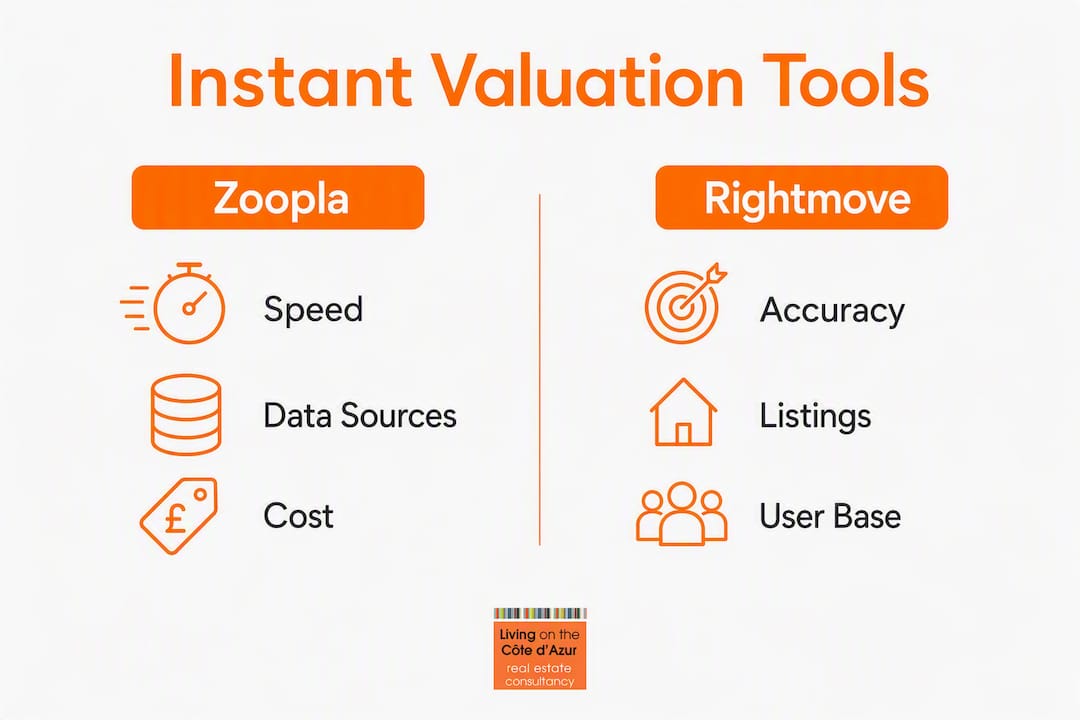
Zoopla and Rightmove both use automated valuation models (AVMs) fed by Land Registry sold prices and their own listing databases. The Nationwide House Price Index operates differently: it tracks price movements across regions using mortgage approval data, so it tells you whether your local market is rising or falling rather than what your specific home is worth today.

Pro Tip: Run both Zoopla and Rightmove, then use the overlap of their ranges as your working estimate. If the two midpoints are more than 10% apart, treat that gap as a signal to commission a formal appraisal before making any financial decision.
How do online valuation tools actually calculate a figure?
Instant valuations are built on automated valuation models, which are statistical engines that process large datasets to estimate a property’s current market value. Understanding what goes in helps you spot where the output may mislead you.
Core inputs the model uses:
- Postcode-level and street-level sold prices from HM Land Registry
- Current and historic listing prices from portals such as Zoopla and Rightmove
- Property attributes: type (terraced, semi-detached, flat), number of bedrooms, floor area where available
- Macro indices such as the Nationwide HPI to adjust for market movement since the last local sale
The most common methods are regression modelling (which weights each attribute by its statistical contribution to price) and nearest-neighbour comparables (which finds the most similar recently sold properties and adjusts for differences). Some tools blend both.
What these models cannot see is equally telling. Condition, recent renovations, a loft conversion, a south-facing garden, or a leasehold with a short remaining term are all invisible to an AVM unless you enter them manually. Micro-location factors — a direct sea view, proximity to a Tube station, or the shadow of a new development — rarely appear in the underlying data at the granularity that moves price. The key factors influencing property value are universal across markets, yet instant tools can only capture the ones that appear in structured public records.
How accurate are instant online estimates?
Instant valuations give a range, not a guarantee. For a standard terraced house or flat in an area with plentiful recent sales, the midpoint of an AVM estimate tends to sit within a single-digit percentage of the eventual sale price. In areas with few transactions, unusual property types, or significant recent renovation, the error can reach low double digits.
Accuracy improves when three conditions align: there have been several comparable sales within the past six to twelve months, the property is a common type for the area, and the local market has been relatively stable. When those conditions hold, the midpoint of a well-constructed AVM is a reasonable working figure for pricing conversations.
Statistic note: HM Land Registry publishes monthly house price trend data for England and Wales, broken down by region and property type. Checking whether your region’s average price has moved since your nearest comparable sold is the single most reliable way to adjust an instant estimate for market drift.
Confidence intervals matter. A tool that returns “£380,000–£440,000” is telling you something important: the model’s uncertainty spans £60,000. Treating the midpoint as a precise figure ignores that signal entirely.
Pro Tip: If the range returned by an instant tool is wider than 15% of the midpoint, the model has insufficient local data. In that case, weight your HM Land Registry comparables more heavily than the AVM output.
What details should you enter to get the most accurate instant estimate?
The quality of an AVM output rises sharply when you supply accurate, complete inputs. Most tools allow you to correct or supplement their pre-filled data.
- Correct address and postcode: Even a minor error here pulls in the wrong comparables.
- Property type: Terraced, semi-detached, detached, or flat — confirm this matches the Land Registry record.
- Bedrooms and bathrooms: Enter the actual current count, not the original build specification.
- Floor area: If you have a surveyor’s report or Energy Performance Certificate, use the stated floor area in square metres.
- Tenure: Freehold or leasehold. For leasehold, note the remaining term — a lease below 80 years materially depresses value and most AVMs do not capture this automatically.
- Recent improvements: A new kitchen, bathroom, or loft conversion added in the past five years can add meaningful value that the model has not seen.
- Local context: Parking, garden size, proximity to a station or outstanding-rated school, and any planning permissions granted.
Pro Tip: Download your property’s Energy Performance Certificate from the government register — it contains the floor area in square metres, which is the single most useful correction you can make to an AVM’s pre-filled data.
When do you need a formal valuation rather than an instant estimate?
An instant AVM is useful for orientation. It is not acceptable to a mortgage lender, a probate court, or a solicitor handling a sale. Three formal routes exist, and the right one depends on your purpose.
Estate agent market appraisal — Free, typically arranged within 48 hours. An agent visits the property, reviews local comparables, and provides a recommended asking price range. This is the right starting point if you are considering selling. It carries no legal weight for mortgage or probate purposes.
RICS-accredited surveyor valuation — The standard for mortgage applications, remortgaging, and legal certainty. A RICS surveyor inspects the property and produces a written report that lenders and courts accept. Fees vary by property value and type; a straightforward residential valuation typically costs several hundred pounds, with turnaround ranging from 3–14 days depending on the surveyor’s availability and the complexity of the property.
Desktop or drive-by valuation — Some lenders accept this for lower loan-to-value remortgages. The surveyor does not enter the property but reviews external condition and comparables. Faster and less expensive than a full inspection, but not universally accepted.
To commission a RICS survey: contact a RICS-registered firm directly or ask your mortgage broker to instruct one on your behalf. The report will state the market value, any material defects, and the basis of valuation. Lenders will not accept a valuation report commissioned by the borrower for a new purchase mortgage — they instruct their own panel surveyor — but for remortgaging, a borrower-commissioned RICS report is often acceptable.
How to use HM Land Registry sold prices to check your estimate
Official sold-price records are the most authoritative comparables available for England and Wales. The process is straightforward.

| Comparable | Address | Sale date | Sale price | Floor area (m²) | Price per m² | Adjusted price |
|---|---|---|---|---|---|---|
| 1 | [Street, Postcode] | [Date] | [£] | [m²] | [£/m²] | [£] |
| 2 | [Street, Postcode] | [Date] | [£] | [m²] | [£/m²] | [£] |
| 3 | [Street, Postcode] | [Date] | [£] | [m²] | [£/m²] | [£] |
Copy this template and populate it from the HM Land Registry sold-price search. Select sales within the past twelve months where possible, prioritising the same property type, similar floor area, and the same street or immediate neighbourhood.
Once you have three to five rows, calculate the price per square metre for each comparable. Apply a simple adjustment for any meaningful difference from your property: a comparable that sold six months ago in a rising market should be nudged upward using the Nationwide HPI’s regional movement for that period. When comparables are sparse, adjusting older sold prices with a local index movement rather than a national average reduces error considerably. A per-square-metre template adapted for any market is available via the Côte d’Azur price-per-m² calculator — the same logic applies to UK comparables.
The Nationwide House Price Index provides regional and national time-series data that functions as a directional sanity check: if your region’s average price has risen 4% since your nearest comparable sold, apply that uplift to the comparable’s price before comparing it to your AVM result.
Common mistakes homeowners make when checking their property’s value
- Trusting a single-point figure. Every AVM returns a range. Treating the midpoint as a precise sale price leads to mispricing.
- Using asking prices as comparables. Listed prices on portals are not sold prices. On the French Riviera, for instance, listed prices run 4–8% above final sale prices — a gap that exists in UK markets too, particularly in slower conditions. Always use Land Registry sold prices.
- Ignoring transaction dates. A comparable from 18 months ago in a market that has moved 6% is not a current comparable without adjustment.
- Failing to adjust for tenure. A leasehold flat with 75 years remaining is worth materially less than an identical freehold property. Most AVMs do not capture this automatically.
- Overlooking condition and recent works. An unrenovated property and a fully refurbished one on the same street can differ by 15–20% in value. The AVM sees neither.
- Accepting the tool’s result when local sales are thin. Fewer than three comparable sales in the past twelve months is a red flag. The model is extrapolating, not measuring.
The corrective action in each case is the same: supplement the AVM with manual comparables from HM Land Registry, adjust for the specific differences, and widen your working range to reflect genuine uncertainty.
Key takeaways
An instant online valuation combined with three HM Land Registry sold comparables gives you a reliable working range for your property’s current market value in under ten minutes.
| Point | Details |
|---|---|
| Start with two instant tools | Run Zoopla and Rightmove; use the overlap of their ranges as your working estimate. |
| Cross-check with sold prices | Pull three to five comparables from HM Land Registry and calculate price per m² for each. |
| Adjust for market drift | Use the Nationwide HPI regional series to uplift older comparables before comparing them to your AVM result. |
| Know when to go formal | Legal, mortgage, and probate purposes require a RICS-accredited valuation; agent appraisals are free but carry no legal weight. |
| Living On The Cote d’Azur | For cross-border or Riviera holdings, Living On The Cote d’Azur applies local sold-price evidence and bespoke advisory to each valuation. |
A note on valuations from a property adviser at Living On The Cote d’Azur
The gap between what a homeowner believes their property is worth and what the market will actually pay is one of the most persistent tensions in real estate. Instant online tools have narrowed that gap considerably for standard UK properties in active markets. Where they still fall short is precisely where the stakes are highest: unique homes, thin local markets, and cross-border holdings where the data infrastructure is less mature.
The French Riviera illustrates this vividly. Median house prices across the Riviera sit around €900,000, with typical family houses ranging from €900,000 to €1.7 million. Apartment price dispersion is even more striking: top neighbourhoods command more than 2.6 times the price per square metre of more affordable areas in the same city. No AVM captures that kind of micro-location premium reliably. The same principle applies in prime UK postcodes — a tool trained on borough-level data cannot price a garden square flat or a listed country house with any confidence.
My practical advice: use the instant tools as a starting point and a conversation anchor, not as a final figure. For UK homeowners who also hold or are considering Riviera property, treat each market with its own local indices and official records. The market value methodology for Riviera purchases differs from the UK approach in meaningful ways — particularly around notarial records, price-per-m² benchmarks by neighbourhood, and the weight given to off-market transactions. Use local evidence, local indices, and local expertise for each jurisdiction. A UK AVM applied to a Cannes apartment is not a valuation; it is a guess dressed in a confidence interval.
Official and practical sources to check next
These are the authoritative references to bookmark before you begin your valuation research:
- HM Land Registry sold-price search — The primary source for England and Wales sold prices. Search by postcode or street, filter by property type and date, and download results. Save a screenshot or export the data if you are building a formal comparables file.
- HM Land Registry house price trend data — Monthly regional and national indices published by the Land Registry. Use these to adjust comparables for market movement since their sale date.
- Market value assessment for Riviera property — For homeowners with French holdings or those considering a Riviera acquisition, this resource explains how local sold-price evidence and notarial records inform a credible valuation in that jurisdiction.
- Property valuation and Riviera investment implications — Explains how valuation methodology affects investment decisions for cross-border portfolios.
Preserve your evidence: download sold-price records from HM Land Registry rather than relying on screenshots alone, as portal data can change. A dated export is far more useful in a formal valuation context than a cached webpage.
Living On The Cote d’Azur: for homeowners with an eye on the Riviera
Knowing your UK property’s current value is the first move. The second, for many of our clients, is understanding what that equity could achieve on the French Riviera, where property appreciation has reached 45% over the past decade in prime locations and off-market opportunities remain largely invisible to portal searches.
Living On The Cote d’Azur connects discerning buyers with over 100,000 properties across Nice, Cannes, Antibes, Saint-Tropez, Monaco, and beyond, including a curated portfolio of off-market luxury properties that never appear on public portals. Our advisory covers legal audits, tax optimisation, financing, and the kind of micro-location intelligence that no AVM can replicate. If you have established your UK position and are ready to explore what the Riviera offers, speak with our team directly.
FAQ
How do I check what my property is worth?
Run a free instant valuation on Zoopla or Rightmove using your address, then cross-check the result against recently sold prices for comparable properties on the HM Land Registry sold-price service. Using both steps together gives you a more reliable range than either source alone.
How do I know the current value of a property?
The most reliable DIY method is to combine an automated valuation model (AVM) from a portal such as Zoopla or Rightmove with three to five Land Registry sold comparables, adjusted for any differences in size, condition, and sale date. For a legally or financially binding figure, commission a RICS-accredited surveyor.
How do you calculate the value of your property?
Calculate price per square metre from your Land Registry comparables, adjust for market movement using the Nationwide HPI regional series, and apply any premium or discount for condition, tenure, and micro-location factors the AVM cannot see. The result is a defensible range rather than a single number.
How do I find the actual value of a property?
For a legally accepted figure, a RICS-accredited surveyor provides the most authoritative answer, typically within 3–14 days and at a cost of several hundred pounds depending on property type and value. For a quick working estimate, the HM Land Registry sold-price search combined with a free instant valuation tool is the fastest credible route.
This article provides general information about property valuation methods and tools. It is not professional financial, legal, or surveying advice. Always confirm current figures and regulatory requirements with HM Land Registry, a RICS-accredited surveyor, or a qualified legal professional before making financial decisions.
Recommended
 //
//