
TL;DR:
- Property acquisition is the legal process of transferring ownership of real estate through multiple stages, from identifying a property to closing the deal. It requires thorough due diligence, structured financing, and precise legal contracts to ensure long-term success. Strategic engagement of acquisition agents and early exit planning greatly improves investment outcomes.
Property acquisition is defined as the legal process of gaining ownership or control over real estate, whether for personal use or investment purposes. It encompasses every stage from identifying a target asset to completing the transfer of title, and it applies equally to a family buying a villa on the Côte d’Azur and a fund acquiring a commercial portfolio in Paris. The U.S. residential market recorded approximately 5.64 million existing home sales in 2021 alone, which illustrates the sheer scale at which property changes hands globally. Understanding what property acquisition involves, and what can go wrong, is the single most important preparation any buyer or investor can make before committing capital.
What is property acquisition and why does it matter?
Property acquisition is the structured transfer of real estate ownership from one party to another, governed by contract law, financing agreements, and regulatory compliance. The term covers both residential purchases and commercial real estate acquisition, though the complexity and timelines differ considerably between the two. In residential contexts, the process is relatively contained. In commercial real estate acquisition, due diligence alone typically requires 60–90 days to complete.
The distinction matters because many buyers treat acquisition as a single event rather than a multi-stage process. Signing a purchase agreement is not the end. It is the midpoint. Everything before it, from market analysis to financing approval, and everything after it, from title registration to post-closing compliance, forms part of the full acquisition cycle. Investors who understand this perform better because they plan for the whole process, not just the moment of exchange.
Livingonthecotedazur works with buyers across this entire cycle, from the first property search to the final notarial act, which is why our clients rarely encounter the surprises that catch unprepared buyers off guard.
What are the main steps in the property acquisition process?
The acquisition process follows a sequential structure: identify the property, submit a letter of intent, conduct due diligence, arrange financing, draft and review contracts, and then close. Each stage gates the next. Skipping or rushing any one of them creates risk that compounds later.
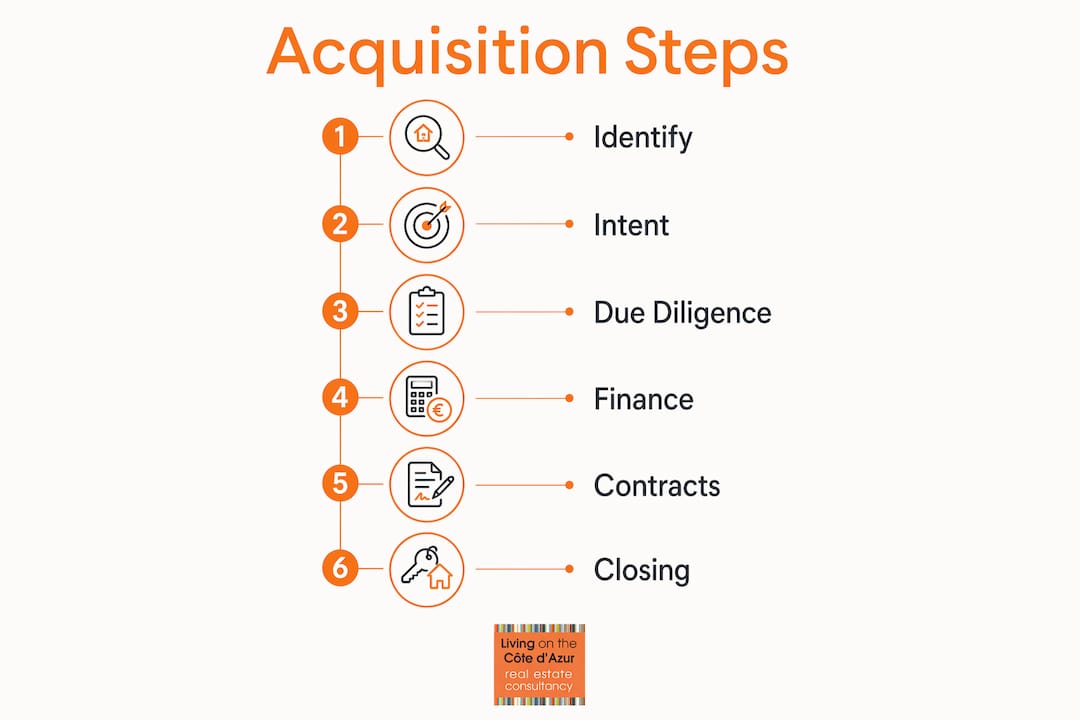
Step 1: Identify and evaluate target properties
Buyers begin by defining their criteria: location, asset type, budget, and intended use. For investors, this stage also includes analysing yield potential, capital growth prospects, and exit options. A property that looks attractive on price alone may fail on zoning restrictions or rental demand.

Step 2: Submit a letter of intent
A letter of intent signals serious interest and outlines the proposed terms before a binding contract is signed. It is not legally binding in most jurisdictions, but it sets the tone for negotiation and protects both parties from wasted time.
Step 3: Conduct due diligence
Due diligence is a detailed investigation covering title searches, environmental assessments, zoning analysis, structural surveys, and financial records. For commercial assets, this may include Phase I and Phase II environmental studies. Skipping this stage is the most common and most costly mistake buyers make.
Step 4: Arrange financing
Buyers confirm their financing structure at this stage, whether through a mortgage, private lending, or equity. Commercial property acquisition typically requires down payments of 20%–30% of the purchase price. That range reflects lender risk appetite and the buyer’s credit profile.
Step 5: Draft and review contracts
Contracts must be tailored to the specific transaction. Generic agreements lack the enforceability and risk protections that experienced buyers require. A specialist solicitor or notaire reviews every clause before signature.
Step 6: Close and comply post-closing
Closing transfers legal title. Post-closing obligations, such as tax filings, registration, and compliance with planning conditions, must be met to protect the acquisition long term. Well-structured agreements and diligent post-closing compliance prevent costly disputes.
Pro Tip: Build a closing checklist at the start of the process, not at the end. Knowing every required document, approval, and payment in advance prevents last-minute delays that can void contracts or trigger penalty clauses.
How do legal and financial considerations affect acquisition success?
Legal and financial precision are not secondary concerns in property acquisition. They are the foundation on which every other decision rests. A property selected with care but acquired through a poorly drafted contract is an asset at risk from the moment of purchase.
Contract quality determines enforceability
Experienced investors rely on customised contracts rather than standard templates because generic agreements fail to address the specific risks of each transaction. A contract for a coastal villa in France carries different obligations than one for a commercial warehouse in Lyon. Clauses covering planning permissions, environmental warranties, and seller representations must be written for the asset in question.
Financing structures carry tax consequences
The way a purchase is financed directly affects the buyer’s tax position. Complex instruments such as CEMA (Consolidation, Extension, Modification of Mortgage) agreements, used in certain commercial acquisitions, affect timing, cost structure, and tax obligations significantly. Buyers who choose financing structures without tax advice often pay more than necessary at closing and in subsequent years.
Key financial considerations every buyer should address before signing:
- Down payment requirements. Commercial acquisitions typically require 20%–30% of the purchase price as a deposit.
- Loan-to-value ratios. Lenders assess the asset’s value independently, which can differ from the agreed purchase price.
- Interest rate structures. Fixed versus variable rates affect long-term holding costs, particularly for assets held over a decade.
- Tax on acquisition. Stamp duty, notarial fees, and transfer taxes vary by jurisdiction and asset type.
- Private lending terms. Private loans often carry higher rates but offer speed and flexibility that institutional lenders cannot match.
“Successful acquisitions depend not only on finding the right property but also on precise contract drafting, structured financing, and legal compliance.” This is not a counsel of caution. It is the difference between an asset that performs and one that drains capital through disputes, penalties, or missed tax efficiencies.
Pro Tip: Engage a tax adviser before selecting your financing structure, not after. In France, the choice between holding property personally or through an SCI (Société Civile Immobilière) affects inheritance tax, income tax, and capital gains treatment in ways that cannot easily be unwound after purchase.
What roles do acquisition agents and managers play?
A property acquisition agent is a specialist who sources, evaluates, and secures properties on behalf of a buyer, with a focus on investment metrics rather than transaction volume. This distinguishes them from traditional estate agents, whose primary obligation is to the seller.
Acquisition agents specialise in strategic procurement aligned to the client’s investment goals. They assess yield, capital growth potential, market positioning, and exit options before recommending a property. A traditional agent presents what is listed. An acquisition agent finds what fits.
Acquisition managers operate at a higher strategic level, typically within institutional or corporate investment contexts. Acquisition managers analyse market trends, property valuations, and negotiate terms to align purchases with broader corporate investment goals. They coordinate legal teams, financial advisers, and due diligence specialists across the full acquisition timeline.
The value these professionals add extends well beyond finding a property:
- Market analysis. They identify undervalued assets and emerging locations before prices reflect wider demand.
- Investment metrics. They calculate net yield, internal rate of return, and capital growth projections for each target asset.
- Negotiation. They negotiate price, terms, and conditions with the seller’s representatives from a position of knowledge.
- Exit strategy planning. Acquisitions and dispositions are inherently linked. A skilled acquisition agent considers the eventual sale before the purchase is agreed.
- Stakeholder coordination. They manage solicitors, surveyors, lenders, and notaires to keep the process on schedule.
For buyers acquiring luxury property in prime locations, the acquisition agent’s knowledge of off-market stock and local relationships is often the deciding factor between securing the right property and missing it entirely.
What are the most effective strategies for property investment through acquisition?
Successful real estate acquisition is not a matter of instinct. It is a matter of process, information, and timing applied consistently across every transaction.
Prioritise due diligence above all else
Environmental assessments and zoning analysis are not optional extras. They are the mechanism by which buyers avoid acquiring liabilities disguised as assets. A property with undisclosed contamination or planning restrictions can cost multiples of its purchase price to resolve. Phase I environmental studies identify historical land use risks. Phase II studies confirm or rule out contamination through physical testing.
Align acquisition with exit strategy from the outset
Successful acquisition strategies always integrate dispositions planning. Knowing how and when you intend to sell, refinance, or transfer an asset shapes every decision from the financing structure to the contract terms. Investors who plan their exit before they sign the purchase agreement consistently outperform those who treat disposal as a future problem.
Use technology to manage documentation securely
Virtual Data Rooms (VDRs) are now standard practice for managing the large volumes of confidential documents generated during the 60–90 day acquisition closing period. They provide secure access for all parties, create an audit trail, and reduce the risk of document loss or unauthorised disclosure. For cross-border acquisitions involving multiple jurisdictions, VDRs are not a convenience. They are a necessity.
Balance growth and income in your acquisition criteria
| Acquisition focus | Typical profile | Key risk |
|---|---|---|
| Capital growth | Prime residential, emerging locations | Illiquidity during downturns |
| Income yield | Commercial, multi-unit residential | Tenant default, void periods |
| Balanced return | Mixed-use, established resort markets | Higher entry price |
| Legacy and wealth transfer | Prestige residential, trophy assets | Concentration risk |
The Côte d’Azur market, for example, consistently attracts buyers seeking both prestige and long-term capital appreciation. Understanding investment risk in real estate before committing to any acquisition strategy protects capital and preserves optionality.
Pro Tip: Never acquire a property without a clear answer to this question: “Under what conditions would I sell this asset, and to whom?” If you cannot answer it before signing, your due diligence is incomplete.
Key takeaways
Property acquisition succeeds when legal precision, structured financing, and thorough due diligence are treated as equal priorities alongside property selection itself.
| Point | Details |
|---|---|
| Acquisition is a process, not an event | Every stage from due diligence to post-closing compliance affects the outcome and the asset’s long-term value. |
| Contract quality is non-negotiable | Customised contracts protect buyers from risks that generic agreements leave exposed. |
| Financing structure affects tax position | Choosing the wrong financing instrument can increase tax liability and closing costs significantly. |
| Acquisition agents add strategic value | They evaluate investment metrics and plan exit strategies, not just facilitate transactions. |
| Exit planning begins at acquisition | Investors who define their disposal strategy before signing consistently achieve better returns. |
Why acquisition planning is the part most buyers get wrong
Ab Kuijer’s perspective
After years of working with buyers across the Côte d’Azur and beyond, the pattern I see most consistently is this: buyers invest enormous energy in choosing the right property and almost none in planning the acquisition itself. They find the villa, fall in love with the view, and then treat the legal and financial stages as administrative formalities to be completed as quickly as possible.
That is precisely where value is lost. I have seen buyers pay tens of thousands of euros more than necessary because they chose the wrong financing structure. I have seen acquisitions collapse at the notarial stage because due diligence was rushed and a planning restriction emerged too late to renegotiate. I have seen investors hold assets they cannot sell because they never considered the exit when they bought.
The uncomfortable truth is that the property itself is rarely the problem. The acquisition process around it is where most mistakes happen. A well-located asset acquired through a poorly structured transaction will underperform a modestly located asset acquired with precision and care.
My advice is always the same: treat the acquisition process with the same rigour you apply to the property search. Appoint your legal adviser and tax specialist before you submit your first offer. Build your timeline around the due diligence requirements, not around your desire to close quickly. And always, always know your exit before you sign.
The buyers who do this consistently build portfolios that perform. The ones who do not spend years managing problems that were entirely avoidable.
— Ab Kuijer
How Livingonthecotedazur supports discerning buyers through every acquisition stage
Acquiring prestige real estate on the Côte d’Azur demands more than a property search. It demands a curated process built on local knowledge, legal rigour, and financial clarity. Livingonthecotedazur guides buyers through every stage of the luxury real estate transaction, from identifying the right asset across a portfolio of over 100,000 properties to coordinating legal audits, tax optimisation, and financing arrangements. Our longstanding relationships with local notaires, specialists, and private networks give clients access to opportunities that never reach the open market. For buyers who expect both prestige and performance, we are the partner who makes the difference between a beautiful property and a sound investment. Contact us to discuss your acquisition goals.
FAQ
What is property acquisition in simple terms?
Property acquisition is the legal process of gaining ownership or control over a piece of real estate. It covers every stage from identifying a property to completing the transfer of title.
How long does the property acquisition process take?
Residential acquisitions typically complete in four to twelve weeks. Commercial property acquisitions generally require 60–90 days to complete due diligence, financing, and legal processes.
What is a property acquisition agent?
A property acquisition agent sources and secures properties on behalf of buyers, focusing on investment metrics and strategic fit rather than simply facilitating a sale. They differ from traditional estate agents, who represent the seller.
What is the most important stage in property acquisition?
Due diligence is the most critical stage. It reveals title defects, environmental issues, zoning restrictions, and financial risks that could undermine the investment if left undiscovered before contracts are signed.
Do I need a specialist for property acquisition in France?
Yes. French property law requires a notaire to complete any transfer of ownership. For complex or high-value acquisitions, a specialist legal adviser and tax consultant are also necessary to protect your position and structure the purchase correctly.
Recommended
 //
//