
TL;DR:
- Property management for second homes on the Côte d’Azur includes operations, legal compliance, and guest services to protect and generate income. Local, on-the-ground teams offer prompt response, vetted vendors, and expertise crucial for luxury properties. Owners benefit from tailored strategies that balance stewardship, rental income, and capital growth while avoiding legal and tax pitfalls.
Property management for second homes is the full suite of operational, legal, and guest-facing services that keep a luxury holiday property safe, compliant, and income-ready while you are elsewhere. For a UK buyer on the Côte d’Azur, it means someone trustworthy is on the ground when you cannot be.
Three outcomes owners gain immediately:
- Peace of mind: regular inspections, emergency response, and vetted staff protect your asset year-round.
- Income options: short-stay lets, bail mobilité leases, or hybrid models generate revenue without sacrificing your own access.
- Local compliance: tourist registration, the 120-day cap framework, and social charges at a rate effective from January 2026 are handled by specialists who know French law.
This guide covers fees, legal and tax flags for UK buyers, and a practical framework for choosing the right manager.
Table of Contents
- What property management services actually cover for luxury second homes
- Property management versus asset management: why the distinction matters
- Why a local, on-the-ground presence is non-negotiable on the Riviera
- Revenue strategies for your Riviera second home
- Typical fee structures and costs owners should budget for
- Legal, tax and compliance essentials for UK buyers
- How to choose the right property manager: questions and red flags
- From purchase to first rental: a typical onboarding timeline
- Advantages and disadvantages of hiring a local luxury manager
- Key takeaways
- The view from the Riviera
- Living On The Cote d’Azur: from acquisition to fully managed asset
- Useful sources
- FAQ
What property management services actually cover for luxury second homes
Day-to-day stewardship of a prestige villa goes far beyond changing the linen. A full-service manager handles:
- Regular property inspections with photo reports
- Pre-arrival preparation: housekeeping, hospitality setup, fresh flowers, stocked essentials
- Pool and garden maintenance on agreed schedules
- Utilities and meter management, including supplier liaison
- Mail collection and owner notification
- Contractor coordination for repairs and preventive maintenance
- Safety checks required for lets: smoke and CO detectors, electrical safety certificates
- Guest vetting, booking management, and channel distribution
- Tourist registration, tourist tax collection, and basic financial reporting
For practical seasonal checklists and routine villa care, the villa maintenance guide from Living On The Cote d’Azur is a useful reference.
Pro Tip: Ask your manager to hold a dedicated maintenance reserve — typically one to two months of projected rental income — so urgent repairs never wait for owner approval and guests are never inconvenienced.

Property management versus asset management: why the distinction matters
Property management and asset management are distinct disciplines: the former covers day-to-day operations; the latter targets long-term value optimisation and capital improvements.
- Property management: inspections, housekeeping, guest handling, compliance, maintenance.
- Asset management: market forecasting, capex recommendations, repositioning for higher yields, renovation oversight.
Consider a pool modernisation on a Cannes villa. The cost might run €40,000–€60,000, yet a heated infinity pool with updated lighting can lift peak-season weekly rates significantly and add measurable value at resale. An asset manager identifies that opportunity; a property manager simply maintains the existing pool.
Owners who want pure stewardship need a property manager. Those targeting yield and capital growth benefit from combined asset management, where strategic decisions sit alongside daily operations. For value-focused buyers, proven ROI strategies on the Côte d’Azur are worth reviewing before you appoint anyone.
Why a local, on-the-ground presence is non-negotiable on the Riviera
A remote platform cannot call a trusted plumber at 10 PM in Antibes. Local teams with vetted artisans and a curated network of service providers are the single most important differentiator in Riviera property management.
Practical advantages of genuine local presence:
- Immediate emergency response without waiting for remote authorisation
- Established relationships with local notaires, tax advisers, and insurance brokers
- Vetted garden, pool, and cleaning teams who know the property
- Familiarity with commune-specific rules (Cannes, Nice, Saint-Tropez each have nuances)
- Concierge coordination: private chefs, yacht transfers, security, airport collection
When evaluating a manager, request: contractor vetting records, proof of staff background checks, local insurance certificates, and at least two client references with comparable properties. Generic platforms that operate across multiple countries rarely meet the discretion and responsiveness that a prestige Riviera property demands. For a broader view of luxury property services, the range of what a high-end manager should offer is instructive.
Revenue strategies for your Riviera second home
Three models dominate second home rental management on the Côte d’Azur, each with distinct trade-offs.
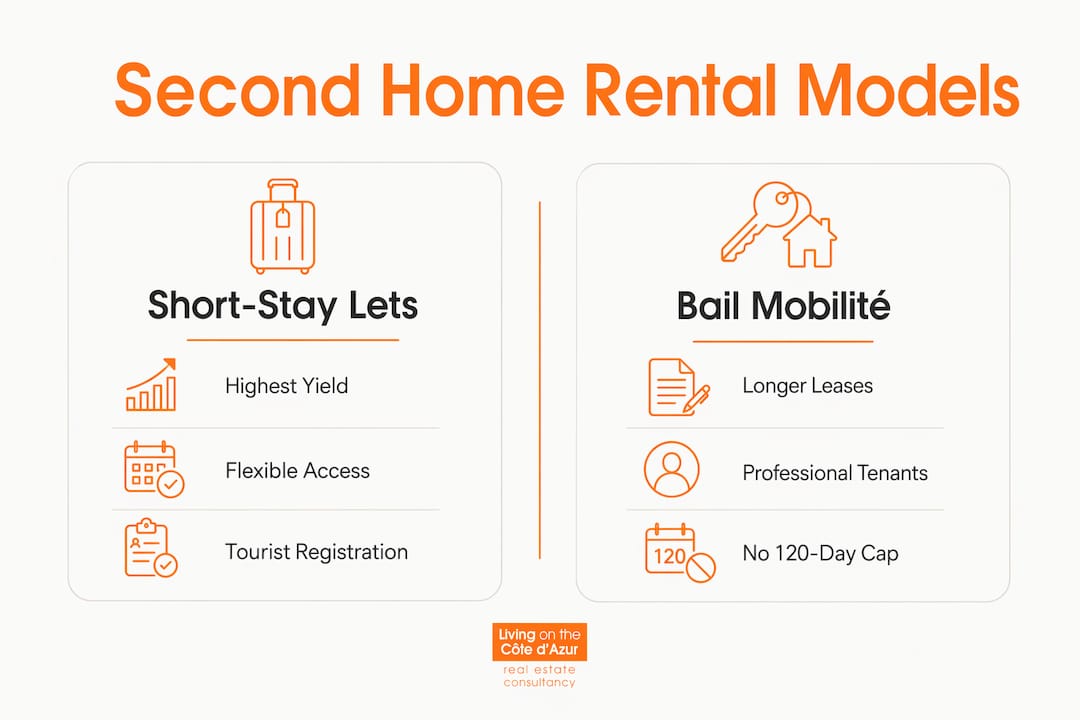
Short-stay tourist lets deliver the highest nightly rates during July and August. They are subject to tourist registration, tourist tax collection, and in many communes a 120-day annual cap for primary residences (though second homes are typically exempt from the cap itself; local change-of-use rules still apply). Peak pricing is the main attraction; high turnover and wear are the cost.
Bail mobilité (mobility leases) run from one to ten months, targeting professionals, researchers, or corporate relocatees. No 120-day cap applies, guests tend to treat properties with greater care, and income is steadier. The trade-off is a lower nightly equivalent rate than peak-season short-lets.
Hybrid models combine both: short-lets through summer, a mobility lease from October to May. This approach balances owner access and year-round income and is common in tech-park communes such as Sophia Antipolis and Biot.
| Strategy | Peak yield | Owner access | Regulatory complexity |
|---|---|---|---|
| Short-stay lets | Highest | Flexible | Higher |
| Bail mobilité | Moderate | Limited in-season | Lower |
| Hybrid | Strong overall | High season reserved | Moderate |
Pro Tip: Use calendar fencing from the outset: block your own preferred dates before any listing goes live. Changing blocked dates later creates friction with guests and managers alike.
Typical fee structures and costs owners should budget for
Management fees for short-let operations typically run 15–25% of rental revenue, with operating costs for a typical holiday home ranging from €1,500–€5,000 annually before taxes and mortgage.
| Fee type | What it covers |
|---|---|
| Management fee | Bookings, guest handling, reporting (15–25% of rental revenue or fixed) |
| Cleaning and turnover | Professional housekeeping between stays |
| Garden and pool maintenance | Scheduled upkeep, chemical treatments, seasonal care |
| Utilities management | Supplier liaison, meter readings, invoice processing |
| Insurance | Buildings, contents, and public liability for lets |
| Local taxes | Taxe foncière, taxe d’habitation on second homes |
One-off onboarding costs include: initial property audit, professional photography, safety certificates, key duplication, and security upgrades. Budget a maintenance reserve separately from operating costs.
Initial capital checklist:
- Buildings and contents insurance update
- Energy performance certificate (DPE)
- Electrical and gas safety certificates
- Professional photography and virtual tour
- Tourist registration number
Legal, tax and compliance essentials for UK buyers
French property ownership carries specific recurring obligations. Taxe foncière applies annually to all owners; taxe d’habitation still applies to second homes despite the 2023 abolition headlines (which applied only to primary residences). Côte d’Azur communes, designated as zones tendues, can add a surcharge of up to 60% on the taxe d’habitation for second homes.
Key figures:
- IFI (wealth tax): applies if French property assets exceed €1.3 million
- Capital gains tax: 19% plus social charges of 18.6% (effective January 2026) for non-residents
- Annual tax burden: typically €2,500–€5,000 for a €500,000 second home before rental income
For UK buyers post-Brexit, the social charges position has shifted materially. Budget the full 18.6% on any future capital gain. Cross-border residency and tax complexities require careful mapping of days spent in each country to avoid unexpected exposure.
French inheritance law can create significant beneficiary liabilities unless you plan with a French-law compliant will or an appropriate ownership structure such as an SCI. Consult a bilingual notaire and a cross-border tax adviser before making any structural decisions. The luxury real estate tax guide from Living On The Cote d’Azur covers the key planning considerations.
How to choose the right property manager: questions and red flags
Ten questions to ask shortlisted managers:
- Do you have a physical office and permanent staff on the Riviera?
- What is your response time for maintenance emergencies?
- How do you vet and supervise subcontractors?
- What insurance do you carry for the property and guests?
- Can you demonstrate tourist registration compliance in this commune?
- How are owner funds held and reported?
- What booking channels do you use and who controls the listings?
- How do you handle guest disputes or damage claims?
- What are your exit terms if we are dissatisfied?
- Can you provide two references from comparable luxury properties?
Red flags: no local office or permanent staff; opaque fee schedules; refusal to share references; insufficient public liability insurance; inability to demonstrate regulatory compliance.
Documents to request: sample service level agreement, insurance certificates, a sample monthly owner report, client references, and contractor vetting records.
From purchase to first rental: a typical onboarding timeline
Practical onboarding tasks include insurance updates, utility registration, energy and safety certificates, and hiring local cleaning and maintenance teams. Allow 6–12 weeks from completion to a rental-ready listing, longer if renovation or significant safety works are needed.
- Weeks 1–2: Initial property audit and full inventory; key handover and security review.
- Weeks 2–4: Insurance update; utility contracts transferred; energy and safety certificates commissioned.
- Weeks 3–6: Professional photography; listing creation and channel registration; tourist registration number obtained.
- Weeks 6–10: First operational readiness check; cleaning and maintenance teams briefed; owner blackout dates locked.
- Weeks 10–12: Live listings; first bookings accepted; reporting cadence agreed with owner.
Owner onboarding checklist: provide spare keys and alarm codes; share preferred supplier contacts; confirm owner blackout dates; agree inspection frequency and reporting format.
Advantages and disadvantages of hiring a local luxury manager
Advantages:
- Immediate local emergency response and vetted vendor network
- Regulatory expertise: tourist registration, commune rules, tax reporting
- Concierge-level guest services that protect reviews and repeat bookings
- Asset-minded advice on maintenance and capital improvements
Disadvantages:
- Management fees reduce net rental yield (typically 15–25% of revenue)
- Less direct control over day-to-day decisions
- Higher guest turnover from short-lets increases wear on furnishings
- Quality varies significantly; poor selection amplifies all risks
Pro Tip: Contractual protections matter as much as choosing the right manager. Insist on clear performance KPIs, a defined inspection cadence, and a 30-day exit clause with no penalty if agreed standards are not met.
Key takeaways
Hiring a local luxury manager on the Côte d’Azur protects your asset, keeps you compliant, and unlocks income options that a remote or DIY approach cannot match.
| Point | Details |
|---|---|
| Hire local for luxury | On-the-ground teams with vetted vendors are essential for prestige Riviera properties. |
| Budget realistically | Operating costs run €1,500–€5,000 annually; management fees typically take 15–25% of rental revenue. |
| Know your tax position | Social charges stand at 18.6% (January 2026); IFI applies above €1.3M in French property assets. |
| Match strategy to goals | Choose stewardship, full rental management, or a hybrid based on your priorities for use, yield, and legacy. |
| Living On The Cote d’Azur | Offers acquisition, legal and tax advisory, and on-the-ground management support for luxury second home buyers on the Riviera. |
The view from the Riviera
The most common mistake I see affluent buyers make is treating property management as an afterthought — something to arrange after completion, once the excitement of acquisition has settled. On the Côte d’Azur, that sequence costs money and creates avoidable risk. The management structure, the tax planning, and the revenue strategy should be modelled before you sign, not after.
We have seen properties sit idle for a full season because tourist registration was not obtained in time, and we have seen owners receive unexpected IFI assessments because no one mapped their worldwide property assets before purchase. Conversely, owners who appoint a capable local team from day one — one with genuine legal and tax advisory capability alongside operational management — tend to generate income within their first summer and avoid the compliance surprises that erode returns. The Riviera rewards preparation. It is as simple as that.
Living On The Cote d’Azur: from acquisition to fully managed asset
Where most buyers must assemble a property manager, a tax adviser, and a legal team separately, Living On The Cote d’Azur brings all three together under one roof. With access to over 100,000 properties across Nice, Cannes, Antibes, Saint-Tropez, and beyond, the firm guides clients from off-market acquisition through legal audit, tax structuring, and on-the-ground management. For UK buyers navigating post-Brexit social charges, French inheritance law, and the nuances of Riviera short-let compliance, that integrated capability is the difference between a prestige asset that performs and one that quietly drains. Request a bespoke onboarding audit to understand exactly what your property needs before the first guest arrives.
Useful sources
- French government tax guidance for non-residents — authoritative overview of taxe foncière, taxe d’habitation, IFI, and capital gains for non-resident owners.
- Côte d’Azur Tourisme (official regional tourism office) — tourist registration requirements, local tourism statistics, and seasonal visitor data for the region.
- UK government guidance on overseas property — HMRC guidance on declaring overseas rental income and capital gains for UK residents.
- French inheritance and cross-border tax traps — practical guide for UK nationals on residency days, social charges, and succession planning.
- Homebuying.uk practical checklist for buying abroad — onboarding tasks, insurance, and utility registration steps for new overseas owners.
FAQ
What does property management for second homes include?
Property management for second homes covers day-to-day operations: inspections, housekeeping, maintenance, guest handling, tourist registration, and owner reporting. On the Côte d’Azur, a full-service manager also coordinates legal compliance and local tax obligations.
How much do property management fees cost in France?
Management fees for short-let operations typically run 15–25% of rental revenue, with annual operating costs for a 100m² holiday home ranging from €1,500–€5,000 before taxes.
What is the 120-day cap and does it apply to my second home?
The 120-day national cap on short-stay lets primarily targets primary residences in France. Second homes are generally exempt from the cap itself, though local commune rules on tourist registration and change-of-use still apply.
What taxes do UK buyers pay on a French second home?
UK owners pay taxe foncière and taxe d’habitation annually. Capital gains are taxed at 19% plus social charges of 18.6%. IFI (wealth tax) applies if French property assets exceed €1.3 million.
What is a bail mobilité and why does it suit second home owners?
A bail mobilité is a furnished lease of one to ten months for mobile professionals or researchers. It carries no 120-day cap, attracts careful tenants, and provides steadier off-season income than short-stay lets.
How long does onboarding take before a property is rental-ready?
Allow 6–12 weeks from purchase completion to a live rental listing, covering insurance updates, safety certificates, professional photography, tourist registration, and channel setup.
What are the red flags when choosing a property manager?
Key red flags include no physical local office, opaque fee structures, refusal to provide client references, insufficient public liability insurance, and an inability to demonstrate tourist registration compliance.
How can Living On The Cote d’Azur help with second home management?
Living On The Cote d’Azur integrates acquisition, legal and tax advisory, and on-the-ground property management for luxury second home buyers across the French Riviera, from Nice and Cannes to Saint-Tropez and Monaco.
Recommended
 //
//