
TL;DR:
- Real estate fractionalization provides buyers with recorded equity stakes in properties, offering appreciation and shared costs. Success depends on governance, liquidity, and cross-border tax considerations, especially for UK buyers in France. Proper legal, tax, and market due diligence are essential before investing in fractional property ownership.
Real estate fractionalization gives you a recorded, proportional equity stake in a physical property — not merely the right to use it. Unlike a timeshare, where you purchase access to a property for a fixed period each year, fractional ownership means your name (or your holding vehicle) appears on the title, and your share appreciates or depreciates in line with the underlying asset. For UK buyers eyeing the Côte d’Azur, three things matter most from the outset: the governance terms in the operating agreement, the cross-border tax treatment between France and the UK, and realistic liquidity expectations before you commit capital.
Table of Contents
- What is real estate fractionalization and how does it work?
- How does fractional ownership differ from a timeshare or simple co-ownership?
- What are the legal and tax considerations for UK buyers in France?
- What due diligence should you carry out before committing?
- What do fractional properties typically cost, and what returns can you expect?
- How liquid is a fractional interest, and what are your exit options?
- How do you evaluate a specific fractional offering?
- What happens to a fractional interest when you die?
- What are the practical next steps and timeline?
- Key takeaways
- Why fractional ownership is often misread as a lifestyle product
- How Living On The Cote d’Azur supports your fractional purchase
- Useful sources and further reading
- FAQ
What is real estate fractionalization and how does it work?
Fractional ownership is most commonly implemented via a holding company — typically a French SCI, an LLC, or a special purpose vehicle (SPV) — so that operational decisions, liability and transfer mechanics are centrally managed. You do not buy the bricks directly; you buy a membership interest in the entity that holds the title.
Common share sizes run from one-eighth to one-half of a property. A one-eighth share maps to roughly 6–7 weeks of annual usage in a whole-home model, allocated through a booking system governed by the operating agreement. Costs, income and capital appreciation all flow proportionally to each owner’s percentage.

The sponsor or manager sits at the centre of the structure, handling maintenance, bookings, insurance and accounts. Voting thresholds for major decisions — capital expenditure, refinancing, sale of the asset — are set in the operating agreement, which also determines how usage is scheduled and how disputes are resolved.
Pro Tip: Ask for the operating agreement before you ask for the price. The governance terms determine your real rights far more than the headline share price does.
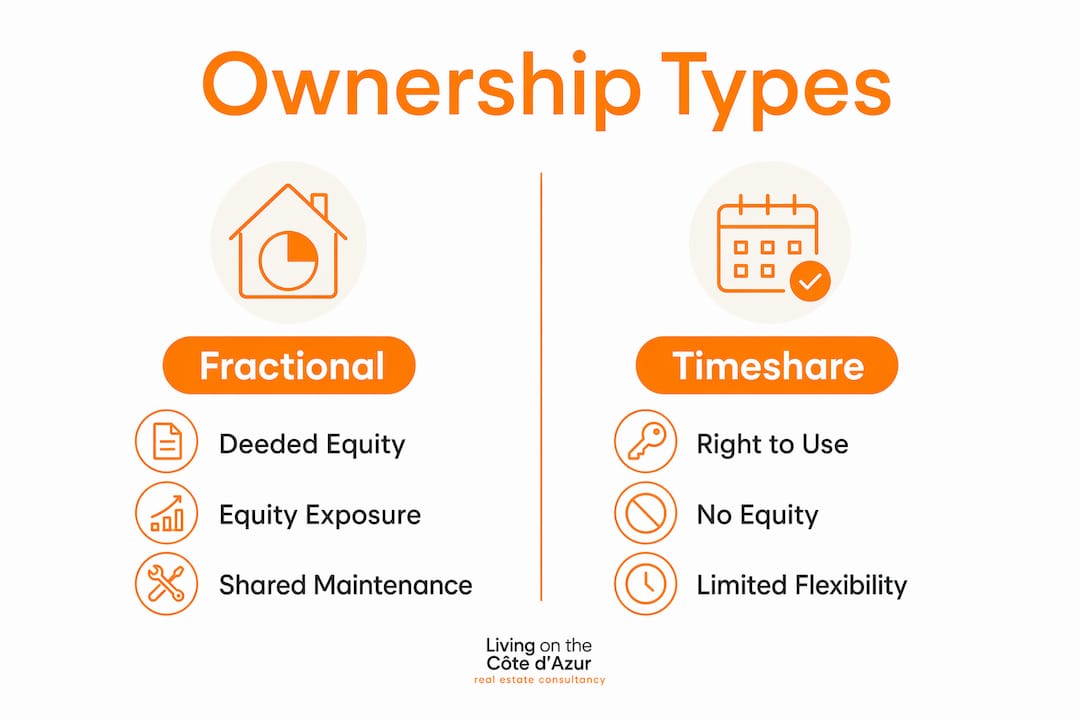
How does fractional ownership differ from a timeshare or simple co-ownership?
| Feature | Deeded fractional ownership | Timeshare (right-to-use) | Simple co-ownership (TIC) |
|---|---|---|---|
| Equity stake | Yes — recorded deed or SPV interest | No — usage rights only | Yes — individual deed per owner |
| Capital appreciation | Shared proportionally | None | Shared proportionally |
| Owner pool | Typically 2–8 owners | — | Unlimited |
| Governance | Operating agreement | Resort management | Self-managed or informal |
| Resale | Subject to right of first refusal | Very limited secondary market | Open, but partition risk |
| Usage | Weeks allocated by share size | Fixed week(s) per year | Agreed informally or by deed |
A deeded fractional interest sits between outright ownership and a timeshare: you gain equity exposure and a proportional share of any appreciation, while sharing the cost burden. Simple tenancy in common (TIC) offers similar equity rights but without the centralised governance that protects co-owners from a rogue partner forcing a partition sale.
When does fractional make more sense than buying outright? When the trophy property you want — a villa in Saint-Tropez, a penthouse above Monaco — carries a price that would concentrate too much of your net worth in a single illiquid asset. Fractional ownership reduces that single-asset concentration risk while preserving exposure to prime locations, which is why industry analysts identify access and diversification as the primary drivers of the model.
What are the legal and tax considerations for UK buyers in France?
French property ownership triggers several tax obligations regardless of how many people share the title.
- Taxe foncière: an annual land tax levied on the owner of record; in a fractional structure, this is typically apportioned by ownership percentage.
- Taxe d’habitation: largely abolished for primary residences but may still apply to secondary homes in certain communes.
- Purchase taxes and notary fees: on a resale property, expect total acquisition costs (droits de mutation plus notary fees) of approximately 7–8% of the purchase price. New-build purchases attract VAT at 20% instead, with reduced registration duties.
- Capital gains tax: French non-residents pay tax on gains from French property sales; the rate and any applicable social levies depend on your residency status and the holding period.
UK buyers must also declare French property interests to HMRC. Rental income from a French property is reportable on a UK Self Assessment return, with double-taxation relief available under the France-UK tax treaty. French property held through an SPV or SCI may be treated differently for UK inheritance tax purposes depending on whether HMRC classifies the interest as a foreign situs asset or a UK-domiciled asset.
The operating agreement can waive default partition rights and impose right-of-first-refusal clauses, lien mechanics and remedies for unpaid assessments — all of which affect your legal position as a co-owner under French law. Cross-border tax advice from a Franco-UK specialist is not optional; it is the single most cost-effective step you can take before signing.
Pro Tip: Structure your fractional interest through a French SCI if succession planning is a priority. An SCI allows you to gift shares to heirs progressively, potentially reducing French inheritance tax exposure over time. Coordinate this with your UK adviser to avoid double-taxation surprises.
What due diligence should you carry out before committing?
Essential documents to request
- Operating agreement (or shareholders’ agreement for an SPV/SCI)
- SPV/SCI articles of association and shareholder register
- Approved annual budgets for the past three years
- Reserve fund study and current reserve balance
- Insurance policies (building, contents, liability)
- Title report and any registered charges or mortgages
- Recent maintenance logs and any outstanding works orders
Questions to put to the sponsor
- What is the management fee, and how has it changed over the past three years?
- How is the capital reserve calculated, and what triggers a special assessment?
- How is usage time allocated — fixed weeks, rotating schedule, or points-based booking?
- What is the resale process, and does the sponsor offer a buyback facility?
- What voting threshold is required to approve a sale of the whole property?
- How are disputes between co-owners resolved, and is there an independent arbitration mechanism?
Red flags include ambiguous exit clauses, a reserve fund below three months of operating costs, frequent unilateral fee increases by the sponsor, and veto rights with no appeal process. Sponsors provide convenience but increase counterparty risk; a thorough audit of sponsor accounts is as important as reviewing the property itself. For a deeper look at the pros and cons before you proceed, the fractional ownership pros and cons guide is worth reading in full.
What do fractional properties typically cost, and what returns can you expect?
Indicative cost and share structure
| Share size | Typical price range (luxury Côte d’Azur) | Platform investment models |
|---|---|---|
| 1/8 | Higher-end property segment; usage typically allocated by booking system | Lower-end platforms offer shares at modest prices |
| 1/4 | Typical fractional share with negotiated access and cost sharing | Platform prices vary |
| 1/2 | Larger fractional share, less commonly offered | Not typical at this level |
The Côte d’Azur price ranges above are illustrative of the luxury segment; actual pricing depends on the specific property and location. Online fractional investment platforms operate at far lower per-share prices ($500–$5,000), but these target different asset types and liquidity profiles entirely.
Ongoing costs typically include a management fee (often 1–2% of asset value annually), a contribution to the capital reserve, building insurance, and your proportional share of taxe foncière. The principal trade-off is reduced capital burden and easier diversification against reduced day-to-day control and illiquidity. Capital appreciation on prime Riviera property has historically been the dominant return driver; rental income, where permitted by the operating agreement, provides a secondary yield.
How liquid is a fractional interest, and what are your exit options?
Liquidity is the most frequently underestimated constraint in fractional ownership. Secondary market sales typically require offering co-owners the right of first refusal first, then sponsor approval, and can involve administrative fees and price discounts to attract a buyer quickly.
The three primary exit paths are:
- Sale to co-owners: the fastest route, but only viable if a co-owner wants to increase their share.
- Sponsor or platform buyback: some structures include a buyback facility, though terms and pricing vary.
- Open market resale: possible but subject to right-of-first-refusal periods and approval steps that can extend the process by several months.
Treat a fractional interest as a medium-to-long-term holding. A 5–10 year horizon is realistic for prime luxury property; attempting to exit within two or three years often means accepting a discount. For leisure-market context, real estate appreciation trends in other high-demand destinations illustrate how holding period materially affects net returns in fractional structures.
How do you evaluate a specific fractional offering?
Decision checklist
- Does the ownership goal align — residence, investment, or both?
- Are governance terms transparent: voting thresholds, booking rights, fee caps?
- Is the reserve fund adequately funded relative to the property’s age and condition?
- Are resale rules clearly defined, with a realistic secondary market or buyback option?
- Has an independent legal audit of the operating agreement been commissioned?
Pros and cons for HNW buyers on the Côte d’Azur
Advantages:
- Access to trophy properties in Cannes, Antibes or Saint-Paul de Vence without full capital concentration
- Proportional share of capital appreciation on prime assets
- Professional management removes day-to-day operational burden
Disadvantages:
- Loss of unilateral control over the property and its use
- Illiquidity: no central exchange, no guaranteed buyback
- Governance disputes can be costly and slow to resolve
Decision flow: a red flag in the operating agreement triggers an immediate legal audit before any deposit. A borderline offering warrants negotiation on reserve levels or fee caps. A clean offering with transparent governance and a funded reserve is the only basis for proceeding, and then only with a conditional deposit pending full legal review. Explore the full range of luxury real estate investment options on the Côte d’Azur to benchmark any fractional offering against outright ownership alternatives.
What happens to a fractional interest when you die?
Fractional interests held through an SCI or SPV can be gifted or inherited, but the mechanics depend entirely on the operating agreement and the articles of the holding entity. Most well-drafted agreements include a right of first refusal triggered on death, giving surviving co-owners the option to purchase the deceased’s share before it passes to heirs.
- French succession law (réserve héréditaire) applies to French situs assets, which can override a UK will if the property is held directly or through a transparent entity.
- An SCI can offer more flexibility, allowing progressive gifting of shares to children under the French donation abattement rules.
- UK domiciliaries with French property interests face potential exposure to both French inheritance tax and UK inheritance tax; the France-UK estate tax treaty provides partial relief but does not eliminate double exposure.
For a structured approach to legacy planning and portfolio structuring, coordinate French and UK advisers before the purchase, not after. The ownership model you choose — direct, SCI, or SPV — shapes your succession options for decades.
Pro Tip: Include your fractional interest explicitly in your UK will and instruct your French notaire to prepare a separate French testament. Two coordinated documents prevent the intestacy rules of either country from overriding your intentions.
What are the practical next steps and timeline?
Suggested timeline from interest to completion
- Weeks 1–2: Commission a Franco-UK tax opinion on the proposed structure and your personal tax position.
- Weeks 2–4: Instruct a French avocat to audit the operating agreement, SPV/SCI articles and title.
- Weeks 3–5: Commission an independent valuation of the whole property and the fractional share.
- Week 5–6: Negotiate terms, reserve levels and any amendments to the operating agreement.
- Week 6–8: Sign a conditional promesse de vente (deposit agreement) subject to legal and tax sign-off.
- Weeks 8–16: Satisfy conditions, arrange financing if required, and proceed to notarial completion (acte authentique).
Documents to collect during the diligence window
- Full operating agreement and any amendments
- Three years of audited accounts for the SPV/SCI
- Reserve fund balance and most recent reserve study
- Building survey and any outstanding planning consents
- Insurance schedule and claims history
Brief Living On The Cote d’Azur’s buyer agents early in the process. With access to over 100,000 properties across the Riviera — from Menton to Saint-Raphaël — we can cross-check whether the fractional offering you are considering is priced fairly against comparable whole-ownership and fractional alternatives in the same micro-market.
Key takeaways
Real estate fractionalization gives UK buyers a deeded equity stake in a luxury property, but governance, liquidity and cross-border tax treatment that determine whether the investment actually delivers.
| Point | Details |
|---|---|
| Deeded equity, not usage rights | Fractional ownership records a proportional equity interest; your share appreciates with the asset. |
| Governance is the critical variable | The operating agreement sets voting rights, fee caps, booking rules and exit mechanics — audit it before any deposit. |
| Expect illiquidity | Sales require right-of-first-refusal steps and sponsor approval; plan for a 5–10 year holding period. |
| Budget for all fees | Management fees, reserves, taxe foncière and notary costs (approximately 7–8% on resale) all reduce net returns. |
| Living On The Cote d’Azur | Provides legal audits, tax planning coordination and off-market search across prime Côte d’Azur locations. |
Why fractional ownership is often misread as a lifestyle product
Marketing for fractional properties leans heavily on the dream: a villa above Villefranche-sur-Mer, the scent of lavender, the light on the water. That framing is not wrong, but it obscures what you are actually buying — a partnership interest in a legal entity, governed by a contract, with co-owners you may never meet. The lifestyle is real. The governance risk is equally real.
What experienced buyers consistently underestimate is the sponsor’s discretion. In many structures, the sponsor controls the booking calendar, sets the maintenance budget and decides when to refinance. The operating agreement may give co-owners a vote on major decisions, but day-to-day authority often rests entirely with the manager. That is not a flaw in the model; it is the model. The question is whether the terms protecting your interests are robust enough to make that acceptable.
The buyers we work with at Living On The Cote d’Azur who navigate fractional ownership most successfully are those who treat it as a partnership from the first conversation — not as a property purchase with extra paperwork. They commission the legal audit before the emotional attachment sets in, they negotiate reserve levels before signing, and they plan the exit before they plan the décor.
How Living On The Cote d’Azur supports your fractional purchase
Fractional ownership on the Côte d’Azur demands more than a property search — it requires a coordinated team of legal, tax and market specialists working in your interest from day one. Living On The Cote d’Azur brings all of that together: legal audit coordination, Franco-UK tax planning, independent valuation support, and access to off-market properties across prestigious locations from Saint-Tropez to Monaco. Our buyer agents cross-check every fractional offering against the broader market so you know precisely what you are paying for and why. If you are ready to explore a confidential search or commission a legal audit of a specific offering, speak with our team through our buyer representation service — the first conversation costs nothing and often saves considerably more.
Useful sources and further reading
The following primary and official sources informed this article and are recommended for further reading:
- Deeded fractional ownership explained — LegalClarity
- Fractional ownership — Wikipedia
- Fractional real estate ownership — Benzinga
- Fractional ownership — Investopedia
- French tax authority (Direction Générale des Finances Publiques)
- French notarial service — Notaires de France
- French government property and succession information — Service-Public.fr
- Living On The Cote d’Azur — luxury fractional real estate
- Living On The Cote d’Azur — villa ownership models and legacy planning
FAQ
What is real estate fractionalization in simple terms?
Real estate fractionalization means multiple buyers each own a proportional, recorded equity stake in a single property, sharing costs, usage rights and capital appreciation according to their ownership percentage.
How does fractional ownership differ from a timeshare?
Fractional ownership gives you a deeded equity interest that appreciates with the property; a timeshare gives you only the right to use a property for a fixed period each year, with no equity or appreciation.
What share sizes are typical in fractional real estate?
Common shares run from one-eighth to one-half of a property. A one-eighth share typically equates to roughly 6–7 weeks of annual usage in a whole-home fractional model.
Is real estate fractionalization safe for UK buyers in France?
It can be, provided you commission a legal audit of the operating agreement, obtain Franco-UK tax advice, and verify that the reserve fund is adequately funded before signing anything.
What taxes apply to UK buyers holding a fractional share in France?
French acquisition costs on a resale property run approximately 7–8% (notary fees plus droits de mutation). Annual taxe foncière applies, and capital gains on disposal are subject to French non-resident tax rules. UK buyers must also report French income and gains to HMRC under the France-UK double-taxation treaty.
How do you exit a fractional real estate investment?
The three main routes are sale to a co-owner, a sponsor or platform buyback, or open-market resale subject to right-of-first-refusal steps. Expect the process to take several months and plan for a 5–10 year holding period.
What is the operating agreement and why does it matter?
The operating agreement governs voting rights, fee structures, booking allocation, resale rules and exit mechanics. It can waive default partition rights and override standard tenancy-in-common protections, making it the single most important document in any fractional structure.
How does Living On The Cote d’Azur help with fractional purchases?
Living On The Cote d’Azur coordinates legal audits, Franco-UK tax planning and off-market property searches across the Côte d’Azur, giving buyers independent market intelligence and specialist support throughout the purchase process.
Recommended
 //
//