TL;DR:
- Villa certification confirms legal, safety, and sustainability standards for lawful operation and investment value. Certified villas command higher sales and rental premiums due to verified performance and quality standards. Combining legal certification with voluntary accreditation enhances long-term asset value and market credibility.
Villa certification is the formal process that confirms a villa complies with essential legal, safety, and quality standards required for lawful operation and credible investment. For luxury real estate investors, it encompasses two distinct layers: mandatory regulatory certificates that govern whether a villa may legally operate, and voluntary accreditations such as LEED, BREEAM, or EDGE that signal sustainability and operational excellence. Both layers carry direct financial consequences. Certified villas command 6–11% higher sales premiums and 5–12% higher rental premiums than uncertified properties. Understanding villa certification meaning, requirements, and benefits is no longer optional for discerning investors. It is the foundation of a sound acquisition strategy.
What is villa certification and why does it matter legally?
Villa certification is defined as official confirmation, issued by a competent authority or accredited body, that a property meets prescribed standards for construction, safety, occupancy, and intended use. The term covers a spectrum of documents, from government-issued building permits to internationally recognised green labels. Each certificate serves a different purpose, and confusing them is one of the most costly mistakes an investor can make.

The clearest illustration of mandatory villa certification comes from Indonesia, where the regulatory framework is among the most detailed in the world. Under Indonesia’s 2021 Omnibus Law, every commercial villa must hold a valid SLF certificate (Sertifikat Laik Fungsi). The SLF certifies that the physical building structure is safe and fit for its intended occupancy. Without it, insurance claims are invalidated and operations can be suspended immediately.
The SLF sits within a hierarchy of permits that investors must understand:
- NIB (Nomor Induk Berusaha): The business registration number that establishes the legal entity permitted to operate the villa commercially.
- PBG (Persetujuan Bangunan Gedung): The building approval permit that replaces the older IMB. It approves the design and intended function of the structure before construction begins.
- SLF (Sertifikat Laik Fungsi): Issued after construction, it certifies the building’s structural integrity, fire safety systems, mechanical installations, sanitation, and accessibility. This is the certificate that makes operation lawful.
- KBLI (Klasifikasi Baku Lapangan Usaha Indonesia): The business classification code that must match the villa’s actual commercial activity, such as short-term rental or hospitality.
- Zoning and usage permits: These confirm the land is designated for the intended commercial purpose, a critical check before any acquisition.
The SLF inspection is conducted by a certified technical assessor appointed by local government. The assessor examines structural integrity, fire suppression systems, electrical installations, water and sanitation infrastructure, and accessibility provisions. A villa that passes receives its SLF; one that fails must remediate and reapply.
Pro Tip: Never conflate the PBG with the SLF. The PBG approves what you plan to build; the SLF confirms what you actually built is safe to use. Investors who purchase villas with only a PBG in place are acquiring an asset that cannot legally operate until the SLF is obtained.
The consequences of non-compliance extend beyond operational suspension. An invalid SLF means any insurance policy covering the property is void. In the event of fire, structural failure, or guest injury, the investor bears full liability with no insurer recourse. For high-net-worth buyers, this is not a regulatory technicality. It is a material financial risk.
How do voluntary certifications enhance villa investment value?
Voluntary sustainability and quality certifications represent the second layer of villa certification meaning, and they carry growing financial weight. Programmes such as LEED (Leadership in Energy and Environmental Design), BREEAM (Building Research Establishment Environmental Assessment Method), EDGE (Excellence in Design for Greater Efficiencies), and Greenship assess a villa’s environmental performance across energy use, water consumption, materials sourcing, and indoor air quality.
The market advantages are measurable. Studies in markets including Trancoso and Dubai show that green-certified villas consistently achieve 6–11% higher sales premiums and 5–12% higher rental premiums compared to uncertified equivalents. These are not marginal gains. On a villa priced at €3 million, a 9% sales premium represents €270,000 in additional value.
The key benefits of voluntary villa certification include:
- Sales and rental premiums: Verified green status commands consistent price advantages in competitive luxury markets.
- Guest trust and booking confidence: Third-party verification signals authenticity that self-reported “eco-friendly” claims cannot replicate.
- Investor and lender confidence: ESG disclosure frameworks such as SFDR (Sustainable Finance Disclosure Regulation) require documented third-party energy data. Self-reported claims are insufficient for bankable green assets.
- Future-proofing against regulation: Certified villas are positioned ahead of tightening energy performance requirements across European and Asian markets.
- Brand differentiation: In a saturated luxury rental market, a LEED or BREEAM certificate is a credible differentiator that generic marketing cannot replicate.
The role of eco-luxury credentials in the French Riviera market follows the same logic. Buyers in Saint-Tropez and Monaco increasingly request documented sustainability performance as part of their due diligence.
“Certified villas are benchmarks of future-proof luxury. Certifications like BREEAM and Greenship are essential risk mitigation tools protecting long-term value in sustainability-conscious markets. Buyers are no longer satisfied with aesthetic opulence alone; they demand verified performance.”
Future-proof luxury: the rising demand for sustainable villas
Green certification is not a one-time achievement. Ongoing operational compliance requires carbon footprint audits, waste management protocols, and sustainable procurement practices. Guests in the luxury segment detect authenticity. A villa that earns LEED certification and then abandons its operational standards faces reputational damage that erodes the very premium the certificate was meant to create. Greenwashing is not merely an ethical failure. It is a financial one.
What is villa accreditation and how does it differ from certification?
Villa accreditation is distinct from certification, though the two terms are frequently used interchangeably. Certification confirms that a villa meets a defined technical standard, typically assessed against a fixed checklist. Accreditation is official recognition by a tourism authority, industry body, or government agency that a villa meets broader quality, safety, and operational standards for the hospitality sector.
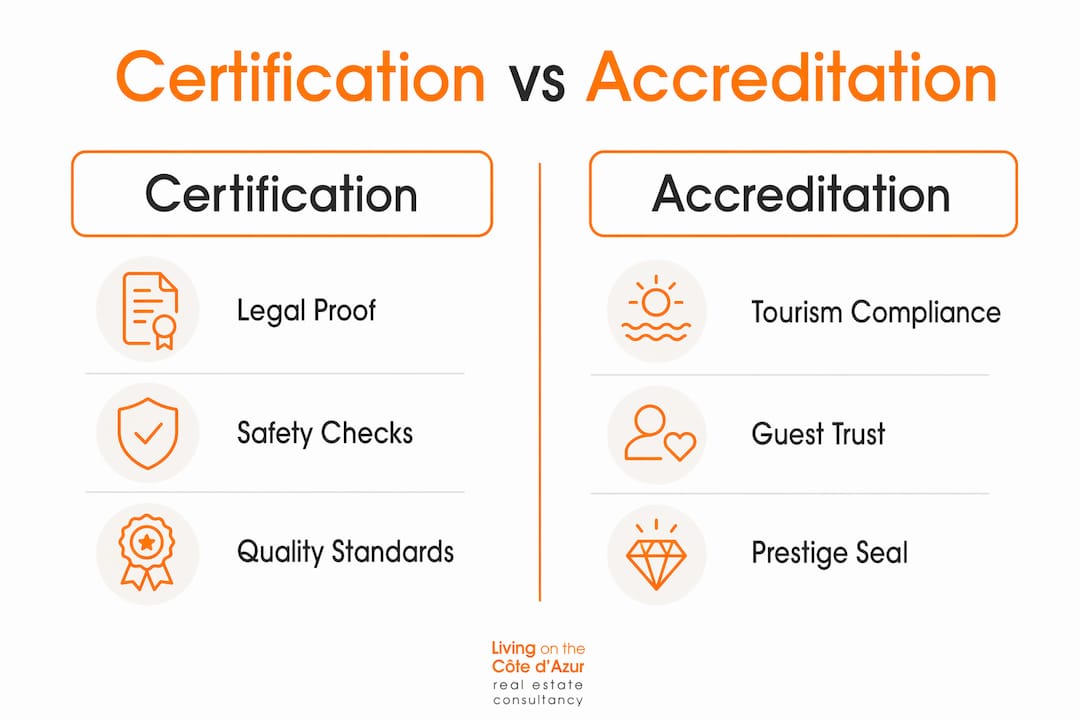
In Bali, accreditation often involves compliance with local tourism regulations administered by the Dinas Pariwisata (tourism department), alongside alignment with international hospitality standards. The accreditation process assesses safety protocols, health standards, sustainability practices, and guest experience consistency. Properties that achieve accreditation signal to international booking platforms and guests that they have been officially vetted.
The practical differences between accreditation and certification are best understood through their scope:
| Aspect | Certification | Accreditation |
|---|---|---|
| Issued by | Technical body or standards organisation | Tourism authority or industry association |
| Focus | Specific technical standard (safety, energy, construction) | Holistic operational and quality standard |
| Renewal | Periodic re-inspection or audit | Annual or biennial review |
| Market signal | Compliance and performance verified | Official recognition and hospitality quality |
| Examples | SLF, LEED, BREEAM, EDGE | CHSE, Bali tourism department approval |
The CHSE (Cleanliness, Health, Safety, and Environment) programme, introduced in 2020, has been adopted by over 1,200 tourism businesses in Bali, including villas. CHSE accreditation improves guest confidence by providing an independently verified commitment to hygiene and safety standards. For investors targeting the short-term rental market, CHSE accreditation is a direct booking conversion tool.
The advantages of pursuing accreditation alongside legal certification include:
- Increased visibility on international booking platforms that filter for accredited properties.
- Reduced liability exposure through documented compliance with health and safety protocols.
- Stronger negotiating position with property managers and hospitality operators.
- Enhanced reputation as a luxury asset in markets where guest reviews drive occupancy rates.
Accreditation functions as the ultimate trust signal for international guests. It differentiates properties that meet high operational standards beyond what regulatory compliance alone requires. For investors in the luxury segment, combining legal certification with tourism accreditation creates a property that is both legally protected and commercially positioned for premium returns.
How to obtain villa certification and maximise ROI
Obtaining villa certification requires a structured approach that begins before acquisition and continues through the operational life of the property. Investors who treat certification as an afterthought consistently underestimate both the cost and the timeline involved.
Conduct a pre-acquisition legal audit. Before signing any purchase agreement, verify which certificates the property currently holds. Confirm the NIB, PBG, and SLF are valid and match the intended commercial use. A villa marketed as a rental property but holding permits for residential use only cannot legally operate commercially without reclassification.
Identify mandatory certificates for the target market. Requirements differ significantly by jurisdiction. In Indonesia, the SLF is non-negotiable for commercial operation. In France, energy performance certificates (DPE) are mandatory for sale and rental. In Spain, a tourist licence (licencia turística) governs short-term rental legality. Map the specific requirements of your target market before committing capital.
Select voluntary certifications aligned with your investment goals. If your exit strategy involves selling to an institutional buyer or ESG-focused fund, LEED or BREEAM certification is a bankable asset. If your primary goal is rental yield in a guest-facing market, CHSE or equivalent hospitality accreditation delivers faster commercial returns. The two goals are not mutually exclusive, but prioritisation matters.
Document energy and safety performance from day one. ESG disclosure frameworks require third-party verified data. Investors who begin auditing energy consumption, water use, and carbon output at acquisition have a significant advantage when applying for green certification later. Retroactive documentation is both costly and incomplete.
Engage a certified technical assessor early. For mandatory certificates like the SLF, the assessor’s findings determine whether the property passes or requires remediation. Engaging an assessor during due diligence, rather than after purchase, allows you to price remediation costs into the acquisition offer.
Integrate certification into property management. Villa management standards must reflect the requirements of any certification held. Carbon audits, waste management records, and procurement logs are not administrative burdens. They are the evidence base that sustains certification and protects the premium it commands.
Pro Tip: The most common and costly error investors make is confusing the IMB (the old Indonesian building permit, now replaced by PBG) with the SLF. A villa with a valid IMB but no SLF is not legally fit for occupancy under current law. Always verify against the current regulatory framework, not the documents the seller presents.
Key takeaways
Villa certification is the single most important compliance and value-creation lever available to luxury real estate investors, combining mandatory legal requirements with voluntary sustainability credentials that directly drive sales and rental premiums.
| Point | Details |
|---|---|
| Mandatory certificates are non-negotiable | An SLF, PBG, and NIB must be valid before a villa can legally operate commercially in Indonesia. |
| Voluntary green labels command measurable premiums | LEED, BREEAM, and EDGE-certified villas achieve 6–11% higher sales prices and 5–12% higher rental income. |
| Accreditation differs from certification | Tourism accreditation such as CHSE signals operational quality; certification confirms technical compliance. |
| ESG frameworks require third-party data | Self-reported eco claims do not satisfy SFDR disclosure requirements; formal certification and audit data are mandatory. |
| Certification is an ongoing commitment | Green and operational certificates require continuous compliance, carbon audits, and documented procurement to retain their value. |
Why certification is now the defining criterion for serious villa investors
I have spent years advising clients on luxury real estate acquisitions across some of the world’s most prestigious markets, and the shift I have witnessed in how certification is perceived is profound. Five years ago, a green certificate was a marketing flourish, a pleasant addition to a brochure. Today, sophisticated buyers treat the absence of certification as a red flag, not a neutral fact.
The change is driven by two forces. The first is regulatory. ESG disclosure frameworks are tightening across Europe and Asia, and institutional capital is flowing only toward assets with documented, third-party verified performance data. A villa without formal certification is increasingly difficult to include in a structured investment vehicle or sell to a fund. The second force is cultural. The luxury guest of 2026 is not simply purchasing comfort. They are purchasing values, and they are perceptive enough to distinguish genuine operational commitment from a logo on a website.
What I find most instructive is the greenwashing risk. I have seen investors earn a LEED certification at construction and then allow operational standards to drift. The certificate remains on the wall, but the carbon audits lapse, the procurement records disappear, and the guest experience no longer reflects the original commitment. The market notices. Review scores decline, and the premium evaporates. Certification is not a destination. It is a discipline.
My advice to any investor considering a villa acquisition is this: treat certification due diligence with the same rigour you apply to title searches and tax structuring. The legal certificates determine whether you can operate. The voluntary certifications determine what your asset is worth. Both deserve expert attention from the moment you identify a property.
— Ab Kuijer
Certified luxury villas on the Côte d’Azur: how Livingonthecotedazur can help
Livingonthecotedazur works with high-net-worth investors who understand that prestige and compliance are inseparable in today’s luxury real estate market. Our team brings deep knowledge of the legal, regulatory, and sustainability standards that govern villa ownership and operation across the French Riviera, from Saint-Tropez to Monaco. We assist clients in identifying off-market certified properties that meet both their aesthetic vision and their investment criteria. Whether you are pursuing a villa with existing green credentials or require guidance on certification requirements before acquisition, our network of legal specialists and technical assessors is at your disposal. Speak with us about your next acquisition.
FAQ
What is villa certification in simple terms?
Villa certification is official confirmation that a villa meets defined legal, safety, or quality standards. It covers mandatory government permits required for lawful operation and voluntary labels such as LEED or BREEAM that verify sustainability performance.
What does villa certification involve for a commercial rental property?
For a commercial rental villa, certification typically involves obtaining a valid building safety certificate (such as Indonesia’s SLF), a business registration number, and the correct usage permits. The SLF inspection covers structural integrity, fire safety, sanitation, and accessibility.
What are the main benefits of villa certification for investors?
Certified villas achieve 6–11% higher sales premiums and 5–12% higher rental premiums than uncertified properties. They also attract higher-quality tenants, satisfy ESG disclosure requirements, and carry lower legal and insurance risk.
How do I obtain villa certification for a property I am acquiring?
Begin with a pre-acquisition legal audit to verify existing permits. Identify mandatory certificates for the jurisdiction, engage a certified technical assessor during due diligence, and select voluntary certifications aligned with your exit strategy and rental goals.
Is villa accreditation the same as villa certification?
No. Certification confirms a villa meets a specific technical standard, such as building safety or energy performance. Accreditation is recognition by a tourism authority or industry body that a villa meets broader operational and hospitality quality standards, such as Indonesia’s CHSE programme.
Recommended
 //
//