
A legacy home is a property whose architecture, materials and stewardship are configured to last, physically, legally and emotionally, across generations. Three pillars decide whether a house earns that status: structural permanence (proportion, light, adaptable circulation), materials that patinate rather than degrade, and governance that keeps the property cohesive when it passes between heirs.
TL;DR:
- Homes with heritage value should have well-maintained, enduring structural features like solid foundations and logical interior layouts that support long-term adaptation.
- Materials such as natural stone, copper, and oak develop with age into desirable patinas, and repairability indicators include traditional joints and original mortar matching.
- Ownership structures like family trusts or co-ownership agreements are crucial for keeping a property intact and preventing family disputes over use and inheritance.
- Flexible, loose-fit design allows rooms to serve multiple generations, with features like wider doorways and ground-floor bedrooms that blend seamlessly into the architecture.
- Buyers should verify documented maintenance history, original components, heritage restrictions, and consider passive sustainability features rather than relying solely on aesthetic appeal.
Table of Contents
- Architectural features that confer lasting value
- Materials and finishes that age into character
- Stewardship, governance and ownership structures
- Adaptability and multigenerational layout design
- Preservation, rehabilitation and regulatory realities
- Sustainability, resilience and passive design in legacy homes
- Practical buyer checklist: assessing a property for legacy potential
- How Living on the Côte d’Azur supports legacy purchases
- Legal considerations related to heritage properties
- A note on stewardship, from where we stand
- Contact us to start a legacy property search
- FAQ
- Sources
- Selected primary sources and further reading
Architectural features that confer lasting value
We’ve walked through enough Riviera villas to know that permanence shows up in the bones of a house long before it shows up in the finishes. Generous proportions, a double circulation plan (so a corridor never forces you through someone’s bedroom to reach the kitchen) and a clear hierarchy between primary and secondary spaces all signal a house built to be lived in differently by different generations, not just occupied by one family’s habits.
When we view a property with legacy potential, we look for specific, checkable signs rather than a general impression of grandeur:
- A roofline with consistent, well-maintained lines and no visible sagging or patch repairs
- Foundations free of recent underpinning work, cracking, or damp staining at the base
- An interior sequence that flows logically from arrival to private quarters, not a maze of retrofitted additions
- Rooms oriented to capture natural light through the day, especially south-facing living spaces
- Service routes (plumbing risers, electrical chases) with evident spare capacity for future upgrades
That last point matters more than most buyers realise. A house with room to grow its systems can absorb a new wing, a lift, or a modern kitchen without ever touching its original fabric.
Materials and finishes that age into character
The materials that make a house feel genuinely enduring are rarely the ones that dazzle at first viewing. Natural stone, hand-worked copper, oak joinery and lime-based finishes all improve with decades of weather and use, developing a patina that synthetic alternatives simply cannot replicate. A limestone façade softens and warms in colour. Copper roofing turns from bright orange to a settled green. Oak floors deepen in tone where feet have worn a path for fifty years.
Look for joinery details that suggest repairability rather than replacement:
- Mortise-and-tenon or pegged joints in doors, shutters and staircases rather than glued composite units
- Mortar that matches the original stone in colour and hardness, not a grey cement patch
- Window frames thick enough to have been reglazed or resealed multiple times without weakening
Pro Tip: Ask to see the subfloor, the roof timbers and a corner of exposed mortar before you fall for the staged interiors: that’s where you learn whether the house was built to last or simply dressed to sell.
Stewardship, governance and ownership structures
A beautiful house can still fracture a family if nobody has agreed how it will be used, funded or passed on. Ownership vehicles such as family trusts, co-ownership agreements, or in France an SCI (société civile immobilière) structure can keep a property intact across heirs rather than forcing a sale to settle competing claims, though the right structure depends on each family’s situation and should be confirmed with a notaire or tax adviser.
Use agreements that spell out who stays when, and who pays for what, head off a lot of friction before it starts. Before buying, it’s worth asking:
- What maintenance has been documented over the past ten to twenty years, and by whom?
- Is there a capital reserve, or has upkeep been paid ad hoc as problems arose?
- Who currently has authority to approve repairs, and how will that authority transfer?
Adaptability and multigenerational layout design
The best legacy homes we encounter weren’t built as rigid monuments. They use what architects call loose-fit design: rooms sized and positioned so a study can become a bedroom, or a guest suite can become independent living quarters for a parent or adult child, without touching a load-bearing wall. Multigenerational home design trends increasingly favour exactly this, with private wings and flexible layouts designed to support different generations living under one roof with real independence.
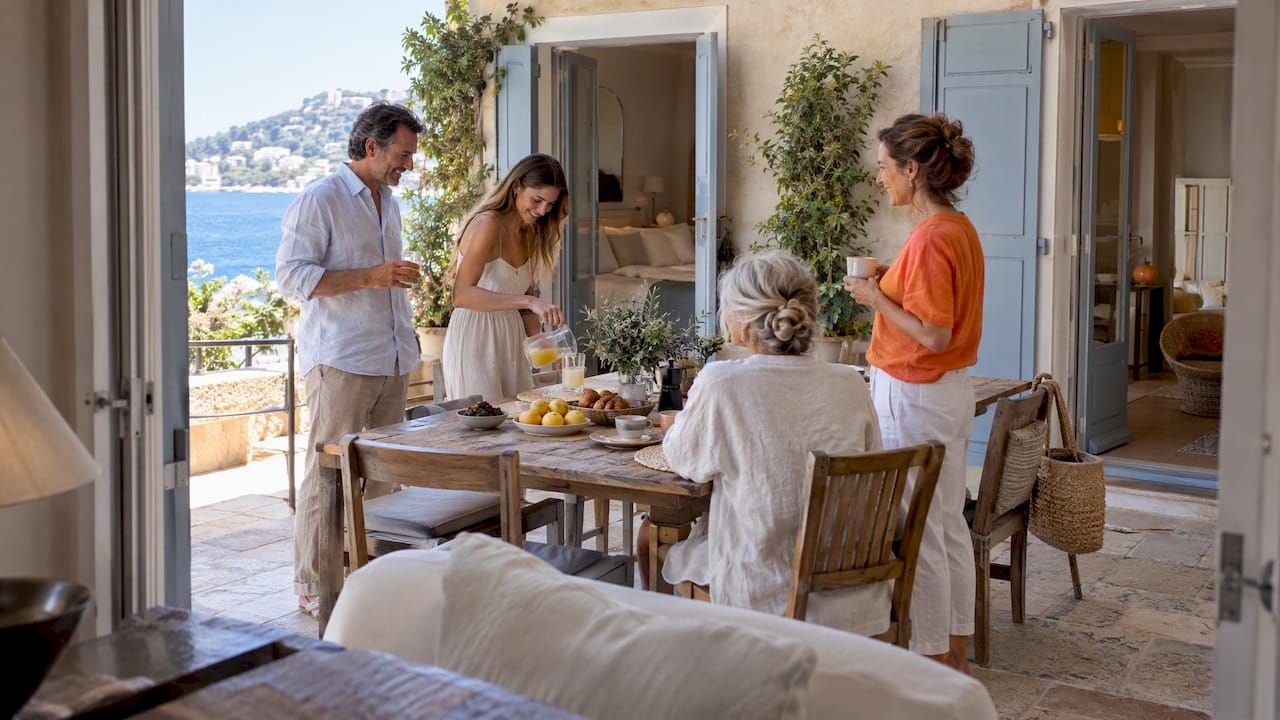
Universal design features, when done well, disappear into the architecture: wider doorways that look proportionate rather than institutional, a ground-floor bedroom with a discreetly accessible bathroom, gentle ramps worked into a garden path.
For buyers weighing alterations, a sensible sequence keeps heritage impact low:
- Audit existing circulation before adding a single new door or corridor
- Convert underused space (attics, old service quarters) before extending the footprint
- Add private suites within the existing envelope rather than new wings where possible
- Reserve structural changes for genuine capacity limits, not convenience
Preservation, rehabilitation and regulatory realities
Knowing the difference between preservation, rehabilitation and restoration saves buyers from costly missteps. The Secretary of the Interior’s Standards for the Treatment of Historic Properties define preservation as retaining historic fabric with minimal intervention, rehabilitation as adapting a property for continued use while respecting its character, and restoration as returning it to a specific historic appearance. These standards also permit sensitive upgrades to mechanical and electrical systems where needed to keep a building functional.
Sensitive upgrading of heating, plumbing or wiring is generally appropriate when it preserves visible fabric, according to the same preservation guidelines, which note that good preservation practice is often synonymous with sustainability. New additions, by contrast, risk undermining value when they compete visually with the original structure rather than defer to it.
Practical expectations worth noting:
- Heritage authorities typically review exterior changes more strictly than interior ones
- Compliance timelines for listed or protected properties often run longer than standard renovation permits
- Working with an architect experienced in heritage cases tends to shorten disputes over scope
Sustainability, resilience and passive design in legacy homes
Many of the oldest luxury properties on the Mediterranean coast were already built to manage heat, light and air long before anyone used the word “sustainable.” Thick stone walls provide thermal mass that keeps interiors cool in summer. Shuttered windows and deep eaves control direct sun. Cross-ventilation through aligned openings moves air without mechanical help.
Original passive features worth identifying before you modernise anything:
- Thermal mass in solid stone or rendered masonry walls
- Shading from loggias, deep window reveals, or mature planting
- Cross-ventilation paths between opposing windows or courtyards
Preservation guidance consistently frames the most sustainable building as the one that already exists, once its original passive features are understood and conserved rather than replaced. For coastal estates, salt exposure, humidity and occasional storm damage call for discreet interventions: invisible insulation behind original plasterwork, sympathetic double glazing within existing frame profiles, and regular inspection of metalwork and render exposed to sea air.
Practical buyer checklist: assessing a property for legacy potential
Before making an offer on a property you’re hoping will last, work through a short, concrete list rather than relying on impression alone.
- Request maintenance records covering at least the past decade, including roof and drainage work
- Ask whether a structural survey has been carried out, and review it in full
- Check drainage around the foundations after recent rain if possible
- Ask the seller or their architect which elements are original and which have been replaced
- Confirm with the notaire whether any heritage designation or restriction applies to the property
Watch for red flags that quietly inflate long-term cost: extensive replacement of non-original fabric with mismatched materials, inconsistent detailing between rooms, or vague answers about past repairs.
Pro Tip: If a seller can’t produce any maintenance history at all, assume you’re buying the survey yourself, and price that into your offer.
How Living on the Côte d’Azur supports legacy purchases
Finding a legacy property on the French Riviera means searching further than any single agency’s listings. We search broadly in the local market, including off-market opportunities, for buyers who want more than a pretty facade. We can help verify maintenance history, connect buyers with architects and renovation specialists familiar with heritage considerations, and coordinate legal and tax advisers through to the notaire.
A buyer agent earns their place on a legacy purchase by catching the stewardship risks a viewing alone won’t reveal: undocumented repairs, unclear ownership history, or a layout that resists adaptation. That due diligence tends to matter more on a legacy home than on any other kind of property.
Legal considerations related to heritage properties
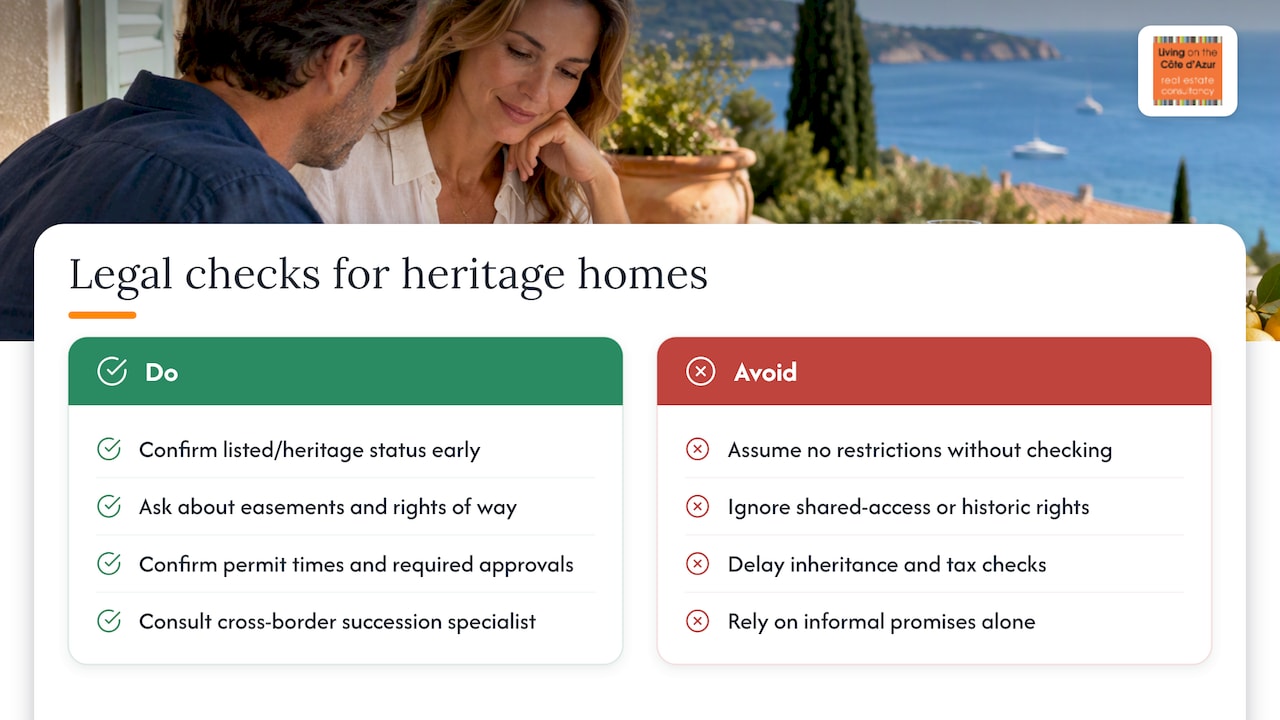
Heritage status brings real benefits and real constraints, and buyers should understand both before committing to a legacy property. A property with landmark or listed status in France (classé or inscrit) often carries restrictions on exterior alterations, window replacement, roofing materials and sometimes interior features of historic significance. These restrictions exist to protect the property’s character, but they also mean renovation permits can take longer and require approval from local heritage authorities before work begins.
Not every legacy-worthy property carries formal protection. Many fine older houses on the Côte d’Azur have no listed status at all, which gives owners more latitude but also means there’s no external body enforcing sympathetic repair: that responsibility falls entirely on the owner and, eventually, their heirs.
Buyers should also ask whether any easements, rights of way, or shared access agreements apply, particularly on larger estates where a neighbouring property or a local commune may hold historic rights over part of the land. Cross-border succession adds another layer: inheritance law and tax treatment for heritage property can differ significantly from one country to the next, and family members inheriting across borders sometimes face disputes that are best handled with specialist legal support, such as the kind offered through cross-border succession and inheritance services. None of this replaces proper legal advice from a notaire or solicitor qualified in the relevant jurisdiction, but knowing the right questions to ask before you buy saves considerable difficulty later.
A note on stewardship, from where we stand
We’ve seen enough families argue over a house that nobody had properly prepared to be shared. The ones who get it right treat stewardship as a decision made now, not a problem for later. Every repair, every agreement, every record kept today becomes the reason the house still feels right in forty years.
— Ab Kuijer
Contact us to start a legacy property search
If you’re weighing a legacy purchase on the French Riviera, our search mandate service targets the specific architectural and stewardship qualities that matter to you, searching well beyond public listings. Our full-service buyer broker approach then carries you through negotiation, due diligence, and the notaire process, with trusted architects, renovation specialists, and legal contacts brought in exactly when you need them.
Get in touch through our buyer agent contact page to start a conversation about the kind of legacy property you’re looking for.
FAQ
What are the benefits of owning legacy real estate?
Legacy real estate tends to hold emotional and financial value that compounds over time, because well-maintained materials and architecture age into character rather than obsolescence. Owning a property with documented history and clear stewardship also tends to make it easier to pass on without family disputes over condition or use.
What is considered a high-end house?
A high-end house generally combines prime location, quality materials, generous proportions and strong architectural integrity, though exact price thresholds vary widely by region and market. On the French Riviera, high-end typically means a property in a sought-after setting with materials and craftsmanship built to last well beyond a single ownership cycle.
What key features define a luxury mansion?
A luxury mansion is usually defined by scale, architectural quality, premium materials, and a setting that reinforces privacy and prestige, such as sea views, mature grounds or a protected hillside position. Features like well-proportioned rooms, natural light, and durable finishes such as stone or oak tend to distinguish a genuine luxury mansion from a simply large house.
What are the benefits of owning legacy land?
Legacy land, particularly estate grounds attached to a historic property, often provides long-term flexibility, from preserving views and privacy to accommodating future generations’ needs without subdividing the main house. Land with documented boundaries and clear usage history also tends to be easier to transfer between heirs without legal complication.
Sources
- The Secretary of the Interior’s Standards for the Treatment of Historic Properties With Guidelines For Preserving, Rehabilitating, Restoring & Reconstructing Historic Buildings
- NPS article: treatment and preservation guidance
- A playbook for adaptable intergenerational homes | TU Delft Repository
Selected primary sources and further reading
- Secretary of the Interior’s Standards for Treatment of Historic Properties
- NPS preservation and sustainability guidance
- A playbook for adaptable intergenerational homes
- Legacy investment on the French Riviera
- International inheritance and succession services
Recommended
 //
//