
The essentials are location, income and paperwork. A sound investment property sits in an area with real rental demand, produces positive cash flow once every cost is accounted for, needs no hidden capital repairs, and comes with a clean title and legal record.
TL;DR:
- Properties in areas with limited new-build permits and rising vacancy rates often pose higher future rental competition and lower profitability.
- A healthy investment typically shows a cap rate of 5 to 8 percent, with cash-on-cash return and NOI accurately calculated using conservative estimates.
- Inspection focus should be on roof, foundation, HVAC, plumbing, and electrical systems, especially in older properties, to avoid costly surprises.
- Short-term rentals succeed only where regulation, high nightly rates, and limited supply align, while long-term rentals suit markets with steady job growth and low turnover.
- An experienced buyer agent can significantly reduce the risk by verifying permits, conducting off-market searches, and coordinating local due diligence for international investors.
Table of Contents
- Location and neighbourhood fundamentals: what actually drives rental demand?
- What financial metrics actually prove a property is profitable?
- Property condition: what should an inspection actually cover?
- Should you rent short-term or long-term?
- Legal checks and due diligence you must not skip
- How to run the numbers: a short underwriting workflow
- Red flags and a final pre-offer checklist
- Why a buyer agent can materially reduce risk
- What does the buying timeline actually look like from search to closing?
- What’s the true total cost of buying, beyond the purchase price?
- Practical underwriting matters more than the postcode
- How Living On The Cote d’Azur helps you buy with confidence
- Sources
- FAQ
Location and neighbourhood fundamentals: what actually drives rental demand?
Strip away the sales pitch and location comes down to four things: how people get to work, whether jobs are growing nearby, what schools sit within catchment, and whether the street feels safe after dark. A flat two minutes from a tram stop rents faster and holds its value better than an identical flat fifteen minutes’ walk from anything.
Supply matters as much as demand. A neighbourhood with rising vacancy, a heavy new-build pipeline, or listings sitting for months is telling you something the estate agent won’t.
Before committing to an area, check the availability of Real Estate SEO Services to boost your property’s market visibility and capture leads effectively.
- Public transport links, major employers and school catchments within realistic commuting distance
- Local vacancy rates and average days on market for comparable properties
- New-build permits filed nearby, which signal future rental competition
- Job growth, migration trends and any infrastructure projects planned for the next five years
Your strategy should follow the location, not the other way round. A steady, established suburb suits a cash-flow investment property, while an area with rising employment and limited housing stock often rewards patience and appreciation instead. On the Côte d’Azur, the market signals shift block by block, so a strong Cannes postcode can behave nothing like one twenty minutes inland.
What financial metrics actually prove a property is profitable?
Numbers separate a good property from a good story. Net Operating Income (NOI) is your rental income minus operating expenses, excluding mortgage payments. Cap rate divides NOI by the purchase price. Cash-on-cash return measures the annual cash flow against the actual cash you put in, which matters far more once financing enters the picture.
Say a property generates £24,000 a year in rent, with £8,000 in operating costs. NOI is £16,000.
Statistic to remember: a 5–8% cap rate is generally considered healthy for long-term rentals, though the right figure depends heavily on local risk and market maturity.
Financing changes everything below the NOI line:
- Investment loans typically demand larger deposits and higher interest rates than owner-occupier mortgages
- Lenders often require several months of reserves set aside before they’ll approve the loan, which directly reduces your cash-on-cash return
- The 1% rule (monthly rent should roughly match a small percentage of purchase price) and the Gross Rent Multiplier are useful quick filters, but neither replaces a proper cash-flow model
Treat both quick filters as a first pass, not a verdict.
Property condition: what should an inspection actually cover?
The roof, foundation, HVAC, plumbing and electrical systems are where costly surprises live. Damp and mould are the easiest warning signs to miss on a quick viewing, particularly in older stone-built properties common across the Riviera. The age of major systems tells you more than the age of the building itself; a 1960s villa with a 2020 rewire is a very different proposition to one with original wiring.
For anything over twenty years old, order specialist inspections before you commit:
- Roof survey to catch deferred repairs invisible from the ground
- Sewer scope on older properties, especially where drainage has never been documented
- Structural assessment if you notice cracking, uneven floors or recent patch repairs
- HVAC inspection to price replacement costs into your offer rather than discovering them after completion
Use inspection findings as leverage, not just information. A genuine defect gives you grounds to negotiate a price reduction, request an escrow for repairs, or walk away entirely.
Pro Tip: Get at least two independent quotes for any major repair flagged in an inspection before you negotiate. Sellers routinely dispute a single contractor’s figure, but two matching quotes are hard to argue with.
Should you rent short-term or long-term?
The right rental strategy depends entirely on what the local market and its rules will actually allow. Short-term rentals make sense where tourism is strong, nightly rates are high and the existing STR supply is genuinely limited. That combination describes much of the Côte d’Azur in peak season, but regulation and future supply pipeline matter more than headline nightly rates, so check local licensing rules before you assume a listing can legally operate as a holiday let.
Long-term lets suit areas with steady job growth, low vacancy and family-friendly amenities, where tenant turnover stays low and management is far simpler.
Property type should follow strategy:
- A studio or one-bedroom flat near the coast fits short-term tourist demand
- A three-bedroom family home fits long-term tenants near schools and employers
- Multi-unit buildings spread risk across several tenancies rather than one
Legal checks and due diligence you must not skip
A title search should surface every lien, encumbrance and unresolved boundary dispute before you sign anything. Open permits and unpermitted work follow the property, not the seller, so buyers routinely inherit code violations they never caused and have to fix at their own cost.
Before making an offer, confirm:
- Whether any HMO or short-term rental licence applies, checking the relevant municipal portal directly rather than trusting the listing description
- HOA or condominium bylaws, financial reserves and any rental restrictions, requested in writing early in the process
- Certificate of occupancy status and any pending special assessments on shared buildings
None of this is glamorous work, but skipping it is how experienced investors end up with expensive surprises six months after completion.
How to run the numbers: a short underwriting workflow
Treat underwriting as a funnel: fast filters first, full model second, lender scrutiny last.
- Apply the 1% rule and GRM to eliminate properties that are obviously overpriced relative to achievable rent
- Build a conservative cash-flow model using realistic rent comparables, a genuine vacancy buffer, and honestly estimated operating expenses rather than the seller’s optimistic figures
- Check what the lender will actually require, including Debt Service Coverage Ratio (DSCR), reserve requirements, and how the appraisal is likely to land against your offer price
Statistic to remember: practical underwriting guidance consistently stresses running NOI, cap rate and cash-on-cash return properly on any property that survives the quick filters, rather than relying on rules of thumb for the final decision.
Discard deals quickly at the filter stage. Reserve the detailed model for properties that already look genuinely promising.
Red flags and a final pre-offer checklist
Some warning signs should stop you before you even book a second viewing. A price sitting well above recent comparable sales with no obvious justification, combined with unusually long days on market, usually means the seller is testing the market rather than pricing it realistically.
Watch for:
- Falling local prices or a major local employer closing, both of which point to weakening future demand
- Uninsurable risks, unpermitted work, or pending special assessments uncovered during due diligence
- Persistently high vacancy rates across comparable properties in the same building or street
If you spot one of these, you still have levers before walking away: an inspection credit, a price reduction, or an escrow held back for known repairs. Use them, or use your feet.
Why a buyer agent can materially reduce risk
Buying abroad multiplies every risk on this list. An independent buyer agent sources off-market opportunities local listing portals never show, coordinates specialist inspections on your behalf, and runs the local due diligence you simply cannot do from another country.
For international investors, that typically means:
- Viewing management and negotiation handled by someone who knows the local market’s real pricing, not the asking price
- Referrals to trusted notaries, tax advisers and renovation specialists who already understand cross-border buyers
- Practical coordination through to signing, rather than you juggling time zones and language barriers alone
What does the buying timeline actually look like from search to closing?
Most international investors underestimate how long a considered purchase takes, and rushing it is where mistakes creep in. A realistic timeline runs in five broad phases.
Weeks 1 to 4: define and search. Set your budget, target area and rental strategy, then start reviewing listings and off-market opportunities matched against your criteria.

Weeks 3 to 8: viewings and shortlisting. For international buyers, this often means a dedicated viewing trip covering several properties in a few days rather than repeat visits, since flights and time zones make casual second looks impractical.
Weeks 6 to 10: offer and negotiation. Once you’ve found the right property, your offer should already reflect any known condition issues, since renegotiating after acceptance is harder in most markets than pricing risk in upfront.
Weeks 8 to 14: due diligence and financing. This is where title searches, permit checks, specialist inspections and mortgage approval all run in parallel. Financing for investment properties typically takes longer to arrange than for a primary residence, given the larger deposit and reserve requirements lenders impose.
Weeks 12 to 16: exchange and completion. In France, this phase runs through the notaire, who handles the legal transfer and registers the sale. Buyers unfamiliar with French property purchase mechanics are often surprised by how central the notaire’s role is compared with conveyancing processes elsewhere.
End to end, three to four months is a realistic expectation for a straightforward purchase. Complex title issues, mortgage delays or off-market negotiations can stretch that considerably.
What’s the true total cost of buying, beyond the purchase price?
Closing costs, taxes, fees and the first year of ongoing expenses all add up faster than most first-time investors expect.
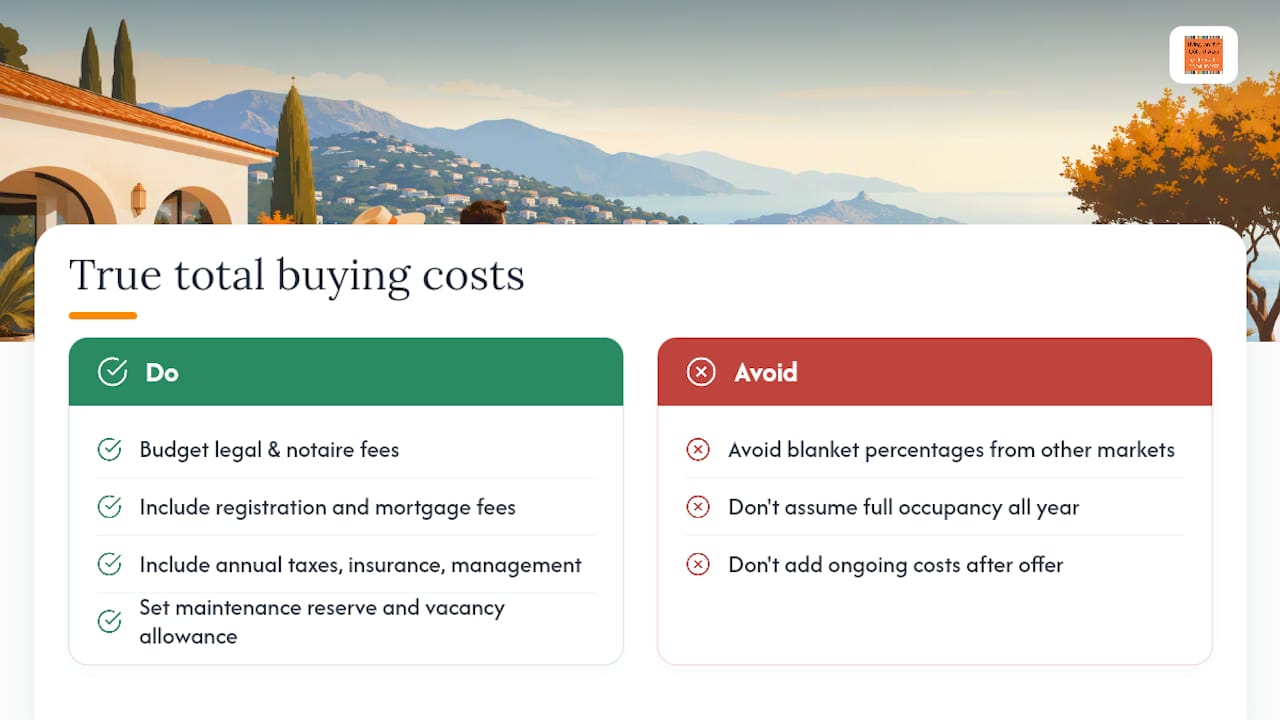
On the acquisition side, budget for legal fees, notaire fees where applicable, registration taxes, and any mortgage arrangement fees charged by the lender. These vary significantly by country and by property value band, which is exactly why a blanket percentage figure quoted for one market can mislead a buyer purchasing in another. France applies its own property tax rules for foreign investors, distinct from Spain’s or Portugal’s, so never assume a figure quoted for one jurisdiction applies to another.
Ongoing costs are where inexperienced investors underbudget most. Beyond mortgage payments, factor in annual property taxes, building insurance, management fees if you’re not self-managing, a realistic maintenance reserve (older buildings need more), and a genuine vacancy allowance rather than assuming full occupancy every month of the year. The English Private Landlord Survey 2024 offers a useful benchmark for how landlord operating costs and vacancy patterns actually play out in practice, even for investors buying outside England, because the underlying cost categories translate across markets.
Add these ongoing figures into your cash-flow model before you make an offer, not after. A property that looks profitable on purchase price alone can turn negative once insurance, management and a proper maintenance reserve are priced in honestly.
Practical underwriting matters more than the postcode
Most advice on this topic obsesses over finding the “right” location and treats the numbers as an afterthought. That’s backwards. A mediocre location with disciplined underwriting and conservative assumptions on vacancy and repairs will outperform a glamorous postcode bought on optimism and a seller’s spreadsheet.
The gap between what property investment promises and what actually delivers usually comes down to one habit: running the numbers conservatively before you fall in love with a property, not after. International buyers on the Côte d’Azur and in Ibiza face an extra layer most domestic guides ignore entirely, since local licensing rules, notaire processes and financing norms differ enough from a buyer’s home market that assumptions imported wholesale from elsewhere routinely fail.
That’s precisely where cross-border underwriting breaks down for solo buyers, and where a buyer agent earns their place. Not because DIY underwriting is impossible from abroad, but because verifying permits, licensing status and realistic rent comparables in a foreign jurisdiction takes local access most investors simply don’t have. Prioritise the cash-flow model first, the location second, and treat local representation as a legitimate shortcut to both, not a shortcut around due diligence.
— Ab Kuijer
How Living On The Cote d’Azur helps you buy with confidence
An independent buyer agent can be an alternative to underwriting a foreign market alone. Such agents represent buyers rather than sellers, searching the entire local market through networks of agents and developers, including off-market opportunities that never reach public listing portals.
That matters most for international buyers running exactly the checks covered above from another country: verifying title, licensing status and realistic rent comparables without local access is where most cross-border purchases go wrong. Whether you need a full search mandate or the full-service approach through to the notaire, the service is built around buyer representation, not selling you a listing.
Start by getting in touch through the Living On The Cote d’Azur site to discuss your search criteria and budget.
Sources
Verify licensing rules directly through GOV.UK’s HMO guidance and check landlord cost benchmarks in the English Private Landlord Survey 2024 before finalising any cash-flow assumptions.
- Gov
- What to look for in an investment property – Rocket Mortgage
- The numbers to run before buying a rental property – Mashvisor
- How to buy an investment property and make it cash flow – EffectiveAgents
FAQ
What is the 2% rule for property?
It’s rarely achievable in expensive coastal markets like the Côte d’Azur, where the 1% rule is already a demanding benchmark, so treat 2% as a bonus filter rather than a realistic target everywhere.
What should I look for in an investment property?
Focus on location fundamentals, honest rental income after every cost, manageable maintenance risk, and a clean legal and title record. Verifying seller-provided numbers rather than taking them at face value is one of the most consistently overlooked steps.
What is the 1% rule?
It’s a fast elimination filter, not a substitute for a full cash-flow model that accounts for financing, taxes and vacancy.
How do I tell if an investment property is a good investment?
Run NOI, cap rate and cash-on-cash return using conservative, realistic assumptions rather than the seller’s figures. A cap rate in the 5 to 8% range is generally considered healthy for long-term rentals, though the right benchmark shifts with local market risk and financing costs.
Recommended
 //
//