
TL;DR:
- Buying off-plan on the Côte d’Azur offers investors the chance to purchase property below market value, benefiting from appreciation and premium unit access through staged payments and legal protections. This strategy involves risks like construction delays and market corrections but can be managed with thorough due diligence, legal safeguards, and strategic village selection. Successful off-plan investing requires patience, detailed research, and selecting locations with limited supply and strong international demand.
Buying off-plan is defined as purchasing a property before construction is complete, securing it at today’s price while the asset appreciates through the build period. For investors considering the Côte d’Azur, this strategy carries particular weight: villages such as Cannes, Nice, Saint-Paul-de-Vence, and Mougins are drawing global capital precisely because off-plan prices sit below completed market values, payment structures ease cash flow, and new builds arrive with warranties and energy efficiencies that older stock cannot match. The question is not simply whether to buy off-plan, but how to do so with the precision and protection the strategy demands.
Why buy off-plan: the core financial case
Off-plan property, known in France under the legal framework of Vente en l’État Futur d’Achèvement (VEFA), is the recognised industry standard for purchasing new builds before completion. Buyers exchange contracts based on architectural plans and specifications, then pay in staged instalments tied to construction milestones rather than in a single lump sum at completion. This structure is the primary reason sophisticated investors favour the approach.

The financial logic is direct. Off-plan prices typically sit 5 to 15 per cent below the equivalent completed unit in the same development. That discount represents immediate paper equity the moment you exchange, and it compounds if the local market rises during the construction period. On the Côte d’Azur, where Livingonthecotedazur tracks annual appreciation of 5 to 8 per cent in prime locations, the arithmetic is compelling.
Premium units sell first: corner apartments with panoramic sea views over the Baie des Anges, penthouses above Nice’s Mont Boron, and garden-level residences in Mougins with Provençal courtyard access are reserved by early buyers and simply unavailable once the development reaches the open market. Committing off-plan is the only way to secure the best address within a building. For investors focused on rental yield, the premium unit commands the premium rate.
Staged payment structures with low initial deposits and balances due at completion ease financial pressure considerably. Rather than deploying the full purchase price on day one, capital can remain invested elsewhere during the build period, generating returns that partially offset holding costs. This flexibility is a structural advantage over buying completed property, where the full sum transfers immediately.
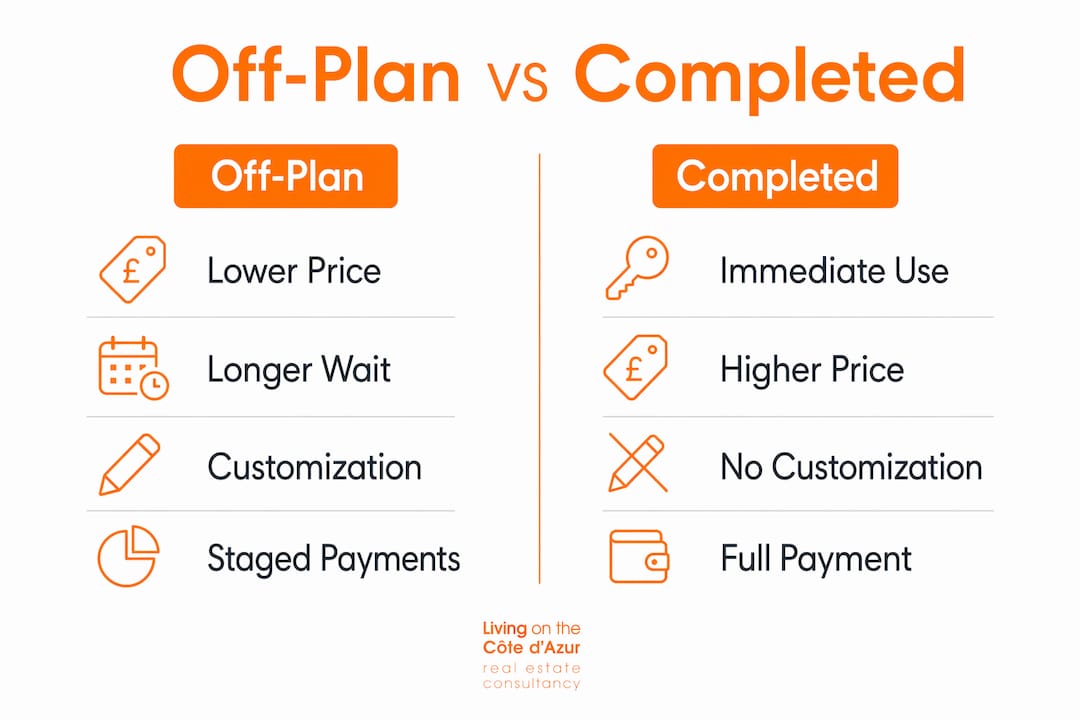
What practical advantages does off-plan buying offer?
Beyond the headline price discount, the advantages of buying off-plan accumulate across several dimensions that matter to discerning investors.
- Energy efficiency. New-build homes can be up to 21 per cent more energy-efficient than older properties, saving up to £420 per year on running costs. On the Côte d’Azur, 2026’s eco-villas with solar arrays and green certifications are attracting buyers who value both the planet and their portfolio, and lower running costs translate directly into stronger net yields for seasonal lettings.
- Warranties. In the UK, the NHBC Buildmark warranty provides 10-year structural cover, including a two-year builder warranty and eight years of insurance against structural defects, with deposit protection up to £100,000. French VEFA contracts carry equivalent protections: the garantie de parfait achèvement (one year), garantie biennale (two years for equipment), and garantie décennale (ten years for structural integrity). These warranties reduce maintenance risk in the early years of ownership, a period when older properties often demand costly remediation.
- Customisation. Buyers may customise kitchens, flooring, and bathroom fittings before completion, subject to build stage and developer options. In a luxury context, this means your Cannes apartment can arrive with the marble, the cabinetry, and the smart-home integration you specified, rather than requiring an expensive post-completion fit-out.
- Lower notary fees. In France, purchasing a new build under VEFA attracts notary fees of approximately 2 to 3 per cent of the purchase price, compared to 7 to 8 per cent for existing properties. On a €1.5 million apartment in Valbonne or Roquebrune-Cap-Martin, that difference is material.
- First occupancy. You receive a property that no one has lived in, with no deferred maintenance, no outdated systems, and no negotiation over the condition of fixtures.
Pro Tip: When reviewing a VEFA contract in France, confirm that your deposit is held in a ring-fenced escrow account by a notaire or bank, not by the developer directly. This single step is the most effective protection against developer insolvency.
What are the risks of off-plan investment and how do you manage them?
The benefits of off-plan purchase are real, but so are the risks. Investors who approach this strategy without preparation expose themselves to outcomes that erode returns or, in extreme cases, result in significant losses. The risks are manageable. They are not ignorable.
Construction delays. Delays can disrupt financing or move-in timing, and mortgage offers typically expire after six months. Maintain a buffer of at least six months beyond the projected completion date and keep your mortgage provider informed throughout the build. In France, VEFA contracts specify a contractual delivery date with financial penalties for the developer if breached, which provides a degree of protection but not immunity.
Market corrections. Price falls during the build period can reduce the property’s value below the purchase price, creating negative equity and mortgage valuation shortfalls. The Côte d’Azur’s track record of sustained demand from international buyers provides a degree of insulation, but no market is immune to broader economic shocks. Stress-test your purchase against a 10 to 15 per cent price correction before committing.
Developer insolvency. Without proper legal protection, buyers may recover little or nothing of their deposit. The legal categorisation of your deposit as secured or unsecured determines whether full recovery or losses occur. In France, VEFA law requires developers to hold a garantie financière d’achèvement (GFA), a financial completion guarantee from a bank or insurer, which is a stronger protection than many other jurisdictions offer.
Cash-flow timing mismatches. Investors must prepare for cash-flow disruptions caused by construction delays to avoid forced sales and eroded returns. Financing readiness is as critical as market forecasts. Ensure your liquidity position can absorb a delayed completion without forcing you to sell another asset at an inopportune moment.
Specification changes. Developers occasionally substitute materials or alter layouts between planning and completion. Your contract should specify finishes in precise detail, with substitution clauses that require your written consent for any material change.
“The most common mistake we see is buyers focusing entirely on the price discount and ignoring the legal architecture of their deposit protection. The discount means nothing if the developer fails and your deposit is unsecured.” — Livingonthecotedazur advisory team
Understanding investment risk categories before you commit is not optional. It is the foundation of a sound off-plan strategy.
How does off-plan buying work in Côte d’Azur villages?
The Côte d’Azur is not a single market. It is a constellation of distinct villages and towns, each with its own character, price trajectory, and investment logic. Off-plan buying here means selecting your position within this mosaic before the wider market catches up.
Consider the current pipeline. Sainte-Maxime’s beachside designer apartments, steps from Garonette sands, are available from €1.2 million off-plan, with Nartelle beach sunsets and a ferry to Saint-Tropez as the lifestyle backdrop. Nice’s Mont Boron sea-view towers blend biophilic design with VEFA protections. In Mougins, where Picasso once kept his studio, new residences are appearing among the medieval lanes and Michelin-starred restaurants. Menton, with its lemon-scented ramparts and the Fête du Citron drawing visitors each February, is seeing renewed interest from buyers who want Monaco proximity without Monaco prices.
The table below illustrates how village characteristics translate into investment considerations:
| Village | Character | Off-plan investment appeal |
|---|---|---|
| Cannes | Croisette glamour, film festival prestige | High rental demand, international profile |
| Nice | Urban culture, Baie des Anges, transport links | Strong capital growth, broad tenant pool |
| Mougins | Provençal village, art, gastronomy | Boutique supply, premium pricing |
| Menton | Botanical gardens, lemon festival, Monaco border | Emerging market, lower entry price |
| Saint-Paul-de-Vence | Art galleries, medieval walls, celebrity heritage | Scarcity value, long-term appreciation |
| Valbonne | Tech hub, international schools, village charm | Year-round demand, family rental market |
Infrastructure investment drives value. The Nice Côte d’Azur airport expansion, improved rail links between Cannes and Monaco, and the continued growth of Sophia Antipolis as a European technology hub all strengthen the case for off-plan purchases in the surrounding villages. Buyers who commit now in Roquebrune-Cap-Martin, Beausoleil, or Cap-d’Ail are positioning ahead of the infrastructure dividend.
Seasonal events amplify short-term rental yields and long-term desirability. The Cannes Lions festival in June, the Monaco Grand Prix in May, and the Menton Lemon Festival in February create concentrated demand spikes that justify premium nightly rates. Investors buying off-plan in these catchment areas are not simply buying property. They are buying a position in one of the world’s most consistently desirable lifestyle markets.
Pro Tip: For the strongest capital growth, prioritise off-plan developments within walking distance of a village centre or seafront. Properties in Théoule-sur-Mer, Mandelieu-la-Napoule, and Roquefort-les-Pins that combine village access with natural surroundings consistently outperform isolated new builds on resale.
Off-plan vs completed property: which suits your strategy?
The choice between off-plan and completed property is a question of priorities, not of one option being universally superior. The trade-offs are clear once you map them against your investment timeline and risk appetite.
| Factor | Off-plan | Completed property |
|---|---|---|
| Purchase price | 5 to 15% below market value | Full market price |
| Customisation | Available before completion | Limited to post-purchase renovation |
| Rental income | Delayed until completion | Immediate |
| Notary fees (France) | 2 to 3% | 7 to 8% |
| Warranties | 10-year structural cover | Depends on age and condition |
| Risk level | Higher (construction, market, developer) | Lower (known asset, known condition) |
| Capital growth potential | Higher (buy at discount, appreciate during build) | Lower (already at market price) |
Off-plan suits investors with a two to four year horizon who can absorb the wait for rental income and are prepared to conduct thorough due diligence on the developer and contract. Completed property suits buyers who need immediate yield or who are unwilling to carry construction risk. For those who want the certainty of an existing asset with the character of the Riviera, the advantages of existing properties on the French Riviera are worth examining alongside the off-plan case.
The most sophisticated investors we work with at Livingonthecotedazur often hold both: an off-plan position in a village like Biot or La Colle-sur-Loup for capital growth, and a completed property in Cannes or Nice generating immediate seasonal rental income. The two strategies complement rather than compete with each other.
Key takeaways
Buying off-plan in the Côte d’Azur delivers the strongest returns when investors combine price discipline, legal rigour, and local market knowledge before committing.
| Point | Details |
|---|---|
| Price advantage is immediate | Off-plan discounts of 5 to 15% create equity from exchange, before the market moves. |
| VEFA protects French buyers | The garantie financière d’achèvement and escrow deposit rules are stronger protections than many markets offer. |
| Premium units go first | Corner apartments, sea-view floors, and garden residences are reserved by early buyers and unavailable later. |
| Village selection determines yield | Cannes, Nice, Valbonne, and Menton each offer distinct rental demand profiles that affect return calculations. |
| Risk requires active management | Construction delays, market corrections, and developer insolvency are real but manageable with legal preparation and cash-flow buffers. |
The case for patience and precision
Off-plan buying is one of the few strategies in real estate where patience is directly rewarded with a financial discount. What I have observed over years of working with buyers across the Côte d’Azur is that the investors who do best are not those who chase the largest headline discount. They are the ones who spend the most time on the developer’s track record, the contract’s legal architecture, and the specific village’s supply pipeline.
The Côte d’Azur has a structural advantage that most off-plan markets lack: genuine scarcity. You cannot build new seafront in Èze or add medieval lanes to Saint-Jeannet. When a quality off-plan development appears in these locations, the supply is finite and the demand is international. That combination is what separates a sound off-plan investment from a speculative one.
My honest counsel is this: do not buy off-plan to save money on the purchase price alone. Buy off-plan because you have identified a specific village, a specific developer with a verified completion record, and a specific unit type that the local rental market consistently demands. The risk management framework you apply before signing is worth more than any discount you negotiate at the table. The Riviera rewards those who arrive prepared.
— ab
Discover off-plan opportunities on the Côte d’Azur
At Livingonthecotedazur, we curate off-plan and new-build opportunities across the French Riviera’s most sought-after villages, from Cannes and Nice to Mougins, Valbonne, and Menton. Our portfolio is selected for capital growth potential, VEFA legal compliance, and lifestyle quality. We work with buyers from across the world, and we accept cryptocurrency payments for those who prefer to move capital efficiently. Whether you are structuring a legacy investment for your family or building a portfolio of seasonal rental assets, our specialists provide personalised guidance from first enquiry to notaire signature. Explore our curated Riviera luxury listings and contact us to discuss your off-plan strategy in confidence.
FAQ
What does off-plan mean in property buying?
Off-plan means purchasing a property before construction is complete, based on architectural plans and specifications. In France, this is governed by the VEFA contract, which includes statutory deposit protection and a financial completion guarantee.
Is buying off-plan worth it on the Côte d’Azur?
Buying off-plan on the Côte d’Azur is worth it for investors with a two to four year horizon who prioritise capital growth, lower notary fees, and access to premium units before they reach the open market. The region’s sustained international demand and infrastructure investment strengthen the case.
How are deposits protected when buying off-plan in France?
French VEFA law requires developers to hold a garantie financière d’achèvement from a bank or insurer, and deposits must be held in escrow by a notaire or bank. This means your capital is not accessible to the developer until construction milestones are met.
What are the main risks of off-plan investment?
The primary risks are construction delays disrupting financing, market corrections reducing the property’s value below the purchase price, and developer insolvency. All three are manageable through legal due diligence, cash-flow buffers, and verified deposit protection before you exchange contracts.
Can I customise an off-plan property before completion?
Yes. Subject to the build stage and the developer’s options programme, buyers can typically select kitchen finishes, flooring, bathroom fittings, and in some cases internal layouts. The earlier you commit, the broader the customisation options available to you.
Recommended
 //
//